
Search Results for: Artificial Intelligence And Data

How Eight Canadian MSBs Landed in a U.S. Iran Sanctions Case

November 9, 2026 | NCFA Story Intelligence | Risk Compliance And Regtech, Cross Border Payments And FX, Digital Assets Blockchain And Tokenization
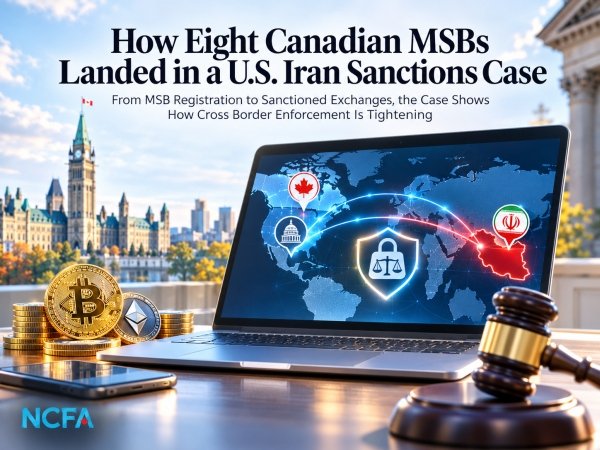
AI illustration of Eight Canadian MSBs linked to U.S. Iran sanctions with FINTRAC, crypto transactions and cross border enforcement imagery

When Canadian MSB Registration Meets Sanctions, Crypto and Financial Crime

On November 6, 2026, eight Canadian money services businesses appeared on a U.S. sanctions list. Every one of them had a Canadian MSB registration number.

That number meant the business had entered Canada's federal registration system. It didn't mean FINTRAC had approved the firm, cleared its customers or vouched for every transaction passing through it. Until November 6, that distinction could sound technical.

Then the U.S. Treasury allegations arrived. Treasury says several of the eight firms converted cash or conventional currency into digital assets that reached sanctioned Iranian exchanges, addresses associated with the Islamic Revolutionary Guard Corps and, in some cases, wallets tied by U.S. authorities to Canadian drug trafficker Ryan Wedding.

The firms had Canadian addresses, Canadian corporations and Canadian registration numbers. Now they also had OFAC designations.

The same day, FINTRAC coordination with OFAC and FinCEN became public. Then Canada's financial intelligence agency disclosed what had been happening inside its own MSB regime during 2026: 161 registrations revoked, more than $198 million in penalties against nine MSBs, and 28 MSB non compliance matters sent to law enforcement.

FINTRAC didn't say that the eight OFAC firms were among those revocations, penalties or referrals. Canadian disclosure rules generally prevent it from making that connection public unless the law allows it.

But the sequence is hard to miss. Canada had already spent years strengthening Canada's tightening AML rules around MSBs, crypto, ownership and financial reporting. Now eight registered Canadian businesses were inside a U.S. sanctions action, and Canada's financial intelligence agency was confirming that it helped.

This is a story about what a registration number can prove, what it can't prove, and what happens when the transactions behind it reach sanctioned networks abroad.

Registration Brings MSBs Inside the System The Starting Point

Canada requires money services businesses to register with FINTRAC so authorities know who's operating, who controls the business and what services it offers. The registry brings firms into view, but it doesn't certify what happens inside every transaction.

That distinction had already surfaced before November. In September, Maple Digital and the TGR network raised questions about how much an active registration can really tell a bank or counterparty. There was no finding that Maple itself laundered money, but corporate and personnel connections showed why a FINTRAC number couldn't settle questions about directors, related companies or sanctions exposure.

What FINTRAC Registration Actually Means

FINTRAC MSB registration rules make the boundary clear. Registration is not a licence, endorsement or certification.

A registration number confirms that a business met the legal requirements to enter the MSB registry. It doesn't certify every customer, counterparty, wallet, source of funds or sanctions control used by the firm.

FINTRAC can later revoke registration if a business becomes ineligible or fails to meet registration obligations.

The eight firms designated by OFAC had Canadian registration numbers, corporate identities and physical addresses. Some operated from Vancouver, Toronto, North York, Richmond Hill, Thornhill and Montreal.

Those registrations told counterparties the businesses had entered Canada's MSB system. They didn't establish what customers were doing through the firms or where every transaction ended.

Iran Transactions Already Carry Extra Questions 2020 to 2026

Iran connected transactions don't enter this story as ordinary transfers. Canada already requires reporting firms to treat them as high risk.

By July 2026, Canada's Iran AML controls still required enhanced checks covering identity, source of funds or virtual currency, beneficial ownership, recordkeeping and possible sanctions evasion. The warning was already built into the system before Treasury named the eight Canadian firms.

The Checks Already Required

FINTRAC's Iran directive requires reporting entities to treat transactions originating from or bound for Iran as high risk.

Firms must verify clients, examine the source of funds or virtual currency, establish the purpose of the transaction and obtain beneficial ownership or control information where required. They're also expected to pay particular attention to possible sanctions evasion.

Earlier that summer, sanctions on Iranian crypto exchanges included Nobitex, Wallex, Bitpin and Ramzinex. Aban Tether Exchange and Shelbit later joined the sanctions record.

By November, several of those names appeared again in Treasury's allegations involving Canadian MSBs. The counterparties weren't unknown names at the far end of a payment chain anymore.

Then the Trail Reaches Canadian MSBs November 6, 2026

OFAC now names eight Canadian businesses under Executive Order 13902. They look different on paper, but they share one uncomfortable fact: each had entered Canada's MSB registry before U.S. authorities placed it inside an Iran sanctions case.

The Eight Canadian Businesses

1380079 BC Ltd, also identified as Amin Exchange Vancouver and Sarafi Amin. OFAC lists locations in North Vancouver and Montreal and MSB registration M23258996.

2397639 Ontario Ltd, operating as Farah Exchange in North York. OFAC lists MSB registration M19648033.

B Galaxy Inc, also identified as Cryptoyal and C Exchange, with addresses in North York and Thornhill. OFAC lists MSB registration N300001022.

CCC Inc, also identified through names including Ccurrency Exchange, Sarafi C, Cryptoyal and C Exchange. OFAC lists MSB registration N300000785.

Darvish Exchange, also identified as Kanata MD Inc and Canada Exchange, with Richmond Hill and North York addresses. OFAC lists MSB registration N300000169.

Diverse Trade Inc, operating as Million Exchange, Million Money Exchange and Millionex, with addresses in Richmond Hill, Toronto and Montreal. OFAC lists MSB registration M19315656.

NIA Nations Currency Ltd, also identified as NIA Exchange and NIA Nations Exchange, with Vancouver and North Vancouver addresses. OFAC lists MSB registration M21153461.

Top PC Technician Inc, also identified as 2840711 Ontario Inc, Amin Exchange Toronto and Aminex Toronto, with North York and Thornhill addresses. OFAC lists MSB registration M21487848.

OFAC's published TRON addresses also give exchanges and compliance teams blockchain identifiers associated with several of the designated firms.

Treasury alleged that NIA Nations dealt with addresses associated with the IRGC and with Nobitex, Wallex, Ramzinex and Bitpin. Darvish Exchange allegedly dealt with Nobitex, Wallex, Aban Tether Exchange and Shelbit.

Farah Exchange allegedly dealt with Shelbit and Wallex. Amin Exchange allegedly received hundreds of thousands of dollars from Shelbit. These weren't generic country risk warnings anymore. Treasury was attaching named Canadian firms to named counterparties.

The Case Crosses From Sanctions Into Drug Money Treasury Allegations

Then another thread appears. Treasury also alleges that some of the same Canadian MSBs handled proceeds connected with Ryan Wedding, the Canadian former Olympic snowboarder accused by U.S. authorities of running a multinational cocaine trafficking organization.

The case isn't only about Iranian exchanges now. It also touches alleged Canadian drug cash, and Treasury says some of the same businesses appear in both trails.

Where the Two Trails Meet

Treasury says addresses associated with Million Exchange sent digital assets to addresses associated with the IRGC or terrorism. It also alleges that the business converted Canadian drug proceeds into digital assets.

Amin Exchange allegedly received funds from sanctioned Iranian exchange Shelbit and converted millions of dollars in Canadian drug cash into digital assets for transfer abroad.

Farah Exchange allegedly dealt with Shelbit and Wallex and sent digital assets to addresses associated with terrorism and to addresses Treasury connects with Wedding.

Treasury also says an address associated with CCC Inc received hundreds of thousands of dollars from terrorism associated addresses.

These are U.S. Treasury allegations. An OFAC designation isn't a criminal conviction.

In the sanctions allegations, investigators followed counterparties. Which exchange received the funds? Which wallet had already been linked to a sanctioned actor?

In the Wedding allegations, they also followed the source. Where did the cash come from? Why was it converted? Treasury says some of the same Canadian businesses appeared in both trails.

FINTRAC Steps Into the Same Case November 6, 2026

The U.S. action could have ended as a foreign sanctions story. It doesn't.

FINTRAC confirms that it coordinated with OFAC and FinCEN, then Canada's financial intelligence agency publishes numbers showing just how active MSB enforcement has become at home.

Since the beginning of 2026, FINTRAC says it has revoked 161 registrations, more than during the previous three years combined. Over the past year, it imposed more than $198 million in penalties against nine MSBs and disclosed 28 MSB non compliance matters to law enforcement.

The November total didn't appear out of nowhere. By May, FINTRAC's MSB revocations were already reaching money transfer, FX, virtual currency and payment service businesses.

Those Numbers Describe Different Actions

A registration revocation removes a business from Canada's MSB registry. An administrative monetary penalty punishes regulatory violations, while a law enforcement disclosure gives police information that may support an investigation or prosecution.

None of those actions is a criminal conviction.

The $198 million total is also heavily concentrated in a few exceptional cases. The Cryptomus record FINTRAC penalty was about $176.96 million, accounting for most of the total.

FINTRAC says it generally can't identify firm specific compliance action unless public disclosure is legally permitted. The public record therefore does not establish that any of the eight OFAC designated firms are among the 161 revocations, nine penalized MSBs or 28 referrals.

Before November 6, Canada's tougher MSB enforcement could be seen through revoked registrations, individual penalties and new AML powers.

Now FINTRAC is publicly confirming that Canadian financial intelligence also fed an international sanctions action. The coordination is public. The firm by firm Canadian enforcement record isn't.

The Registration Number Means Less Than It Did at the Start After November 6

The same number that placed each firm inside Canada's MSB system now appears on the same record as an OFAC designation.. That doesn't make registration meaningless. It changes what everyone around the firm has to ask next.

A bank can confirm registration and still need to understand the customer. A payment partner can confirm it and still need to know where the funds came from. A crypto exchange can confirm it and still need to screen the wallet. A foreign counterparty still needs to know who's at the other end.

What Happens After an OFAC Designation

U.S. property and interests in property belonging to designated entities are blocked and must be reported to OFAC. U.S. persons are generally prohibited from dealing with designated entities unless an exemption or authorization applies.

Entities owned 50% or more by blocked persons can also be blocked under OFAC rules. Banks, exchanges and other counterparties can add the newly published names and wallet addresses to their sanctions screening.

That doesn't mean every Canadian bank is automatically required to close every relationship with an OFAC designated Canadian business. Obligations depend on the parties, transaction and applicable law.

For legitimate MSBs, registration still opens the door to operating within Canada's regulated system. Remittance, FX, payments and digital asset firms remain important to customers who need alternatives to the largest banks.

International access depends on more than the registry. Banks, exchanges and settlement partners also need confidence in ownership, source of funds, sanctions controls, wallet screening and transaction monitoring. If that confidence disappears, the registration number won't preserve the relationship.

The Case Comes Back to Canada What Happens Next

OFAC has named the firms and FINTRAC has confirmed the coordination. The rest of the Canadian story hasn't been written yet.

Registrations can be revoked. FINTRAC penalties can become public where the law permits. Police can investigate, prosecutors can lay charges where the evidence supports them, and criminal assets can be identified and recovered.

None of those outcomes can be read into the OFAC designation today.

What happens next will show whether the November 6 sanctions action is followed by Canadian registration, regulatory, police or asset recovery measures involving any of the eight firms.

The Registration Was Only the Beginning

Eight Canadian businesses entered November 6 with MSB registration numbers. They ended the day on a U.S. sanctions list.

That doesn't prove they committed a crime in Canada. It doesn't prove FINTRAC revoked their registrations, penalized them or referred them to police.

For legitimate operators, the demands are becoming harder to ignore. Know the customer, source of funds and beneficial owner. Know the wallet and the exchange. Keep records good enough to revisit a transaction when an address later appears on a sanctions list.

Those checks aren't free, especially for smaller firms. Banks, exchanges and settlement partners also have to decide whom they're willing to keep connected to their own systems.

Canada's MSB sector still serves real needs in remittances, foreign exchange, cross border commerce and financial access. November 6 doesn't change that.

What it does leave unresolved is what comes next for these eight firms.

OFAC has made its allegations public. FINTRAC has confirmed the cross border coordination. The next chapter is whether that intelligence leads to Canadian regulatory, police or asset recovery action involving any of the eight.

Talking Point

An MSB registration tells you that a firm entered Canada's regulated system. It doesn't tell you enough about the customers, funds, wallets and counterparties behind that number.


What Happens Next?
  • Will FINTRAC publicly revoke or penalize any of the eight designated firms where disclosure is legally permitted?
  • Will Canadian police announce investigations, charges or asset seizures connected with the alleged activity?
  • How quickly will banks, crypto exchanges and payment providers add OFAC's newly published names and wallet addresses to screening?
  • Will stronger FINTRAC registration powers change how higher risk MSBs respond to information requests?
  • Can legitimate remittance, FX and digital asset firms meet higher sanctions and wallet screening expectations without losing banking and settlement access?
What Did You Think?

Does the November 6 action show that Canada's AML system is becoming more effective across borders, or will the stronger proof come only when Canadian investigations and asset recovery follow?

Share this story → Explore related intelligence → Subscribe

Share this story → Explore related intelligence → Subscribe


NCFA Canada logoThe National Crowdfunding & Fintech Association (NCFA Canada) is a financial innovation ecosystem that provides education, market intelligence, industry stewardship, networking and funding opportunities and services to thousands of community members and works closely with industry, government, partners and affiliates to create a vibrant and innovative fintech and funding industry in Canada. Decentralized and distributed, NCFA is engaged with global stakeholders and helps incubate projects and investment in fintech, alternative finance, crowdfunding, peer-to-peer finance, payments, digital assets and tokens, artificial intelligence, blockchain, cryptocurrency, regtech, and insurtech sectors. Join Canada's Fintech & Funding Community today FREE! Or become a contributing member and get perks. For more information, please visit: www.ncfacanada.org
NCFA Financial Innovation MapNCFA Innovation Opportunity BriefsNCFA Fintech Insights
NCFA Fintech WhispererNCFA Fintech Fridays PodcastNCFA Weekly Newsletter


How to Reduce Work Stress and Fatigue

Nov 9, 2026

AI illustration of a professional woman taking a relaxing stretch break at her desk to reduce work stress and fatigue in a bright office.

Work can be stressful, especially in our busy world. Many people feel pressured to meet deadlines and juggle multiple tasks, which can leave them feeling overwhelmed. Work stress and fatigue can hurt both your job performance and your personal life. Recognize these feelings and look for ways to reduce them for better overall well-being.

Many believe that working long hours is unavoidable. However, you can find simple ways to manage stress and boost your energy for a more balanced and satisfying work life. Here are some strategies to help you reduce work stress and fatigue.

Set Healthy Boundaries

Setting boundaries is the first step in managing stress. In a world that expects you to always be available, define your work hours. Let your colleagues know when you are available, and stick to that schedule. When you decide when to stop working, make sure you follow through. This may mean turning off notifications or avoiding emails after work hours.

Taking breaks throughout the day is also crucial. Short breaks can increase your productivity and clear your mind. Use these moments to move away from your desk, go for a walk, or take deep breaths. These small pauses can refresh your energy and help you focus better.

The Role of Physiotherapy

Physiotherapy North York can help reduce work-related stress and fatigue. It improves movement and function, which can help you feel more comfortable. Stress often shows up as physical tension, especially in the neck, back, and shoulders. Physiotherapists can identify and treat these tensions to reduce discomfort.

Physiotherapy also teaches you how to use your body correctly. Learning to sit, stand, and lift properly can help prevent strain and injuries over time. Many physiotherapists provide personalized exercises that meet your needs, helping you keep a healthier posture and movement. The benefits of physiotherapy go beyond relaxation; they help you manage your body better and improve your overall health.

Focus on Physical Well-Being

Your physical health greatly affects how you manage stress. Regular exercise is an excellent way to reduce stress and fatigue. Whether you prefer walking, yoga, or the gym, choose an activity you enjoy. Exercising releases endorphins, which help lift your mood and boost your energy.

Good nutrition is also vital. Eating a balanced diet filled with whole foods, fruits, vegetables, and lean proteins provides the energy you need for the workday. Staying hydrated is important too, as it helps your body perform at its best.

The Chiropractor's Touch

Chiropractors offer another way to reduce stress and fatigue by focusing on spine health. Proper spine alignment can improve how your body functions. Misalignments can cause discomfort and tension, which may increase stress. Regular chiropractic adjustments can help bring balance back and relieve these issues.

A chiropractor often combines adjustments with guidance on posture, ergonomics, and lifestyle changes. This complete approach treats not just the symptoms but also the underlying causes of your stress and fatigue. Many clients feel more relaxed and energized after chiropractic sessions, showing how spinal health affects well-being.

Relaxation Techniques

Adding relaxation techniques to your daily routine can help you manage stress. Simple practices like deep breathing, meditation, or mindful walking can calm you and reduce anxiety. Taking a few minutes each day to focus on your breath or appreciate your surroundings can greatly shift your mental state.

Mindfulness helps you stay in the present moment, allowing you to step back from overwhelming thoughts. It can also improve your focus, making it easier to complete tasks clearly. As you practice mindfulness, you may feel calmer and more resilient when facing workplace challenges.

Support Systems

No one should handle stress alone. Building a strong support system at work can make a big difference. Sharing experiences with trusted colleagues can provide emotional relief and build friendship. Team-building activities or group discussions can create a supportive atmosphere, making it easier to tackle challenges together.

If stress feels too heavy, consider talking to a counsellor or therapist. Sometimes, an objective view can help you find specific strategies for your situation. This resource can help you manage stress better and improve your mental health.

See:  Burnout Reflects How Work Gets Structured

In the end, reducing work-related stress and fatigue needs a well-rounded approach that includes physical health, emotional well-being, and supportive relationships. By being proactive about your needs, you can create a more balanced and fulfilling work experience. Small changes can lead to big improvements in your quality of life.


NCFA Canada logoThe National Crowdfunding & Fintech Association (NCFA Canada) is a financial innovation ecosystem that provides education, market intelligence, industry stewardship, networking and funding opportunities and services to thousands of community members and works closely with industry, government, partners and affiliates to create a vibrant and innovative fintech and funding industry in Canada. Decentralized and distributed, NCFA is engaged with global stakeholders and helps incubate projects and investment in fintech, alternative finance, crowdfunding, peer-to-peer finance, payments, digital assets and tokens, artificial intelligence, blockchain, cryptocurrency, regtech, and insurtech sectors. Join Canada's Fintech & Funding Community today FREE! Or become a contributing member and get perks. For more information, please visit: www.ncfacanada.org

NCFA Financial Innovation MapNCFA Innovation Opportunity BriefsNCFA Fintech Insights
NCFA Fintech WhispererNCFA Fintech Fridays PodcastNCFA Weekly Newsletter


NCFA Weekly Fintech Intelligence Oct 31-Nov 6, 2026

Oct 31, 2026 | Last Updated: Nov 6, 2026 | NCFA Fintech Whisperer | Artificial Intelligence And Data, Capital Markets Infrastructure And Funding, Cross Border Payments And FX, Cybersecurity Fraud And Financial Crime, Digital Assets Blockchain And Tokenization, Digital Banking And BaaS, Digital Identity And Trust, Insurance And Insurtech, Lending Consumer Credit And BNPL, Open Banking Open Finance And Data Sharing, Payments Infrastructure And Money Movement, Regulation And Policy, Risk Compliance And Regtech, SME Finance And Business Banking, Sustainable Finance ESG And Financial Inclusion, Treasury Liquidity And Cash Management, Wealthtech Investing And Trading

Fintech market intelligence visualization

Image: Freepik

NCFA Fintech Whisperer tracks weekly fintech market intelligence that changes how financial markets operate. Coverage spans NCFA's full financial innovation taxonomy, with Canada first and global developments included when they materially affect rules, market access, competition, capital, technology adoption, distribution, risk or execution. We focus on changes that founders, investors, financial institutions, regulators and operators may need to act on, not simply what's making headlines. This page is updated throughout the week as material developments emerge, then closed and archived before the next weekly window begins.

Missed a prior week's Fintech Whisperer? Browse December 6 to 12, 2025, December 13 to 19, 2025, January 1 to 9, 2026, January 10 to 16, 2026, January 17 to 23, 2026, January 24 to 30, 2026, January 31 to February 6, 2026, February 7 to 13, 2026, February 14 to 20, 2026, February 21 to 27, 2026, February 28 to March 6, 2026, March 7 to March 13, 2026, March 14 to March 20, 2026, March 21 to March 27, 2026, March 28 to April 3, 2026, April 4 to 10, 2026, April 11 to 17, 2026, April 18 to 24, 2026, April 25 to May 1, 2026, May 2 to 8, 2026, May 9 to 15, 2026, May 16 to 22, 2026, May 23 to 29, 2026, May 30 to June 5, 2026, June 6 to June 12, 2026, June 13 to June 19, 2026, June 20 to June 26, 2026, June 27 to July 3, 2026, July 4 to July 10, 2026, July 11 to July 17, 2026, July 18 to July 24, 2026, July 25 to July 31, 2026, August 1 to August 7, 2026, August 8 to August 14, 2026, August 15 to August 21, 2026, August 22 to August 28, 2026, August 29 to September 4, 2026, September 5 to September 11, 2026, September 12 to September 18, 2026, September 19 to September 25, 2026, September 26 to October 2, 2026, October 3 to October 9, 2026, October 10 to October 16, 2026, October 17 to October 23, 2026, October 24-October 30, 2026.

Weekly Fintech Market Intelligence Oct 31 to Nov 6, 2026

Artificial Intelligence And Data

Wealthsimple Penny Will Execute Financial Tasks With Client Approval

November 5, 2026, Canada
  • Wealthsimple introduced Penny on November 5, an AI assistant designed to help clients manage transfers, invoices and investments using their financial information.
  • Penny is designed to prepare actions such as sending e-Transfers or placing securities orders, but each money movement or trade requires client confirmation. The announcement does not establish that Penny is already publicly available.
  • Wealthsimple also plans connections to ChatGPT and Claude in early 2027, with client permission at setup and another check before critical actions.

Penny brings the practical test of financial AI into everyday accounts. Can a client see exactly what an agent plans to do before approving it? Wealthsimple is keeping confirmation in the transaction path, a useful response to AI agent authorization risks. Banks and fintechs competing here will need reliable permissions and clear records, not just a better chat interface.

MAS Opens Finance AI Institute With Three Programs

November 3, 2026, Singapore
  • The Monetary Authority of Singapore confirmed that its Future of Finance Institute began operations on November 3, initially focused on AI in finance.
  • PathFin.ai will share practical adoption work, BuildFin.ai will develop tools and practices for AI agents, and SafeFin.ai will support risk assessment, testing and assurance.
  • The institute plans to expand beyond AI into tokenization. Specific shared tools and additional implementation details are still to follow.

Singapore wants financial firms to solve common AI deployment problems together instead of rebuilding every control separately. Vendors should watch the tools that emerge from BuildFin.ai and SafeFin.ai. Shared practices can make procurement easier, but they can also raise the minimum standard for selling AI into banks.

HKMA Launches Project SAGE for Agentic Finance

November 2, 2026, Hong Kong
  • Hong Kong Monetary Authority launched Project SAGE, short for Securing Agentic Finance with Governance and Enablement, to support practical agentic finance use cases while developing governance around them.
  • The work covers consumer payments, business procurement and treasury, and machine to machine payments, with specific attention to agent identity, delegated authority, authentication and interoperability.
  • HKMA also created an Agentic Finance Expert Group bringing together financial institutions, technology providers, professional services firms and academia to examine implementation, liability and consumer protection.

Project SAGE moves the agentic finance debate toward the control layer that determines whether financial agents can be trusted to act. Identity alone is not enough. Firms need to prove who delegated authority, what the agent can do and how that authority is revoked. Those questions sit at the centre of AI agent financial authorization and security.

Ireland Sets January Date for AI Consumer Sandbox

November 2, 2026, Ireland
  • The Central Bank of Ireland announced that its third Innovation Sandbox Programme will focus on advancing AI for consumer benefit.
  • Applications are scheduled to open in January 2027. Successful participants will receive structured regulatory advice and specialist support.
  • Officials highlighted fairness of automated decisions, consumer vulnerability, fraud resilience and accountability as practical areas for development.

Firms building AI tools for customer decisions will get a direct route to test designs with the regulator. That matters more than another broad statement on responsible AI. Applicants should arrive with specific decision flows, customer safeguards and evidence they can evaluate during the program.

Capital Markets Infrastructure And Funding

Budget Proposes $15M Capital Gains Exemption for Canadian Builders

November 5, 2026, Canada
  • Budget 2026 proposes a Canada Growth Incentive with a new tax exemption on up to $15 million in capital gains from qualifying investments in eligible Canadian companies.
  • The proposal also expands the small business capital gains rollover so investors can defer more tax when proceeds are reinvested in another eligible Canadian small business.
  • The government estimates $715 million in tax relief over four years beginning in 2027 to 2028. Eligibility and legislative implementation still need to be settled.

For Canadian founders and early investors, exit taxation affects where companies are built and where proceeds get invested next. The proposed relief could make staying in Canada more attractive when a venture succeeds. But the eligibility rules will decide who actually benefits, especially founders, employees with equity and angels backing smaller deals. Until enacted, founders shouldn't price the proposed exemption into a transaction.

BitGo Launches Institutional Trading and Crypto Financing Desk

November 4, 2026, United States
  • BitGo launched Global Markets on November 4, combining its institutional execution, prime financing, derivatives and collateral management businesses after acquiring NYDIG's institutional trading operation.
  • Its institutional offering includes spot and block trades, options, swaps and loans against digital asset collateral, with qualified custody supporting collateral management.
  • Pete Janney, formerly of NYDIG, leads the business. BitGo has not disclosed trading volumes or lending balances for the newly combined unit.

BitGo can now sell custody and financing together rather than leave institutions to connect several providers. That makes collateral eligibility, liquidation terms and counterparty exposure central buying decisions. Clients comparing BitGo's institutional custody services with its new trading desk should press for actual funding costs and settlement performance. The launch alone doesn't establish market share.

CFTC Opens Regulated Exchange Route for Equity Perpetual Futures

November 3, 2026, United States
  • CFTC Chairman Michael Selig announced that perpetual futures on individual equities may begin trading on designated contract markets that are also SEC notice registered national securities exchanges for security futures.
  • The announcement addresses a US access route for a product structure more commonly traded offshore, under existing security futures jurisdiction.
  • Permission is not proof of live trading. No specific newly listed equity perpetual contract or exchange trading volume was confirmed in the statement.

US exchanges now have a route to list equity perpetual futures within registered markets. Brokers can assess a product category many traders currently find offshore. But the business case depends on actual contracts, margins, clearing arrangements and liquidity. No exchange volume was announced, so this is a permission milestone rather than evidence of trading demand.

Broadridge Adds Governance Layer to NYSE Tokenized Shares

November 2, 2026, United States
  • Broadridge plans to provide onchain shareholder governance and digital transfer agency services for the New York Stock Exchange's proposed tokenized securities platform, which remains subject to regulatory approval.
  • The integration would connect tokenized ownership with shareholder records, proxy materials, meeting agendas, voting rules and verified voting entitlements across supported wallets, broker interfaces and ProxyVote.
  • Broadridge says its digital and traditional transfer agency services will work together so NYSE listed issuers can support tokenized shares without separating shareholder rights from established issuer servicing.

Tokenized public equities need more than trading and settlement. They also need reliable ownership records, corporate actions and voting rights. Broadridge is building those functions into the NYSE model before launch, extending the tokenized securities infrastructure layer already forming around regulated markets. Regulatory approval and issuer participation are the next proof points.

Consensys Introduces Cross Ledger Settlement Technology

November 2, 2026, Global
  • Consensys introduced Sovereign Network Interoperability on November 2 for institutions running separate ledgers and market infrastructure.
  • The technology is designed to coordinate securities settlement, foreign exchange and collateral movement without moving assets off their native ledgers.
  • The company describes a technology offering for banks, custodians and market operators. The announcement does not establish customer production volumes.

Financial institutions increasingly face a cost for every separate ledger connection. Consensys is selling a way to coordinate transactions while institutions keep control of their own networks. Buyers will need to test settlement finality, exception handling and integration cost before treating interoperability as solved.

UK Assigns Six Banks to Digital Gilt and Approves Depository Link

November 2, 2026, United Kingdom
  • The UK assigned DIGIT pilot roles to Barclays, HSBC, Lloyds, Morgan Stanley, NatWest and RBC Capital Markets.
  • The Bank of England approved a link between HSBC and LSEG digital securities depositories, allowing investors to access the planned issue through either infrastructure.
  • The first digitally native UK government bond remains a planned pilot issuance by the first quarter of 2027. No completed gilt issuance was announced on November 2.

The approved connection could let investors reach the digital gilt through two depositories instead of one. That gives banks and custodians a real interoperability problem to solve before issuance. They’ll need to test ownership records, settlement finality and investor access. A successful pilot could establish a useful model for digital government bond distribution, but no gilt has been issued yet.

Eurex Plans Hybrid Clearing for Digital and Traditional Assets

November 2, 2026, Germany
  • Eurex Clearing announced plans to combine clearing of conventional instruments and digital assets within a single central counterparty structure.
  • The proposed hybrid approach aims to let participants use existing margin, risk management and default processes while connecting new tokenized products.
  • This is an announced infrastructure plan. The release does not establish that all planned digital clearing services are already in production.

A shared clearing house could give tokenized instruments access to familiar margin and default processes. That may be cheaper than running separate clearing arrangements. Members should test legal finality, collateral treatment and what happens when a digital transaction fails. Eurex has announced the design; live eligible products and actual clearing volumes remain the proof.

tZERO Signs $350M SPAC Transaction With FG Imperii

November 2, 2026, United States
  • Tokenized market infrastructure provider tZERO signed a definitive business combination agreement with FG Imperii Acquisition Corp., with a $350 million pre-money valuation including milestone dependent value.
  • The SPAC has up to approximately $231 million held in trust before redemptions. The transaction also references additional financing arrangements and shareholder approvals.
  • Closing is still subject to conditions. The combined company is expected to seek a NYSE American listing under the symbol TZRO after completion.

The proposed listing could give tZERO capital and a public market valuation for its regulated tokenization business. But the amount available depends on redemptions, financing and closing conditions. Investors should track cash actually delivered and trading activity across its platforms. **A signed SPAC deal is not a completed funding round.**

Canadian Marketplace Trading Fee Cap Drops to $0.0017

November 2, 2026, Canada
  • CSA amendments to National Instrument 23-101 set an active trading fee cap of CAD $0.0017 per share for securities priced at CAD $1.00 or more, including applicable US interlisted securities.
  • The adopted amendments were scheduled to come into force November 2, 2026, subject to necessary approvals. Some jurisdictions have issued temporary blanket relief, so participants must check local application.
  • The related CIRO trading increment amendments align certain Canadian quotations for US interlisted stocks with corresponding US increments.

For active traders, a small fee change can matter across millions of shares. Dealers should model the cap alongside spreads and rebates, then confirm which provincial relief orders apply before changing routing. The November implementation brings the fee cap into actual execution costs for affected markets.

BMO Completes Euroz Hartleys Capital Markets Acquisition

November 1, 2026, Canada and Australia
  • BMO completed its acquisition of Euroz Hartleys’ Australian capital markets business on November 1.
  • The transaction adds Perth based equities research, institutional sales, trading, equity capital markets and strategic advisory capabilities.
  • BMO had operated in Australia since 2004 through Melbourne. The new Perth presence expands its local distribution and metals and mining franchise.

This expands BMO’s ability to connect Australian mining issuers with global institutional capital and advisory services. For smaller market participants, it raises the competitive standard for research, placement reach and cross border execution. The integration matters more than the acquisition headline.

Cross Border Payments And FX

Aqua Global Connects Aquila Banks to StoneX FX and 140 Currencies

November 5, 2026, United Kingdom and Global
  • Aqua Global announced a StoneX integration for Aquila, its banking messaging and transaction automation platform, on November 5.
  • The integration is designed to give banks using Aquila API access to StoneX foreign exchange liquidity and cross border payments in more than 140 currencies.
  • The companies announced the connection but did not release live payment volumes, customer counts for the new integration or a full corridor fee schedule.

Banks using Aquila could add currency coverage without building a separate payment connection for every corridor. That's commercially useful only if rates, compliance checks and failed payment handling work inside normal operations. Firms evaluating bank and cross border payment connections should compare actual execution costs and settlement times rather than count currencies on a slide.

Bitrefill Uses Lightspark USDC to Pay Suppliers in Three Markets

November 4, 2026, United States, Mexico and Brazil
  • Bitrefill is using Lightspark's global payout API to pay suppliers from a USDC balance, converting into bank payments in the United States, Mexico and Brazil.
  • Supported instant rails include FedNow and RTP for eligible US accounts, SPEI in Mexico and PIX in Brazil. Bitrefill's suppliers receive local currency rather than cryptocurrency.
  • Bitrefill serves more than one million customers and lists over 8,000 products across more than 180 countries. Its chief executive says supplier payments can now arrive in minutes instead of days; no independent cost savings figure was supplied.

A gift card seller has to keep suppliers funded even when customers pay in crypto and its suppliers expect local cash. Bitrefill is using stablecoins behind the scenes, not asking suppliers to change what they accept. That puts live evidence behind the cross border stablecoin supplier payments opportunity. The financial test is conversion cost, available liquidity and reliable delivery across more corridors.

RTGS.global Adds AMINA Bank Fiat Accounts and Digital Wallet Access

November 3, 2026, United Kingdom and Switzerland
  • RTGS.global added FINMA regulated AMINA Bank to its cross border network, giving eligible clients a route to both commercial bank accounts and digital asset wallets.
  • Initial services include CHF and EUR fiat accounts with local payment rails and digital wallets. USD and GBP accounts are planned but are not part of the initial offering.
  • Eligible payment firms onboard directly with AMINA and hold accounts in their own business names. AMINA is the first network bank offering both fiat and digital asset capabilities under this arrangement.

Payment providers often need one bank for currency accounts and another provider for digital assets. RTGS.global is reducing that integration burden for eligible firms, although bank onboarding and market coverage still apply. Its value will depend on account approval, funding speed and costs across the banking and digital asset payment connections customers actually use.

Razorpay Gets Final GIFT City Payments Licence

November 3, 2026, India
  • Razorpay received its final Payment Service Provider licence from the International Financial Services Centres Authority to operate in GIFT City.
  • The company says the regulated structure brings international collections, investing related flows, settlement and multiple currencies into one offering.
  • Razorpay cites live integrations with RBL Bank and ICICI Bank, and says platform integration can take two to three weeks. Investment platform launches remain forthcoming.

The licence gives Razorpay a regulated route for cross border payment products and a clearer sales pitch to global platforms. Firms evaluating the service should check permitted flows, payout corridors, bank coverage and actual onboarding time rather than treating the licence as proof that every corridor is live.

Thunes Raises China Instant Payout Limit to US$10,000

November 2, 2026, China and Global
  • Thunes expanded its UnionPay connection so financial institutions, payment service providers and money transfer operators can send instant consumer payouts to eligible UnionPay cards across 79 major Chinese banks.
  • The expanded service supports payouts of up to US$10,000 per recipient cardholder per day, increasing the capacity available through the existing Thunes and UnionPay relationship.
  • Thunes identifies Africa, Australia, Indonesia, New Zealand, Thailand and the United States among the expansion corridors feeding payments into mainland China.

The higher ceiling moves this rail beyond smaller remittance tickets and gives payment providers more room to serve larger consumer transfers without splitting them across transactions. The competitive question is whether instant card payouts can win volume from bank based cross border flows on cost, reliability and reach as cross border payment infrastructure becomes faster and more programmable.

Hong Kong FPS Plans UnionPay QR Payments This Year

November 2, 2026, Hong Kong and China
  • HKMA announced plans to connect Hong Kong’s Faster Payment System with UnionPay International by the end of 2026.
  • The planned link will gradually enable QR payments across UnionPay and partner networks spanning more than 100 million merchants in Hong Kong, mainland China and over 40 overseas markets.
  • The connection is planned, not a completed general rollout. Market availability will depend on participating providers and deployment phases.

Cross border QR acceptance could give Hong Kong bank and wallet users more ways to pay abroad without using a separate travel wallet. Providers should watch fees, currency conversion and participating banks. Merchant reach alone does not establish how much of that network a customer can actually use.

Navro Gains Texas Money Transmission Licence

November 2, 2026, United States and United Kingdom
  • Navro obtained a Texas money transmitter licence, expanding its US state permissions for processing payments and remittances.
  • Its service connects business payment routes through a single API and contract, including international payroll, pensions and other cross border flows.
  • Navro says it serves more than 200 corporate workforce payout customers and international payment activity for 1,700 pension schemes. The company also holds a Canadian foreign MSB registration.

Texas adds another state where Navro can offer regulated payment services directly under its own permission. That makes licensing a sales advantage for firms managing payroll and international disbursements. Clients still need to check other state permissions, supported payout routes and bank arrangements. **One API does not mean one licence covers the entire US.**

Cybersecurity Fraud And Financial Crime

FCA Opens Quantum Financial Crime Experiments for 2027

November 5, 2026, United Kingdom
  • The UK Financial Conduct Authority opened expressions of interest for its Quantum Experimentation Group on November 5, inviting financial firms, quantum providers and research laboratories.
  • Its first experiments will focus on financial crime detection and comparing quantum computing with existing approaches, while assessing practical regulatory issues.
  • Registration closes December 31, 2026. The group is expected to launch in the first quarter of 2027; no completed fraud detection deployment is being claimed.

The FCA is offering firms a route to test whether quantum systems outperform established financial crime tools before committing to expensive infrastructure. Interested compliance vendors need measurable detection questions and credible comparison data. This complements the earlier financial sector quantum readiness work, but the immediate opportunity is experimentation, not a production procurement mandate.

Crédit Mutuel Arkéa Cyberattack Disrupts Bank Transfers

November 4, 2026, France
  • Crédit Mutuel Arkéa disclosed an external cyberattack on November 4 that allowed attackers to transfer money from the bank's own account to accounts at other institutions.
  • The bank traced the intrusion through a service provider's platform, not through its Fortuneo subsidiary or customer accounts. It temporarily suspended some transfers while tightening controls.
  • Arkéa said customer deposits were not financially affected and most transfer services resumed the same morning. It did not confirm a final loss amount, although it acknowledged reports were of the right order of magnitude.

This is a bank payment authorization problem with a third party entry point. Payment firms can't judge resilience only by whether customer accounts were compromised. They also need controls over vendor permissions, treasury transactions and emergency transfer suspension. The cost becomes immediate when legitimate customer payments stop while the bank investigates. Arkéa's precise financial loss remains unconfirmed.

Mashreq Adds Generative AI to Fraud Investigations

November 3, 2026, United Arab Emirates
  • Mashreq launched generative AI capabilities with Clari5, part of Perfios, inside its existing fraud management platform.
  • The deployment focuses on fraud detection, investigator productivity and decision support rather than a separate consumer chatbot.
  • The partners describe an operating deployment, but have not supplied verified loss reduction or false positive figures.

The business case for fraud AI is investigator time and better decisions, not simply faster generated explanations. Mashreq’s deployment puts those claims inside a bank control environment. Buyers should ask for measured investigation throughput, detection quality and evidence trails before extending automation.

HKMA Releases Post Quantum Toolkit for Banks

November 2, 2026, Hong Kong
  • The Hong Kong Monetary Authority launched a Post Quantum Cryptography Toolkit for the banking sector during Hong Kong FinTech Week.
  • The toolkit supports banks planning their transition to cryptographic controls designed to withstand future quantum attacks.
  • HKMA expects the materials to develop further as banks apply them and cryptographic standards and practices mature.

This is a procurement and migration issue for banks long before quantum attacks become routine. Firms need to identify where vulnerable cryptography protects customer data, transactions and long lived records. Vendor contracts and implementation roadmaps are where the work becomes expensive.

Canada Launches Maple Disruption 2.0 With Over 50 Fraud Partners

November 2, 2026, Canada
  • The Canadian Anti-Fraud Centre and RCMP’s National Cybercrime Coordination Centre began Maple Disruption 2.0 for November 2 to 6.
  • More than 50 organizations are participating, including banks, telecom companies, crypto exchanges, police, regulators and technology firms.
  • The operation targets infrastructure used by criminals, including fraudulent websites, email addresses, phone numbers, bank accounts and cryptocurrency accounts. Final disruption totals have not been released.

A fraud report is more useful when it leads to a blocked account, disabled number or removed website. Maple Disruption brings the organizations controlling those channels into the same operation. Banks and fintechs should examine how quickly shared fraud intelligence reaches the team that can act. The real test is disruption achieved, not the number of participants.

Digital Assets Blockchain And Tokenization

BVNK Opens Live OUSD Minting and Payments on Four Networks

November 6, 2026, Global
  • BVNK made Open USD available on November 6 for eligible business customers outside the European Economic Area, with minting, redemption, holding and transfers against USD balances.
  • The platform supports OUSD on Ethereum, Solana, Base and Tempo. Customers can use direct treasury access, embedded payment APIs or wholesale mint and burn arrangements.
  • BVNK says customers can open an OUSD wallet and begin using the service now. It has not reported transaction volume or the number of customers using the newly added asset.

BVNK gives payment providers a working route from dollars to stablecoin balances and back. It's useful for firms that need treasury and customer payouts without building four blockchain integrations themselves. The buying decision still comes down to liquidity, redemption and compliance costs. Those are the same operating constraints in NCFA's programmable stablecoin payments research.

Budget Would Require Canadian Banks to Issue Stablecoins Through Subsidiaries

November 5, 2026, Canada
  • Budget 2026 proposes barring federally regulated banks, insurers and trust companies from issuing stablecoins directly. They would instead use eligible nonfinancial subsidiaries regulated under the Stablecoin Act.
  • Ottawa also proposes applying the Stablecoin Act to foreign institutions not already subject to Canadian prudential regulation, bringing more issuers into the proposed federal perimeter.
  • The Stablecoin Act is enacted, but its principal operating requirements remain pending. These Budget 2026 changes are proposals, not new issuer permissions or current prohibitions.

Banks could still distribute digital money, but issuing it would require a different legal structure. That matters for licensing, reserves and who carries redemption obligations. Canadian wallets and PSPs also need clear treatment of foreign issuers, not just domestic products. NCFA's stablecoin regulatory guide tracks the existing framework while Ottawa works through the proposed amendments.

Bitget Lets Traders Keep Crypto With Outside Custodians

November 5, 2026, Global
  • Bitget launched its Open Custody Network on November 5 to connect eligible trading accounts with banks and institutional custodians while assets stay outside Bitget's custody.
  • The network uses asset mirroring to support spot, margin and futures trading against holdings maintained at participating custody providers.
  • Access depends on customer eligibility, custodian support and trading arrangements. Bitget did not disclose how much trading volume currently uses the new network.

Institutional traders want exchange liquidity without giving one exchange control of their entire asset pool. Bitget is separating those functions, but clients still need to review collateral rights, liquidation instructions and settlement responsibility. The distinction matters alongside NCFA's crypto custody and exchange trust research. Keeping assets elsewhere is useful only when the legal and operational controls hold under stress.

First Abu Dhabi Bank Completes Two Way Crypto Custody Transfers

November 3, 2026, United Arab Emirates and Global
  • Komainu completed transfers both into and out of its regulated digital asset custody environment for First Abu Dhabi Bank, announcing the test on November 3.
  • The bank and custodian say the transfers settled instantly and used a framework integrated with FAB Global Markets' institutional operations.
  • The custody arrangement can support future financing backed by digital assets held in regulated custody. No live financing volume was disclosed with the completed transfers.

The important step is that a major bank can send assets into custody and retrieve them through an operating connection. That is more useful than another memorandum of understanding. Institutions assessing regulated digital asset custody infrastructure will still want evidence of withdrawal reliability, segregation and collateral enforceability before expanding lending against these assets.

Liquid Restores Full Bitcoin Backing for LBTC

November 3, 2026, Global
  • Liquid’s bitcoin reserve again matched the outstanding LBTC supply on November 3. SideSwap reported approximately 4,270.54 BTC held against the same amount of LBTC in circulation.
  • The restoration followed the September 6 exploit and reserve contributions that included 300 BTC and 250 BTC on November 2.
  • SideSwap had reopened its own peg out service, but direct Federation peg outs had not fully resumed. Reserve backing and withdrawal availability remain separate issues.

Restoring the reserve closes one immediate solvency gap, but it does not restore every withdrawal route. Users and trading firms still need to check liquidity, redemption channels and governance controls. The unresolved commercial issue is how a federated bitcoin product earns back confidence after a reserve failure.

Hong Kong Moves Tokenized Bank Settlement to 24/7

November 2, 2026, Hong Kong
  • HKMA advanced EnsembleTX to support 24/7 interbank settlement of tokenized deposit transactions using tokenized central bank money, removing the conventional operating hour constraint from the settlement leg.
  • The pilot now includes 12 tokenized deposit banks and 20 other industry participants testing real value transactions across treasury and tokenized asset use cases.
  • EnsembleTX remains a controlled pilot. HKMA has not published transaction volumes or opened the infrastructure as a general market service.

Always available tokenized assets need an equally available cash leg. Hong Kong has connected both sides inside a regulated pilot, which makes settlement hours less of a constraint on treasury and tokenized fund activity. The commercial test is volume, participant growth and movement from pilot access toward production use in tokenized collateral and cash settlement.

Ireland Creates Dedicated Tokenization Access Point

November 2, 2026, Ireland
  • Central Bank of Ireland published its feedback on distributed ledger technology and tokenization and said it will expand its Innovation Hub with a dedicated Tokenisation Access Point.
  • The central bank will also use policy sprints to engage firms on emerging regulatory issues, with tokenization a particular focus over the coming months.
  • Its priorities include central bank money settlement, tokenized collateral, legal and regulatory clarity, common standards and links to Eurosystem initiatives including Pontes and Appia.

Ireland is giving tokenization firms a more direct route into regulatory engagement while the supporting settlement and legal framework is still being built. That can surface custody, asset servicing and interoperability issues before firms scale them. The opportunity is shifting from issuance toward the regulated infrastructure around tokenized real world assets.

HKMA Opens tConnect Launchpad for Tokenization

November 2, 2026, Hong Kong
  • HKMA and Cyberport launched tConnect Launchpad to connect financial institutions, technology providers and digital asset firms around tokenization projects.
  • The initiative aims to develop and test new uses of tokenized financial infrastructure, extending participation beyond the banks already active in HKMA programs.
  • The launchpad is a collaboration and validation route. It is separate from EnsembleTX’s 24/7 tokenized deposit settlement pilot.

Tokenization firms need ways to reach regulated bank partners before they can prove demand. tConnect creates another entry point to test that fit. The useful measure will be projects that progress from collaboration into funded deployments, not how many firms attend.

THORChain Halts Swaps After Reported 10 ETH Error

October 31, 2026, Global
  • THORChain’s official community update described a global network pause following a reported 10 ETH double spend during the October 31 period.
  • The presenter said the cause was not yet known and might relate to a large outbound queue. This was a working theory, not a confirmed root cause.
  • Developers were expected to investigate before normal swaps resumed. The community update did not establish a completed remediation or verified loss total.

The pause is a direct operating interruption for traders and liquidity providers relying on cross chain swaps. Those users need current chain status, outbound queue visibility and clear incident reports. An unexplained refund error also raises questions about how the protocol handles exceptional transactions under load.

Digital Banking And BaaS

Budget Proposes Raising CDIC Deposit Protection to $250,000

November 5, 2026, Canada
  • Budget 2026 proposes increasing eligible Canada Deposit Insurance Corporation coverage from $100,000 to $250,000 per applicable insurance category.
  • Other proposals include temporary extra protection following qualifying life events such as a home sale and removing the cap for eligible deposits held in registered and tax free accounts.
  • The government also proposes periodic framework reviews and changes to CDIC membership conditions. Existing deposit insurance limits still apply until legislation takes effect.

Higher deposit protection could make customers more comfortable keeping larger balances at smaller federally insured banks. That affects a bank's funding cost and its ability to compete for savings. The proposed changes could help challengers, but firms must explain the current coverage accurately until Parliament changes the law. Smaller banks may benefit most if stronger insurance coverage helps them compete for deposits.

Budget Proposes One Year Bank Licence Decisions and Easier Challenger Ownership

November 5, 2026, Canada
  • Budget 2026 proposes a one year statutory decision limit for applications to enter the federal financial institution framework, aimed at giving prospective entrants more predictable review timelines.
  • The government would raise the bank equity threshold triggering widely held ownership requirements from $12 billion to $25 billion and ease specified rules for certain foreign bank subsidiaries below $8 billion in equity.
  • Other proposals would support qualifying federal credit union investment structures and give solvent institutions more options to transfer assets and liabilities. The changes need legislation.

Getting a banking licence is expensive before the first account opens. A clearer decision period could make financing a challenger bank more realistic, while the ownership changes may let growing banks retain strategic investors longer. The details matter. Canada's Budget 2026 financial competition analysis sets out the wider context, but applicants still need to meet prudential standards.

Revolut Begins Banking in New Zealand With NZ$120M Plan

November 3, 2026, New Zealand
  • Revolut registered as a bank in New Zealand and began operating Revolut Bank New Zealand on November 3, supported by a planned NZ$120 million investment over five years.
  • Its initial savings offer includes a 3.50% introductory variable annual rate for eligible new retail customers for four months, with daily interest payments.
  • Eligible deposits are protected up to NZ$100,000 under New Zealand’s Depositor Compensation Scheme. Revolut cites more than 80 million customers globally.

Revolut can now compete on deposits rather than relying only on its existing account and payment products. For incumbent banks, the pressure is immediate on savings pricing and mobile acquisition. For digital challengers, the licence shows how costly and valuable direct deposit capacity can be.

CLICX Selects Vault Core for Thailand Virtual Bank

November 3, 2026, Thailand
  • CLICX selected Thought Machine’s Vault Core as its banking technology platform for its planned virtual bank in Thailand.
  • The venture combines Krungthai Bank, Advanced Info Service and PTT Oil and Retail Business, linking banking with telecom and retail distribution.
  • Thought Machine describes CLICX as the first of Thailand’s new virtual banks to reach operational readiness against the Bank of Thailand’s timetable. Customer launch is a separate milestone.

Thailand’s virtual bank contest is turning into a distribution and core technology test. CLICX brings banking, mobile and physical retail reach together, but readiness alone does not establish account growth. The first customer offers and their economics will tell competitors whether that combination works.

OppFi Withdraws Applications for BNC Bank Acquisition

November 3, 2026, United States
  • OppFi withdrew regulatory applications associated with its proposed acquisition of BNCCORP and BNC National Bank from the OCC, Federal Reserve and FDIC.
  • The company cited limited opportunity to resolve potential regulatory concerns and called for greater clarity around fintech acquisitions of community banks.
  • OppFi maintained its full year 2026 outlook of $600 million to $610 million in revenue and $115 million to $120 million in adjusted net income.

Buying a bank can give a lending platform more direct control of funding and products, but the approval process can disrupt the whole plan. OppFi’s withdrawal puts a price on regulatory uncertainty. Other fintech acquirers need credible alternatives while approval remains unresolved.

Digital Identity And Trust

Fourthline and Veridas Complete Bank Identity Merger

November 3, 2026, Netherlands and Spain
  • Fourthline and Veridas closed their merger on November 3, combining identity verification, biometrics, fraud controls and compliance technology across more than 50 countries.
  • The combined group expects roughly 200 million identity checks in 2026 and more than €50 million in revenue. These are company projections, not confirmed full year results.
  • The financing package includes up to €65 million from equity and debt sources. Existing customer products and integrations remain in operation while the firms integrate.

Banks now face a larger identity vendor combining onboarding, biometrics and fraud controls. That may reduce integration work, but a bigger provider can also command more pricing power. Buyers should compare approval accuracy, portability and contract terms before consolidating suppliers. The projected 200 million checks are useful scale context, not proof that the merger has improved results.

Insurance And Insurtech

Amdocs Acquires EIS Insurance Software for About $340M

November 3, 2026, United States
  • Amdocs completed its acquisition of insurance software provider EIS for approximately $340 million in cash. Additional payments depend on performance.
  • EIS provides core software for policy administration, billing, claims and customer engagement and serves insurers including Allstate, Aflac and Desjardins.
  • Amdocs plans to extend its aOS agentic operating system into insurance, but the announcement does not establish finished customer deployments of the combined offering.

Amdocs has bought its way into the systems insurers use to administer policies, bill customers and settle claims. For EIS clients, the first questions are service continuity and integration cost. For competing vendors, the threat is a supplier that can combine core software with enterprise AI services. Actual insurer deployments will determine whether that combination pays off.

Singapore Plans US$200M Data Centre Insurance Facility

November 2, 2026, Singapore
  • Singapore announced an industry collaboration to develop a specialist data centre insurance facility with US$200 million in initial planned underwriting capacity.
  • MSIG, Gallagher Re, SCOR, Samsung Re and the Cybersecurity Association Singapore are among the participants. A memorandum of understanding was expected during the week.
  • The proposed facility targets construction, operating, supply chain, design and cyber risks. Its operating launch and final coverage terms were not announced.

Data centre builders need insurance that spans power, construction, equipment and cyber exposures rather than isolated policies. Pooling underwriting capacity could make larger projects easier to finance, especially as AI raises infrastructure demand. The test is whether the facility offers useful terms and capacity once it opens.

Lending Consumer Credit And BNPL

FCA Sets Expectations for Early Motor Finance Settlements

November 3, 2026, United Kingdom
  • The FCA published expectations for lenders choosing to make settlement offers on motor finance complaints during the partial suspension of the motor finance redress scheme.
  • The FCA expects clear settlement letters and an offer worth no less than the maximum redress due under the scheme methodology, including applicable adjustments and caps.
  • The guidance addresses voluntary early settlement offers. Firms are not required to make offers, and an accepted full settlement may ordinarily withdraw the related complaint.

Motor finance lenders can settle some claims before the wider redress process ends, but an early offer has to stand up to scrutiny. A poorly explained calculation can create another dispute. Firms should keep a clear record of the amount offered, the customer’s options and the effect on any open complaint. Faster resolution only helps when customers can understand the terms.

Open Banking Open Finance And Data Sharing

Bank of Canada Opens Accreditation Consultation

November 2, 2026, Canada
  • The Bank of Canada opened its first consultation on draft supervisory guidelines for accreditation under Canada’s consumer directed banking program.
  • The draft is the first of a planned series of guidelines and addresses practical expectations for prospective participants under Canada’s consumer directed banking rules.
  • Feedback on clarity, practicality, completeness and implementation is due December 8, 2026.

Accreditation is moving from legislation toward the application work firms must actually complete. Fintech applicants should test the proposed evidence requirements against their operating models now. The deadline is a chance to resolve costly ambiguity before onboarding and compliance processes become fixed.

Payments Infrastructure And Money Movement

Canada Confirms Real Time Rail Launch for November 9

November 5, 2026, Canada
  • Payments Canada confirmed on November 5 that the Real Time Rail is scheduled to launch November 9, 2026, after years of development and testing.
  • The system is designed for instant, data rich payments with clearing and settlement available 24 hours a day, every day among connected participants.
  • The rollout is phased. Initial access and payment volumes depend on participant certification, readiness and migration schedules; the November 9 date does not mean every Canadian bank or fintech can send RTR payments immediately.

The date finally gives payment teams a launch milestone they can plan around. For merchants and treasury operators, the value comes when their providers actually enable funds to arrive in seconds. Access still depends on testing, settlement arrangements and participant readiness. NCFA's RTR access rules guide shows why a system launch does not give every provider immediate access.

Pliant Opens Business Payment Controls to AI Agents

November 4, 2026, Germany, Canada and Global
  • Pliant raised $80 million in Series C funding on November 4 and says authorized third party AI agents can connect to its B2B payment infrastructure through Model Context Protocol (MCP).
  • The company reported exceeding $100 million in annual recurring revenue after three consecutive years of doubling its business. It processes billions of dollars in annual business payment volume.
  • Pliant is expanding in the United States and Canada. Its agent infrastructure can support finance workflows, but the announcement does not report autonomous payment volumes or independently audited agent outcomes.

Pliant is making corporate payment infrastructure accessible to software agents, not just staff clicking through expense screens. That creates demand for clear limits, approvals and records of who authorized each instruction. Canadian firms already face these AI agent payment authority questions. The $80 million round funds expansion, while transaction controls and customer adoption will determine the product's value.

European Payments Council Updates Payee Name Matching Rules

November 3, 2026, European Union
  • The European Payments Council published version 2.0 of its Verification of Payee matching recommendations on November 3 following its 2026 scheme rulebook consultation.
  • The new guidance clarifies the character set used in payee name matching and how responding payment service providers determine match outcomes.
  • The recommendations support implementation of the existing Verification of Payee scheme. They are not a separate new payment system or a new statutory mandate.

A recipient name that differs slightly from the bank's record can interrupt a legitimate payment or confuse a sender. Consistent matching gives banks a better chance to handle those cases without weakening fraud checks. PSPs should test character handling and near matches against real customer records, then measure false warnings and stopped payments. The rules work only when the customer experience is clear.

Ebury and Form3 Plan Canadian Real Time Rail Connectivity

November 3, 2026, Canada and United Kingdom
  • Ebury selected Form3 to support its planned connection to Canada’s Real Time Rail, extending their existing relationship across UK Faster Payments and European SEPA infrastructure.
  • Form3 expects Ebury to join during the 2027 participation stages. Canada’s RTR is undergoing phased deployment, with an initial launch scheduled for the fourth quarter of 2026.
  • Form3 reports processing 5 billion transactions a year for more than 40 customers. The Ebury announcement does not establish that its Canadian RTR payments are already live.

Ebury is preparing to sell instant Canadian payments through infrastructure it already uses abroad. That may shorten integration work, but customers cannot use an announcement to settle funds. The next milestones are access and testing under Canada’s RTR rules, followed by actual payment availability. Corporate clients should watch those dates before changing treasury processes.

Sunrate Gives Authorized AI Agents Commercial Cards

November 2, 2026, Hong Kong and Global
  • Sunrate launched a programmable multicurrency virtual commercial card that lets authorized AI agents create and manage payment instruments, initiate transactions and retrieve payment outcomes.
  • Businesses retain control through predefined authorization rules and spending policies. Sunrate says the card is designed to keep agent initiated payments inside auditable business controls.
  • Sunrate completed Mastercard Agent Pay certification and is connecting the card to a broader set of payment, foreign exchange, compliance, onboarding and conversational agents inside Sunrate.AI.

The shift is from an AI assistant recommending a payment to software executing one under delegated authority. That turns spending limits, identity, revocation and transaction logs into core payment infrastructure. The same control questions are emerging across AI agent financial authorization and security.

Unlimit Goes Live at The Souled Store in India

November 2, 2026, India
  • The Souled Store deployed Unlimit payment acceptance across its website and mobile app, giving the fintech a live retail implementation rather than a future partnership announcement.
  • The integration supports UPI, net banking, credit cards and debit cards and is designed for traffic spikes around limited releases, product drops and seasonal sales.
  • Unlimit says its infrastructure supported payment acceptance during The Souled Store's recent Spider Man collection launch. The companies did not publish transaction volume, conversion uplift or payment success rates.

Peak demand is where payment infrastructure becomes visible to a merchant. A provider that keeps checkout working during short bursts of traffic can directly influence completed sales, but the useful benchmark is measured performance rather than the integration itself. Transaction success, latency, conversion and processing economics will show whether the deployment strengthens Unlimit's position in India's competitive payments market.

OKX Launches US Mastercard Card Backed by Stablecoins

November 2, 2026, United States
  • OKX launched a virtual Mastercard payment card for eligible US customers, issued through WebBank and backed by USDC, USDT and USDG held in OKX Pay.
  • Users can add the card to Apple Pay or Google Pay. OKX advertises zero transaction and foreign exchange fees on purchases, with rewards subject to limits and eligibility.
  • The product is not available in every US state and merchant acceptance does not establish universal account eligibility. The company has not disclosed card payment volume.

OKX has given eligible US stablecoin holders a spending option without a separate manual cashout. The question is how the product handles conversion costs, availability and rewards once customers use it regularly. For payment firms, this adds another live case to the stablecoin card settlement market. It is not a Canadian card launch.

Regulation And Policy

Canada Introduces Bill S-8 With New MSB and Crypto ATM Controls

November 3, 2026, Canada
  • Finance Canada introduced Bill S-8 on November 3. It would strengthen registration checks for money services businesses and expand FINTRAC’s authority to refuse or revoke registrations.
  • The bill would restrict unlawful crypto ATMs, cash transactions of $10,000 or more and certain third party cash deposits. It would also allow regulated businesses to use financial crime information disclosed by law enforcement.
  • These are proposed changes, not current obligations. The government has introduced the bill, but Parliament has not enacted these measures.

Bill S-8 would make registration harder for risky money services businesses and change how financial crime intelligence reaches regulated firms. Crypto ATM operators should review the proposed restrictions against their current licences and locations. Payment firms should examine what new information FINTRAC could demand. NCFA’s crypto ATM money laundering guidance offers background, but the bill is not yet law.

SEC Updates Crypto Guidance on Securities Tests

November 2, 2026, United States
  • The SEC Division of Corporation Finance updated its staff FAQs on crypto assets on November 2, building on the September guidance and the March interpretive release.
  • The FAQs address classification and transactions involving crypto assets, including functional systems, decentralization and securities analysis.
  • The SEC explicitly states that these are staff views, not Commission rules, and that they do not create new legal obligations.

Crypto issuers and counsel now have more specific staff language to test against token design and disclosures. The guidance can narrow unanswered questions, but it is not legal immunity. Businesses should track which interpretations affect their product structures without presenting staff FAQs as binding law.

MAS Offers S$30M Grant and Proposes Insurer Capital Relief

November 2, 2026, Singapore
  • MAS launched a S$30 million grant to help insurers build teams and expertise for infrastructure investing. The grant took effect November 2.
  • MAS also proposed lower capital charges for qualifying infrastructure debt, certain protected infrastructure investments and senior securitization tranches.
  • Comments on the proposed insurance capital changes are due December 18, 2026. The capital treatment is not yet final.

Singapore is attacking two barriers to insurance capital reaching infrastructure deals, expertise and capital cost. Insurers can assess the grant immediately, while asset managers should examine whether the proposed risk criteria fit the deals they can originate. The consultation could alter financing demand across infrastructure and securitized assets.

OSFI Cryptoasset Capital Guideline Takes Effect

November 1, 2026, Canada
  • OSFI's 2027 cryptoasset capital and liquidity guideline took effect November 1 for federally regulated institutions with an October 31 fiscal year end. Institutions with a December 31 year end move to the guideline on January 1, 2027.
  • The final treatment excludes qualifying client clearing exposures from the Group 2 exposure limit, reducing the prudential burden on banks providing eligible clearing services.
  • OSFI also recognizes matching positions in the same Group 2a cryptoasset across regulated exchanges for capital purposes, while existing limits remain for other forms of hedging.

The implementation date turns the September rulebook into a balance sheet decision for affected banks. Clearing, custody, trading and financing teams can now price eligible activity against the final treatment. The distinction between tokenized deposits and crypto exposures remains important under Canada's OSFI 2027 crypto rules.

Risk Compliance And Regtech

OCC Gives Bank Examiners a Super Intelligence Review Guide

November 4, 2026, United States
  • The OCC published an examiner guide on November 4 for reviewing banks’ use of super intelligence and autonomous AI in ordinary operations.
  • The guide covers existing governance, model risk, technology and operational risk practices. It directs examiners to tailor scrutiny to the consequences, autonomy and oversight of each use case.
  • The OCC expressly says the guide creates no new bank requirements, enforceable standards or supervisory expectations. Banks are not required to adopt a separate super intelligence risk category.

Banks don’t have a new AI rule to implement here. They do have a clearer view of the questions examiners may ask about consequential automated decisions. Can staff stop an agent? Who approved its authority? Can the bank explain a failure? Those are practical tests of AI agent authorization controls, even though the OCC guide imposes no new standards.

Honey Badger Puts Live Fraud Workflows in Risk Teams' Hands

November 2, 2026, United States
  • Honey Badger launched Risk Playbooks, a visual builder that lets fraud and risk teams combine signals from more than 150 data feeds, set rules and scoring, and publish the workflow through a single live API.
  • The product is available now and is already being used by fintech, lending and payments businesses. Honey Badger says customers have reduced build and deployment time by about 90%, a company reported figure.
  • Risk teams can update live controls without waiting for engineering releases, while an optional feedback loop can use confirmed outcomes to recommend changes to scorecards.

Moving fraud logic from engineering queues into the risk function can shorten the time between a new attack pattern and a production control. It also makes governance more important because rule changes can affect onboarding, approvals and declines immediately. The product will be more valuable if customers can show faster response without increasing false positives, exceptions or unexplained automated decisions.

FCA Documents AI and Control Failures at Wholesale Banks

November 2, 2026, United Kingdom
  • The FCA found a coding defect that stopped data from reaching a financial crime control for an extended period, with the gap discovered through unrelated activity rather than completeness monitoring.
  • An algorithm change produced an unintended large intraday position after testing failed to model near simultaneous fills in different locations and the order management component reported executed quantity incorrectly.
  • The regulator also cited inaccurate AI generated code that contributed to a service outage, unapproved AI use that exposed sensitive information, incomplete AI inventories and weak controls around approvals and kill switches.

The FCA is giving firms failure patterns they can test against now. Data lineage, change testing, AI inventories, conditional approvals and kill switch ownership all become concrete control questions rather than abstract governance principles. Similar issues are emerging across AI, programmable finance and financial crime regulation.

SME Finance And Business Banking

Liberis and Qred Complete Merger Combining Bank and Embedded SME Lending

November 2, 2026, United Kingdom and Sweden
  • Liberis and Qred completed their merger after approval from Sweden’s financial supervisor, combining Qred’s regulated banking model with Liberis’s lending distribution through platform partners.
  • The group serves more than 60,000 small businesses in 17 countries and reports access to about 11.5 million potential merchant customers.
  • Both brands and existing integrations continue for now. Product integration and expansion plans remain future work.

The merger puts regulated bank funding and embedded business lending under one owner. Liberis gains another way to fund offers delivered through its partners. Qred gains wider merchant distribution. Small businesses will judge the combination on approval times, price and repayment flexibility. Reach across 17 countries is valuable only if the lending economics hold up.

Sustainable Finance ESG And Financial Inclusion

FCA Sets June 2027 ESG Ratings Authorization Window

November 3, 2026, United Kingdom
  • The FCA finalized its first regulatory regime for ESG ratings providers, covering transparency, governance, systems, controls, conflicts of interest and engagement with rating users and rated entities.
  • Providers can begin applying for authorization on June 24, 2027. The regime takes effect on June 29, 2028, subject to applicable exemptions.
  • The FCA regulates how ratings are produced and communicated. It does not prescribe a particular sustainability score or methodology.

ESG ratings providers now have deadlines, not just broad calls for better disclosure. Firms selling ratings in the UK should review their conflicts controls, methodologies and customer explanations ahead of the June 2027 application window. Asset managers have work too. They need to know whether the ratings suppliers embedded in their products can meet the new standards before June 2028.

Treasury Liquidity And Cash Management

HashKey Uses Standard Chartered Tokenized Bank Deposits

November 3, 2026, Hong Kong
  • HashKey adopted Standard Chartered’s institutional tokenized deposit service for treasury management and settlement activity.
  • The service represents commercial bank deposits on Standard Chartered’s blockchain infrastructure, keeping them within an approved banking environment.
  • HashKey identifies faster transfers and extended availability for institutional treasury and liquidity across markets. Transaction volumes have not been disclosed.

Tokenized deposits are becoming a treasury product for actual institutional customers, not just a bank demonstration. The commercial value rests on when money can move, how much liquidity must sit idle and what treasury systems can connect. Measured customer flows are the next test.

HKEX Accepts RMB Government Bonds as Derivatives Margin

November 2, 2026, Hong Kong
  • HKEX clearing houses HKCC and SEOCH began accepting eligible Chinese government and policy bank bonds through Bond Connect, along with offshore Ministry of Finance bonds, as noncash margin collateral.
  • Seven institutions posted more than RMB 400 million of eligible bonds on the first operating day.
  • The new eligibility lets participants meet listed derivatives margin requirements without first selling eligible bonds or converting them to cash.

Clearing members can now use certain RMB bonds as margin instead of tying up as much cash. **More than RMB 400 million posted on day one** gives this a stronger operating basis than a policy proposal. The saving will depend on haircuts, custody charges and funding costs. Banks should measure the cash released, not just the amount of collateral accepted.

Wealthtech Investing And Trading

Wealthsimple Plans CADD Stablecoin Rewards at 3.25%

November 5, 2026, Canada
  • Wealthsimple announced plans to let eligible customers hold CADD, a Canadian dollar stablecoin issued by a regulated financial institution, inside its platform by the end of 2026.
  • It is advertising a 3.25% annual reward on eligible CADD holdings. The announced product was not yet available to Wealthsimple clients on November 5.
  • CADD is designed for 1:1 redemption in Canadian dollars. The product’s reward structure, eligibility and risk disclosures will need scrutiny when Wealthsimple opens access.

Wealthsimple could bring Canadian dollar digital assets to customers who would never open a crypto wallet themselves. CADD already exists, so this is a new distribution and reward announcement, not the launch of the stablecoin itself. NCFA covered CADD's original regulated issuance in May. The next test is how many clients use it for payments or cash management rather than simply collecting rewards.

Wealthsimple Adds Free Canadian Options and Faster Trades

November 5, 2026, Canada
  • Wealthsimple launched commission free options trading on Canadian stocks and direct indexing within existing accounts on November 5.
  • The company says its faster trading experience is available now, reducing a mobile trade from eight steps and 21 seconds to two steps and four seconds. Order execution can be up to six times faster, according to Wealthsimple.
  • Wealthsimple Pro is planned for the end of 2026, while retail perpetual futures on crypto, metals and indices are planned for late November. They were not announced as available on November 5.

Zero commission Canadian options put more pressure on trading fees, while faster order entry makes a difference for active clients. Direct indexing adds a tax planning product within accounts investors already use. The bigger competitive test is whether Wealthsimple can serve frequent traders without higher spreads or weaker execution. Its planned perpetual futures also bring suitability and leverage questions that matter as much as headline pricing.

Capital.com Receives Singapore Licence Ahead of 2027 Launch

November 2, 2026, Singapore
  • Capital Com Securities (Singapore) received a Monetary Authority of Singapore capital markets services licence for securities and over the counter derivatives dealing.
  • This is Capital.com’s first licensed market in Southeast Asia. The company plans to begin onboarding clients in early 2027.
  • The company plans local identity verification through Singpass MyInfo and two factor authentication. A licence does not mean the trading service has already opened to Singapore customers.

Capital.com has permission to enter Singapore, but it still needs customers. The company plans to begin onboarding in 2027, so local brokers have time to prepare. Investors should compare the instruments, trading costs and safeguards actually offered at launch. Regulatory approval opens the market; it does not establish customer traction.

Weekly Close

Canada’s RTR launch, proposed banking reforms and new digital asset rules make this a consequential week for financial innovation. Globally, firms are putting AI, tokenization and new payment infrastructure into practical use. For Canadian fintechs, the opportunity is in execution. Clearer rules, better access and products that solve real customer problems will determine who can compete and grow.

NCFA offers various curated resources to help founders and investors stay current on developments that impact fintech markets. Get the weekly Whisperer and related market intelligence through NCFA's newsletter, view the latest fintech news and insights, industry research, or launch into emerging financial innovation opportunities.


NCFA Canada logoThe National Crowdfunding & Fintech Association (NCFA Canada) is a financial innovation ecosystem that provides education, market intelligence, industry stewardship, networking and funding opportunities and services to thousands of community members and works closely with industry, government, partners and affiliates to create a vibrant and innovative fintech and funding industry in Canada. Decentralized and distributed, NCFA is engaged with global stakeholders and helps incubate projects and investment in fintech, alternative finance, crowdfunding, peer to peer finance, payments, digital assets and tokens, artificial intelligence, blockchain, cryptocurrency, regtech, and insurtech sectors. Join Canada's Fintech & Funding Community today FREE! Or become a contributing member and get perks. For more information, please visit www.ncfacanada.org

NCFA Financial Innovation MapNCFA Innovation Opportunity BriefsNCFA Fintech Insights
NCFA Fintech WhispererNCFA Fintech Fridays PodcastNCFA Weekly Newsletter

Canadian ESG Firms Face UK and EU Rules Abroad

November 4, 2026 | NCFA Story Intelligence | Sustainable Finance And ESG, Regulation And Policy, Competition And Market Structure
AI illustration of Canadian ESG firms facing UK and EU rating rules as they expand from Canada into regulated European markets.

Canada keeps lighter rules at home while UK and EU requirements follow Canadian ESG firms into foreign markets

ESG ratings promised investors a shortcut.

Instead of digging through climate data, labour records, governance practices and supply chains themselves, they could buy a score and put it to work.

Then the scores started disagreeing.

The same company could look strong through one provider and much weaker through another. Nobody had to be cheating or doing bad work. One firm might care more about carbon exposure. Another might put more weight on labour practices, board governance or supply chains. Even when they looked at the same issue, they weren't always using the same data.

Investors were left with a problem. They had bought a shortcut and now had to check the shortcut.

In Britain, thousands of financial firms eventually built their own checks around ratings they were already paying for. The FCA estimates that extra work now costs about £495 million every year.

Regulators eventually made a choice that wasn't obvious at the start. They didn't force every provider to use the same formula. They started regulating the firms producing the ratings.

The EU rules have applied since July 2, 2026. On November 3, 2026, the UK Financial Conduct Authority published its final ESG ratings rules. From June 29, 2028, firms caught by the UK regime need FCA authorisation.

Canada hasn't followed them.

That gives a Canadian startup more breathing room at home.

Then it lands a customer in London, Paris or Frankfurt.

The Canadian rules haven't changed. The business suddenly has.

One Company, Two ESG Scores, Two Different Stories 2020 to 2021

The first crack appears when investors compare the ratings side by side. MIT researchers find average correlation of only about 0.54 across major ESG ratings. Major credit ratings from Moody's and Standard & Poor's are around 0.92. An investor can look up one company, buy two ESG scores and still be left wondering which picture is closer to reality.

Why the Scores Split Apart

MIT finds the biggest source of disagreement in the measurements themselves. About 56% of the difference comes from providers choosing different indicators, estimates or datasets for the same issue.

Another 38% comes from scope. One provider includes an issue. Another leaves it out.

Only about 6% comes from weighting.

These ESG ratings comparability problems were already surfacing years before regulators stepped in.

The scores didn't just disagree. Investors often couldn't see enough to understand why.

One provider knocks a company down for carbon exposure. The investor sees the score fall and assumes climate risk is driving the result. But that number also reflects choices about which indicators were used, which data was trusted and how the provider turned those inputs into a score.

Another barely moves on carbon but cuts the same company for governance or labour practices. The company itself hasn't changed between the two ratings. What changed is the lens used to judge it. Same company. Same ESG label. Different story.

The UK Gives the Industry a Chance to Fix Itself 2021 to 2023

Regulators don't reach for licences first. IOSCO publishes recommendations in 2021. The UK follows with a voluntary Code of Conduct in December 2023. Providers are asked to explain their methods, clean up conflicts and show customers more about the data and assumptions behind the score. The industry gets a chance to prove it can clean things up without direct regulation.

Providers sign up, publish more detail and tighten their controls. They still get to build their own methods and scores. That keeps room for different models to compete, but it also leaves customers comparing very different ways of measuring the same company.

Customers keep doing their own checks anyway. Banks, asset managers and other users still have to decide whether the provider's data, methodology and controls are strong enough for their own decisions. More disclosure helps, but the doubt doesn't go away.

The Shortcut Starts Costing Almost as Much as the Rating 2024 to 2025

Then the FCA counts the cost. About 5,400 regulated firms are using outside ESG ratings. They spend roughly £622 million on products containing them in the year to November 2024. Around 3,400 firms also have their own staff checking whether those ratings are good enough to use. That extra work costs an estimated £495 million a year.

What £495 Million of Checking Looks Like

Firms doing the extra work use an average of almost 3 full time employees.

About £104 million of the annual bill comes from fixing problems or chasing information that isn't easy to find.

One firm tells the FCA that adding a new ratings provider can take 9 to 12 months once it reviews the methodology and changes its technology.

55% of users report concerns about provider systems and controls. Another 48% report transparency problems.

The market has reached an awkward place. Firms are paying for ratings, then paying again to work out how much faith to put in them.

A rating only saves time if the buyer trusts the data, methodology and controls used to produce it. By this point, many firms aren't simply reading the score. They're reviewing the provider, checking the method and sometimes changing their own systems before the rating can be used.

By 2025, thousands of firms have built their own second opinion inside the company. Some are spending months onboarding providers and assigning staff just to close information gaps or resolve concerns before a rating can be trusted. The shortcut has created another job.

Britain Decides Voluntary Rules Aren't Enough 2023 to 2025

The UK now has its answer. HM Treasury asks whether ESG ratings should come under financial regulation. 95% of consultation respondents support bringing them in. The government proceeds. By December 2025, the legal order is in place. The industry had its voluntary first chance. The next stage comes with a regulator.

Before, a provider could follow the voluntary code and convince customers that its controls were good enough. The customer could accept that explanation, ask for more or walk away. The regulator wasn't deciding whether the provider could stay in the market.

Under FCA rules, that choice disappears. Firms in scope have to meet requirements around governance, conflicts, systems, data and disclosure, and they need authorisation to keep serving the market. If the firm is caught by the regime, meeting the standard becomes part of staying in business.

Europe Makes Foreign Providers Play by Its Rules July 2, 2026

Europe gets there first. Its ESG Ratings Regulation starts applying on July 2, 2026 and puts ESMA in charge. Then the reach widens. A Canadian provider can be in Toronto, build the rating in Canada and still face European requirements when it sells that rating to European customers. Being outside Europe doesn't put the business outside the rules.

How a Canadian Provider Can Still Get Into Europe

Equivalence can work when the European Commission decides another country's rules are close enough to its own. The provider also has to be authorised or registered and supervised there.

Canada doesn't currently have that kind of ESG ratings regime.

Endorsement lets an authorised EU provider stand behind ratings produced outside Europe when both providers belong to the same corporate group.

Recognition gives qualifying smaller foreign providers another way in. They still have to meet EU requirements, appoint a legal representative and answer to ESMA.

Europe leaves the door open. Canadian firms just don't get to walk through under Canadian rules alone.

A smaller Canadian provider can still reach European customers without waiting for Canada to create its own ratings licence. Recognition can give qualifying foreign firms a way in when equivalence isn't available, so the market isn't closed to an independent Canadian provider.

But it still has to meet European requirements. Depending on the route, that can mean a legal representative, added documentation and direct accountability to ESMA. The company can stay Canadian, but its European business can't simply run on Canadian rules. Getting into the market is possible. Getting in on Canadian terms isn't.

Canada Tightens ESG Claims but Leaves Ratings Providers Alone 2024 to 2026

Canada hasn't ignored ESG. Investors have challenged the claims behind bank sustainability promises. Competition Act changes have pushed companies to think harder about what they say about environmental performance. Securities regulators also keep a close eye on how funds describe ESG strategies.

Then Canada spends years wrestling with another question. If a lender or investor wants to call something green or transition finance, what should those words actually mean?

An answer finally arrives in October 2026 with Canada's green and transition taxonomy. It gives the market common definitions, but using it is voluntary. And it still doesn't regulate ESG ratings providers. Canada is tightening the claims around the score without licensing the company that produces it.

Three ESG Products That Look Similar Until the Rules Arrive

A taxonomy tells a lender or investor whether an activity fits a green or transition definition.

Disclosure rules tell a company or fund what it has to say.

An ESG rating takes information and turns it into a score, assessment or opinion.

They can all draw from the same sustainability data. They still aren't the same product.

Canadian companies are already raising money for ESG reporting tools built around records that can be checked. Better data helps the whole market. It doesn't turn every ESG software company into a ratings provider.

A Canadian startup can build an ESG scoring product, test it and sell it at home without first getting a dedicated ratings licence. That leaves more of its early budget for product, data, hiring and customers instead of a new authorisation process.

Then it signs a foreign customer. New legal work, documentation, controls and regulatory relationships can arrive with the contract even though the product itself is unchanged. The product hasn't changed. The cost of selling it may have.

Digital Trade Gets Easier but ESG Rules Stay Put October 30, 2026

Then Canada and the EU announce something that sounds promising for exporters. Their Digital Trade Agreement is designed to make electronic contracts, data transfers, signatures and online services easier across the Atlantic. Digitally delivered services between the two markets reached about €19.8 billion in 2025. For a Canadian technology company, parts of the sales process should get simpler.

The ESG rating still has to get past ESMA.

The Canada EU digital trade deal can make contracts, permitted data transfers and online delivery easier for smaller Canadian companies. That can remove friction from how a digital service is sold and delivered across the Atlantic.

If the product is an ESG rating, ESMA's rules still apply. A smoother digital sale doesn't replace recognition, endorsement or any other requirement that applies to the provider itself. The sale may get easier. The regulatory work doesn't disappear.

The FCA Leaves the Score Alone and Goes After the Process November 3, 2026

The UK finally answers the question that had been hanging over ESG ratings for years. It doesn't tell providers to agree. It doesn't choose the right climate model or decide how much governance should count. Instead, it makes providers answer for the work behind the score. Data, methods, conflicts, governance and systems all come under FCA oversight. The opinion can still differ. The provider has to show how it got there.

When a Data Product Becomes an ESG Rating

A company can call itself a data firm, software platform or analytics business. That won't decide whether the rules apply.

Pure data can stay outside the regime. Add an assessment, score or opinion based on ESG factors and the answer can change.

That line gets even more interesting as firms add automated scoring, machine learning and AI generated analysis.

For a Canadian founder, one product update can change more than the feature list. The feature customers want may also be the feature that pulls the product into regulation.

Providers still get to disagree and build different models. One can give climate more weight while another puts more emphasis on governance, and the FCA doesn't try to choose the winner.

What changes is how much of the work behind the score has to stand up to scrutiny. Providers have to explain more about the data, methods, conflicts and controls that produced the result. The rating can stay subjective. The process can't stay hidden.

A Canadian Firm Wins the Customer and Inherits the Rules 2027 to 2028

Now Canada's lighter model meets the export market. A Canadian provider can spend years building under domestic rules, hire a sales team and finally win the overseas client it wanted. Then compliance enters the deal. Britain may require FCA authorisation. Europe may require recognition, endorsement or another permitted path. Lawyers get involved. Controls get added. Contracts change. Someone has to own the relationship with the foreign regulator.

Winning the customer can become the moment the company inherits the regulation.

UK applications begin in 2027. Firms expecting at least £500,000 in ESG ratings revenue over the following 12 months apply first. Smaller providers follow. For a Canadian exporter, the size and timing of the sales pipeline can therefore affect when the FCA application work starts.

A firm serving both the UK and EU can reuse some people, controls and documentation. That should keep the second market from starting entirely from zero, but the two regimes remain separate and each still has its own entry requirements. It can reuse the work. It can't reuse the permission.

When Does Regulatory Divergence Start Costing Canada?

Canada gets a real benefit from staying lighter.

A young ratings or analytics company can spend more of its first dollars on product, hiring and customers instead of building a licence around a market that may still be small.

That works well while Canada is the market.

Then the company wants to scale.

A UK customer can bring FCA requirements into the sales process. A European customer can bring ESMA. The Canadian company starts hiring compliance staff, changing contracts, documenting methods and adding controls that Canada never asked it to build.

Copying the UK or EU isn't an obvious answer either.

A Canadian licence would cost money. Plenty of firms may never need one. Large global providers can spread that cost across thousands of customers. A startup can't.

But staying different isn't automatically free.

If every Canadian firm with global ambitions has to build around foreign rules anyway, Canada's lighter model starts saving less than it first appears.

Canada hasn't crossed that line by law. Some Canadian firms may cross it much sooner.

At what point does regulatory divergence stop saving Canadian firms money and start making international expansion more complicated?

Ottawa hasn't answered that question. Canadian firms trying to sell abroad may answer it first.

What Happens Next?
  • Will FCA and ESMA oversight help smaller providers win business, or make the biggest firms even harder to challenge?
  • How many Canadian firms will build around foreign rules without Canada ever creating its own ESG ratings licence?
  • When does an analytics tool become a rating as founders add scores, rankings and AI generated judgments?
  • Will Canadian exporters start treating UK and EU compliance as the real operating standard even while Canada stays lighter?
  • At what point would Canadian rules make foreign expansion easier instead of simply adding another cost at home?
What Did You Think?

Does Canada's lighter approach give ESG ratings firms a useful advantage, or does that advantage fade once the firms start selling into regulated UK and EU markets?

Share this story → Explore related intelligence → Subscribe


NCFA Canada logoThe National Crowdfunding & Fintech Association (NCFA Canada) is a financial innovation ecosystem that provides education, market intelligence, industry stewardship, networking and funding opportunities and services to thousands of community members and works closely with industry, government, partners and affiliates to create a vibrant and innovative fintech and funding industry in Canada. Decentralized and distributed, NCFA is engaged with global stakeholders and helps incubate projects and investment in fintech, alternative finance, crowdfunding, peer-to-peer finance, payments, digital assets and tokens, artificial intelligence, blockchain, cryptocurrency, regtech, and insurtech sectors. Join Canada's Fintech & Funding Community today FREE! Or become a contributing member and get perks. For more information, please visit: www.ncfacanada.org

NCFA Financial Innovation MapNCFA Innovation Opportunity BriefsNCFA Fintech Insights
NCFA Fintech WhispererNCFA Fintech Fridays PodcastNCFA Weekly Newsletter


Emergency Plumber in Toronto: What Counts as an Emergency and What to Do First

Nov 3, 2026

AI illustration of an emergency plumber in Toronto inspecting shut off valves and plumbing pipes under a kitchen sink

Plumbing problems tend to appear at the worst possible time, whether that is a pipe that starts leaking on a holiday weekend or a basement floor drain that fills with wastewater in the middle of the night. Knowing which problems call for an emergency plumber Toronto homeowners can reach at any hour, and which ones can wait for a regular appointment, helps a household act quickly and limit water damage in the first few minutes.

Problems That Cannot Wait until Morning

Some plumbing problems get worse with every minute. A burst pipe or a leak that sprays or pours water across the floor is the clearest example, since water travels under flooring, into walls, and down to lower levels quickly. Sewage rising through a basement floor drain, a toilet, or a tub is equally urgent, because it signals a blocked or backed-up sewer line and brings health risks into the home.

Other urgent cases include a toilet that keeps overflowing after the water supply is turned off, a water heater leaking from the tank itself, a sump pump that has stopped working while water rises in the pit, and a sudden loss of water to the whole house. In each of these cases, the help of an emergency plumber Toronto residents trust is worth arranging right away rather than the next business day.

Problems That Can Usually Wait

Not every plumbing issue is a plumbing emergency. A single slow drain, a dripping faucet, or a toilet that runs after flushing is inconvenient, but these problems seldom cause damage overnight. If one fixture is clogged while the rest of the house drains normally, it is usually safe to stop using that fixture and book a regular visit.

The simplest way to decide is to ask two questions: is water escaping where it should not be, and does wastewater have nowhere to go? If either answer is yes, the situation should be treated as urgent, while a problem that is contained and stable can generally wait for a scheduled appointment.

Finding and Using the Main Shut-Off Valve

The most useful step in any plumbing emergency is stopping the flow of water. In most homes, the main shut-off valve sits in the basement or utility room, close to where the water line enters the house and often next to the water meter. Turning the handle clockwise closes it and stops water from reaching every fixture.

Many fixtures also have their own valves. A shut-off valve under a sink or behind a toilet can isolate a single leak without cutting water to the whole house, and the cold-water valve above a water heater stops the tank from refilling. Locating these valves before anything goes wrong, and checking that they turn freely, saves valuable time later. A simple tag on the main valve helps every member of the household find it quickly.

First Steps during a Sewer Backup

A sewer backup calls for a different response from a clean-water leak. The first priority is to stop all water use in the house, since every flushed toilet, running tap, or load of laundry adds to the volume that has nowhere to go. Everyone in the home should hold off on using water until the plumber has cleared the line.

Sewage can carry harmful bacteria, so it is best not to touch it. Children and pets should be kept away from the affected area. Belongings can be moved to higher ground if it is safe to do so. Pouring chemical drain cleaners into a backed-up line is best avoided, as they rarely clear a main-line blockage and can make the work more hazardous for the technician.

Staying Safe around Water and Electricity

Standing water near outlets, extension cords, or appliances is a serious hazard. If the electrical panel can be reached without walking through water, switching off power to the affected area reduces the risk. If it cannot be reached safely, it is better to stay out of the flooded space and wait for help.

Once the source of water is under control, removing what can be saved, opening windows for airflow, and taking photographs of the damage are sensible next steps. Wet drywall, carpet, and insulation can develop mould within a few days, so drying the area promptly matters as much as the repair itself.

What to Share during the Call

Typing “emergency plumber Toronto” into a phone late at night is usually the first step. The call that follows goes more smoothly when the caller explains what happened, where the water is coming from, whether it is clean water or sewage, and whether the main valve has been closed. Mentioning the age of the house, the location of the problem, and any access issues, such as a locked side gate or a finished basement ceiling, helps the plumber arrive prepared.

Keeping the phone close after the call is also wise, so the plumber can share an arrival update or ask a quick question about access. If the situation changes while the household waits, for example water spreading into another room or a second fixture backing up, a follow-up call keeps the plumber informed.

What Happens after the Plumber Arrives

The first task for the emergency plumber Toronto homeowners call in is to confirm that the source of water is stopped and the area is safe to work in. From there, the plumber assesses the cause, which may be a failed fitting, a split pipe, a blocked sewer line, or a worn-out appliance.

Some problems can be repaired on the spot, while others need a temporary fix to make the home usable until parts or additional work can be arranged. When a sewer line keeps backing up, a camera inspection may be recommended to find the cause. A clear explanation of what failed and what comes next allows the household to plan with confidence.

Reducing the Risk of the Next Emergency

Many emergencies are preceded by warning signs that are easy to overlook. Drains that slow down repeatedly, gurgling sounds from fixtures, damp patches on ceilings, and a water bill that rises without explanation are all worth investigating before they turn into a crisis.

A simple meter test can reveal hidden water leaks. Turning off all the water in the home, recording the reading on the water meter, and checking it again after at least twenty minutes is all it takes. If the reading has changed, water is escaping somewhere. Testing the sump pump before spring, keeping grease out of kitchen drains, and protecting exposed pipes in unheated areas all reduce the chance of needing an emergency plumber Toronto families depend on at an inconvenient hour.

AI illustration of emergency plumber tools and plumbing fittings on a wooden workbench including pipe wrench, valve, hoses, pliers, and thread seal tape

Help around the Clock

Drain Express provides emergency plumbing services across the Greater Toronto Area twenty-four hours a day, seven days a week, including holidays. Its highly qualified plumbers serve both residential and commercial clients, the work comes with a warranty, and the team has completed more than 5,000 jobs.

See: How Do You Finance a Home That Needs Repairs?

A little preparation makes every plumbing emergency easier to manage. Knowing where the shut-off valves are, recognizing which problems cannot wait, and having the number of an emergency plumber Toronto households can count on all help turn a stressful night into a problem that is contained, repaired, and behind them.


NCFA Canada logoThe National Crowdfunding & Fintech Association (NCFA Canada) is a financial innovation ecosystem that provides education, market intelligence, industry stewardship, networking and funding opportunities and services to thousands of community members and works closely with industry, government, partners and affiliates to create a vibrant and innovative fintech and funding industry in Canada. Decentralized and distributed, NCFA is engaged with global stakeholders and helps incubate projects and investment in fintech, alternative finance, crowdfunding, peer-to-peer finance, payments, digital assets and tokens, artificial intelligence, blockchain, cryptocurrency, regtech, and insurtech sectors. Join Canada's Fintech & Funding Community today FREE! Or become a contributing member and get perks. For more information, please visit: www.ncfacanada.org

NCFA Financial Innovation MapNCFA Innovation Opportunity BriefsNCFA Fintech Insights
NCFA Fintech WhispererNCFA Fintech Fridays PodcastNCFA Weekly Newsletter


Notaries and Financial Planners on the Same Team: Jason Barakat’s Model for Family Protection

November 3, 2026

Most families meet their notary and their financial planner at different moments, in different offices, often years apart. The will gets signed in one place, the life insurance policy is arranged in another, and the retirement plan takes shape somewhere else again.

For Jason Barakat, President and CEO of Nolos Cabinet Multidisciplinaire Inc. in Montreal, that separation is where family protection tends to come apart. His view is easy to state and harder to put into practice. He sees the legal plan and the financial plan as two halves of the same promise a parent makes to a family, and when the people who build each half never speak, the family ends up carrying the risk.

Two Plans That Rarely Meet

A complete family protection plan has legal and financial sides. The legal side covers documents such as wills, protection mandates for incapacity, and marriage or cohabitation agreements, while the financial side covers life and disability insurance, retirement savings, and the beneficiary designations attached to each account and policy.

Each side can be done well on its own and still work against the other. A beneficiary designation on an insurance policy might send money somewhere the will never intended, or a will might divide an estate in a way that looks fair on paper but leaves heirs without the cash to settle debts or taxes. Nobody in either office made a mistake; the two plans just never met.

That gap is familiar ground for Jason. From 2003 to 2021, he served as President and Principal Officer of La Capitale Services Conseils, where he developed specialized financial services for Quebec's public sector employees and helped workers plan for retirement.

During that period, the firm's assets under management grew from $300 million to over $3 billion. Working at that scale keeps a leader close to the moment when financial plans meet real family life.

What Each Profession Brings to the Table

In Quebec, the notary holds a distinct place in family matters. A notarial will, for example, does not need to be probated by a court, which can spare a grieving family time and cost. Notaries also draft protection mandates and marriage contracts, the documents that decide who acts and who inherits when life changes suddenly.

Financial planners deal with a different set of questions. How much income would the family need if a parent could no longer work? Is there enough coverage to carry the household, or to fund the children's education? Are retirement savings on track, and who receives them?

According to Jason Barakat, those two sets of questions belong in the same conversation. The notary understands what the law allows and requires, and the planner knows what the family can afford and what it would need in a crisis. With both looking at the same plan, contradictions surface early, while there is still time to fix them.

How Jason Barakat Built the Model Into Nolos

That conviction shaped the company he founded in 2022. Nolos Cabinet Multidisciplinaire Inc. brings FinTech, InsurTech and LegalTech together on one platform, with an ecosystem that includes a Quebec-based legal firm, a notarial study and a national financial MGA (Master General Agency) distributing protection and wealth solutions from Canada's top financial institutions.

The team was built to match. Lawyers, notaries, financial planners, and experts in related fields work inside the same organization, so a family's legal and financial needs get looked at together from the start.

The structure serves a mission of access. Nolos was built to open legal and financial services to middle-class families, the households that often can't justify hiring several separate professionals and asking them to coordinate. Wealthier families have long had that coordination through family offices, a world Jason knows well.

In 2021, he partnered with Peartree Canada to help family offices, high-net-worth individuals and organizations with strategic giving and philanthropic planning. Nolos applies a similar principle of coordinated advice to a much wider group of Canadians.

Technology as the Connective Layer

Putting professionals under one name is only a first step; they also need to share information, keep documents consistent, and give families a clear view of where their plan stands.

Jason's answer to that challenge is technology. In 2022, he acquired Skylegal, a Quebec legaltech firm. More recently, he acquired a tech firm that develops software and applications for public and private institutions, adding further technological capabilities to the Nolos platform. His aim is to bring legal and financial services under one roof so the family using them experiences something coherent and not a collection of separate appointments.

He is equally clear that technology supports the human relationship. A family deciding who will care for their children, or how to provide for a spouse, needs a trusted professional across the table, and good systems give that professional a fuller picture of the family's situation.

Estate Planning as a Family Conversation

Jason's interest in this field runs through his own education and service. He studied finance and business law at Concordia University's John Molson School of Business and completed extensive studies in estate planning, individual and group insurance, and strategic philanthropy.

In 2023, he launched a charitable foundation, later named the Nolos Foundation, with a mission of access to justice and family legacy planning. The foundation carries the same belief that drives the company, namely that financial knowledge and legal protection should be within everyone's reach, including people who can't afford a full team of advisors.

As a husband and father of two, he also approaches the subject personally. Estate planning works best when it begins with the conversations a family has before a crisis, while decisions can still be made calmly and together.

A Practical Starting Point for Families

For families who have never brought their advisors together, the first step can be modest. Gather the existing documents, meaning the will, any protection mandate, insurance policies and the beneficiary designations on retirement accounts, and ask whether the people who prepared them have ever compared notes. Often they haven't.

See: Expanding Access to Digital Financial Advice in Canada

Jason Barakat believes that single question is where better family protection begins. Through Nolos and its foundation in Montreal, he continues to build a model where notaries and financial planners work from the same plan, so more Canadian families can count on protection that holds together when they need it most.


NCFA Canada logoThe National Crowdfunding & Fintech Association (NCFA Canada) is a financial innovation ecosystem that provides education, market intelligence, industry stewardship, networking and funding opportunities and services to thousands of community members and works closely with industry, government, partners and affiliates to create a vibrant and innovative fintech and funding industry in Canada. Decentralized and distributed, NCFA is engaged with global stakeholders and helps incubate projects and investment in fintech, alternative finance, crowdfunding, peer-to-peer finance, payments, digital assets and tokens, artificial intelligence, blockchain, cryptocurrency, regtech, and insurtech sectors. Join Canada's Fintech & Funding Community today FREE! Or become a contributing member and get perks. For more information, please visit: www.ncfacanada.org

NCFA Financial Innovation MapNCFA Innovation Opportunity BriefsNCFA Fintech Insights
NCFA Fintech WhispererNCFA Fintech Fridays PodcastNCFA Weekly Newsletter


NCFA Weekly Fintech Intelligence Oct 24-Oct 30, 2026

Oct 24, 2026 | Last Updated Nov 4, 2026 | NCFA Fintech Whisperer | Regulation And Policy, Capital Markets Infrastructure And Funding, Artificial Intelligence And Data, Cybersecurity Fraud And Financial Crime, Competition And Market Structure, Cross Border Payments And FX, Wealthtech Investing And Trading, Digital Banking And BaaS, Digital Assets Blockchain And Tokenization, Payments Infrastructure And Money Movement, Risk Compliance And Regtech, Sustainable Finance ESG And Financial Inclusion

Fintech market intelligence visualization

Image: Freepik

NCFA Fintech Whisperer tracks weekly fintech market intelligence that changes how financial markets operate. Coverage spans NCFA's full financial innovation taxonomy, with Canada first and global developments included when they materially affect rules, market access, competition, capital, technology adoption, distribution, risk or execution. We focus on changes that founders, investors, financial institutions, regulators and operators may need to act on, not simply what's making headlines. This page is updated throughout the week as material developments emerge, then closed and archived before the next weekly window begins.

Missed a prior week's Fintech Whisperer? Browse December 6 to 12, 2025, December 13 to 19, 2025, January 1 to 9, 2026, January 10 to 16, 2026, January 17 to 23, 2026, January 24 to 30, 2026, January 31 to February 6, 2026, February 7 to 13, 2026, February 14 to 20, 2026, February 21 to 27, 2026, February 28 to March 6, 2026, March 7 to March 13, 2026, March 14 to March 20, 2026, March 21 to March 27, 2026, March 28 to April 3, 2026, April 4 to 10, 2026, April 11 to 17, 2026, April 18 to 24, 2026, April 25 to May 1, 2026, May 2 to 8, 2026, May 9 to 15, 2026, May 16 to 22, 2026, May 23 to 29, 2026, May 30 to June 5, 2026, June 6 to June 12, 2026, June 13 to June 19, 2026, June 20 to June 26, 2026, June 27 to July 3, 2026, July 4 to July 10, 2026, July 11 to July 17, 2026, July 18 to July 24, 2026, July 25 to July 31, 2026, August 1 to August 7, 2026, August 8 to August 14, 2026, August 15 to August 21, 2026, August 22 to August 28, 2026, August 29 to September 4, 2026, September 5 to September 11, 2026, September 12 to September 18, 2026, September 19 to September 25, 2026, September 26 to October 2, 2026, October 3 to October 9, 2026, October 10 to October 16, 2026, October 17 to October 23, 2026.

Weekly Fintech Market Intelligence Oct 24 to Oct 30, 2026

Regulation And Policy

CIRO Proposes a 60 Day National Complaint Standard

October 29, 2026, Canada
  • CIRO proposed cutting the standard deadline for dealer complaint responses from 90 days to 60 days.
  • Dealers could use up to 30 additional days for complex, exceptional or externally delayed matters, while still completing a fair and documented investigation.
  • The proposal would apply across investment dealers and mutual fund dealers. Comments close January 27, 2027.

A shorter national deadline changes staffing, escalation and evidence requirements for dealer complaint teams. Firms that still rely on manual handoffs will have less room for delay. Compliance vendors also get a clearer design target for case routing, document collection and management reporting.

FCA Forces HTX Out of Active UK Business

October 29, 2026, United Kingdom
  • The FCA secured High Court undertakings that stop HTX from knowingly promoting cryptoasset services unlawfully to UK consumers.
  • HTX is no longer active in the UK. Consumers cannot make new deposits, new UK users cannot register and the exchange cannot target or actively seek UK customers.
  • The settlement follows FCA legal action launched in October 2025 after HTX repeatedly failed to engage over UK financial promotion rules.

The FCA has converted a promotions case into a practical market exit. Offshore location doesn't protect a crypto platform from UK conduct rules when it still reaches UK customers. Exchanges, affiliates and distribution partners need controls that can prove where promotions land and who can still open or fund an account.

Bank of England Opens a Route for Tokenized CCP Collateral

October 29, 2026, United Kingdom
  • The Bank of England opened a consultation on how central counterparties can seek approval to accept tokenized versions of collateral that is already eligible under the proposed UK CCP Rulebook.
  • The draft supervisory statement does not create a separate regime or new collateral requirements. CCPs still have to show that tokenized collateral can be valued, transferred and realized when needed, including during stress.
  • The Bank is also asking whether the same supervisory approach could support future use of tokenized money market fund units, gold and stablecoins. Comments close February 12, 2027.

Tokenized collateral now has a defined supervisory route into central clearing. CCPs can design against that route, but approval will still turn on liquidity, custody, legal certainty and access during stress. That connects directly with NCFA’s work on tokenized assets becoming market infrastructure.

FCA Sets the Economics for UK Consolidated Tape Data

October 29, 2026, United Kingdom
  • The Financial Conduct Authority opened CP26/39 on how the future UK equity consolidated tape provider should share income with firms that contribute market data.
  • The FCA also proposes enhanced operational incident reporting for all consolidated tape providers, extending resilience requirements beyond the commercial terms of the equity tape.
  • The consultation closes December 17, 2026. The FCA plans to confirm the income sharing approach in early 2027 and expects the equity tape to begin operating in 2027 or early 2028.

The UK equity tape now has a clearer business model and a harder resilience test. Trading venues and prospective tape operators need to price income sharing, service continuity and incident reporting together. Data coverage alone won’t win this market.

SEBI and Bank of England Formalize CCP Oversight Cooperation

October 28, 2026, India and United Kingdom
  • SEBI and the Bank of England signed a memorandum covering cooperation and information exchange for clearing corporations recognized by SEBI.
  • The agreement gives the Bank a formal basis to rely on SEBI's regulatory and supervisory work while applying its own responsibility for UK financial stability.
  • The arrangement covers cooperation on central counterparties under each authority's laws and is intended to support international clearing activity across the two jurisdictions.

Cross border clearing works only when supervisors can rely on each other. This agreement gives Indian clearing corporations a clearer route into UK oversight while preserving the Bank of England’s financial stability role. The next test is whether recognition and access become easier in practice.

SFC Publishes Final Guidance for Nov 1 Retail Fund Rules

October 28, 2026, Hong Kong
  • Hong Kong's Securities and Futures Commission published implementation guidance for the revised Code on Unit Trusts and Mutual Funds, which takes effect November 1, 2026.
  • The package includes a supplemental circular on liquidity risk management and updated guidance for the Fund Authorisation Simple Track.
  • The SFC also refreshed frequently asked questions covering the revised retail fund rules and authorization of UCITS funds.

The implementation window is effectively over. Fund managers and distributors now need their liquidity controls, derivatives processes and authorization workflows ready for the November 1 rules. The value of the guidance is operational certainty before the new regime goes live.

Canada Sets Out Stablecoin Issuer Rules

October 24, 2026, Canada
  • Canada published proposed Stablecoin Regulations that would bring the Stablecoin Act into operation and require covered issuers other than banks to register with the Bank of Canada.
  • Reserve assets must equal or exceed outstanding stablecoins at the end of each day. Eligible reserves are limited to high quality liquid assets, must be segregated and bankruptcy remote, and must be held with qualified custodians formed in Canada.
  • Issuers would have to redeem at par within three business days and couldn't charge more than 1%. Interest or yield tied to holding a stablecoin would be prohibited, while transaction based rewards would remain permitted. Comments close December 23, 2026, with implementation targeted for fall 2027.

Canada now has enough detail for firms to start building against the rulebook rather than policy direction. Issuers can model reserve composition, custody, redemption costs, reward structures and Bank of Canada registration now. Payment firms also need to map where stablecoin activity pulls them into RPAA oversight. NCFA's stablecoin regulatory framework tracks those layers together.

Capital Markets Infrastructure And Funding

Chainlink Makes Traditional Asset Pricing Available 24/7

October 29, 2026, Global
  • Chainlink 24/7 is live with continuous market data for equities, commodities and other traditional assets across trading sessions, weekends and holidays.
  • The feeds support tokenized assets, perpetual futures, prediction markets and lending markets that need collateral values after conventional exchanges close.
  • Aave is the launch partner, giving the service immediate distribution inside one of the largest onchain lending platforms.

Tokenized markets can't run continuously on stale prices. Chainlink is closing that gap with a single pricing reference that stays available when the underlying exchange is shut. The commercial test is whether continuous data supports deeper weekend liquidity and broader use of traditional assets as onchain collateral.

Clearstream Wins Control Agent Authorization for Tokenized Funds

October 29, 2026, Luxembourg
  • Luxembourg's CSSF authorized Clearstream to act as a Control Agent under Blockchain Law IV, giving it a regulated role in the issuance and oversight of tokenized fund shares.
  • Asset managers can tokenize selected share classes inside existing UCITS or alternative investment fund structures while keeping established transfer agents, administrators, custodians and depositaries in place.
  • The Control Agent maintains the central issuance account on distributed ledger infrastructure, tracks the holding chain and reconciles issued volume against investor positions. Clearstream says its integrated DLT service remains subject to completion of CSSF regulatory processes.

Fund managers can now add a regulated digital issuance layer without replacing the service providers they already use. That lowers the cost of testing tokenized share classes and strengthens the case for tokenized assets as market infrastructure. Live issuance volume and distributor adoption are the next proof points.

Thailand Proposes Crypto Derivatives Licences for Existing Exchanges

October 29, 2026, Thailand
  • Thailand's Securities and Exchange Commission opened consultation on eight draft regulatory notifications covering crypto derivatives licensing, exchanges, clearing houses and intermediaries under the country's Derivatives Act.
  • Existing licensed digital asset businesses could apply to offer derivatives without establishing separate companies. The proposals also revise financial reporting requirements for derivatives exchanges and clearing houses.
  • The proposals follow an earlier consultation from April to May 2026. Comments close November 28, 2026. The new licensing arrangements are not yet in effect.

Thailand is working to give crypto exchanges a route into regulated derivatives trading without forcing them to build separate businesses. That could lower expansion costs while bringing trading, clearing and risk controls under closer supervision. Combined with Thailand's recently finalized crypto ETF rules, the proposals give exchanges and investment firms more ways to serve investors. The next test is whether the final licensing requirements make commercial entry practical.

Goldman Sachs Joins EquiLend 1Source

October 28, 2026, United States and Canada
  • Goldman Sachs is now using EquiLend 1Source, the distributed ledger platform built to reduce breaks and reconciliation work in securities finance.
  • Goldman joins BNY and National Bank of Canada. BNY and National Bank began transmitting live transactions onto the shared ledger in October 2025.
  • EquiLend says additional counterparties are adopting the platform, which uses one shared transaction record across securities lending and financing workflows.

A shared ledger becomes more useful as both lenders and large borrowers join it. Goldman adds another major institutional node to 1Source and strengthens the case for replacing bilateral reconciliation with a common record. The next proof point is transaction volume and how quickly more counterparties stop running parallel comparison processes.

DTCC Tokenization Service Goes Live With 20 DTC Participants

October 28, 2026, United States and Global
  • DTCC launched the Tokenization Service through The Depository Trust Company, allowing eligible users to create tokenized representations of securities held at DTC and convert between traditional and tokenized forms.
  • DTC holds more than $114 trillion in assets under custody. Twenty DTC participants have signed agreements to access the service, including Bank of America, Barclays, Citi, Fidelity, J.P. Morgan, Morgan Stanley, State Street and UBS.
  • The service currently connects to Canton Network and DTCC's private Besu network. DTCC says additional blockchain networks will be added in 2027 after earlier limited production trades with more than 30 firms.

Tokenization has moved from DTCC’s roadmap into live depository infrastructure. Banks and asset managers can now test whether tokenized positions improve collateral use, liquidity or settlement while keeping the underlying DTC rights intact. NCFA’s crypto custody intelligence tracks the same shift toward regulated tokenized market infrastructure.

HKEX Extends Its Fund Platform Across Distribution and Settlement

October 28, 2026, Hong Kong
  • HKEX launched Platform and Nominee Services on its Integrated Fund Platform, adding master distribution, nominee and administration functions to the existing fund repository and order routing services.
  • The expanded platform supports onboarding, order processing, settlement, payments, reconciliation and reporting across distributors, fund managers and transfer agents.
  • The participant base has grown from 33 firms when order routing launched in July 2025 to more than 60 distributors, fund houses and transfer agents.

HKEX is pulling more fund distribution work onto shared infrastructure. That can reduce duplicated integrations across managers, distributors and transfer agents. The commercial test is whether the larger network lowers servicing cost and makes new fund distribution easier.

Archax Brings 24/7 Euro Government Bill Exposure Onchain

October 28, 2026, European Union
  • Archax launched €GOVY on Stellar, giving eligible institutions continuous tokenized exposure to short dated euro area government debt.
  • The product automatically reinvests proceeds as underlying bills mature, so investors do not have to redeem and reinvest at each maturity.
  • Archax distributes €GOVY to EU clients through Archax Markets Europe, which received Spanish authorization in September to provide execution, placement, custody and related investment services.

Archax is extending tokenized government debt from issuance into continuous institutional access. The firm has already demonstrated onchain delivery versus payment with tokenized cash. Now the question is whether euro investors use the product for treasury, collateral and liquidity management.

Mirae Completes Tokenized Funding Note Issuance on Solana

October 28, 2026, Hong Kong
  • Mirae Asset Securities completed an institutional tokenized funding note issuance on Solana under its US$3 billion Guaranteed Structured Note Programme.
  • The transaction used US dollar six month floating rate notes issued in Hong Kong. Mirae handled token issuance, payments and lifecycle management.
  • Singapore regulated Marketnode acted as an authorized distributor, giving eligible institutional investors a route to hold the notes in tokenized form on public blockchain infrastructure.

Public blockchain infrastructure is moving into institutional note issuance with regulated distribution attached. Mirae controls the instrument lifecycle while Marketnode provides the investor route. That fits the broader shift NCFA tracks in tokenized capital markets infrastructure.

Pontoro Launches Live Liquidity Pool for Private Markets

October 28, 2026, United States and United Kingdom
  • Pontoro launched the first live deployment of its Automated Liquidity Pool on Stellar with Archax and the Stellar Development Foundation.
  • The pool combines liquid money market assets with private market fund interests and uses rules based pricing as liquidity is consumed.
  • Pool interests are issued as permissioned onchain tokens for approved investors, while redemptions draw first from the liquid sleeve and can be constrained when liquidity is exhausted.

Private market tokenization needs usable exits, not just digital ownership records. Pontoro is testing that problem with a live pool that combines liquid assets and private fund interests. NCFA has tracked the same liquidity constraint in tokenized asset liquidity infrastructure.

Janus Henderson Launches Blockchain Native Nasdaq 100 Fund

October 27, 2026, Global
  • Janus Henderson and Centrifuge launched JQQQ, a blockchain native fund designed to track the Nasdaq 100 Index through an issuer sponsored investment strategy.
  • The fund is built for issuance and operation on public blockchain infrastructure and uses Centrifuge technology for onchain fund administration and distribution.
  • Janus Henderson says its onchain platform now includes more than $1 billion in institutional strategies across U.S. Treasuries, structured credit and public equities.

This pushes onchain funds beyond cash and credit into public equities. Janus Henderson already has more than $1 billion in onchain strategies, so distribution and servicing scale now matter more than proof of concept. The larger question is how quickly tokenized funds become normal market infrastructure.

Chainlink Connects Qualified Custody to DeFi Lending

October 26, 2026, United States and Global
  • Chainlink CustodySync lets qualified custodians give institutional clients access to DeFi lending while the underlying assets remain in custody.
  • Anchorage Digital is the launch partner, connecting federally chartered digital asset custody with onchain borrowing workflows.
  • Chainlink estimates roughly $700 billion in digital assets are held in custody, compared with about $250 trillion across traditional custody.

Institutional DeFi has had a custody problem. Institutions often need assets to stay inside qualified custody, while lending protocols expect collateral to interact with onchain contracts. CustodySync creates a bridge between those control models. Usage will show whether that bridge can turn idle custodied assets into repeatable financing activity.

Hong Kong Opens 24/7 Trading for Tokenized Public Funds

October 26, 2026, Hong Kong
  • Hong Kong's Securities and Futures Commission approved secondary trading of two existing SFC authorized ChinaAMC tokenized money market funds on an SFC licensed virtual asset trading platform. Trading began October 26 and runs around the clock.
  • The funds can now trade between investors in a secondary market instead of relying only on conventional subscriptions and redemptions at net asset value.
  • The SFC requires fair pricing controls, liquidity provision, investor disclosures and market making arrangements. Platforms must also show indicative NAV data and warn investors when execution prices materially diverge from it.

The commercial test for tokenized funds just changed. The question is no longer whether a regulated fund can be put on chain. It's whether investors will use continuous liquidity when the underlying portfolio still operates on conventional market hours. Spreads, market maker depth and off hours price gaps now become the metrics worth watching.

Malaysia Tightens the Gate for Electronic Trading Platforms

October 26, 2026, Malaysia
  • Bank Negara Malaysia issued a revised Electronic Trading Platforms Framework covering platform services in wholesale money and foreign exchange markets.
  • Eligible operators must obtain BNM approval before offering electronic trading platform services in Malaysia. Services involving instruments outside the framework still require approvals from the relevant authorities where applicable.
  • The revised rules replace the original 2019 framework and take effect November 1, 2026.

For venue operators, this is an access issue, not a documentation exercise. Firms serving Malaysian institutional flows need to know whether their platform, instruments and client model fall inside the approval perimeter before November 1. Banks and liquidity providers should be checking the venues they rely on at the same time.

Europe Puts a €1 Billion Digital Bond on Live Pontes Rails

October 26, 2026, Euro Area
  • The European Stability Mechanism priced its first digitally native benchmark bond at €1 billion. Deutsche Bundesbank acts as issuing and paying agent, while Clearstream provides the digital market infrastructure.
  • Clearstream creates and manages the bond digitally and runs delivery versus payment settlement on its D7 DLT platform. The cash leg settles through Pontes directly in TARGET using central bank money.
  • The bond is expected to list on the Luxembourg Stock Exchange and qualify for Eurosystem collateral use. Clearstream also expects eligibility at Eurex Clearing and inclusion in general collateral baskets at Eurex Repo.

This is where digital bond settlement on Pontes starts competing on infrastructure, not demos. The value is interoperability with markets institutions already use. Banks, custodians and issuers can now compare digital issuance with conventional settlement on liquidity, collateral mobility, operating cost and execution time.

Aviva Opens Tokenized Access to £22 Billion Sterling Fund

October 26, 2026, United Kingdom
  • Aviva Investors launched a tokenized share class of its Sterling Liquidity Fund on the XRP Ledger. The existing fund has about £22 billion in assets under management.
  • Aviva invested £50 million in the new share class, taking investment across its two tokenized share classes above £86 million. The fund is an Ireland domiciled UCITS money market fund and uses a digital twin model.
  • Eligible investors can access the share class with digital wallets. BNY is the fund custodian, Komainu supports digital asset custody and Licuido provides tokenization infrastructure.

This is distribution infrastructure attached to a large existing fund, not a sandbox asset. The Schroders tokenized money market fund approval provides another regulated institutional benchmark. The next proof point is whether tokenized access changes subscriptions, settlement, collateral use or investor reach. Fund managers should watch where wallet based access removes friction and where the conventional fund stack still does the heavy lifting.

Artificial Intelligence And Data

Powens Uses AI Agents to Build and Repair Open Finance Connections

October 28, 2026, Europe
  • Powens launched an internal AI system that builds new Open Finance connectors and repairs existing connections across an infrastructure estate of more than 1,800 connectors.
  • The system has already delivered 12 new connectors. Powens says typical repairs that could take up to two days now take about 10 to 15 minutes.
  • Every proposed connector or fix still requires engineer approval before it goes live. Powens reports that 50% of proposed fixes are currently approved directly by its engineers.

AI is now changing the cost structure behind open finance connectivity. Powens is using agents inside production engineering while keeping human approval before release. For operators, the useful benchmark is whether faster connector maintenance improves uptime and coverage without weakening control evidence. NCFA’s open banking intelligence tracks those operating requirements.

Casap Expands Agentic AI Across Financial Operations

October 28, 2026, United States
  • Casap raised a US$56 million Series B led by Base10 Partners, bringing total funding to US$90 million, while expanding its agentic AI platform beyond fraud and disputes into collections, claims and other complex financial operations.
  • The company says it now serves more than 100 banks, credit unions, fintechs and processors and grew revenue 10 times since its Series A. Those figures are company reported.
  • Casap says its agents resolve 73% of dispute cases without manual intervention, with human teams handling exceptions and higher risk decisions. The company has not published independently audited performance data.

The more important signal is operating expansion, not the financing round. Casap is moving agentic automation from one regulated workflow into several functions where decisions affect customers, losses and recovery. Financial institutions adopting similar systems need clear authority boundaries, exception handling and evidence for every automated action as AI agent financial authorization and security becomes an operating control.

RBC Blocks Personal AI Agents From Direct Online Banking Access

October 27, 2026, Canada
  • RBC says it has blocked third party personal AI agents from direct access to authenticated RBC digital properties, including online banking.
  • The bank says personal agents may need account credentials or stored passwords to act for users and points to fraud, consumer harm and wider financial system risk as reasons for the restriction.
  • Canadian Press reporting on October 29 says BMO and TD also confirmed they do not permit direct personal AI agent access, while CIBC does not support it and Scotiabank plans to limit access.

Banks are setting the access rules before personal AI agents become a normal financial interface. Canada’s consumer driven banking system is built around permissioned data sharing, while agent access adds delegated authority and transaction control. Authentication, consent and liability now need a workable model for agents as well as people.

Cybersecurity Fraud And Financial Crime

Binance Reports $6.3 Billion Security Incident

October 30, 2026, Global
  • Binance estimates the incident affected approximately $6.3 billion and says blockchain partners have frozen about $3 billion onchain.
  • Its preliminary investigation points to a compromised DevOps engineer laptop that allowed an attacker to reach a service container and submit unauthorized withdrawal transactions. Binance says it has found no evidence that wallet private keys were exposed.
  • Binance temporarily suspended withdrawals during security checks and says the SAFU Fund and company funds will cover losses. A detailed technical review and updated proof of reserves are still pending.

The scale makes endpoint access, service permissions and withdrawal authorization a board level control issue for digital asset platforms. The final technical account will matter more than early attack theories. Exchanges, custodians and infrastructure vendors should compare privileged access, transaction approval and emergency freeze controls against the failure path Binance ultimately confirms.

NIST Sets the Migration Roadmap for Post Quantum Cryptography

October 27, 2026, United States
  • NIST finalized IR 8547, its official roadmap for moving from quantum vulnerable cryptography to post quantum standards.
  • Federal high value and high impact systems must prioritize migration, with key establishment targeted for 2030 and digital signatures for 2031. The broader federal migration target remains 2035.
  • The report identifies vulnerable algorithms, replacement standards and migration work across products, services and the wider cryptographic supply chain.

Quantum migration now has federal target dates, which turns a distant security issue into a planning deadline. Financial firms need cryptographic inventories, vendor commitments and replacement schedules before 2030 pressure arrives. NCFA’s post quantum planning analysis explains why the work has to start well before vulnerable systems fail.

Competition And Market Structure

South Korea Fines Google and Apple KRW 63.71B Over App Payments

October 28, 2026, South Korea
  • South Korea's Korea Media and Communications Commission fined Google KRW 42.9 billion and Apple KRW 20.81 billion for restricting developers' payment choices and other app market violations.
  • Both platforms restricted external payment methods and charged developers a 26% commission when they used permitted third party payment systems. Developers also lost access to certain features available through the platforms' own payment services.
  • The regulator ordered changes to payment policies and app review procedures. This is its first enforcement action under South Korea's 2021 law prohibiting app stores from forcing particular payment methods.

App stores are payment gatekeepers, not just software distributors. South Korea's orders challenge the fees and restrictions that make competing payment systems harder to sell. Developers could gain more control over checkout costs and customer payments, while payment providers get a better chance to compete. The commercial test is whether Google and Apple implement the required changes without replacing old restrictions with new ones.

CFTC Takes Utah to Court Over Prediction Market Control

October 27, 2026, United States
  • The CFTC sued Utah to block the state from using state law to shut down CFTC registered contract markets.
  • The Commission says Congress gave it exclusive federal jurisdiction over registered derivatives exchanges and argues Utah's enforcement obstructs that federal structure.
  • The CFTC says it has also initiated legal proceedings against nine other states and filed briefs in four federal courts of appeal and one state supreme court.

Prediction markets are now a jurisdiction fight over who controls access to federally regulated contracts. The outcome can change where platforms can operate and how state restrictions interact with CFTC registration. Canada is watching the same category develop through firms such as Verdx and its event contract dealer application.

Sustainable Finance ESG And Financial Inclusion

Thailand Mandates ISSB Climate Reporting for Listed Firms From 2027

October 26, 2026, Thailand (announced October 28)
  • Thailand's Securities and Exchange Commission issued nine notifications effective October 26 aligning listed company sustainability disclosures with IFRS S1 and IFRS S2 standards.
  • SET50 companies must report 2027 information in 2028. SET100 companies follow one year later, with wider coverage of listed companies, property funds and infrastructure funds phased in through 2031.
  • The rules require independent assurance of greenhouse gas emissions disclosures and provide five transition relief measures, including initial relief for Scope 3 emissions and comparative reporting.

Thai issuers now have firm deadlines to build emissions records, reporting controls and assurance processes that investors can check. That's commercial work for data providers, auditors and compliance software firms. Canada is taking a different approach with its voluntary green and transition taxonomy. Firms serving both markets will need to distinguish mandatory company disclosures from voluntary investment classifications. The immediate priority in Thailand is getting the data and controls ready before the first reporting year.

Cross Border Payments And FX

Canada and EU Plan to Connect RTR and TIPS Instant Payments

October 30, 2026, Canada and European Union
  • Canada and the EU agreed to support work by the Eurosystem, Bank of Canada and Payments Canada toward connecting their instant payment systems for faster international transfers.
  • The proposed link would connect Canada's planned Real-Time Rail (RTR) with Europe's TARGET Instant Payment Settlement (TIPS) system, creating a potential route for near real time payments between Canadian and European accounts.
  • The commitment does not establish a live payment corridor. No launch date, participating banks, access rules or transaction fees have been announced.

Connecting RTR and TIPS could give Canadian payment providers a faster, lower cost alternative to traditional international transfers. The commercial opportunity depends on who gets access, how foreign exchange works and what transactions cost. Firms preparing for Canada's Real-Time Rail access requirements should include European connectivity in their planning, but it's not a service they can offer customers yet.

Movantis Adds Stellar to Its Cross Border Settlement Rails

October 29, 2026, Americas
  • Movantis integrated Stellar as an additional digital settlement rail inside its existing multi rail cross border payments infrastructure.
  • The first planned use case will settle value from the United States to El Salvador using USDC on Stellar, with regulated local partners handling conversion and final payout.
  • Movantis says its network already processes more than $60 billion a year across more than 200 million transactions, 130 countries and 90,000 payout locations.

Movantis is adding stablecoin settlement inside an existing payments network rather than launching a separate crypto product. With more than $60 billion in annual flow already on its infrastructure, even a narrow corridor can become meaningful quickly. NCFA’s programmable stablecoin payments opportunity tracks the same commercial shift toward settlement, treasury and payout infrastructure.

Flywire Goes Live Across Liquidity Services B2B Marketplace

October 29, 2026, United States and Global
  • Liquidity Services implemented Flywire for domestic and cross border B2B payments across a global ecommerce marketplace serving more than 6 million qualified buyers and 15,000 corporate and government sellers.
  • The deployment supports localized payment methods, currency conversion and compliant payment workflows across more than 100 countries.
  • Liquidity Services says its marketplaces have completed more than US$15 billion in transactions over 25 years. Flywire did not disclose payment volume processed through the new implementation.

This is a live enterprise payment deployment rather than a partnership announcement. Flywire is being embedded inside a marketplace where cross border settlement, foreign exchange and reconciliation are part of the transaction flow. The next proof point is whether the integration lowers payment friction and cost at scale across complex B2B transactions.

Wealthtech Investing And Trading

Ondo Brings Seven Tokenized Portfolios to Solana

October 29, 2026, Global
  • All seven Ondo Intelligent Portfolios are now live on Solana for eligible investors outside the United States through supported wallets and applications.
  • The portfolios passed $40 million in total value locked during their first four weeks on Ethereum and BNB Chain.
  • Ondo already has more than $500 million in tokenized asset value on Solana, giving the portfolio lineup an existing distribution base on the network.

Tokenized investing is moving from single assets into packaged portfolio products that can travel across wallets and chains. The early $40 million uptake gives Ondo more evidence than a typical launch. The next test is whether multi asset tokens attract sustained balances and repeat use beyond crypto native investors.

Webull Canada Connects Brokerage Accounts to Personal AI Assistants

October 27, 2026, Canada
  • Webull Canada lets eligible investors connect their brokerage accounts to AI assistants including ChatGPT, Perplexity, Claude and Grok through Model Context Protocol.
  • Users can access live market data, balances and positions, analyze portfolios and prepare orders through plain language prompts. Trades still require the investor to review and confirm the order on Webull.
  • The integration runs on Webull's global infrastructure, which supports more than 29 million registered users. Rollout to all eligible Canadian accounts is expected by the beginning of November.

Canadian brokerage competition is moving from AI research tools into account connected workflows. Webull keeps final trade approval with the investor, but the assistant can now reach live balances, positions and order preparation. Questrade introduced a similar Canadian brokerage connection in July, giving the market two live models to compare.

Digital Banking And BaaS

nbkc Moves to Assume LSBX Consumer BaaS Portfolio

October 30, 2026, United States
  • nbkc bank filed an application with the FDIC to assume the consumer focused Banking as a Service portfolio operated by LSBX, the BaaS division of Lincoln Savings Bank.
  • nbkc says it currently has about 13 fintech BaaS relationships, approximately 3.6 million BaaS customers and 30 employees dedicated to the business.
  • The transaction is expected to close in early 2027 subject to regulatory approval. nbkc plans to merge the LSBX offering into its existing BaaS business and operate it under the nbkc brand.

The proposed transfer would consolidate another sponsor bank portfolio inside an institution already operating at material BaaS scale. Fintech partners will be watching program migration, risk appetite and service continuity because banking as a service partnerships depend as much on the regulated bank relationship as on the front end product.

CIBC Adopts Vault Core Starting With Simplii

October 29, 2026, Canada
  • CIBC will become the first large Canadian bank to adopt Thought Machine's Vault Core banking platform.
  • The Simplii Account will be the first deployment. CIBC plans to use its own product and engineering teams to build products on the new core.
  • CIBC also completed a £30 million minority strategic investment in Thought Machine earlier in 2026.

This gives Canada a major test of whether a large incumbent can add a modern core without waiting for a full bank replacement program. Starting with Simplii gives CIBC a digital brand where product speed matters. Watch migration scope, product release cycles and whether the platform eventually expands deeper into CIBC's retail stack.

Ripple Announces Final OCC Approval for National Trust Bank

October 26, 2026, United States
  • Ripple announced that the Office of the Comptroller of the Currency granted final approval to charter Ripple National Trust Bank after conditional approval in December 2025.
  • The approved activities include managing segregated reserves for RLUSD, acting as collateral trustee for RLUSD holders and providing fiduciary digital asset custody services.
  • RLUSD will continue to be issued by Standard Custody & Trust Company. Ripple says RLUSD has reached a $2.5 billion market cap, while the new national trust bank will provide its approved custody services after it opens.

The charter gives Ripple a federally supervised operating base around reserves and custody, building on the earlier U.S. crypto trust charter approvals. The next test is execution. Institutions will be watching how quickly the bank becomes live capacity and whether Ripple can turn the charter into deeper relationships across payments, custody and capital markets.

Digital Assets Blockchain And Tokenization

MetaMask Makes Stellar a Default Network for Every Account

October 29, 2026, Global
  • Stellar is now a default network in MetaMask Mobile and Extension. Every existing MetaMask account receives a Stellar address without a separate setup step.
  • Users can hold and manage XLM, Stellar assets and smart contract tokens, send and receive them, and swap between Stellar and other supported networks.
  • Stellar processed $55.6 billion in payment volume in 2025, up 52% year over year, while MetaMask gives the network direct distribution through a major self custody wallet.

The important change is distribution. Existing MetaMask users get Stellar access without installing another wallet, while Stellar gains a direct route into a large self custody user base. Usage will show whether easier access produces more balances, transfers and token activity.

Curve Goes Live on Stellar With Native Stablecoin Liquidity

October 29, 2026, Global
  • Curve Finance launched on Stellar mainnet in its first native deployment outside the EVM ecosystem.
  • The initial release brings Curve's audited StableSwap implementation to Stellar, allowing users to create pools, swap assets and provide liquidity without permission.
  • Curve plans to add FXSwap after its audit is complete, extending the model toward liquidity between assets tied to different currencies.

Stablecoins and tokenized assets need deep markets after issuance. Curve gives Stellar a familiar liquidity engine without routing users through another chain. NCFA has tracked the same institutional requirement in tokenized asset liquidity infrastructure. Depth and spreads will determine whether this deployment becomes commercially important.

Taurus Adds Live Stellar Smart Contract Custody and Issuance

October 29, 2026, Switzerland and Global
  • Taurus added live support for Stellar smart contract assets through its institutional custody and tokenization platforms.
  • Banks and financial institutions can now custody, issue and manage these assets through the same Taurus interfaces and APIs they already use for other networks.
  • The integration supports standardized and custom smart contract structures for securities, funds and other regulated financial instruments.

Banks can add Stellar assets without building another custody stack from scratch. That lowers integration cost and lets network choice depend more on the asset and client use case. NCFA’s crypto custody intelligence tracks why regulated custody and issuance controls are becoming core tokenized market infrastructure.

CADC Reserve Trust Announces Final Prospectus Receipt

October 27, 2026, Canada
  • CADC Reserve Trust announced that the Ontario Securities Commission issued a receipt for its final prospectus dated October 22, covering a continuous offering of CADC tokens at a fixed price of C$1.00.
  • The prospectus qualifies CADC distribution across every Canadian province and territory.
  • Authorized Participants can include registered crypto trading platforms, Canadian financial institutions and platforms with exemptive relief to trade stablecoins on a non custodial basis.

CADC now has a securities law distribution route that can reach Canada nationally through regulated and exempt participants. That gives wallets, trading platforms and financial institutions another domestic stablecoin model to assess alongside the proposed federal regime. NCFA's Canada stablecoin market entry analysis explains the broader issuer and infrastructure choices opening around these rules.

BNY Adds XRP and RLUSD to Institutional Custody

October 27, 2026, United States
  • BNY now supports XRP and RLUSD on its Digital Asset Custody platform for eligible institutional clients.
  • The expansion builds on BNY's role as primary reserve custodian for RLUSD and its existing custody relationship with Ripple Prime.
  • Ripple and BNY are also exploring tokenized trade finance. That work remains exploratory, while the custody support for XRP and RLUSD is live.

The live signal is custody access inside BNY's institutional control environment. That removes one practical barrier for firms that can use digital assets only through established custody, governance and operating processes. Adoption now depends less on whether custody exists and more on what institutions are permitted to do with the assets once held.

Payments Infrastructure And Money Movement

Natural Gives AI Agents Direct Choice of Payment Rails

October 29, 2026, United States
  • Natural moved Direct into general availability, allowing authorized AI agents to choose ACH, wire or real time payments over RTP and FedNow when a transaction is executed.
  • Agents can choose the rail based on the recipient, delivery speed and cost while using the same Natural wallet already used for cards and other payment functions.
  • Existing business controls and limits remain attached to the wallet. Natural says mailed checks, international wires and additional rails are planned but are not part of the current live capability.

The operating change is runtime payment choice. An agent can select how money moves instead of following a payment rail fixed earlier in the workflow. That flexibility increases the importance of transaction limits, recipient validation and revocation because AI agent payment authorization now has to hold across several rails, not just one.

Polygon Opens Its Payment Stack to Solana Businesses

October 29, 2026, Global
  • Polygon Open Money Stack now supports Solana businesses from bank or card funding through stablecoin balances and final payout.
  • The live stack can accept bank transfers, cards, cash or crypto, convert between fiat and crypto, hold funds in wallets and route tokens across Solana, Polygon and other supported chains.
  • Payouts can reach bank accounts, cards, cash locations or wallets, giving Solana businesses one operating layer across funding, orchestration and settlement.

The integration reduces how many providers a Solana payments company has to stitch together before it can move money end to end. That makes network choice less important than reach, compliance and payout coverage. The commercial test is whether one orchestration layer can lower integration cost enough to pull more payment volume onto stablecoin rails.

PayFacto Opens Konek to Its Canadian Merchant Network

October 29, 2026, Canada
  • PayFacto is integrating Konek across its Canadian merchant and partner network, adding account based payments alongside card payments.
  • Konek lets customers pay participating online merchants directly from a chequing or savings account at a participating financial institution through Interac Direct.
  • Interac designed the wallet to lower acceptance cost compared with most traditional cards and to reduce fraud and chargeback disputes for merchants.

Konek is taking account based payments into merchant distribution rather than waiting for a new national rail to create the use case. PayFacto gives Interac a practical channel into commerce where card economics already matter. NCFA's Canadian online payments analysis tracks how cards, wallets and bank payments are competing for that checkout.

WalletConnect Makes Stellar Payments Live Across Its Network

October 29, 2026, Global and Bermuda
  • WalletConnect added Stellar support across a network that reaches 900 million end users, more than 700 wallets and over $400 billion in annual transaction volume.
  • WalletConnect Pay now supports Stellar payments, and LOBSTR is the first Stellar wallet live with the payment service.
  • WalletConnect and Penrose Partners plan to extend the service to Bermuda merchants. Premier Tickets is expected to begin accepting payments in the second quarter of 2027.

WalletConnect gives Stellar another route into wallets and payment applications at large distribution scale. Merchant rollout in Bermuda still comes later, so adoption should be measured first through wallet connections and payment volume. The direction fits NCFA’s programmable payments opportunity around wallet access, settlement and merchant acceptance.

Adyen Adds Visa Passkeys to Its Payment Authentication Layer

October 29, 2026, United Kingdom
  • Adyen rolled out Visa Payment Passkey through Authenticate, the authentication module inside Adyen Uplift.
  • Eligible customers can authenticate online purchases using the device unlock method they already use, including fingerprint or face recognition.
  • Merchants using Authenticate can receive the new method without building another integration. The UK launches first, with broader global expansion planned for 2027.

Authentication is becoming part of payment orchestration rather than another merchant integration. Adyen can now route an eligible shopper into device based authentication from inside its existing stack. Merchants should watch both conversion and fraud because the commercial win requires improvement on both.

Robinhood Makes RLUSD Live Across Chain and Bitstamp

October 27, 2026, United States
  • RLUSD is live on Robinhood Chain and Bitstamp by Robinhood. Ripple says the stablecoin is expected to reach the Robinhood app later this year.
  • Robinhood plans to use RLUSD on the XRP Ledger for institutional settlement and integrate Ripple Treasury into its global cash and liquidity operations.
  • Ripple Prime already provides Bitstamp with lending and margin financing across roughly 20 digital assets. Robinhood reports 28.6 million funded customers globally.

This links stablecoin distribution, institutional settlement, treasury and financing inside one large trading group. The important test is usage. Watch settlement volume, treasury adoption and whether RLUSD becomes a working asset across Robinhood's institutional flows rather than another listed stablecoin.

Dutch Merchants Can Start Moving From iDEAL to Wero

October 26, 2026, Netherlands
  • From October 26, ABN AMRO business customers with iDEAL contracts can begin the technical migration to Wero as the Netherlands moves toward replacing iDEAL.
  • The change requires new API connections, payment page updates and transaction processing changes. Standard payments, refunds and e invoicing are part of the October migration phase.
  • iDEAL is expected to remain available through December 31, 2027. Wero adds functions that extend beyond today's iDEAL model, with subscriptions and pay on delivery capabilities scheduled for later phases.

This phase puts migration work into merchant roadmaps. PSPs and payment teams now have to decide when to update integrations, how long to support both rails and which new Wero functions justify moving early. The long overlap gives merchants breathing room, but it also creates a two year distribution contest for the providers handling the transition.

Risk Compliance And Regtech

Napier AI Brings Real Time LSEG Risk Data Into Payment Screening

October 29, 2026, Global
  • Napier AI completed technology validation for integrating LSEG World Check On Demand into its transaction screening platform.
  • Financial institutions can apply newly published sanctions, politically exposed person, adverse media and enforcement intelligence through an API within minutes of publication by LSEG analysts.
  • The screening workflow can be configured around an institution's own risk appetite, policies and payment data rather than applying one uniform screening rule across every transaction.

Faster intelligence only matters if it reaches the payment decision before funds move. The integration shortens the gap between a new risk signal and transaction screening while keeping policy configuration with the financial institution. That makes data freshness, alert quality and audit evidence key measures of whether AI and financial crime compliance actually improve in production.

S&P Global Ratings Puts Vault Risk Data Onchain

October 28, 2026, United States and Global
  • S&P Global Ratings' Vault Risk Assessment data is now available onchain through Chainlink DataLink, with Base as the first supported blockchain.
  • The assessments cover credit quality, liquidity mismatch, curator risk, blockchain risk, protocol risk, security and governance. They are risk opinions, not credit ratings.
  • Deposits in blockchain lending vaults reached approximately $10 billion in September 2026, up from $1.5 billion two years earlier.

Independent risk analysis is moving into the same environment where onchain capital is allocated. That can make vault selection and governance more comparable for institutions that need third party evidence before deploying funds. The next step is whether protocols and investment committees begin using the assessments as a formal control rather than optional information.

Australian Court Orders The Star to Pay A$260 Million for AML Failures

October 28, 2026, Australia
  • Australia's Federal Court ordered The Star Entertainment Group to pay A$260 million for breaches of anti money laundering and counter terrorism financing laws.
  • The Court found The Star failed to maintain a compliant AML program and failed to monitor customers well enough to identify, mitigate and manage money laundering and terrorism financing risk.
  • The penalty follows earlier state and Commonwealth action, including A$200 million in penalties for conduct that the Court said significantly overlapped with the current proceedings.

A$260 million turns weak AML controls into a board level cost. Financial firms should read the judgment as an operating warning on customer risk assessment, monitoring and program evidence. The penalty also raises the price of waiting until supervisory concerns become enforcement.

Further Embeds ADGM Compliance Rules Into Tokenized Assets

October 27, 2026, Abu Dhabi
  • Further Asset Management adopted Chainlink Automated Compliance Engine inside Anubis, its machine readable compliance platform for tokenized assets.
  • The initial ADGM deployment can apply configured controls covering issuance, KYC, AML, ownership, trading, custody and sanctions before a transaction executes.
  • ADGM is home to more than 340 financial institutions, giving the deployment a regulated market where tokenized asset rules can be translated directly into transaction controls.

Tokenized assets become easier to scale when compliance rules can travel with the transaction instead of being checked in a separate manual process. Further is testing that model inside a regulated financial center. The critical proof point is whether institutions adopt the controls in live issuance and trading workflows.

SME Finance And Business Banking

Lendistry Opens OrigenLink Lending as a Service to Banks

October 29, 2026, United States
  • Lendistry announced OrigenLink, a managed lending as a service platform designed to let banks offer additional small business credit options inside their own customer experience.
  • The model removes the need to send borrowers who do not fit a bank's existing products to a separate Lendistry application, allowing participating banks to retain the relationship while adding Lendistry products.
  • Lendistry says it has deployed more than US$11 billion to small businesses since 2015 and uses AI and automation across the lending lifecycle. The US$11 billion figure is company reported.

OrigenLink changes the handoff between a bank and an alternative lender. Instead of losing a customer when the bank cannot make the loan, the institution can keep the relationship and add another credit path behind its own brand. That gives banks a way to expand SME lending without building every underwriting and servicing capability internally.

Billd and Cross River Take Flex Line Nationwide

October 27, 2026, United States
  • Billd launched Flex Line nationally with Cross River Bank originating the revolving credit product for qualified commercial subcontractors.
  • The working capital line is not tied to an individual construction project and replenishes as balances are repaid, giving subcontractors another source of liquidity alongside traditional bank credit.
  • Billd positions the product around the cash flow mismatch created when subcontractors must pay labour and materials before receiving payment from contractors or project owners.

Construction finance exposes the working capital problem in unusually clear terms: businesses often have confirmed work but still need liquidity before invoices are paid. Flex Line adds another embedded credit option for that gap and extends the broader shift toward small business working capital and lending being delivered closer to the operating workflow.

Weekly Close

Canada's proposed stablecoin rules would require 100% daily reserve backing, redemption within three business days and a maximum 1% redemption fee, with implementation targeted for fall 2027. Meanwhile, Ripple secured final OCC trust bank approval, BNY opened institutional custody for XRP and RLUSD, and Robinhood brought RLUSD into its trading infrastructure, reaching a platform with 28.6 million funded customers. Companies that control custody, distribution and settlement stand to gain.

Canada's challenge is to turn its regulatory framework into commercially viable infrastructure before global networks capture the market.

NCFA offers various curated resources to help founders and investors stay current on developments that impact fintech markets. Get the weekly Whisperer and related market intelligence through NCFA's newsletter, view the latest fintech news and insights, industry research, or launch into emerging financial innovation opportunities.


NCFA Canada logoThe National Crowdfunding & Fintech Association (NCFA Canada) is a financial innovation ecosystem that provides education, market intelligence, industry stewardship, networking and funding opportunities and services to thousands of community members and works closely with industry, government, partners and affiliates to create a vibrant and innovative fintech and funding industry in Canada. Decentralized and distributed, NCFA is engaged with global stakeholders and helps incubate projects and investment in fintech, alternative finance, crowdfunding, peer to peer finance, payments, digital assets and tokens, artificial intelligence, blockchain, cryptocurrency, regtech, and insurtech sectors. Join Canada's Fintech & Funding Community today FREE! Or become a contributing member and get perks. For more information, please visit www.ncfacanada.org

NCFA Financial Innovation MapNCFA Innovation Opportunity BriefsNCFA Fintech Insights
NCFA Fintech WhispererNCFA Fintech Fridays PodcastNCFA Weekly Newsletter