




Karsten Wenzlaff, Advisor
August 26th, 2025
Karsten Wenzlaff is a Crowdfunding and Fintech Expert from Germany. He is Secretary-General of Digit[...]


November 4, 2026 | NCFA Story Intelligence | Sustainable Finance And ESG, Regulation And Policy, Competition And Market Structure

ESG ratings promised investors a shortcut.
Instead of digging through climate data, labour records, governance practices and supply chains themselves, they could buy a score and put it to work.
Then the scores started disagreeing.
The same company could look strong through one provider and much weaker through another. Nobody had to be cheating or doing bad work. One firm might care more about carbon exposure. Another might put more weight on labour practices, board governance or supply chains. Even when they looked at the same issue, they weren't always using the same data.
Investors were left with a problem. They had bought a shortcut and now had to check the shortcut.
In Britain, thousands of financial firms eventually built their own checks around ratings they were already paying for. The FCA estimates that extra work now costs about £495 million every year.
Regulators eventually made a choice that wasn't obvious at the start. They didn't force every provider to use the same formula. They started regulating the firms producing the ratings.
The EU rules have applied since July 2, 2026. On November 3, 2026, the UK Financial Conduct Authority published its final ESG ratings rules. From June 29, 2028, firms caught by the UK regime need FCA authorisation.
Canada hasn't followed them.
That gives a Canadian startup more breathing room at home.
Then it lands a customer in London, Paris or Frankfurt.
The Canadian rules haven't changed. The business suddenly has.
One provider knocks a company down for carbon exposure. The investor sees the score fall and assumes climate risk is driving the result. But that number also reflects choices about which indicators were used, which data was trusted and how the provider turned those inputs into a score.
Another barely moves on carbon but cuts the same company for governance or labour practices. The company itself hasn't changed between the two ratings. What changed is the lens used to judge it. Same company. Same ESG label. Different story.
Providers sign up, publish more detail and tighten their controls. They still get to build their own methods and scores. That keeps room for different models to compete, but it also leaves customers comparing very different ways of measuring the same company.
Customers keep doing their own checks anyway. Banks, asset managers and other users still have to decide whether the provider's data, methodology and controls are strong enough for their own decisions. More disclosure helps, but the doubt doesn't go away.
A rating only saves time if the buyer trusts the data, methodology and controls used to produce it. By this point, many firms aren't simply reading the score. They're reviewing the provider, checking the method and sometimes changing their own systems before the rating can be used.
By 2025, thousands of firms have built their own second opinion inside the company. Some are spending months onboarding providers and assigning staff just to close information gaps or resolve concerns before a rating can be trusted. The shortcut has created another job.
Before, a provider could follow the voluntary code and convince customers that its controls were good enough. The customer could accept that explanation, ask for more or walk away. The regulator wasn't deciding whether the provider could stay in the market.
Under FCA rules, that choice disappears. Firms in scope have to meet requirements around governance, conflicts, systems, data and disclosure, and they need authorisation to keep serving the market. If the firm is caught by the regime, meeting the standard becomes part of staying in business.
A smaller Canadian provider can still reach European customers without waiting for Canada to create its own ratings licence. Recognition can give qualifying foreign firms a way in when equivalence isn't available, so the market isn't closed to an independent Canadian provider.
But it still has to meet European requirements. Depending on the route, that can mean a legal representative, added documentation and direct accountability to ESMA. The company can stay Canadian, but its European business can't simply run on Canadian rules. Getting into the market is possible. Getting in on Canadian terms isn't.
A Canadian startup can build an ESG scoring product, test it and sell it at home without first getting a dedicated ratings licence. That leaves more of its early budget for product, data, hiring and customers instead of a new authorisation process.
Then it signs a foreign customer. New legal work, documentation, controls and regulatory relationships can arrive with the contract even though the product itself is unchanged. The product hasn't changed. The cost of selling it may have.
The Canada EU digital trade deal can make contracts, permitted data transfers and online delivery easier for smaller Canadian companies. That can remove friction from how a digital service is sold and delivered across the Atlantic.
If the product is an ESG rating, ESMA's rules still apply. A smoother digital sale doesn't replace recognition, endorsement or any other requirement that applies to the provider itself. The sale may get easier. The regulatory work doesn't disappear.
Providers still get to disagree and build different models. One can give climate more weight while another puts more emphasis on governance, and the FCA doesn't try to choose the winner.
What changes is how much of the work behind the score has to stand up to scrutiny. Providers have to explain more about the data, methods, conflicts and controls that produced the result. The rating can stay subjective. The process can't stay hidden.
UK applications begin in 2027. Firms expecting at least £500,000 in ESG ratings revenue over the following 12 months apply first. Smaller providers follow. For a Canadian exporter, the size and timing of the sales pipeline can therefore affect when the FCA application work starts.
A firm serving both the UK and EU can reuse some people, controls and documentation. That should keep the second market from starting entirely from zero, but the two regimes remain separate and each still has its own entry requirements. It can reuse the work. It can't reuse the permission.
Canada gets a real benefit from staying lighter.
A young ratings or analytics company can spend more of its first dollars on product, hiring and customers instead of building a licence around a market that may still be small.
That works well while Canada is the market.
Then the company wants to scale.
A UK customer can bring FCA requirements into the sales process. A European customer can bring ESMA. The Canadian company starts hiring compliance staff, changing contracts, documenting methods and adding controls that Canada never asked it to build.
Copying the UK or EU isn't an obvious answer either.
A Canadian licence would cost money. Plenty of firms may never need one. Large global providers can spread that cost across thousands of customers. A startup can't.
But staying different isn't automatically free.
If every Canadian firm with global ambitions has to build around foreign rules anyway, Canada's lighter model starts saving less than it first appears.
Canada hasn't crossed that line by law. Some Canadian firms may cross it much sooner.
At what point does regulatory divergence stop saving Canadian firms money and start making international expansion more complicated?
Ottawa hasn't answered that question. Canadian firms trying to sell abroad may answer it first.
Share this story → Explore related intelligence → Subscribe
 The National Crowdfunding & Fintech Association (NCFA Canada) is a financial innovation ecosystem that provides education, market intelligence, industry stewardship, networking and funding opportunities and services to thousands of community members and works closely with industry, government, partners and affiliates to create a vibrant and innovative fintech and funding industry in Canada. Decentralized and distributed, NCFA is engaged with global stakeholders and helps incubate projects and investment in fintech, alternative finance, crowdfunding, peer-to-peer finance, payments, digital assets and tokens, artificial intelligence, blockchain, cryptocurrency, regtech, and insurtech sectors. Join Canada's Fintech & Funding Community today FREE! Or become a contributing member and get perks. For more information, please visit: www.ncfacanada.org
 |  |  |
|---|---|---|
 |  |  |
October 30, 2026 | NCFA Story Intelligence | Digital Assets Blockchain And Tokenization, Cybersecurity And Fraud, Competition And Market Structure

On October 29, 2026, Binance suffered unauthorized withdrawals with an estimated US$6.3 billion impact, while Polymarket suffered a separate third party breach that forced its international prediction market to halt trading. Binance says the attack may have started with a compromised DevOps engineer’s laptop. Polymarket says one of its third party providers was compromised. The Binance hack and Polymarket breach aren’t known to be connected, but both exposed a similar weakness. Neither required the underlying blockchain to fail.
At Binance, the attacker reached systems capable of submitting withdrawal transactions. The exchange says it has found “no evidence of any wallet private key leak.” About US$3 billion has been frozen onchain, and Binance says customers won’t absorb the loss. Deposits are operating normally. Withdrawals remain paused while the exchange rebuilds parts of the withdrawal service.
Polymarket faced a different failure. Its international exchange entered cancel only mode at 2:05 p.m. ET, identified the compromised provider at 2:37 p.m., prepared to resume trading at 2:55 p.m. and marked the incident resolved at 3:05 p.m. Polymarket says “Anyone who has been impacted will be made whole.” The platform is operating again, but full reimbursement of every affected user hadn’t been independently confirmed at the latest verification cutoff.
Binance shows what can happen when attackers reach the systems that authorize money movement. Polymarket shows how hostile code can reach customers through software sitting between them and the market. In both cases, the financial rails could keep processing instructions after the instructions themselves had been compromised.
TRM estimates approximately US$6.36 billion moved from Binance wallets across ten blockchains. Elliptic independently calculates about US$6.43 billion.
Binance’s official estimate remains approximately US$6.3 billion. Different pricing times produce small differences, but all three calculations land around the same extraordinary number.
A compromised employee device can sit several steps away from a private key and still reach systems that decide which transactions get signed.
For an exchange, authorization controls become part of custody whether the private key leaks or not.
Tether, Circle and other issuers could immobilize supported balances while stolen assets were still moving.
Bitcoin and ether stayed visible but movable. Tracing the money and controlling the money were two different powers.
Polymarket hasn’t confirmed a final loss figure or victim count. Outside estimates range from about US$2.2 million to US$2.7 million.
Polymarket says affected users will be made whole. Full reimbursement hadn’t been independently verified at the latest cutoff.
Binance hasn’t finished proving the recovery works just because deposits are back. Withdrawals still have to resume without reopening the weakness that forced them to stop. The exchange also needs to show that replacement assets fully support customer liabilities after billions moved out. Its promised postmortem needs to explain how unauthorized withdrawals passed internal controls and what changed before the system reopened.
The updated Proof of Reserves will put numbers behind the customer protection promise. Binance says customers won’t absorb the loss. Reserve data can show whether the assets behind customer balances have actually been restored.
Polymarket isn’t finished once trading comes back either. Affected users still need to be fully reimbursed. Two third party compromises in four months also leave a harder question over the business. **How much outside software should be able to touch an authenticated customer session before the market itself becomes exposed?**
The Binance hack showed that a platform can lose billions without evidence that its private keys were stolen. Polymarket showed that a market can remain technically intact while hostile code reaches customers through a supplier. Stablecoin issuers then froze billions of dollars that native bitcoin and ether issuers couldn’t freeze because no such issuer exists. Binance’s own balance sheet became the backstop after those controls ran out.
That is where the competitive line in digital finance is moving.
The strongest platforms won’t be the ones that simply claim secure infrastructure. They’ll be the ones that can **limit what a compromised employee, supplier or software component can do, stop bad instructions before settlement, isolate losses quickly and carry the financial weight when prevention fails**.
Binance and Polymarket are now being measured on exactly that.
The blockchain may settle the transaction. Trust won’t come from the blockchain alone. It will depend on everything that happens before an instruction reaches the chain and everything a company can still do after something goes wrong.
How 4,000 BTC Left Liquid Network Without A Stolen Key
How nearly an entire reported Bitcoin reserve left through an apparently valid process even though the obvious authorization key remained intact.
Binance Left Canada but the Fight Reached Supreme Court
How Binance’s Canadian exit became a wider test of regulatory reach, company records and access to digital asset markets.
Polymarket Earns Approval to Relaunch in the U.S.
How Polymarket moved back toward regulated US market access after acquiring a licensed derivatives exchange.
Canada Proposes Stablecoin Market Entry Rules
Canada’s proposed rules put reserves, custody, redemption, data security and recovery directly into the stablecoin operating model.
The National Crowdfunding & Fintech Association (NCFA Canada) is a financial innovation ecosystem that provides education, market intelligence, industry stewardship, networking and funding opportunities and services to thousands of community members and works closely with industry, government, partners and affiliates to create a vibrant and innovative fintech and funding industry in Canada. Decentralized and distributed, NCFA is engaged with global stakeholders and helps incubate projects and investment in fintech, alternative finance, crowdfunding, peer-to-peer finance, payments, digital assets and tokens, artificial intelligence, blockchain, cryptocurrency, regtech, and insurtech sectors. Join Canada's Fintech & Funding Community today FREE! Or become a contributing member and get perks. For more information, please visit: www.ncfacanada.org
| | |
|---|---|---|
| | |
October 27, 2026 | NCFA Regulatory Intelligence | Regulation And Policy, Capital Markets Infrastructure And Funding, Competition And Market Structure

Proposed Rule Changes Could Lower Financing Costs for Smaller Canadian Companies
On July 16, 2026, the Canadian Securities Administrators (CSA) published Consultation Paper 51-406 on modernizing public company regulation. The CSA wants feedback on whether simpler reporting rules and fewer private placement restrictions could help Canadian companies raise capital at a lower cost. The changes could affect financial reporting, institutional investment and access to financing, particularly for smaller listed businesses. Comments close November 13, 2026.
Two ideas stand out. (1) The CSA is considering a new exemption that could let qualifying public companies raise money from institutional investors without the usual four month restriction on reselling shares. (2) It is also asking whether a company's size and business operations should matter more when deciding which reporting rules apply. Both could affect the cost of raising capital and doing business as a public company. Nothing has been approved yet.
Canada had approximately 3,000 listed companies in March 2026, according to the CSA. About 76% were classified as venture issuers, and only 12% had a market value above C$1 billion. Most listed companies are relatively small, but they still pay for audits, accounting, legal advice and regular regulatory filings. Those expenses add up, especially for businesses that depend on outside investment to grow.
The consultation covers five main reporting questions.
Today, whether a company qualifies as a venture issuer largely depends on the exchange where its shares trade. The CSA wants to know whether revenue, assets, market value or the amount of shares held by public investors would be better measures. It is also considering changes to the existing system and whether larger venture issuers should move to senior exchanges.
A small company listed on a senior exchange may face more demanding reporting rules than a larger business on a venture exchange. Changing the criteria could make reporting costs more reasonable for some companies, although others might face new requirements. The rules would also need to be predictable so companies aren't forced to change their reporting practices every time their market value moves.
The CSA is asking whether certain venture issuers should receive relief from specific International Financial Reporting Standards (IFRS) requirements. Some accounting rules involve specialist advisers, detailed valuations and substantial preparation costs. Regulators want to know which requirements are particularly expensive and which information investors actually use. Any relief needs to save companies money without taking away financial information investors rely on.
Public companies generally must announce a material change promptly and then file a separate report within 10 days. A material change is an important development affecting a company's business, operations or capital. The CSA is asking whether a news release containing all the required information could replace the second filing when properly submitted through SEDAR+. It also wants to clarify which developments require a material change report. That could reduce legal bills and paperwork without leaving investors in the dark.
Certain eligible venture issuers can already choose to report financial results every six months instead of every quarter. The CSA is considering whether that option should be available to all public companies. Fewer reports could save money, but investors would have less frequent financial updates. That could be a concern for companies whose finances are changing quickly or that regularly need fresh capital. Regulators are also asking whether companies using this option should face additional conditions, particularly when raising money through a prospectus.
The US Securities and Exchange Commission (SEC) proposed several changes in May 2026. These include allowing public companies to report financial results every six months instead of quarterly, making it easier for more companies to raise money through registered share offerings, and reducing some reporting requirements for smaller businesses. The proposals aren't final rules yet.
The CSA wants feedback on whether similar changes would benefit Canada. Canadian companies compete with US businesses for investment, so differences in reporting costs and financing rules can matter. Making it cheaper and easier to raise capital could help Canadian companies compete, but investors still need reliable information to assess risk. Canada's large number of smaller listed companies also means US approaches may need to be adapted to suit.
Private placement rules are among the most important issues for companies trying to raise money. Under many existing exemptions, investors who buy newly issued shares from a public company must generally wait four months before reselling them. Because their money is tied up, they may demand a lower share price. That can leave founders and existing shareholders with less ownership after a financing.
The CSA is reviewing whether these restrictions are still necessary in every situation. One option is a new Qualified Institutional Purchaser (QIP) exemption. It could let eligible Canadian public companies sell shares to qualifying institutional investors through registered dealers without the usual four month resale restriction. Conditions would still apply, and the exemption is only being considered at this stage.
Some investment funds have rules that limit their ability to buy shares they cannot readily sell. Removing that restriction for qualifying transactions could bring more institutions into Canadian financings. More interested buyers might help companies negotiate better prices or complete deals that otherwise wouldn't happen. The final rules would determine whether those benefits are achievable.
The consultation raises four practical questions about how such an exemption could work.
Who could use it? The CSA wants feedback on which public companies and institutional investors should qualify. Setting the requirements too narrowly might exclude investors the exemption is intended to attract. Making them too broad could create new risks for investors and the market.
Would a registered dealer have to arrange the deal? Dealers can check eligibility, review information and help oversee a financing. That can protect investors and improve accountability. But dealers also charge fees, which matter when a company is raising a relatively small amount of capital. The CSA is asking whether mandatory dealer involvement strikes the right balance.
How would investors be protected? If newly issued shares can be sold immediately, regulators need to consider disclosure requirements, legal remedies and possible short selling arrangements. Investors buying shares in the public market shouldn't be left without important information. The legal protections available in a private placement can also differ from those in a public offering made through a prospectus.
Would the change bring in more money? Giving institutions another way to invest doesn't automatically mean they'll invest more. Companies still need attractive businesses, reasonable valuations and willing buyers.
Canada has already seen strong demand for more flexible financing rules. Following changes to the Listed Issuer Financing Exemption, hundreds of companies raised almost C$4 billion in the first year under the higher limits, roughly eight times the earlier pace. The increase doesn't necessarily prove the rule changes caused every financing, but it shows how extensively companies used the expanded exemption.
The proposed QIP exemption would work differently, focusing on institutional investors. Its value would depend on whether those investors bring additional capital and whether issuers can raise money on better terms. For smaller public companies, even a modest improvement in financing prices can mean issuing fewer shares and preserving more ownership. Companies and dealers with direct private placement experience can help regulators understand where the current restrictions make deals harder or more expensive.
The CSA wants feedback before deciding whether to change the rules. Companies and investors don't need to address every question. They can focus on the issues they know best and explain how the current requirements affect their decisions.
Founders and public company executives can share what they spend on reporting, audits and legal work. They can explain which filings take the most time, whether those costs influence where they list and how much money could be saved through simpler requirements. Real examples would help regulators separate necessary investor disclosures from work that adds limited value.
Investors and investment dealers can explain how resale restrictions affect private placements. That includes discounts investors seek, deals that are difficult to complete and cases where institutions cannot participate. They can also identify what information and safeguards they would need before accepting shares without a resale hold.
Accountants, securities lawyers and other advisers can explain which requirements create unnecessary work and where simpler rules might introduce new problems. Readers preparing their own comments can also review the industry submissions published by Quebec's Autorité des marchés financiers. These include responses from Fiore Management & Advisory Corp., SRI Capital Advisors and Canadian Independent Finance and Innovation Counsel. They offer examples of how other market participants are approaching the proposals.
Comments close November 13, 2026. Issuers, investors, dealers, advisers and other interested parties can submit feedback directly to the CSA using the online form or by uploading a PDF letter. Comments should focus on relevant consultation questions and include practical examples, financing costs or investor experience where possible. Submissions may be published. For technical help with the submission process, contact the CSA Secretariat at info@acvm-csa.ca.
Canada's public markets need to be affordable for smaller companies and attractive to investors. Reporting expenses can take money away from business growth, while private placement restrictions can affect financing prices and who is able to invest. The CSA's review is an opportunity to see which requirements still serve a useful purpose and which may be making capital harder or more expensive to obtain.
The proposed institutional financing exemption and review of venture issuer rules deserve particular attention. Both could help companies access capital or reduce costs, but the benefits will depend on how any changes are designed. Founders, investors, dealers and advisers have an opportunity to provide that practical evidence before the November 13 deadline. The goal is better access to capital while keeping the information and protections investors need to participate with confidence.
The National Crowdfunding & Fintech Association (NCFA Canada) is a financial innovation ecosystem that provides education, market intelligence, industry stewardship, networking and funding opportunities and services to thousands of community members and works closely with industry, government, partners and affiliates to create a vibrant and innovative fintech and funding industry in Canada. Decentralized and distributed, NCFA is engaged with global stakeholders and helps incubate projects and investment in fintech, alternative finance, crowdfunding, peer-to-peer finance, payments, digital assets and tokens, artificial intelligence, blockchain, cryptocurrency, regtech, and insurtech sectors. Join Canada's Fintech & Funding Community today FREE! Or become a contributing member and get perks. For more information, please visit: www.ncfacanada.org
| | |
|---|---|---|
| | |
October 23, 2026 | NCFA Insight | Capital Markets Infrastructure And Funding, Competition And Market Structure, SME Finance And Business Banking
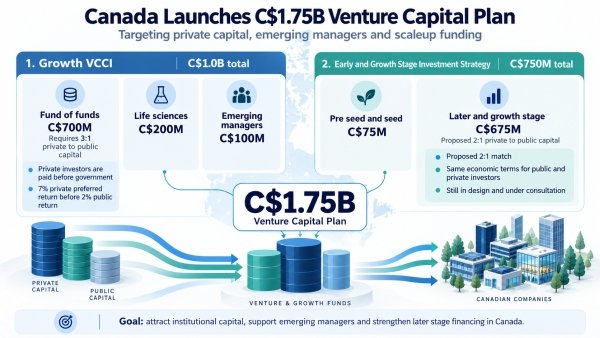
On October 22, 2026, Industry Minister Mélanie Joly launched Canada's C$1.75 billion Venture and Growth Capital Plan. It combines C$1 billion for a new Venture and Growth Capital Catalyst Initiative with C$750 million for early and growth stage investing. Ottawa expects the programs to attract at least C$3.8 billion of private investment, taking the total pool above C$5.5 billion.
Canada may be reaching an important turning point in how it supports venture capital. The plan is more targeted than another funding announcement. It uses public capital to attract institutional investors, broaden the fund manager base and strengthen later stage financing where Canadian companies often rely heavily on foreign capital.
The C$1.75 billion is federal capital, not money already invested in startups. Most of it will move through fund managers that must raise private capital before investing in venture funds or companies. The first C$700 million fund of funds competition is open now, while the largest growth stage stream is still being designed.
The plan has five funding streams.
Founders won't apply directly for most of this money. BDC will manage the federal investments, while selected fund managers raise private capital and invest through venture funds or eligible companies. The structure is meant to increase the amount of private money available across the financing cycle rather than turn C$1.75 billion into startup grants.
The C$700 million fund of funds stream is the first part with final application terms. Applications close January 21, 2027 at noon Pacific. Managers must be raising at least C$150 million, show Canadian venture investment experience and demonstrate institutional backing or a comparable track record.
The C$100 million emerging manager allocation addresses another weakness. In 2025, the five largest Canadian venture funds captured 83% of all capital raised, while emerging managers raised only C$249 million. A separate stream gives newer managers room to build track records without having to clear the C$150 million minimum used for the main fund of funds competition.
The C$675 million later and growth stage stream targets Series B and beyond, where the financing gap becomes more pronounced. Its current design covers growth equity, opportunity funds, continuation vehicles and some innovation focused buyout strategies. It isn't open for applications yet, and ISED and BDC are accepting feedback until November 23, 2026 at 5 p.m. Pacific.
The most consequential part of the plan may be how Ottawa is using public money to improve the economics for private investors. Selected fund of funds managers must raise C$3 of private capital for every C$1 of public capital. A fund receiving C$50 million from Ottawa would therefore need at least C$150 million from private investors.
The fund of funds terms give private investors priority when returns are distributed. Private investors are paid before the government. They first recover their contributed capital and receive enough additional distributions to reach a 7% internal rate of return. Federal capital is then repaid and begins earning its 2% return before remaining profits are distributed under the fund's waterfall. The 7% isn't guaranteed. Private investors still carry venture risk, but they receive better economics than the federal government when a fund performs well enough to return capital and profits.
Federal money is also put to work early. Public and private capital are generally drawn equally until the government's commitment has been used, even though federal capital represents about 25% of a fund meeting the minimum 3 to 1 private match. That can make participation more attractive to institutional investors by delaying some of their capital calls.
The program still keeps a strong Canadian investment requirement. At least 60% of fund investments must go into qualifying Canadian venture funds. Managers can invest up to 30% of a fund directly into companies, but at least 90% of those direct investments must go to Canadian based businesses.
Previous programs show that the model can attract larger pools of capital. Across VCAP and earlier VCCI programs, Ottawa reports C$1.2 billion of federal investment, C$3.7 billion raised by recipient managers and C$6.4 billion invested in Canadian companies by supported funds and other investors.
The proposed C$675 million growth stage stream takes a different approach. Its current design calls for at least C$2 of private capital for every C$1 of federal investment, but public and private investors would receive the same economic terms. That could make sense in a market where the priority is increasing the number of investors able to finance larger Canadian rounds.
The need is visible in the numbers. Canadian VC investment reached C$2.69 billion across 250 deals in the first half of 2026, but 16 financings of C$50 million or more absorbed 59% of all capital. Later stage activity fell to 18 deals, growth stage financing totalled only C$127 million across three deals and foreign investors participated in 56% of later stage rounds.
International capital is an advantage, something Canada should augment, not replace. The weakness appears when Canadian investors aren't able to lead or anchor enough of those larger rounds. More domestic growth capital can give strong companies another option when they are deciding where to raise, who joins the cap table and how much of the next stage of growth remains anchored in Canada.
Private capital is already moving into the gap. RBC recently launched a C$1.4 billion Canadian technology initiative that includes a growth fund for later stage technology companies. Public capital can widen that market by bringing more pension funds, insurers, family offices and fund managers into the same part of the financing cycle.
The emerging manager stream could broaden Canada's venture market as well. In 2025, government backed VCAP and VCCI capital represented 36% of Canadian VC fundraising. The next step is getting more pension funds, insurers, family offices and other private investors to keep investing after public capital has helped funds build a track record.
Exit markets remain a constraint. Canada recorded 18 venture backed exits worth C$716 million in the first half of 2026 and no venture backed IPOs. Funds ultimately need acquisitions, secondary sales or public markets to return money to investors and put that capital back to work.
Canada has an opportunity to use public capital differently this time. The C$1.75 billion plan can bring more institutional investors into venture, give emerging managers room to build credible track records and expand the pool of capital available when Canadian companies reach larger rounds. The turning point comes if it broadens the investor base (not just the amount of capital available), and those investors earn competitive returns and keep allocating capital after the incentives have done their job. That would move Canada closer to a venture market that compounds on its own rather than waiting for the next government program.
The National Crowdfunding & Fintech Association (NCFA Canada) is a financial innovation ecosystem that provides education, market intelligence, industry stewardship, networking and funding opportunities and services to thousands of community members and works closely with industry, government, partners and affiliates to create a vibrant and innovative fintech and funding industry in Canada. Decentralized and distributed, NCFA is engaged with global stakeholders and helps incubate projects and investment in fintech, alternative finance, crowdfunding, peer-to-peer finance, payments, digital assets and tokens, artificial intelligence, blockchain, cryptocurrency, regtech, and insurtech sectors. Join Canada's Fintech & Funding Community today FREE! Or become a contributing member and get perks. For more information, please visit: www.ncfacanada.org
| | |
|---|---|---|
| | |
October 20, 2026 | Market Activity | Cross Border Payments And FX, Payments Infrastructure And Money Movement, Competition And Market Structure

On October 20, 2026, Mississauga fintech RemitBee announced a partnership with payment processor Adyen to simplify customer payments and support international expansion. A day earlier, RemitBee announced another partnership with TerraPay to expand overseas payouts, including transfers to digital wallets. Adyen will help RemitBee collect payments, while TerraPay will provide more ways to deliver money abroad. The agreements address two costs that can make international payments difficult to scale, collecting funds and paying recipients.
Founded in 2015, RemitBee serves hundreds of thousands of customers and supports transfers from Canada to more than 150 countries. It also offers RPass, a platform for businesses making international supplier, contractor and employee payments. The company has spent more than a decade building its Canadian customer base and international payment connections. Now it's expanding the services behind those transactions without having to build every payment connection itself.
Adyen will initially handle card payment collection in Canada, with additional payment methods planned as the relationship develops. RemitBee already supports debit card funding for international transfers and card payments for certain other services. The new arrangement focuses on how those payments are processed, rather than introducing card funding to the entire business for the first time.
Managing disputes has been costly. In an interview published by Adyen, RemitBee said its previous chargeback process involved too much manual work for the number of cases it handled. Adyen's automated tools and lower dispute fees could reduce that expense. Moving more payments onto one platform should also make reporting and reconciliation easier.
Adyen has direct acquiring and banking capabilities in the United States, United Kingdom and European Union. RemitBee sees those connections as useful for expansion beyond Canada, where adding separate processors and banking relationships would increase costs and complexity. It's an operating decision as much as a technology upgrade. Fewer systems to manage could leave more resources for customers and new products.
That choice also fits Canada's changing payment market. Adyen Canada became a member of Payments Canada in July 2026 as part of a broader expansion of payment system membership. Membership doesn't automatically provide direct access to every payment rail, but it gives newer payment providers a stronger position in Canada's financial infrastructure.
TerraPay gives RemitBee more ways to pay recipients through local banks and digital wallets. Its network connects 3.7 billion digital wallets and 7.5 billion bank accounts across more than 156 countries, with coverage in the United States, Asia, the Middle East and Africa.
For Canadian businesses paying overseas suppliers and contractors, more local payout options could mean fewer payment providers to manage. RemitBee can use TerraPay's network while continuing to handle currency conversion, customer service and compliance.
RemitBee's published consumer pricing offers free e-Transfer, EFT and bill payment funding on transfers of C$500 or more, with separate charges for debit cards. Its stated exchange rate margin generally ranges from 0.3% to 0.8%, depending on the destination. Lower processing and payout costs could improve RemitBee's margins or help it compete on price, but neither partnership has disclosed expected savings.
RemitBee's opportunity extends beyond consumer remittances. Canadian companies paying international suppliers, contractors and employees need competitive exchange rates, reliable delivery and clear payment records. Banks and established providers such as Wise already serve these customers, so adding more payment networks won't be enough to win their business.
RemitBee has an opening with smaller firms that regularly pay people across several countries. A business might need to pay one supplier through a bank account and another contractor through a mobile wallet, without managing separate providers for each destination. Combining those payment options with currency conversion and business payment records could make RPass more useful to companies with recurring international expenses.
There is still a commercial risk. RemitBee relies on outside processors and payout networks, while competitors can negotiate their own arrangements and compete aggressively on price. Its advantage will depend on retaining customers, keeping transfer costs competitive and earning enough from recurring business payments to support growth.
RemitBee is expanding its international payments business by connecting established processors and payout networks rather than owning them. That keeps the cost of expansion more manageable, but gives the company less direct control over key services. Can RemitBee turn access to global payment networks into a lasting competitive advantage, or will pricing, customer relationships and reliable delivery ultimately determine who wins?
The National Crowdfunding & Fintech Association (NCFA Canada) is a financial innovation ecosystem that provides education, market intelligence, industry stewardship, networking and funding opportunities and services to thousands of community members and works closely with industry, government, partners and affiliates to create a vibrant and innovative fintech and funding industry in Canada. Decentralized and distributed, NCFA is engaged with global stakeholders and helps incubate projects and investment in fintech, alternative finance, crowdfunding, peer-to-peer finance, payments, digital assets and tokens, artificial intelligence, blockchain, cryptocurrency, regtech, and insurtech sectors. Join Canada's Fintech & Funding Community today FREE! Or become a contributing member and get perks. For more information, please visit: www.ncfacanada.org
| | |
|---|---|---|
| | |
October 15, 2026 | Market Activity | Banking Infrastructure, Embedded Finance, Open Banking and Consumer-Driven Finance

On October 15, 2026, Toronto fintech Flinks launched Professional Services and Managed Services to help banks and fintechs develop financial products and operate the technology supporting them. The expansion takes Flinks beyond financial data connectivity into building and maintaining banking capabilities, including payment integrations, account switching and embedded financial services.
Majority owned by National Bank of Canada, Flinks reports connectivity to more than 15,000 financial institutions and serves clients including EQ Bank, National Bank and Wealthsimple. The new offerings formalize work Flinks has already performed for institutional customers, combining project development with ongoing responsibility for integrations, technical support and service operations.
In an October 15 company article, Flinks Chief Revenue Officer Eddie Beqaj describes a project involving an unnamed Canadian bank and one of its business customers. The bank already supports account transfers, bill payments and Interac e-Transfer through its APIs. Its customer operates a software platform that collects payments from many organizations, but the money arrives through different channels, making it difficult to match payments with invoices.
The bank wants to connect those payment services directly to the customer's software so collections can flow through one banking relationship. That would simplify reconciliation for the customer while giving the bank an opportunity to attract and retain substantial commercial deposits. The payment technology already exists. Flinks' role is to make it work inside software the bank doesn't control.
Flinks says it completed a paid discovery phase and assigned a team to develop the integration. Its commercial value will depend on whether the software customer directs meaningful payment activity and balances through the bank.
There is a useful Canadian comparison. Dream Payments embedded payment capabilities into business software using J.P. Morgan's banking infrastructure. Dream provides payment execution and related controls within software applications. Flinks is helping a bank connect its existing payment services to a commercial customer's platform. Both approaches bring banking functions into applications businesses already use, although they serve different objectives.
Professional Services covers the work required to turn a banking capability into a product customers can use. Flinks helps define the business case, designs the integration and supplies developers to build it. The company incorporates security and regulatory requirements during development rather than leaving them until implementation.
Managed Services covers the work that follows launch, including partner onboarding, accreditation, consent management, technical support and service commitments. Flinks has brought its existing Flinks Outbound infrastructure into this offering. Institutions sharing financial data with external providers can use Flinks to manage those connections instead of maintaining separate integrations and operating relationships with every recipient.
Client requests helped drive the decision to formalize the services. Eddie Beqaj, Chief Revenue Officer, Flinks:
"Our clients kept bringing us ideas that weren't on anyone's roadmap, including ours."
Beqaj also cites work with a major Canadian bank to transfer customers' Interac e-Transfer contacts and bill payees when they switch accounts. Preserving those payment arrangements removes a practical obstacle to changing banks, particularly for customers with recurring payments and established recipients. The example connects to a larger question explored in NCFA's open banking intelligence hub. How can financial data portability lead to easier account switching and greater competition when customers still have to move their payment relationships?
Flinks is moving beyond banking connectivity to build and operate financial services for its clients. The opportunity is to turn custom bank projects into lasting customer relationships, but the real measure will be whether Flinks can reuse its technology across clients without repeatedly rebuilding the same integrations.
The National Crowdfunding & Fintech Association (NCFA Canada) is a financial innovation ecosystem that provides education, market intelligence, industry stewardship, networking and funding opportunities and services to thousands of community members and works closely with industry, government, partners and affiliates to create a vibrant and innovative fintech and funding industry in Canada. Decentralized and distributed, NCFA is engaged with global stakeholders and helps incubate projects and investment in fintech, alternative finance, crowdfunding, peer-to-peer finance, payments, digital assets and tokens, artificial intelligence, blockchain, cryptocurrency, regtech, and insurtech sectors. Join Canada's Fintech & Funding Community today FREE! Or become a contributing member and get perks. For more information, please visit: www.ncfacanada.org
| | |
|---|---|---|
| | |
October 15, 2026 | Insight | Fintech Funding, Embedded Finance, Payments Infrastructure

On October 15, 2026, New York fintech Ramp announced US$1.85 billion in financing at a US$60 billion valuation, less than three months after expanding its corporate cards and financial operations platform into Canada. Ramp now serves more than 85,000 businesses and reports over US$2 billion in annualized revenue. Its growing financial resources raise the stakes for Canadian competitors Float, Venn and others, particularly as corporate cards, payments and expense software increasingly compete for the same business customers.
Ramp already sells more than corporate cards. Its platform combines spending controls, supplier payments, accounting automation and financial software, with new AI services extending its reach. The financing gives Ramp substantial resources to expand those products and compete for larger accounts, while Canadian fintechs face decisions about pricing, customer acquisition and which financial services they can profitably provide.
Dragoneer Investment Group led the primary financing round, with Thrive Capital, Founders Fund, Sands Capital and Avenir Growth as co-leads. Ontario Teachers' Pension Plan also participated. Ramp's valuation has risen from US$44 billion in June, when it raised US$750 million, bringing total equity financing to approximately US$5 billion.
Ramp reports more than US$275 billion in annualized purchase volume, up 175% year over year. Its enterprise customers generating over US$100,000 in revenue for Ramp increased 113%, indicating greater adoption among larger businesses. Ramp earns revenue through interchange, software subscriptions, interest and other services.
Ramp's US$60 billion valuation implies a valuation-to-annualized-revenue multiple below 30x, based on its reported revenue run rate of more than US$2 billion. That reflects substantial investor expectations for continued growth. Ramp also reports positive cash flow, although it hasn't disclosed sufficient financial results to establish sustained profitability.
More than half of Ramp's customers use at least two products, and one quarter use three or more. That gives Ramp opportunities to increase revenue from existing accounts while making its platform more useful to finance teams managing several functions. The company has also expanded into accounts receivable automation, AI spending controls and model cost management.
Its Router.com service selects AI models based on cost and performance, while AI Token Spend Management tracks spending across providers, teams and models. Eric Glyman, Ramp's co-founder and co-CEO, described the company's ambition in the financing announcement:
"AI opens up much more of the work it takes to run a company."
Greater product adoption may improve revenue per customer and retention, but investors will ultimately need evidence that those gains justify the company's development costs and valuation.
Ramp expanded its Canadian platform in July 2026, offering corporate cards, expense management, reimbursements, bill payments and accounting integrations. Peoples Trust Company issues its Canadian Visa cards. The platform supports CAD spending and virtual USD cards, giving eligible businesses another option for managing domestic and international expenses.
Ramp's Canadian eligibility requirements include a minimum C$25,000 across connected bank accounts. Businesses registered in Quebec and the territories aren't supported, nor are sole proprietorships and unregistered businesses. The restrictions narrow Ramp's initial addressable market and leave opportunities for providers serving those customers.
Toronto based Float competes directly in corporate cards, expense management, bill payments and business accounts. In June, it raised C$85 million in Series C financing to expand its AI finance capabilities and Canadian distribution. Float reports more than 7,500 business customers. Venn competes through corporate cards, multicurrency accounts, foreign exchange and international payments, targeting businesses that need banking and spending tools across currencies.
Ramp's reported customer adoption across multiple products points to a competitive challenge beyond fundraising. When one provider manages cards, expense controls and supplier payments, customers have more reasons to stay. A Canadian fintech offering only one of those services may need to demonstrate stronger functionality, better pricing or savings large enough to justify using another provider.
Ramp's capital could also give it more flexibility to bundle products or invest in customer acquisition. If that leads to lower software prices or more aggressive sales offers in Canada, competitors could face pressure on margins and acquisition costs.
Float and Venn's opportunities lie in the customers and financial requirements they can serve better, including Canadian banking services, domestic payment needs and businesses outside Ramp's current eligibility rules. Local presence has commercial value only when it delivers something customers will pay for or gives them a compelling reason to stay.
For Canadian fintech founders, the choices are increasingly specific. Expand into more financial services, concentrate on a profitable customer segment, or supply payments, integrations and risk controls to larger platforms.
Ramp's US$1.85 billion financing gives an established Canadian market entrant greater resources to compete for corporate spending and financial operations customers. Can Canadian fintechs earn and retain more revenue from each business customer without matching the capital demands of a US$60 billion competitor?
The National Crowdfunding & Fintech Association (NCFA Canada) is a financial innovation ecosystem that provides education, market intelligence, industry stewardship, networking and funding opportunities and services to thousands of community members and works closely with industry, government, partners and affiliates to create a vibrant and innovative fintech and funding industry in Canada. Decentralized and distributed, NCFA is engaged with global stakeholders and helps incubate projects and investment in fintech, alternative finance, crowdfunding, peer-to-peer finance, payments, digital assets and tokens, artificial intelligence, blockchain, cryptocurrency, regtech, and insurtech sectors. Join Canada's Fintech & Funding Community today FREE! Or become a contributing member and get perks. For more information, please visit: www.ncfacanada.org
| | |
|---|---|---|
| | |


August 26th, 2025

January 4th, 2024

June 1st, 2021

September 9th, 2020

July 9th, 2018

January 3rd, 2018

September 25th, 2017

June 20th, 2017

May 10th, 2017

December 14th, 2016