




Karsten Wenzlaff, Advisor
August 26th, 2025
Karsten Wenzlaff is a Crowdfunding and Fintech Expert from Germany. He is Secretary-General of Digit[...]


November 9, 2026 | NCFA Story Intelligence | Risk Compliance And Regtech, Cross Border Payments And FX, Digital Assets Blockchain And Tokenization

On November 6, 2026, eight Canadian money services businesses appeared on a U.S. sanctions list. Every one of them had a Canadian MSB registration number.
That number meant the business had entered Canada's federal registration system. It didn't mean FINTRAC had approved the firm, cleared its customers or vouched for every transaction passing through it. Until November 6, that distinction could sound technical.
Then the U.S. Treasury allegations arrived. Treasury says several of the eight firms converted cash or conventional currency into digital assets that reached sanctioned Iranian exchanges, addresses associated with the Islamic Revolutionary Guard Corps and, in some cases, wallets tied by U.S. authorities to Canadian drug trafficker Ryan Wedding.
The firms had Canadian addresses, Canadian corporations and Canadian registration numbers. Now they also had OFAC designations.
The same day, FINTRAC coordination with OFAC and FinCEN became public. Then Canada's financial intelligence agency disclosed what had been happening inside its own MSB regime during 2026: 161 registrations revoked, more than $198 million in penalties against nine MSBs, and 28 MSB non compliance matters sent to law enforcement.
FINTRAC didn't say that the eight OFAC firms were among those revocations, penalties or referrals. Canadian disclosure rules generally prevent it from making that connection public unless the law allows it.
But the sequence is hard to miss. Canada had already spent years strengthening Canada's tightening AML rules around MSBs, crypto, ownership and financial reporting. Now eight registered Canadian businesses were inside a U.S. sanctions action, and Canada's financial intelligence agency was confirming that it helped.
This is a story about what a registration number can prove, what it can't prove, and what happens when the transactions behind it reach sanctioned networks abroad.
Canada requires money services businesses to register with FINTRAC so authorities know who's operating, who controls the business and what services it offers. The registry brings firms into view, but it doesn't certify what happens inside every transaction.
That distinction had already surfaced before November. In September, Maple Digital and the TGR network raised questions about how much an active registration can really tell a bank or counterparty. There was no finding that Maple itself laundered money, but corporate and personnel connections showed why a FINTRAC number couldn't settle questions about directors, related companies or sanctions exposure.
The eight firms designated by OFAC had Canadian registration numbers, corporate identities and physical addresses. Some operated from Vancouver, Toronto, North York, Richmond Hill, Thornhill and Montreal.
Those registrations told counterparties the businesses had entered Canada's MSB system. They didn't establish what customers were doing through the firms or where every transaction ended.
Iran connected transactions don't enter this story as ordinary transfers. Canada already requires reporting firms to treat them as high risk.
By July 2026, Canada's Iran AML controls still required enhanced checks covering identity, source of funds or virtual currency, beneficial ownership, recordkeeping and possible sanctions evasion. The warning was already built into the system before Treasury named the eight Canadian firms.
Earlier that summer, sanctions on Iranian crypto exchanges included Nobitex, Wallex, Bitpin and Ramzinex. Aban Tether Exchange and Shelbit later joined the sanctions record.
By November, several of those names appeared again in Treasury's allegations involving Canadian MSBs. The counterparties weren't unknown names at the far end of a payment chain anymore.
OFAC now names eight Canadian businesses under Executive Order 13902. They look different on paper, but they share one uncomfortable fact: each had entered Canada's MSB registry before U.S. authorities placed it inside an Iran sanctions case.
Treasury alleged that NIA Nations dealt with addresses associated with the IRGC and with Nobitex, Wallex, Ramzinex and Bitpin. Darvish Exchange allegedly dealt with Nobitex, Wallex, Aban Tether Exchange and Shelbit.
Farah Exchange allegedly dealt with Shelbit and Wallex. Amin Exchange allegedly received hundreds of thousands of dollars from Shelbit. These weren't generic country risk warnings anymore. Treasury was attaching named Canadian firms to named counterparties.
Then another thread appears. Treasury also alleges that some of the same Canadian MSBs handled proceeds connected with Ryan Wedding, the Canadian former Olympic snowboarder accused by U.S. authorities of running a multinational cocaine trafficking organization.
The case isn't only about Iranian exchanges now. It also touches alleged Canadian drug cash, and Treasury says some of the same businesses appear in both trails.
In the sanctions allegations, investigators followed counterparties. Which exchange received the funds? Which wallet had already been linked to a sanctioned actor?
In the Wedding allegations, they also followed the source. Where did the cash come from? Why was it converted? Treasury says some of the same Canadian businesses appeared in both trails.
The U.S. action could have ended as a foreign sanctions story. It doesn't.
FINTRAC confirms that it coordinated with OFAC and FinCEN, then Canada's financial intelligence agency publishes numbers showing just how active MSB enforcement has become at home.
Since the beginning of 2026, FINTRAC says it has revoked 161 registrations, more than during the previous three years combined. Over the past year, it imposed more than $198 million in penalties against nine MSBs and disclosed 28 MSB non compliance matters to law enforcement.
The November total didn't appear out of nowhere. By May, FINTRAC's MSB revocations were already reaching money transfer, FX, virtual currency and payment service businesses.
Before November 6, Canada's tougher MSB enforcement could be seen through revoked registrations, individual penalties and new AML powers.
Now FINTRAC is publicly confirming that Canadian financial intelligence also fed an international sanctions action. The coordination is public. The firm by firm Canadian enforcement record isn't.
The same number that placed each firm inside Canada's MSB system now appears on the same record as an OFAC designation.. That doesn't make registration meaningless. It changes what everyone around the firm has to ask next.
A bank can confirm registration and still need to understand the customer. A payment partner can confirm it and still need to know where the funds came from. A crypto exchange can confirm it and still need to screen the wallet. A foreign counterparty still needs to know who's at the other end.
For legitimate MSBs, registration still opens the door to operating within Canada's regulated system. Remittance, FX, payments and digital asset firms remain important to customers who need alternatives to the largest banks.
International access depends on more than the registry. Banks, exchanges and settlement partners also need confidence in ownership, source of funds, sanctions controls, wallet screening and transaction monitoring. If that confidence disappears, the registration number won't preserve the relationship.
OFAC has named the firms and FINTRAC has confirmed the coordination. The rest of the Canadian story hasn't been written yet.
Registrations can be revoked. FINTRAC penalties can become public where the law permits. Police can investigate, prosecutors can lay charges where the evidence supports them, and criminal assets can be identified and recovered.
None of those outcomes can be read into the OFAC designation today.
What happens next will show whether the November 6 sanctions action is followed by Canadian registration, regulatory, police or asset recovery measures involving any of the eight firms.
Eight Canadian businesses entered November 6 with MSB registration numbers. They ended the day on a U.S. sanctions list.
That doesn't prove they committed a crime in Canada. It doesn't prove FINTRAC revoked their registrations, penalized them or referred them to police.
For legitimate operators, the demands are becoming harder to ignore. Know the customer, source of funds and beneficial owner. Know the wallet and the exchange. Keep records good enough to revisit a transaction when an address later appears on a sanctions list.
Those checks aren't free, especially for smaller firms. Banks, exchanges and settlement partners also have to decide whom they're willing to keep connected to their own systems.
Canada's MSB sector still serves real needs in remittances, foreign exchange, cross border commerce and financial access. November 6 doesn't change that.
What it does leave unresolved is what comes next for these eight firms.
OFAC has made its allegations public. FINTRAC has confirmed the cross border coordination. The next chapter is whether that intelligence leads to Canadian regulatory, police or asset recovery action involving any of the eight.
An MSB registration tells you that a firm entered Canada's regulated system. It doesn't tell you enough about the customers, funds, wallets and counterparties behind that number.
Share this story → Explore related intelligence → Subscribe
Share this story → Explore related intelligence → Subscribe
 The National Crowdfunding & Fintech Association (NCFA Canada) is a financial innovation ecosystem that provides education, market intelligence, industry stewardship, networking and funding opportunities and services to thousands of community members and works closely with industry, government, partners and affiliates to create a vibrant and innovative fintech and funding industry in Canada. Decentralized and distributed, NCFA is engaged with global stakeholders and helps incubate projects and investment in fintech, alternative finance, crowdfunding, peer-to-peer finance, payments, digital assets and tokens, artificial intelligence, blockchain, cryptocurrency, regtech, and insurtech sectors. Join Canada's Fintech & Funding Community today FREE! Or become a contributing member and get perks. For more information, please visit: www.ncfacanada.org
 |  |  |
|---|---|---|
 |  |  |
November 4, 2026 | NCFA Story Intelligence | Sustainable Finance And ESG, Regulation And Policy, Competition And Market Structure
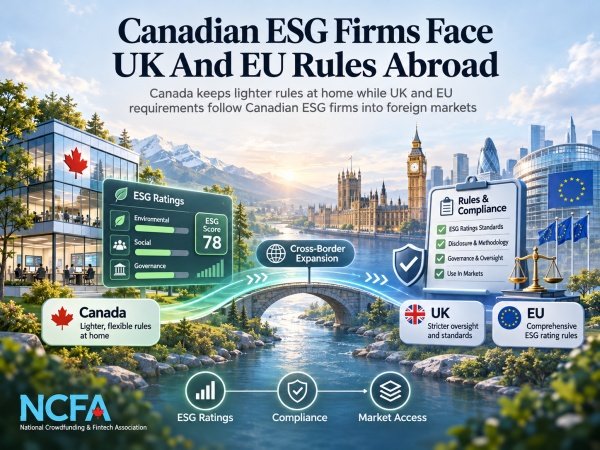
ESG ratings promised investors a shortcut.
Instead of digging through climate data, labour records, governance practices and supply chains themselves, they could buy a score and put it to work.
Then the scores started disagreeing.
The same company could look strong through one provider and much weaker through another. Nobody had to be cheating or doing bad work. One firm might care more about carbon exposure. Another might put more weight on labour practices, board governance or supply chains. Even when they looked at the same issue, they weren't always using the same data.
Investors were left with a problem. They had bought a shortcut and now had to check the shortcut.
In Britain, thousands of financial firms eventually built their own checks around ratings they were already paying for. The FCA estimates that extra work now costs about £495 million every year.
Regulators eventually made a choice that wasn't obvious at the start. They didn't force every provider to use the same formula. They started regulating the firms producing the ratings.
The EU rules have applied since July 2, 2026. On November 3, 2026, the UK Financial Conduct Authority published its final ESG ratings rules. From June 29, 2028, firms caught by the UK regime need FCA authorisation.
Canada hasn't followed them.
That gives a Canadian startup more breathing room at home.
Then it lands a customer in London, Paris or Frankfurt.
The Canadian rules haven't changed. The business suddenly has.
One provider knocks a company down for carbon exposure. The investor sees the score fall and assumes climate risk is driving the result. But that number also reflects choices about which indicators were used, which data was trusted and how the provider turned those inputs into a score.
Another barely moves on carbon but cuts the same company for governance or labour practices. The company itself hasn't changed between the two ratings. What changed is the lens used to judge it. Same company. Same ESG label. Different story.
Providers sign up, publish more detail and tighten their controls. They still get to build their own methods and scores. That keeps room for different models to compete, but it also leaves customers comparing very different ways of measuring the same company.
Customers keep doing their own checks anyway. Banks, asset managers and other users still have to decide whether the provider's data, methodology and controls are strong enough for their own decisions. More disclosure helps, but the doubt doesn't go away.
A rating only saves time if the buyer trusts the data, methodology and controls used to produce it. By this point, many firms aren't simply reading the score. They're reviewing the provider, checking the method and sometimes changing their own systems before the rating can be used.
By 2025, thousands of firms have built their own second opinion inside the company. Some are spending months onboarding providers and assigning staff just to close information gaps or resolve concerns before a rating can be trusted. The shortcut has created another job.
Before, a provider could follow the voluntary code and convince customers that its controls were good enough. The customer could accept that explanation, ask for more or walk away. The regulator wasn't deciding whether the provider could stay in the market.
Under FCA rules, that choice disappears. Firms in scope have to meet requirements around governance, conflicts, systems, data and disclosure, and they need authorisation to keep serving the market. If the firm is caught by the regime, meeting the standard becomes part of staying in business.
A smaller Canadian provider can still reach European customers without waiting for Canada to create its own ratings licence. Recognition can give qualifying foreign firms a way in when equivalence isn't available, so the market isn't closed to an independent Canadian provider.
But it still has to meet European requirements. Depending on the route, that can mean a legal representative, added documentation and direct accountability to ESMA. The company can stay Canadian, but its European business can't simply run on Canadian rules. Getting into the market is possible. Getting in on Canadian terms isn't.
A Canadian startup can build an ESG scoring product, test it and sell it at home without first getting a dedicated ratings licence. That leaves more of its early budget for product, data, hiring and customers instead of a new authorisation process.
Then it signs a foreign customer. New legal work, documentation, controls and regulatory relationships can arrive with the contract even though the product itself is unchanged. The product hasn't changed. The cost of selling it may have.
The Canada EU digital trade deal can make contracts, permitted data transfers and online delivery easier for smaller Canadian companies. That can remove friction from how a digital service is sold and delivered across the Atlantic.
If the product is an ESG rating, ESMA's rules still apply. A smoother digital sale doesn't replace recognition, endorsement or any other requirement that applies to the provider itself. The sale may get easier. The regulatory work doesn't disappear.
Providers still get to disagree and build different models. One can give climate more weight while another puts more emphasis on governance, and the FCA doesn't try to choose the winner.
What changes is how much of the work behind the score has to stand up to scrutiny. Providers have to explain more about the data, methods, conflicts and controls that produced the result. The rating can stay subjective. The process can't stay hidden.
UK applications begin in 2027. Firms expecting at least £500,000 in ESG ratings revenue over the following 12 months apply first. Smaller providers follow. For a Canadian exporter, the size and timing of the sales pipeline can therefore affect when the FCA application work starts.
A firm serving both the UK and EU can reuse some people, controls and documentation. That should keep the second market from starting entirely from zero, but the two regimes remain separate and each still has its own entry requirements. It can reuse the work. It can't reuse the permission.
Canada gets a real benefit from staying lighter.
A young ratings or analytics company can spend more of its first dollars on product, hiring and customers instead of building a licence around a market that may still be small.
That works well while Canada is the market.
Then the company wants to scale.
A UK customer can bring FCA requirements into the sales process. A European customer can bring ESMA. The Canadian company starts hiring compliance staff, changing contracts, documenting methods and adding controls that Canada never asked it to build.
Copying the UK or EU isn't an obvious answer either.
A Canadian licence would cost money. Plenty of firms may never need one. Large global providers can spread that cost across thousands of customers. A startup can't.
But staying different isn't automatically free.
If every Canadian firm with global ambitions has to build around foreign rules anyway, Canada's lighter model starts saving less than it first appears.
Canada hasn't crossed that line by law. Some Canadian firms may cross it much sooner.
At what point does regulatory divergence stop saving Canadian firms money and start making international expansion more complicated?
Ottawa hasn't answered that question. Canadian firms trying to sell abroad may answer it first.
Share this story → Explore related intelligence → Subscribe
The National Crowdfunding & Fintech Association (NCFA Canada) is a financial innovation ecosystem that provides education, market intelligence, industry stewardship, networking and funding opportunities and services to thousands of community members and works closely with industry, government, partners and affiliates to create a vibrant and innovative fintech and funding industry in Canada. Decentralized and distributed, NCFA is engaged with global stakeholders and helps incubate projects and investment in fintech, alternative finance, crowdfunding, peer-to-peer finance, payments, digital assets and tokens, artificial intelligence, blockchain, cryptocurrency, regtech, and insurtech sectors. Join Canada's Fintech & Funding Community today FREE! Or become a contributing member and get perks. For more information, please visit: www.ncfacanada.org
| | |
|---|---|---|
| | |
October 27, 2026

Today's sales teams sell across borders. A firm often closes deals with clients on different continents. Nonetheless, payment friction slowly eats away at revenue. An individual attempts to purchase a service. The credit card is denied by the local bank. The project is delayed due to a slow wire transfer. Certain areas do not support conventional gateways. This friction prevents growth. Payments through cryptocurrency create a powerful alternative route. Another option reduces lost sales. Organizations use it for greater international reach. It also speeds up the gathering of funds.
Payment processing is usually viewed by business leaders as a finance issue only. A huge blunder took place. Payment friction directly hurts sales conversion. The final checkout screen is reached by the buyer. Their credit card is repulsed by the system due to an unknown reason. The customer leaves without completing the purchase. The revenue of the company eludes.
Chargebacks suck profitability. International buyers often cancel orders when they see unsupported payment methods. An unpleasant checkout process disrupts the customer journey. Every failed transaction is marketing money wasted and selling effort lost.
Digital assets are free from banking restrictions. A digital wallet allows clients to send funds directly to merchants. There is no middle bank that can refuse a transaction. This link eliminates obstacles not based on choice. It assures more customers complete their purchase.
Conventional financial networks impose rigid geographic limits. A consumer in a developing nation typically does not have premium credit cards. Their domestic means of payment fail on international sites. These borders get erased by crypto payments. A merchant may accept value from any customer that has an internet connection. This ability greatly extends the total addressable market.
Credit card networks are often controlled by strict approval systems. These systems don’t work for many users. The merchant has to wait days for the cash. Digital ledgers work differently. Settling of transactions takes minutes. The network is always open on weekends and holidays. When a transaction is confirmed by the network, it is final. This permanent nature prevents fraudulent chargebacks. The business’s working capital is immediately available to them.
People won’t stop using their credit cards. Digital assets sit next to them. A customer at an internet checkout simply chooses a digital wallet option rather than tapping in a card number. For B2B sales, a finance team includes a digital address in the normal invoice. Contemporary software applications come with recurring models. A company may set up an auto monthly subscription or retainer by smart contracts. It's merely another measure to intercept income.
The price of the early digital coins fluctuated significantly. A sales team can’t throw out a price on a stock that could fall ten percent in an hour. This problem is solved by stablecoins. Tokens such as USDT and USDC are directly pegged to the US dollar. A single token is worth one dollar. It enables businesses to quote predictable prices. The organization gets a steady amount. Daily sales and invoicing will not be a market concern. See: Programmable stablecoin payments
Using digital wallets brings real monetary advantages. A business instantly expands its global reach. Sales teams experience a lower frequency of declined transactions. The treasury department benefits from a speedier cash settlement. International clients have a much easier buying experience. This increases the overall rate of conversion. Nonetheless, digital assets can’t make a deficient product successful for long. They only optimize the generation of revenue.
New responsibilities always come with innovation. A business must assess the risks before changing its checkout experience.
Even stablecoins need security attention. A business can lose access to a digital vault, resulting in a permanent loss. Organizations must take fraud prevention more seriously. Compliance also requires hard work. Digital assets are strictly classified by tax agencies. A business is required to keep accurate records of any transactions. In addition, companies should comply with the laws of anti-money laundering (AML) and know your customer (KYC). A qualified legal and tax professional should be consulted by the firm in this regard.
A prudent company incorporates new systems gradually. A company should only start with stablecoins to avoid panic. The new option should be clearly visible on the checkout page. The record keeping habit for the accounting department should begin on the first day. Before promoting the new feature to your entire audience, always run a little test transaction.
Most organizations should not manage raw cryptographic keys. They must be careful with evaluations about third-party providers. A business must check the supported currencies. The software must offer instant crypto-to-fiat conversion. The fee structure, integration options, and reporting tools must be verified by executive teams. Security and compliance are 100% mandatory. For example, the finance director of an organization can go to the Cryptobanco official website to see how enterprise-grade infrastructure safely addresses these specific requirements. A dependable partner takes away the technical burden entirely.
Accepting digital funds helps businesses please and retain worldwide customers. It is very important to have a very detailed implementation strategy. Before production, corporate chiefs should check real demand. They must become familiar with their operating costs and the local regulation. With proper deployment of this technology by a company, it eliminates financial friction and speeds up global growth.
The National Crowdfunding & Fintech Association (NCFA Canada) is a financial innovation ecosystem that provides education, market intelligence, industry stewardship, networking and funding opportunities and services to thousands of community members and works closely with industry, government, partners and affiliates to create a vibrant and innovative fintech and funding industry in Canada. Decentralized and distributed, NCFA is engaged with global stakeholders and helps incubate projects and investment in fintech, alternative finance, crowdfunding, peer-to-peer finance, payments, digital assets and tokens, artificial intelligence, blockchain, cryptocurrency, regtech, and insurtech sectors. Join Canada's Fintech & Funding Community today FREE! Or become a contributing member and get perks. For more information, please visit: www.ncfacanada.org
| | |
|---|---|---|
| | |
October 20, 2026 | Market Activity | Cross Border Payments And FX, Payments Infrastructure And Money Movement, Competition And Market Structure

On October 20, 2026, Mississauga fintech RemitBee announced a partnership with payment processor Adyen to simplify customer payments and support international expansion. A day earlier, RemitBee announced another partnership with TerraPay to expand overseas payouts, including transfers to digital wallets. Adyen will help RemitBee collect payments, while TerraPay will provide more ways to deliver money abroad. The agreements address two costs that can make international payments difficult to scale, collecting funds and paying recipients.
Founded in 2015, RemitBee serves hundreds of thousands of customers and supports transfers from Canada to more than 150 countries. It also offers RPass, a platform for businesses making international supplier, contractor and employee payments. The company has spent more than a decade building its Canadian customer base and international payment connections. Now it's expanding the services behind those transactions without having to build every payment connection itself.
Adyen will initially handle card payment collection in Canada, with additional payment methods planned as the relationship develops. RemitBee already supports debit card funding for international transfers and card payments for certain other services. The new arrangement focuses on how those payments are processed, rather than introducing card funding to the entire business for the first time.
Managing disputes has been costly. In an interview published by Adyen, RemitBee said its previous chargeback process involved too much manual work for the number of cases it handled. Adyen's automated tools and lower dispute fees could reduce that expense. Moving more payments onto one platform should also make reporting and reconciliation easier.
Adyen has direct acquiring and banking capabilities in the United States, United Kingdom and European Union. RemitBee sees those connections as useful for expansion beyond Canada, where adding separate processors and banking relationships would increase costs and complexity. It's an operating decision as much as a technology upgrade. Fewer systems to manage could leave more resources for customers and new products.
That choice also fits Canada's changing payment market. Adyen Canada became a member of Payments Canada in July 2026 as part of a broader expansion of payment system membership. Membership doesn't automatically provide direct access to every payment rail, but it gives newer payment providers a stronger position in Canada's financial infrastructure.
TerraPay gives RemitBee more ways to pay recipients through local banks and digital wallets. Its network connects 3.7 billion digital wallets and 7.5 billion bank accounts across more than 156 countries, with coverage in the United States, Asia, the Middle East and Africa.
For Canadian businesses paying overseas suppliers and contractors, more local payout options could mean fewer payment providers to manage. RemitBee can use TerraPay's network while continuing to handle currency conversion, customer service and compliance.
RemitBee's published consumer pricing offers free e-Transfer, EFT and bill payment funding on transfers of C$500 or more, with separate charges for debit cards. Its stated exchange rate margin generally ranges from 0.3% to 0.8%, depending on the destination. Lower processing and payout costs could improve RemitBee's margins or help it compete on price, but neither partnership has disclosed expected savings.
RemitBee's opportunity extends beyond consumer remittances. Canadian companies paying international suppliers, contractors and employees need competitive exchange rates, reliable delivery and clear payment records. Banks and established providers such as Wise already serve these customers, so adding more payment networks won't be enough to win their business.
RemitBee has an opening with smaller firms that regularly pay people across several countries. A business might need to pay one supplier through a bank account and another contractor through a mobile wallet, without managing separate providers for each destination. Combining those payment options with currency conversion and business payment records could make RPass more useful to companies with recurring international expenses.
There is still a commercial risk. RemitBee relies on outside processors and payout networks, while competitors can negotiate their own arrangements and compete aggressively on price. Its advantage will depend on retaining customers, keeping transfer costs competitive and earning enough from recurring business payments to support growth.
RemitBee is expanding its international payments business by connecting established processors and payout networks rather than owning them. That keeps the cost of expansion more manageable, but gives the company less direct control over key services. Can RemitBee turn access to global payment networks into a lasting competitive advantage, or will pricing, customer relationships and reliable delivery ultimately determine who wins?
The National Crowdfunding & Fintech Association (NCFA Canada) is a financial innovation ecosystem that provides education, market intelligence, industry stewardship, networking and funding opportunities and services to thousands of community members and works closely with industry, government, partners and affiliates to create a vibrant and innovative fintech and funding industry in Canada. Decentralized and distributed, NCFA is engaged with global stakeholders and helps incubate projects and investment in fintech, alternative finance, crowdfunding, peer-to-peer finance, payments, digital assets and tokens, artificial intelligence, blockchain, cryptocurrency, regtech, and insurtech sectors. Join Canada's Fintech & Funding Community today FREE! Or become a contributing member and get perks. For more information, please visit: www.ncfacanada.org
| | |
|---|---|---|
| | |
October 21, 2026 | Insight | Capital Markets Infrastructure And Funding, Digital Assets Blockchain And Tokenization, Wealthtech Investing And Trading

On October 20, 2026, the U.S. Securities and Exchange Commission published guidance on tokenized stock trading, clarifying how certain U.S. public shares can trade on blockchain platforms without a company's affirmative approval. The guidance follows the SEC's September 17 Innovation Exemption, which allows limited trading of eligible public stocks through new digital venues. Sixteen companies, including Microsoft, Alphabet and Goldman Sachs, have reportedly objected to having their shares traded on the proposed OKXICE platform.
The exemption doesn't cover every public stock, and companies can block certain trading arrangements. Venues also face limits on which securities they can offer and how much trading they can handle. For investors and market operators, the questions are which stocks qualify, what ownership rights come with the tokens and whether these new platforms can compete with traditional exchanges. The October 20 guidance further explains how the existing exemption works without introducing new regulations.
The SEC allows qualifying venues to trade tokenized National Market System stocks, which generally include eligible shares listed on major U.S. exchanges and certain exchange traded products. The exemption covers qualifying securities tokenized by their issuers and arrangements involving independent third parties. It excludes rights, warrants and tokens that merely track a stock's price without providing the same ownership rights as the underlying security.
The SEC separates eligible stocks into two groups. Tier 1 includes shares in the S&P 500 and Russell 1000, along with certain qualifying exchange traded products. Major companies such as Apple, Microsoft, Alphabet and Nvidia fall within those indexes, although that doesn't automatically make their shares available on a tokenized venue. Tier 2 includes other eligible listed securities outside Tier 1, giving smaller public companies a potential route into these markets.
The limits are strict. A qualifying venue can offer up to 75 Tier 1 symbols, with trading in each capped at 0.25% of the stock's average daily share volume during the previous month. Tier 2 allows up to 250 symbols, with a 2.5% volume cap. Related venues must combine their trading activity when calculating these limits.
Consider a Tier 1 stock averaging 10 million shares traded daily. A qualifying venue and its affiliates could trade up to 25,000 tokenized shares per day. A Tier 2 stock with the same volume would have a limit of 250,000 shares. A first breach of a stock's volume limit doesn't automatically require suspension, but subsequent breaches require a three month trading pause for that security.
Investors must receive the same rights and privileges as holders of equivalent conventional shares. That includes applicable dividends and voting rights. The arrangements supporting those rights must be verified, and venues must meet requirements for trading halts, transaction records and technology safeguards. A token offering only synthetic exposure to a share price doesn't qualify under this exemption.
OKXICE is one of the first proposed venues testing the SEC's approach. It's a joint venture owned equally by Intercontinental Exchange, parent of the New York Stock Exchange, and OKC USA Holding, part of the OKX group. Its public trading notices describe a platform where approved investors could trade tokenized U.S. stocks against stablecoins using automated liquidity pools instead of a conventional stock exchange order book.
OKXICE plans to use Uniswap v4 technology on the X Layer blockchain to let approved investors trade tokenized stocks through pools of shares and stablecoins. Investors would need to verify their identities and use approved digital wallets. OKXICE says it won't hold customer assets or sell newly issued shares. Publishing its plans doesn't mean the SEC has approved the platform or that trading has started.
OKXICE initially proposed 63 stock symbols from 62 companies. Nine companies had objected by October 15, including Broadcom, Verizon, UnitedHealth, CoreWeave and AppLovin. Reporting on October 19 identified seven more, bringing the total to 16 companies, including Microsoft, Alphabet, Goldman Sachs, Qualcomm, Caterpillar, McDonald's and Western Digital.
One of the 16 objectors, Cerebras Systems, wasn't on the original proposed list. That means 15 of the original 62 companies had objected, leaving 47 without a reported objection at that point. Silence doesn't mean approval. It only means the company hasn't exercised its right to block that particular trading arrangement.
Applied Optoelectronics explained its concerns to The Wall Street Journal. The company questioned whether tokenized trading would benefit shareholders and worried about possible effects on its share price, trading activity and volatility. It also didn't want investors to mistake an independent tokenized offering for one supported by the company.
Under the SEC exemption, companies have 30 calendar days after receiving notice to object. If they object in time, that venue can't offer their tokenized shares under the exemption. The objection doesn't automatically prevent every other form of stock tokenization.
Trading platforms face a separate 30 day requirement. They must publish their operating plans at least 30 calendar days before trading begins. The SEC's October 20 guidance confirms that venues can publish proposed stock lists while companies are still deciding whether to object. They must disclose which decisions remain pending and update their lists as objections arrive or the periods expire.
Andrew Cuomo, co-chair of OKXICE, described the issuer objections as a "natural response". He said the venture expected some companies to wait before participating. Whether that resistance eases will depend partly on how the first venues operate and what benefits they can demonstrate to investors and issuers.
The potential appeal is clear. Investors could trade familiar U.S. shares outside regular exchange hours, hold them through approved digital wallets and use blockchain systems to complete transactions. But being able to trade at any hour doesn't guarantee liquidity or a competitive price. New venues still need enough investors and market makers to support reliable trading.
OKXICE proposes using automated market makers instead of matching every buyer and seller through a traditional order book. Liquidity providers would supply tokenized shares and stablecoins to trading pools, earning fees while taking market risk. If those pools don't attract enough capital, investors could face wider spreads or prices that differ from the conventional stock market.
Nasdaq has proposed a different model. In September 2025, Nasdaq sought SEC approval for tokenized stock trading within its existing exchange system. Investors could choose traditional or tokenized settlement, with the Depository Trust Company handling the process. The same trading rules, security identifiers and shareholder rights would apply.
Chuck Mack, Nasdaq's Senior Vice President of North American Markets, explained the company's approach.
"Past market failures teach us that it is imperative to ensure governance, resilience, and investor protection are embedded from the outset."
The two companies are taking different approaches. OKXICE plans to build a new blockchain trading platform, while Nasdaq wants to add tokenized stocks to its existing exchange system. Nasdaq's proposal follows a separate regulatory process and predates the October 2026 objections. For investors, the real focus is which approach offers better prices, reliable trading and strong shareholder protections.
Tokenized shares still need to give investors the same ownership rights as regular stocks. That means making sure dividends reach the right people, shareholders can vote and stock splits or mergers are recorded correctly. Investors who control their own digital wallets also need to protect their access keys. Losing them could mean losing access to their investments.
Investor protections can also differ. OKXICE isn't registered as a traditional stock exchange for trading under this exemption, so some rules that apply to established exchanges don't apply in the same way. The SEC exemption is temporary and lasts five years. That gives regulators time to assess how these markets operate before deciding whether to introduce permanent rules.
For Canadian fintech founders, the business opportunities go beyond operating a trading platform. These markets need companies that can protect assets, maintain accurate ownership records, verify compliance and supply trading liquidity. Brokers and transfer agents may also need new technology to connect blockchain transactions with existing securities systems. Demand for those services will depend on whether investors actually use the new markets.
Canada is also looking at how tokenized securities could trade under its own rules. In March 2026, the Canadian Securities Administrators launched Project Tokenization to explore trading, custody and settlement of digital securities. The initiative has since engaged more than 240 organizations, as reviewed in NCFA's capital markets innovation analysis. Unlike the SEC, Canada hasn't introduced a comparable exemption for tokenized public stock trading. For Canadian exchanges and fintech founders, the U.S. experiment offers an early look at which business models work and where existing securities rules may need to adapt.
If tokenized stocks attract buyers and sellers, keep trading costs competitive and preserve shareholder rights, they could become a useful alternative. If not, investors may have little reason to move away from traditional stock markets.
The National Crowdfunding & Fintech Association (NCFA Canada) is a financial innovation ecosystem that provides education, market intelligence, industry stewardship, networking and funding opportunities and services to thousands of community members and works closely with industry, government, partners and affiliates to create a vibrant and innovative fintech and funding industry in Canada. Decentralized and distributed, NCFA is engaged with global stakeholders and helps incubate projects and investment in fintech, alternative finance, crowdfunding, peer-to-peer finance, payments, digital assets and tokens, artificial intelligence, blockchain, cryptocurrency, regtech, and insurtech sectors. Join Canada's Fintech & Funding Community today FREE! Or become a contributing member and get perks. For more information, please visit: www.ncfacanada.org
| | |
|---|---|---|
| | |
Oct 15, 2026 | Cryptocurrency, Digital Assets, Crypto Exchanges, Market Analysis

Searching for top crypto exchanges by volume is a sensible way to find active venues, but it is a poor way to finish an exchange comparison. A volume number describes recorded turnover during a chosen interval. It does not tell a reader whether the pair they need is deep, whether the displayed price is executable, or whether the venue's terms fit their country and use case. This article looks at the gap between a busy platform and a usable market. It is not a platform ranking or a recommendation to deposit funds.
Volume counts transactions over a specified period, commonly in a quote currency. Activity can improve price discovery and provide more observations, but the number is affected by pair mix, spot or derivatives coverage, fee incentives, and the data provider's method. Two valid rankings can disagree simply because they count different things.
The top crypto exchanges by volume page is useful for making a shortlist. Before reading an order as a recommendation, check the interval, products included, quote currency, and venue coverage. A venue's total may include markets that a reader cannot access, or a product that is irrelevant to the intended task.
Execution lives at the pair level. A venue can be busy overall while a smaller asset has a wide spread and a thin book. The reverse is possible too: a modest venue may be the active place for a particular local-currency pair. Daily turnover is a record of past activity; depth and spread describe what is available near a price now.
The timing gap matters. A 24-hour volume figure and a spread observed this minute are different snapshots. A listing, service interruption, or regional session change can alter the relevant market between them. Record access times, and treat the lack of pair-level timestamps as a real limitation rather than filling it with an assumption.
A city analogy is useful here. A crowded city does not mean every street is open or easy to reach. Aggregate volume describes the city. The route that matters is the actual pair, product, order size, and time of day.
Consider a reader who wants to exchange a less widely traded asset for a local currency. A venue can sit near the top of an aggregate table because its major pairs and derivatives markets are active, yet the relevant local pair may have only occasional trades. The displayed total has not become false; it simply answers a different question. The reader needs to see the current bid and ask, the amount available close to each, the fee schedule, and any transfer or account restrictions that apply before treating the ranking as useful evidence.
This is where a small test order is sometimes discussed, but it is not a universal answer. Fees, withdrawal conditions, eligibility rules, and asset-transfer risks may make a test impractical or expensive. The broader point holds without one: a platform-wide figure should lead to pair-level research, and the details that determine execution should be current when the decision is made.
When a market moves, one venue may print a new trade before an aggregate page catches up. Market makers and arbitrage can narrow the gap, but they do not remove delays, fees, transfer constraints, or regional frictions. Differences can become more visible during fast conditions.
Comparing crypto market prices with a venue quote starts with matching the asset and quote currency. Then identify each number: last trade, bid, ask, midpoint, index, or derivatives mark. A $100 last trade beside a $99.60 bid and a $100.40 ask is not the same observation as a $100 midpoint.
Consider an illustrative snapshot. An aggregate index reads $99.80, while a venue's last trade is $100.30. The venue currently bids $99.90 and asks $100.40. That gap may simply be a trade near the upper edge of a spread. It deserves more scrutiny when it persists across several liquid venues, widens as the market moves, or prevents execution near the displayed quote. Even then, the observation is stronger than any untested accusation about its cause.
Price differences also change how a volume figure should be read. A large total in a pair that repeatedly trades away from other references may call for questions about methodology, concentration, and extraordinary-condition handling. It does not justify declaring that a venue is manipulating prices.
Trading communities influence attention long before an analyst writes a conclusion. A useful discussion may locate an outage notice, explain a technical change, or point to a user report that can be checked. The same social momentum can turn a ranking into proof by repetition: people choose a venue because it appears popular, and the popularity then becomes part of the story.
The phrase web3 social networks covers posts, group chats, live conversations, and creator-led communities. Their strongest use is often discovery and debate. A good contribution names its source, separates fact from opinion, and makes room for correction. A repeated referral code, screenshot, or confident price target does not become independent evidence simply because more accounts repeat it.
Online chatter can improve research when it leads to a service notice, a documentation update, or a detailed report with reproducible steps. It becomes harder to assess when incentives are hidden. Affiliates, project teams, market makers, and ordinary users can all emphasize a venue for different reasons. The answer is not to dismiss every comment; it is to make the incentive part of the reading.
Use sentiment to find questions. If many users mention withdrawal problems, check the venue's status page, terms, incident notices, and whether the disruption is regional or platform-wide. If a community celebrates volume, ask which pairs produced it and whether those pairs are relevant to the reader's task.
Crowd activity can be especially misleading when people share the same screenshot. A volume badge, a single trade print, or a price chart can spread quickly through a group, making one observation look like many independent reports. Look for different kinds of evidence instead: a timestamped status notice, a pair-level order book, a record from another venue, or documentation that explains a product change. Agreement becomes more meaningful when the sources are not all repeating the same original image.
For preliminary research, work through the following order. It keeps a single market metric from doing the work of an entire due-diligence process.
The highest total may be useful for observing a busy market. Another venue may offer the relevant pair, local access, or clearer operating terms. The right conclusion depends on the use case and evidence, not on the position of a row in a table.
For comparison writing, it also helps to keep an awkward result in the note rather than smoothing it away. A high-ranked venue may have the pair but a spread that is wider than a reader expected. A lower-ranked venue may show better visible depth at the moment, yet have conditions that require additional verification. Reporting both observations is more useful than forcing them into a single winner. Markets change by the minute; an honest comparison identifies the measured conditions and leaves room for them to change.
Volume says little about custody, account security, legal protections, tax treatment, or operational continuity. A venue can report substantial activity while its policies change, a product becomes unavailable, or access differs by region. Public rankings also update on their own schedule.
Liquidity is conditional. A tight spread in calm conditions may widen during news, and an order book that looks deep can thin as a larger order consumes visible levels. Compare the depth near the relevant price with the intended order size and urgency. Visible orders can also be cancelled, so a screen is not a promise of execution.
The careful takeaway is modest: use volume to locate research targets, then inspect the pair, the price definition, the operating terms, and the applicable rules. An aggregate ranking cannot establish that a venue is appropriate for a particular person or transaction.
No. The relevant price depends on the pair, quote currency, side of the market, order size, fees, and execution time. A high-volume venue can be competitive in one market and less useful in another.
No. It describes market activity, not custody arrangements, cybersecurity, legal compliance, solvency, or customer protections. Those questions need separate evidence and can vary across entities and jurisdictions.
They may use different venues, intervals, currency conversions, and price definitions. A last trade can also sit away from a current bid or ask. Compare methodology before calling the difference an error.
Treat it as a lead. Check the venue's official status page, timestamps, independent reports, and which product or region is affected. Do not share credentials, keys, or urgent instructions based on an unverified post.
The National Crowdfunding & Fintech Association (NCFA Canada) is a financial innovation ecosystem that provides education, market intelligence, industry stewardship, networking and funding opportunities and services to thousands of community members and works closely with industry, government, partners and affiliates to create a vibrant and innovative fintech and funding industry in Canada. Decentralized and distributed, NCFA is engaged with global stakeholders and helps incubate projects and investment in fintech, alternative finance, crowdfunding, peer-to-peer finance, payments, digital assets and tokens, artificial intelligence, blockchain, cryptocurrency, regtech, and insurtech sectors. Join Canada's Fintech & Funding Community today FREE! Or become a contributing member and get perks. For more information, please visit: www.ncfacanada.org
| | |
|---|---|---|
| | |
October 13, 2026 | Market Activity, Artificial Intelligence and Data, InsurTech, Wealth Management

On October 13, 2026, Manulife launched a new enterprise AI platform to help teams build, deploy and manage artificial intelligence applications across its global insurance and wealth management operations. The platform allows employees to reuse approved AI solutions while applying consistent security and governance processes across different businesses and markets. For the Canadian insurer, the opportunity is to expand successful AI applications without rebuilding the technology and approval processes for every deployment.
The launch builds on Manulife's existing AI investments, including its Microsoft partnership and enterprise platform pilot announced in July. Manulife estimates that its AI initiatives generated $300 million in business value by the end of 2025, through operating cost reductions, additional revenue, fraud prevention and handling business growth more efficiently. The insurer aims to increase that cumulative value to more than $1 billion by 2027.
Manulife's platform provides a common environment for developing and operating AI applications. Developers and data scientists can adapt solutions that have already passed security, risk and governance reviews rather than repeating those steps for every application. The platform also supports choosing AI models according to the complexity of the task, helping teams manage processing costs and energy consumption.
Three existing applications are being integrated.
Together, these applications show how shared infrastructure can support different business functions while allowing teams to adapt tools to their own operational needs. The commercial value comes from making successful applications easier to deploy elsewhere. Insurance and wealth management businesses regularly process documents, review applications, retrieve information and support customers through similar administrative tasks. Reusing those capabilities across multiple operations could reduce development costs, improve service times and allow employees to concentrate on more complex work.
Manulife's expanded Microsoft partnership established much of the technology foundation before October's formal platform launch. The agreement covers Azure, Foundry, Copilot and AI agent management capabilities. Manulife also announced plans to extend Microsoft Copilot to more than 30,000 employees, giving its teams access to AI tools within existing enterprise systems.
Manulife had already reported a 30% increase in developer productivity, while its US Quick Quote application automated nearly half of preliminary underwriting assessments and reduced average turnaround times from days to minutes. In Canada, Manulife also has automated eligible life insurance approvals in as little as two minutes. These earlier applications provide a foundation for expanding AI into additional business processes.
Shared development tools could shorten the time required to introduce new services, while common controls may reduce duplicated technical and compliance work. For Manulife, success will depend on whether more business teams can use AI effectively and deliver improvements in service, operating costs and customer experience.
Manulife's approach reflects a broader approach in how financial institutions may adopt AI. Rather than developing separate applications for every department, insurers and banks are investing in shared platforms that connect AI tools to existing systems and business processes. This creates opportunities for specialized technology providers that can solve industry problems while working within the infrastructure financial institutions already operate.
Vancouver-based insurance automation company Quandri develops software for renewal servicing and insurance brokerage operations. Its specialized approach demonstrates how industry expertise and workflow integration can create value alongside enterprise technology. As insurers expand their AI platforms, fintech suppliers that offer reliable integrations, strong insurance data capabilities and measurable operating improvements may find new opportunities to compete.
Toronto-based Fisent Technologies offers another example through its BizAI platform, which turns unstructured documents and other information into data that existing enterprise workflows can use. Its work across banking, insurance and wealth management highlights demand for AI tools that handle real operational requirements, not simply generate responses. Large insurers may develop common AI infrastructure internally while continuing to benefit from specialized external applications and technology partners.
Governance is also becoming part of the competitive proposition. Financial institutions need to understand how AI applications access data, interact with existing systems and support decisions affecting customers. Those considerations connect with the broader technology dependencies discussed in this OSFI frontier AI analysis. Suppliers that combine useful applications with reliable controls and straightforward integration can help institutions expand AI adoption across regulated operations.
As insurers invest in shared AI platforms, will the greatest competitive advantage come from owning the infrastructure, or from the specialized applications that deliver better services and outcomes for customers?
The National Crowdfunding & Fintech Association (NCFA Canada) is a financial innovation ecosystem that provides education, market intelligence, industry stewardship, networking and funding opportunities and services to thousands of community members and works closely with industry, government, partners and affiliates to create a vibrant and innovative fintech and funding industry in Canada. Decentralized and distributed, NCFA is engaged with global stakeholders and helps incubate projects and investment in fintech, alternative finance, crowdfunding, peer-to-peer finance, payments, digital assets and tokens, artificial intelligence, blockchain, cryptocurrency, regtech, and insurtech sectors. Join Canada's Fintech & Funding Community today FREE! Or become a contributing member and get perks. For more information, please visit: www.ncfacanada.org
| | |
|---|---|---|
| | |


August 26th, 2025

January 4th, 2024

June 1st, 2021

September 9th, 2020

July 9th, 2018

January 3rd, 2018

September 25th, 2017

June 20th, 2017

May 10th, 2017

December 14th, 2016