





Karsten Wenzlaff, Advisor
August 26th, 2025
Karsten Wenzlaff is a Crowdfunding and Fintech Expert from Germany. He is Secretary-General of Digit[...]


AI Agent Research | Nov 10, 2025
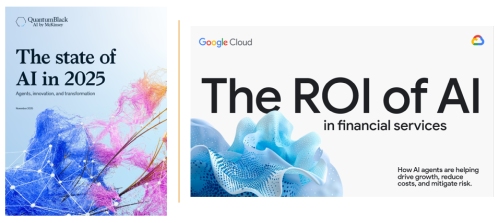
Image: McKinsey and Google Cloud AI in Finance 2025 report covers
November 2025 research from McKinsey's The State of AI in 2025 and Google's The ROI of AI in Financial Services reveal that the way banks measure value from AI is changing. Instead of chasing fast gains from early generative tools, the financial sector is moving toward agentic AI platforms that produce steady operational returns and stronger control over risk and cost.
Google’s global financial services study found that 77% of firms report positive ROI from generative AI this year, matching last year’s figure. The data point indicates that the return base has stabilized after an initial surge (not stagnation or decline). Among responders reporting higher revenue, 51% saw growth (6%-10%), while 30% achieved gains above 10%. These numbers dipped slightly year over year, pointing to a normalization phase as programs scale.
The same study found that:
Spending priorities have shifted decisively:
McKinsey’s global findings confirm this rotation:
High performers stand out whose choices correlate directly with both revenue growth and cost reductions.
Benefits are appearing fastest in software engineering, IT, customer service, and marketing. The McKinsey report found that organizations deploying AI across these functions experienced:
• Average productivity gains of 15%-30% in service and technology teams
• Cost decreases of up to 12% in customer operations and risk processing
• Deployment cycles reduced to three to six months, down from an average of twelve months in 2023
• Revenue growth between 6%-10% for over half of financial institutions using AI in production
• Improved fraud detection accuracy by up to 20%, especially among banks integrating multi-agent risk models
Organizations combining workflow redesign with governance and human oversight achieve higher and more consistent ROI than those focused only on model performance.
According to Google and McKinsey's 2025 AI in finance research reports, AI has entered a new phase. The early boom in generative tools has given way to a steadier phase of operational performance driven by agents. The majority of institutions are already realizing returns, but the next iteration of value capture will come from how well they govern, measure, and scale these systems. Canada’s Opportunity In Efficient Reasoning AI its competitive edge, using discipline, design, and data to turn intelligence into growth.
 The National Crowdfunding & Fintech Association (NCFA Canada) is a financial innovation ecosystem that provides education, market intelligence, industry stewardship, networking and funding opportunities and services to thousands of community members and works closely with industry, government, partners and affiliates to create a vibrant and innovative fintech and funding industry in Canada. Decentralized and distributed, NCFA is engaged with global stakeholders and helps incubate projects and investment in fintech, alternative finance, crowdfunding, peer-to-peer finance, payments, digital assets and tokens, artificial intelligence, blockchain, cryptocurrency, regtech, and insurtech sectors. Join Canada's Fintech & Funding Community today FREE! Or become a contributing member and get perks. For more information, please visit: www.ncfacanada.org
 |  |  |
|---|---|---|
 |  |  |



August 26th, 2025

January 4th, 2024

June 1st, 2021

September 9th, 2020

July 9th, 2018

January 3rd, 2018

September 25th, 2017

June 20th, 2017

May 10th, 2017

December 14th, 2016

Leave a Reply