





Karsten Wenzlaff, Advisor
August 26th, 2025
Karsten Wenzlaff is a Crowdfunding and Fintech Expert from Germany. He is Secretary-General of Digit[...]


January 21, 2026 | Report Insights
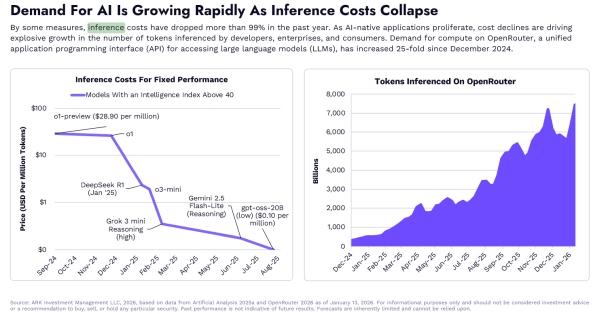
Image: ARK Invest, Big Ideas 2026 report. AI inference cost data reproduced for commentary and analysis.
In January 2026, ARK Invest released its annual research report Big Ideas 2026, building on trends first measured in Big Ideas 2025. The 111 page report spans artificial intelligence, tokenized assets, decentralized finance, Bitcoin, consumer AI platforms, and what ARK describes as the Great Acceleration. Rather than summarizing each theme in isolation, this article focuses on how these technologies accelerate change together inside financial systems.
What felt experimental in 2024 and operationally strained in 2025 now shows up as baseline reality in 2026. AI costs collapse, investment capital concentrates in infrastructure, digital assets move closer to settlement rails, and consumer AI platforms compress decision cycles. These forces do not arrive sequentially. They compound. The result is technically a financial system that no longer needs to pause between decisions.
ARK’s data on collapsing AI inference costs explains why this shift becomes unavoidable. At the same time, investment capital continues to concentrate in infrastructure designed for continuous operation. Together, these forces change how money moves, settles, and gets controlled.
Finance is AI-native by design. It already runs on software, explicit rules, and constant feedback. As AI becomes cheap enough to run continuously, software acts directly inside financial systems instead of waiting for human input.
ARK’s Big Ideas 2026 research shows AI inference costs dropped more than 99% in the past year. That single data point explains why continuous operation becomes economically viable at scale for the first time.
When inference costs fall that far, AI stops being something teams consult occasionally. It becomes something that runs all the time. Human prompts, batch reviews, and periodic decision cycles turn into friction rather than safeguards.
In financial systems, this breaks a long standing boundary. AI no longer stops at scoring, forecasting, or recommendations. It initiates actions. Payment routing adjusts automatically. Exposure limits rebalance in real time. Liquidity thresholds enforce themselves continuously. Software no longer waits for approval at every step.
Founders experience this when systems stay busy all the time instead of spiking occasionally. Investors see it when infrastructure costs stop falling as predictably even while revenue continues to grow. Operating leverage behaves differently because systems no longer rest between decisions.
ARK’s capital analysis shows where investment capital flows as systems scale. In 2025, annual investment in data center systems reached roughly $500B, nearly 2.5 times the long term average from 2012 through 2023. Since the ChatGPT moment, ARK shows growth accelerating from about 5% to 29% annually. The report projects this category of investment could approach $1.4T by the end of the decade.
That level of spending signals where long term value accrues. Capital is not chasing surface automation features. It is concentrating where compute, data availability, uptime, and recovery determine whether systems can operate continuously without failure.
For fintech teams, this breaks a familiar assumption. Products designed for occasional use face redesign pressure. Infrastructure built for constant operation gains structural leverage. Cost structure, resilience, and throughput now shape competitive advantage more than feature differentiation.
Traditional payment systems assume a person initiates the transaction. AI breaks that assumption. Software now initiates payments, manages balances, and settles obligations automatically as conditions change.
This pushes pressure into liquidity management, fraud controls, and settlement logic. Batch review fails quietly when systems never pause. ARK’s analysis of AI driven transaction flows emphasizes sustained throughput and recovery under stress rather than peak performance.
Founders building payment infrastructure encounter this pressure early. Systems designed for bursts now operate under constant load, and cost curves change accordingly. Reliability becomes a competitive feature rather than an operational afterthought.
ARK’s 2026 research frames consumer AI as an operating layer rather than a feature. AI models converge into a consumer operating system, and adoption accelerates faster than earlier digital platforms. As these systems take on purchasing, allocation, and coordination tasks, decision making shifts closer to software execution.
Wallets evolve alongside this change. They function less as interfaces and more as control layers for software driven financial activity. Identity, permissions, and payment logic compress into the same layer.
Investors familiar with earlier platform cycles recognize this pattern. Control consolidates where decisions execute, not where they are merely displayed.
ARK frames tokenized assets as market infrastructure moving trillions of dollars in asset value onto blockchains. Tokenization matters because assets move and settle automatically. DeFi matters because financial rules run on software without manual steps.
ARK’s data shows digital asset application revenue reaches roughly $3.8B in 2025, with around one fifth generated in January alone. The report also notes that about 70 applications generate more than $1M each in monthly recurring revenue. Value capture shifts from base networks toward platforms that control execution, coordination, and user interaction.
For fintech builders, this exposes a structural mismatch. Systems designed for batch reconciliation struggle when assets move continuously.
ARK’s research treats stablecoins as payment and settlement rails, not alternative products. Transaction activity reaches record levels because stablecoins can now move value automatically and clear obligations without waiting for manual steps.
Bitcoin functions as a monetary network with predictable issuance and global settlement. In 2026, its relevance aligns with the same requirement driving stablecoin use. When systems run continuously, money must move at software speed.
This doesn't remove banks, payment firms, or regulators. It changes how settlement works underneath them, reflected in Canada’s Stablecoin Act draft, which outlines how programmable settlement rails are governed.
ARK's analysis points to convergence. Continuous systems expose the limits of oversight built around delayed reporting and human initiated workflows. Design, auditability, and real time visibility matter more because systems no longer pause between decisions.
For policymakers, this changes where effective oversight begins. Rules written for periodic review struggle when financial activity runs continuously. Payments oversight, digital asset policy, and AI governance increasingly overlap because the systems themselves overlap.
Teams that design for transparency and control early reduce downstream risk. Regulators that focus on system behaviour rather than product labels gain clearer visibility and fewer surprises.
Big Ideas 2026 highlights what happens when AI inference costs collapse by more than 99%, investment capital concentrates at unprecedented scale, digital assets mature into settlement rails, and consumer AI platforms compress decision cycles at the same time. Finance changes faster because it already runs on rules, incentives, and software.
AI systems now run continuously. Many teams still model for peak usage instead of sustained operation. The gap appears in compute, monitoring, compliance operations, and incident response long before it shows up in customer metrics.
Infrastructure intensity rises faster than application revenue. ARK’s capital data shows control and throughput capture value before features do. Margins do not scale linearly during infrastructure transitions.
Human initiated workflows. Cost per transaction and average response time lose meaning when systems never pause. Sustained throughput and recovery time under stress become the binding constraints.
Frameworks assume discrete events. Continuous systems blur those boundaries. Risk appears as operational mismatch rather than enforcement action.
 The National Crowdfunding & Fintech Association (NCFA Canada) is a financial innovation ecosystem that provides education, market intelligence, industry stewardship, networking and funding opportunities and services to thousands of community members and works closely with industry, government, partners and affiliates to create a vibrant and innovative fintech and funding industry in Canada. Decentralized and distributed, NCFA is engaged with global stakeholders and helps incubate projects and investment in fintech, alternative finance, crowdfunding, peer-to-peer finance, payments, digital assets and tokens, artificial intelligence, blockchain, cryptocurrency, regtech, and insurtech sectors. Join Canada's Fintech & Funding Community today FREE! Or become a contributing member and get perks. For more information, please visit: www.ncfacanada.org
 |  |  |
|---|---|---|
 |  |  |



August 26th, 2025

January 4th, 2024

June 1st, 2021

September 9th, 2020

July 9th, 2018

January 3rd, 2018

September 25th, 2017

June 20th, 2017

May 10th, 2017

December 14th, 2016

Leave a Reply