





Karsten Wenzlaff, Advisor
August 26th, 2025
Karsten Wenzlaff is a Crowdfunding and Fintech Expert from Germany. He is Secretary-General of Digit[...]


June 26, 2026 | NCFA Insight | SME Finance And Business Banking, Artificial Intelligence And Data, Open Banking And Open Finance, Fintech And Innovation
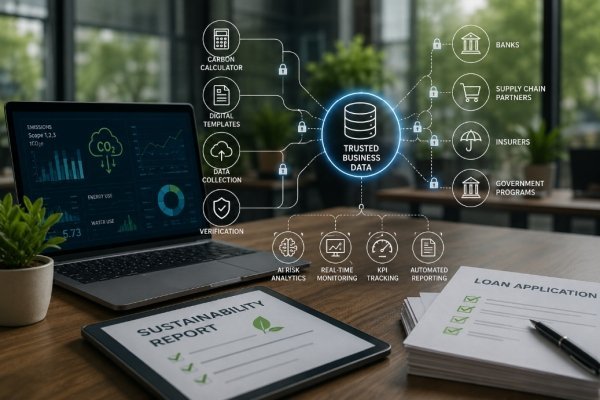
On June 26, 2026, the OECD published Leveraging AI and Digital Tools for SME Sustainable Finance, arguing that one of the biggest barriers to sustainable finance for small and medium sized businesses is not only capital availability but the cost of collecting, verifying, sharing, and monitoring reliable business information.
SMEs account for around 50% of economic output and business sector environmental impacts, yet remain underrepresented in sustainable finance. Sustainable finance markets have grown, but smaller firms still struggle because sustainability data is costly to generate, difficult to verify, and fragmented across reporting frameworks.
So what does this mean?
AI can help lenders process information faster, automate routine work, and monitor portfolios, but only when SMEs can produce trusted, reusable data. Without that foundation, AI just processes weak information faster.
The OECD identifies four main barriers holding back SME sustainable finance:
The report cites survey evidence that SMEs identify lack of time at 42%, technical difficulties at 41%, and high reporting costs at 41% as top barriers to sustainability measurement and reporting.
Many SMEs may want financing for efficiency upgrades, transition investments, or buyer requirements, but the paperwork and verification burden can make targeted sustainable finance harder to access than standard financing.
The OECD looks at the full financing path, not just the lending decision. The process starts when an SME collects sustainability information and continues through bank onboarding, risk review, monitoring, and reporting.
For SMEs, the first job is basic data capture. Carbon calculators, digital templates, consent based APIs, and automated reporting tools can help owners turn energy use, emissions, invoices, utility data, and operating records into information lenders can review.
For financial institutions, the work then moves through three stages. Front office tools can help with onboarding, document intake, product matching, and early screening. Middle office tools can support risk review, evidence checks, benchmarking, and sustainability claim review. Back office tools can monitor targets, prepare reports, track KPIs, and keep portfolio records current.
The OECD’s warning is direct and impactful. AI cannot compensate for missing, inconsistent, or weakly verified data. AI becomes useful only when the underlying information is trusted enough to compare, reuse, and monitor over time.
Sustainable finance does not scale for SMEs if every small loan requires a custom review. Origination, due diligence, verification, monitoring, and reporting all take time. When the loan is small, those fixed costs can make SME sustainable finance unattractive for lenders even when capital is available.
This is why the OECD's lifecycle approach may help. Digital onboarding, reusable sustainability credentials, API based data sharing, AI assisted verification, and continuous monitoring can reduce the cost of serving smaller borrowers.
The opportunity is not just faster approvals. It is making small ticket sustainable finance workable for lenders and less painful for SMEs.
The OECD highlights several initiatives that show how reusable sustainability data can work in practice.
Denmark's Climate Compass gives SMEs a free digital tool to calculate Scope 1, 2, and 3 emissions in line with recognized standards. The SME Climate Hub offers a free carbon calculator for micro and small businesses. Ireland's Climate Toolkit 4 Business combines an emissions calculator with a climate action plan.
Singapore's Project Greenprint helps SMEs generate emissions reports by pulling data from trusted sources, while the United Kingdom's Project Perseus explores how SMEs can share energy data with banks through reporting solutions. Belgium's Kube ESG, developed with major Belgian banks, gives SMEs a digital platform for sustainability reporting.
SMEs shouldn't have to rebuild the same sustainability file for every bank, buyer, or public program. They need data that can be generated once, verified, and reused with permission.
Canada already has many of the building blocks the OECD describes, but policy and market conversations are often separate.
Open banking and open finance can support permission based business data sharing. Digital identity can improve trust and verification. AI underwriting can reduce manual review. Embedded finance can connect lending to accounting, payments, invoicing, payroll, and commerce data. Sustainability reporting tools can help SMEs generate the evidence lenders and buyers increasingly request.
The opportunity is to connect those pieces. If Canadian SMEs can share trusted business and sustainability data through secure, interoperable systems, lenders can reduce manual work and price risk with better information.
That is where sustainable finance becomes a fintech infrastructure problem. The outcome is trusted business data that SMEs can reuse across banks, buyers, insurers, platforms, and government programs.
Open banking in Canada shows how permission based data sharing can improve financial services and reduce friction for consumers and businesses.
NCFA's Open Banking Opportunity Brief explores the commercial opportunities created by data portability and controlled financial data access.
Float's AI business finance stack points to how Canadian SME finance platforms are moving toward connected finance workflows.
EQ Bank's SME operating account push shows how business banking is expanding from accounts into spending, cash flow, and operating tools.
NCFA's Financial Innovation Map tracks opportunities across SME finance, open finance, AI, digital identity, sustainability, and financial data infrastructure.
If trusted SME data was portable and secure between businesses, lenders, buyers, insurers, platforms, and public programs with permission, which parts of commercial lending would still need manual verification?
 The National Crowdfunding & Fintech Association (NCFA Canada) is a financial innovation ecosystem that provides education, market intelligence, industry stewardship, networking and funding opportunities and services to thousands of community members and works closely with industry, government, partners and affiliates to create a vibrant and innovative fintech and funding industry in Canada. Decentralized and distributed, NCFA is engaged with global stakeholders and helps incubate projects and investment in fintech, alternative finance, crowdfunding, peer-to-peer finance, payments, digital assets and tokens, artificial intelligence, blockchain, cryptocurrency, regtech, and insurtech sectors. Join Canada's Fintech & Funding Community today FREE! Or become a contributing member and get perks. For more information, please visit: www.ncfacanada.org
 |  |  |
|---|---|---|
 |  |  |



August 26th, 2025

January 4th, 2024

June 1st, 2021

September 9th, 2020

July 9th, 2018

January 3rd, 2018

September 25th, 2017

June 20th, 2017

May 10th, 2017

December 14th, 2016

Leave a Reply