November 5, 2026 | NCFA Story Intelligence | Risk Compliance And Regtech, Regulation And Policy, Digital Assets Blockchain And Tokenization
Canada keeps closing financial crime gaps, but investigations, prosecutions and asset recovery still have to catch up with the much larger system
Canada added another layer to its anti money laundering system on November 3, 2026.
Bill S-8 would tighten registration for money services businesses, give FINTRAC more grounds to refuse or revoke registrations, add controls for crypto ATMs, restrict some large cash transactions and third party cash deposits, and let regulated firms receive more financial crime information from government and law enforcement.
Five days earlier, the Auditor General had delivered a very different AML announcement.
FINTRAC was taking nearly 4 months on average to provide requested financial intelligence. Half of the recipients surveyed said information sometimes arrived too late to help an active investigation.
A month before that, FATF had praised parts of Canada's system while still calling for stronger supervision, more complex money laundering prosecutions and better asset recovery.
Canada isn't short of rules.
It has spent more than 25 years adding them.
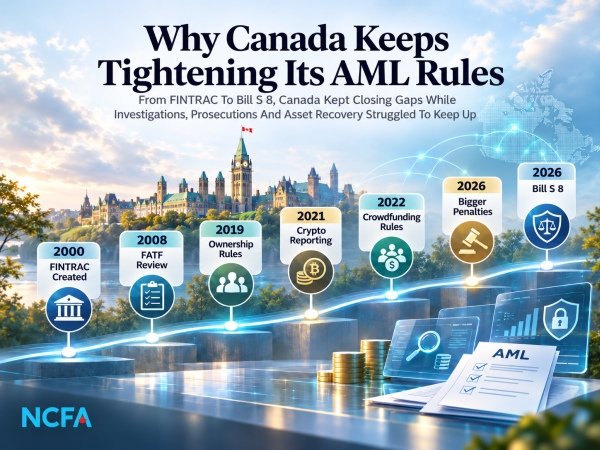
This is a story of Canada closing one financial crime gap after another, only to find that more reports and tougher rules don't automatically produce faster investigations, prosecutions or recovered money.
The 2022 truck convoy became one of the most visible turns in that story.
It wasn't the beginning.
FINTRAC Is Born and the Boundary Starts Moving2000 to 2008
Canada's modern AML system begins in 2000. Parliament creates FINTRAC and requires suspicious transaction reporting and reporting of certain large movements of money. After the September 11 attacks, terrorist financing is added to the mandate. By 2006, Ottawa is already widening the system again with MSB registration, administrative penalties and broader compliance duties. FINTRAC is still young, but money is already finding routes the first rulebook didn't fully cover.
FINTRAC began receiving suspicious transaction reports and voluntary information in 2001. Terrorist financing was added after the Anti Terrorism Act.
Changes passed in 2006 introduced the MSB registration regime and gave FINTRAC authority to impose administrative monetary penalties. Registration came into force in 2008.
Canada starts expanding the system almost as soon as it builds it.
Banks and other reporting firms now have to tell FINTRAC when money looks suspicious. Investigators gain a national source of financial intelligence that didn't exist before, and regulated firms can no longer treat unusual transactions as someone else's problem.
But criminals aren't limited to bank accounts. Money can pass through companies, intermediaries, cash businesses, real estate and foreign accounts. The first rulebook catches more activity, and the routes around it become easier to see.
The First FATF Review Finds the Holes2008 to 2016
FATF's 2008 review gives Canada's young system its first major international stress test. Ottawa gets credit for substantial reforms, but FATF still finds weaknesses in customer checks, supervision, beneficial ownership and FINTRAC's effectiveness. Canada spends the following years tightening many of those areas. By 2014, FATF removes Canada from regular follow up. Two years later, the next full review finds that some of the hardest problems weren't gone. They had moved deeper into the ownership and professional structures around the transaction.
What FATF Kept Finding
The 2008 FATF evaluation called for stronger customer checks, more consistent supervision and better beneficial ownership information.
The 2016 evaluation found substantial progress but continued exposure through legal professionals and opaque companies and legal arrangements.
Lawyers couldn't simply be folded back into the same FINTRAC model either. A 2015 Supreme Court decision found that applying parts of the federal regime to legal counsel violated constitutional protections.
The financial system was becoming easier to monitor. Some of the people behind the money were still difficult to see.
Customer checks get stronger. MSBs register. FINTRAC gains penalties and more supervisory reach. A regulated firm has fewer excuses for not knowing who opened the account or sent the money.
Then investigators reach the company behind the transaction and can hit another wall. The account holder may be visible while the person controlling the corporation isn't. The search moves from the customer to the owner.
Canada Starts Naming the People Behind the Companies2017 to 2019
Federal, provincial and territorial governments agree to improve beneficial ownership records and eliminate bearer shares. From June 2019, most federal corporations have to keep information on individuals with significant control. A numbered company can still stand between suspicious money and its owner, but investigators now have another record to pull when they start taking the structure apart.
Ownership Records Get Stronger Again
The first federal requirement kept ownership information at the corporation.
That changes again in 2024. Most federal corporations must file information about individuals with significant control with Corporations Canada, and some of that information becomes publicly searchable.
It still isn't a complete Canadian system. Provincial and territorial corporate law means ownership information remains spread across jurisdictions.
FATF is still calling for progress toward a pan Canadian beneficial ownership system in 2026.
A shell company becomes less useful when investigators can identify the people with significant control. The ownership trail gets shorter, and legitimate companies get clearer record keeping duties.
The trail can still cross provincial registries, trusts and foreign entities. And while Canada is looking deeper into ownership, another way of moving value is growing outside the familiar bank payment path. The next gap starts with the money itself.
Crypto Opens Another Route for Value to Move2020 to 2021
Virtual currency dealers and foreign MSBs serving Canadians come under FINTRAC requirements in 2020. Large virtual currency transaction reporting follows in 2021. Crypto is no longer treated as a separate financial world. If a business exchanges or transfers virtual currency for Canadians, the same questions about identity, source of funds and suspicious activity follow it there.
Crypto exchanges and payment firms now have to build registration, identity checks, records and reporting into products designed to move value quickly. Legitimate operators gain a clearer path into the Canadian market, but compliance becomes part of the product itself.
Bringing crypto inside FINTRAC doesn't cover every new way Canadians can collect or move money. A year later, crowdfunding and payment platforms show where the boundary still ends. The next expansion arrives in the middle of a national crisis.
The Convoy Turns a Gap Into Permanent RulesFebruary to April 2022
The truck convoy makes another gap visible in real time. Ottawa invokes the Emergencies Act in February and temporarily brings crowdfunding platforms and certain payment providers under AML obligations. The emergency ends. The coverage gap doesn't. Two months later, Canada makes the change part of the ordinary system.
The convoy didn't start Canada's AML expansion. It exposed one channel the existing system hadn't fully captured.
Ottawa closes the gap quickly. Crowdfunding and payment firms that had built businesses outside traditional banking inherit FINTRAC registration, identity checks and reporting. The line around the regulated market moves again.
Legitimate platforms pay for the same controls. Staff, systems, records and audits become part of the cost of staying in business. The government closes one blind spot and pushes compliance deeper into smaller financial firms.
The Net Spreads Across More of Finance2023 to 2025
The next expansion isn't built around one crisis. Mortgage businesses come under FINTRAC in 2024. Armoured car companies follow. In 2025, cheque cashers, factors, financing and leasing firms, title insurers and businesses serving private ATMs join them. Private information sharing between reporting entities also gets a legal route. By 2025, more than 38,000 businesses are inside FINTRAC's supervisory reach.
Why So Many More Businesses Are Now Inside
Canada's 2025 National Risk Assessment identifies vulnerabilities across payment providers, mortgage businesses, crypto assets, crowdfunding, real estate, MSBs and other sectors.
It also says criminals can exploit information gaps between reporting firms. Since March 2025, regulated entities can voluntarily share some personal information under approved codes of practice to detect money laundering, terrorist financing and sanctions evasion.
The system becomes less dependent on one firm spotting one suspicious transaction in isolation.
More businesses are now expected to recognize the same money from different sides.
A suspicious account at one institution can become more useful when another firm recognizes the same owner, wallet or transfer pattern. Activity that once ended inside separate compliance teams can start connecting across institutions.
That gives firms another job. They need controls around what can be shared, why it can be shared and who gets access. Canada gains more intelligence, while compliance becomes a bigger part of running the business.
FINTRAC Starts Throwing Firms Out2025 to 2026
Then enforcement gets much harder to ignore. FINTRAC issued 6 notices of violation worth about $1 million in 2022 to 2023. In 2025 to 2026, it issued 35 notices worth more than $247 million. It also revoked 82 MSB registrations in one year, up from 12 the year before. A payments, FX, remittance or crypto firm can no longer treat registration as something it secures once and files away.
FINTRAC's 2025 to 2026 annual report confirms 82 MSB revocations and more than $247 million in notices of violation.
The escalation was already visible in Cryptomus's record penalty. FINTRAC imposed about $176 million after finding failures that included suspicious transaction and large virtual currency reporting.
Weak compliance can now threaten the economics of the company itself.
A strong operator can benefit when firms that ignore reporting duties or regulator requests lose market access. Banks and partners have more reason to trust an MSB that stays registered and responds when FINTRAC calls.
But the price of proving that compliance is uneven. Large institutions spread legal, data and monitoring costs across millions of customers. A startup can't. The regulator starts removing weaker operators just as the cost of being a strong one keeps rising.
Bill C-12 Makes Compliance Failures Much More ExpensiveMarch 26, 2026
Parliament gives FINTRAC much stronger enforcement tools. Maximum penalties rise sharply. Compliance orders become public. An entity that doesn't comply with an order can face a penalty of up to the greater of $30 million or 3% of global revenue. Ottawa can now hit weak controls much harder without waiting for police to prove a money laundering offence.
For prescribed violations, an entity can face a maximum penalty of $20 million. Aggregate maximums can also be tied to 3% of global revenue.
FINTRAC says the legislation increased some penalty limits by as much as 40 times.
A compliance failure can reach the boardroom long before it reaches a criminal courtroom.
FINTRAC no longer has to wait for a criminal case to hit a company hard. It can order fixes, impose much larger penalties and put compliance failures into public view. For regulated firms, the cost of weak controls can arrive long before police lay a charge.
But the money laundering case still has to be built somewhere else. Police need evidence, prosecutors need a case they can prove and assets have to be found before they disappear. Canada has made it faster to punish weak compliance. Catching and recovering the criminal money is still the slower job.
Ottawa Builds a New Agency for the Part FINTRAC Can't DoApril 2026
A month later, Ottawa goes after that slower part. Bill C-29 proposes a Financial Crimes Agency to investigate serious and complex financial crime and help recover criminal proceeds. FINTRAC can find patterns and send intelligence. The new agency is meant to pick up the trail from there.
What the New Agency Is Supposed to Do
Bill C-29 was introduced April 27, 2026 and is now being considered by a House committee. The agency isn't operational yet.
Its planned workforce includes police and civilian investigators, financial intelligence specialists and asset recovery experts.
Collecting more financial intelligence hasn't produced enough complex cases or recovered money on its own.
FINTRAC can connect reports across institutions and point investigators toward suspicious money. It can tell police where accounts connect and which transactions deserve another look.
Police still have to identify the people, gather admissible evidence and find the assets before they move again. Ottawa is creating another institution because financial intelligence doesn't arrest anyone or recover a dollar by itself.
Two Reviews Show Where the Money Is Still EscapingSeptember to October 2026
By fall, Canada gets two report cards within a month. FATF finds a much stronger system with high quality financial intelligence, but still calls for better supervision, more complex money laundering prosecutions, stronger beneficial ownership coverage and more asset recovery. The Auditor General follows with a problem investigators can feel immediately. Useful intelligence isn't useful enough when it arrives months after police ask for it.
Good Intelligence Can Still Arrive Too Late
The 2026 FATF evaluation says Canada has a mature understanding of financial crime risk and produces high quality intelligence valued by law enforcement.
FINTRAC says FATF found its intelligence was used in 94% of the money laundering and criminal possession investigations reviewed by assessors.
The Auditor General's October 29 audit found that FINTRAC took nearly 4 months on average to provide intelligence when law enforcement flagged a concern.
Half of surveyed recipients said the information sometimes arrived too late to help an ongoing investigation.
The information can be valuable and still lose value while the money keeps moving.
Canada now has more reporting entities, ownership data, penalties, registration controls and financial intelligence than at any earlier point in FINTRAC's history. The reporting side of the system is bigger and harder to ignore.
Investigators still need the information before assets move. Prosecutors still need complex cases they can prove. Governments still need to recover more of the money. Canada has become better at spotting suspicious activity than finishing the journey from report to recovered proceeds.
Bill S-8 Tightens the Perimeter AgainNovember 3, 2026
Five days after the Auditor General's report, Bill S-8 arrives with another set of controls. MSB registration would get tougher. Crypto ATM operators would face more checks and reporting. Some large cash activity would be restricted. Law enforcement could send more information back into regulated firms. Canada is still closing entry points while its newest reviews are pressing the system to do more with the information it already has.
What Bill S-8 Would Change
Bill S-8 is proposed legislation. It isn't law.
The bill would require crypto ATM operators to verify every user's identity, keep transaction records and report each ATM transaction to FINTRAC within 15 days. It would cap a person's transactions at a crypto ATM at $1,000 within 24 hours.
It would prohibit certain third party cash deposits and restrict some cash payments, donations or deposits of $10,000 or more, subject to exemptions and regulations.
It would add new grounds for refusing or revoking MSB registrations, including false or misleading information, and give the Minister of Finance new review and direction powers tied to national security and financial system integrity.
Bill S-8 brings crypto ATM laundering risks back into the centre of the debate after FINTRAC had already documented the use of cash, money mules, private wallets and higher risk exchanges around the machines.
Another gap may close. The pressure on investigators, prosecutors and asset recovery doesn't disappear with it.
Stronger registration can remove operators that lie about their business, ignore regulator requests or raise serious integrity concerns. Legitimate MSBs, payment companies and remittance firms may benefit when weak operators lose access.
Every added check still needs people, systems and legal work. Small firms spread those costs across fewer customers than banks do. Canada can shut bad operators out and still make the door heavier for good ones to open.
The Next Gap Won't Be Fixed by Another Form
Bill S-8 may close more holes around MSB registration, crypto ATMs, cash deposits and financial crime information sharing.
But Canada is reaching the point where adding another reporting obligation produces less value if the rest of the chain can't keep up.
FINTRAC can collect more information.
Banks, fintechs and MSBs can build better controls.
Law enforcement can receive more leads.
None of that helps much if investigators get the intelligence too late, prosecutors can't build enough complex cases or criminal assets are gone before authorities can reach them.
That is where Canada's next AML chapter is heading.
The proposed Financial Crimes Agency could give Ottawa more capacity to investigate serious financial crime and recover proceeds. Bill C-12 gives FINTRAC much stronger leverage over regulated firms. Bill S-8 would tighten who gets into parts of the market and how certain transactions are handled.
Those tools now have to work together.
For fintechs, that creates a different kind of pressure.
The firms that survive stricter registration and supervision may become easier for banks, investors and customers to trust. But every new control also costs money, and smaller operators don't have the same compliance scale as the country's largest financial institutions.
Canada can keep tightening the perimeter.
The bigger question now is whether the system inside that perimeter can move fast enough to catch the money, recover it and still leave room for legitimate firms to compete.
That answer won't come from the next amendment.
It will come from the cases Canada is actually able to finish.
Talking Point
Will Canada's next AML gains come from tougher rules, or from finally turning more financial intelligence into completed cases and recovered assets?
What Happens Next?
Will Parliament pass Bill S-8, and which MSB, crypto ATM and cash provisions will survive the legislative process?
Can FINTRAC shorten intelligence delays while supervising more than 38,000 reporting businesses?
Will the Financial Crimes Agency improve complex investigations, prosecutions and asset recovery once Parliament establishes it?
Will larger penalties improve compliance without giving the largest firms an even greater cost advantage?
Can federal, provincial and territorial governments close the remaining beneficial ownership gaps?
Will wider information sharing help investigators without weakening privacy protections?
What Did You Think?
Has Canada reached the point where better enforcement matters more than another layer of AML rules?
Share this story → Explore related intelligence → Subscribe
The 2022 rule change that permanently brought donation crowdfunding and certain payment providers into Canada's AML regime.
The National Crowdfunding & Fintech Association (NCFA Canada) is a financial innovation ecosystem that provides education, market intelligence, industry stewardship, networking and funding opportunities and services to thousands of community members and works closely with industry, government, partners and affiliates to create a vibrant and innovative fintech and funding industry in Canada. Decentralized and distributed, NCFA is engaged with global stakeholders and helps incubate projects and investment in fintech, alternative finance, crowdfunding, peer-to-peer finance, payments, digital assets and tokens, artificial intelligence, blockchain, cryptocurrency, regtech, and insurtech sectors. Join Canada's Fintech & Funding Community today FREE! Or become a contributing member and get perks. For more information, please visit: www.ncfacanada.org







 The National Crowdfunding & Fintech Association (NCFA Canada) is a financial innovation ecosystem that provides education, market intelligence, industry stewardship, networking and funding opportunities and services to thousands of community members and works closely with industry, government, partners and affiliates to create a vibrant and innovative fintech and funding industry in Canada. Decentralized and distributed, NCFA is engaged with global stakeholders and helps incubate projects and investment in fintech, alternative finance, crowdfunding, peer-to-peer finance, payments, digital assets and tokens, artificial intelligence, blockchain, cryptocurrency, regtech, and insurtech sectors. Join Canada's Fintech & Funding Community today FREE! Or become a contributing member and get perks. For more information, please visit: www.ncfacanada.org









Leave a Reply