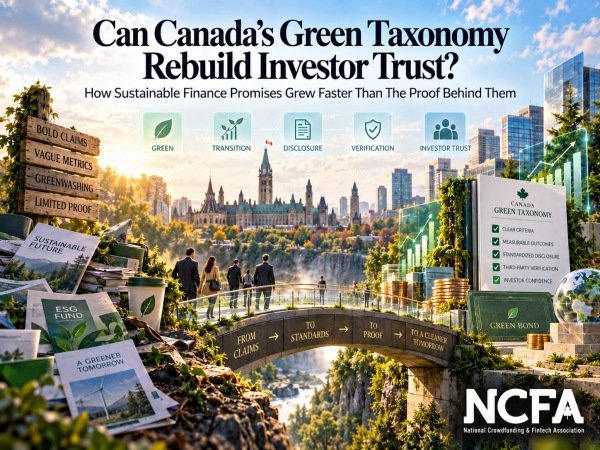
Can Canada’s Green Taxonomy Rebuild Investor Trust?
October 20, 2026 | Last Updated: October 21, 2026 | NCFA Story Intelligence | Sustainable Finance And ESG, Investment And Capital Markets, Regulation And Policy
How Sustainable Finance Promises Grew Faster Than The Proof Behind Them
On October 20, 2026, Canada’s Taxonomy and Transition Planning Council released its final sustainable investment methodology. Canada now has a common way to assess green and transition activities after years of greenwashing disputes over financial products and bank commitments. Ottawa backs and funds the initiative, while an independent council develops and approves the standards. Adoption is voluntary, and detailed sector tests are still being written.
Canadians wanted products and investments that reflected their environmental priorities. Financial institutions saw customers, assets, lending opportunities and a stronger public story. Funds, ETFs, green bonds and huge sustainable finance commitments followed. Then investors started looking more closely at the holdings, counting rules and environmental results behind those claims.
What follows is a story of growing investor demand, billions in financial promises, and the widening gap between what institutions marketed and what they could prove.
A Green Label Starts A Bigger Conversation1990s to 2006
In the 1990s, a green label starts doing more than describing a product. It gives shoppers a reason to choose one brand over another. Some believe the claim; others look for whoever stands behind it. Soon a similar conversation reaches investors. They want to know what their money supports, and financial firms hear a new kind of customer question. Financial firms can see the demand, but they are also selling trust before the market has agreed on the proof.
Customers start asking for proof. Canadian environmental labelling programs such as Environmental Choice and EcoLogo bring product claims into everyday buying decisions during the 1990s. Buyers want to know what a label proves, not simply whether a package looks green. Later, investors bring similar expectations to savings and portfolios. 1
Financial firms see an opening. Responsible investing gains momentum when the UN backed Principles for Responsible Investment launch in 2006. Institutions from 16 countries representing more than US$2 trillion in assets sign on at the New York Stock Exchange. Investors are signalling that environmental, social and governance issues belong in investment decisions, and asset managers have a new market to serve.2
Green Bonds Turn Demand Into Real Deals2007 to 2017
By 2014, green finance has become a deal investors can actually buy. Export Development Canada issues a US$300 million green bond in January.3 Ontario follows with a C$500 million offering that October and draws nearly C$2.4 billion in orders.4 The province has picked Toronto’s Eglinton Crosstown light rail project to receive the funding. The rush to buy tells bankers there's serious demand. Yet the sale raises a question that will follow sustainable finance for years. Once investors hand over their money, who shows them what it actually accomplished?
What Ontario’s C$500 Million Green Bond Let Investors Verify
Ontario offered C$500 million and received nearly C$2.4 billion in orders from more than 80 investor accounts. 85% of the bonds went to investors with green mandates or UN Principles for Responsible Investment affiliations. The sale proved demand. It did not prove the project’s environmental result. The Eglinton Crosstown had to be built, the proceeds tracked and the impact reported.
A green bond gives investors a trail to follow from the offering to the projects that receive the money. By 2021, sustainable finance linked bonds and loans had widened the menu of green, social and linked structures. The products may sit under the same sustainability banner, but the promises are different. A project bond points to named uses of proceeds. Linked financing puts more weight on targets the borrower promises to hit later.
Sustainability linked borrowing can fund ordinary business activity. The borrower agrees to targets that may change the cost of the financing if performance falls short. Investors have to look at the starting point, the target, when it will be measured and what the financial consequence actually is. A weak target or a token pricing change can make the label sound tougher than the economics. Falling emissions intensity also does not guarantee that total emissions fell.
Green bond investors can follow the money from the offering to the eligible projects and then to the impact report. Sustainability linked debt requires a different trail through the target, the measurement and the consequence if performance falls short. Capital raised, capital allocated and environmental results are three different numbers. The International Capital Market Association principles set the market standards behind those structures.
Canadian green bonds find buyers. EDC and Ontario give investors a named framework and intended use of proceeds before the money is committed. Named uses of proceeds give buyers more to check than a broad corporate promise. The proof still comes later. Issuers have to show where the capital went, what was completed and what the project delivered. A successful bond sale doesn't guarantee a successful environmental outcome.
Responsible investing grows beyond niche portfolios. By the end of 2017, Canada counted C$2.13 trillion in professionally managed assets using at least one responsible investment strategy. The Responsible Investment Association’s 2018 report put that at 50.6% of managed assets. The figure included screening and engagement strategies. It was not C$2.13 trillion of new green projects.
Five Banks Put Billions Behind The Promise2021 to 2024
Now the numbers get much bigger. Canada's major banks are no longer just offering individual products. They compete to announce sustainable finance commitments worth hundreds of billions of dollars. Corporate clients see financing opportunities, and the banks gain a powerful message for investors. But five impressive headlines don't necessarily describe five comparable promises. As the figures pile up, the questions get sharper. What counts as sustainable finance, and who gets to decide?
Inside Canada’s C$1.95 Trillion Of Bank Sustainable Finance Targets
Between 2021 and 2023, Canada’s five largest banks put almost C$1.95 trillion of sustainable finance targets into the market. The total is striking, but the commitments were built differently. Each bank chose its own deadline, eligible activities and reporting method.
RBC C$500 billion by 2025. Announced in February 2021 as a sustainable finance commitment. RBC’s original announcement
TD C$500 billion by 2030. Its March 2023 target combined sustainable and decarbonization finance. TD’s target announcement
BMO C$300 billion by 2025. The bank announced a sustainable finance target and later reported surpassing it. BMO’s original commitment
CIBC C$300 billion by 2030. Its sustainable finance programme covers an eligibility approach that investors must examine separately. CIBC’s programme description
The combined C$1.95 trillion is not a cheque written to green projects. Some commitments include social finance, underwriting, advisory work, arranged transactions or existing credit balances. The deadlines also differ. The totals capture the scale of the banks’ ambition and the business they wanted to win, not five comparable pools of new climate capital.
RBC’s March 2024 sustainable finance framework allows authorized credit balances to be added at successive fiscal year ends. A continuing loan can therefore contribute to the cumulative total in more than one year. That doesn't make the loan improper. The C$500 billion headline is not the same as C$500 billion of unique new lending. It also says nothing by itself about the emissions a financed project later avoided.5
Investors need to know what qualifies and how much of the financing is new. They also need to know whether arranged transactions are included and whether the same exposure can appear in more than one reporting period. Borrowers need to know what evidence a bank expects before a project can count. Neither side should confuse the size of a target with measured environmental results.
The banks raise their targets. As climate commitments become part of banks’ public image, Canada’s largest banks announce targets in the hundreds of billions. Corporate lending, underwriting, advisory work and other eligible services may all contribute under a bank’s methodology. A big cumulative number becomes a prominent measure of progress.
Investors start asking what sits behind the totals. A financing commitment can qualify under a bank’s own rules without proving that the financed activity later cut emissions. As the numbers climb, that gap becomes harder to ignore. Banks are selling sustainable finance. Their critics want to know what the money financed and what changed.Institutional investors were sending mixed signals too. In 2024, How Canadian Institutional Investors Voted on Climate 2024 found support for climate shareholder proposals varied sharply across major Canadian asset managers.
Greenwashing Allegations Reach The Banks2022 to 2024
The celebration doesn't last unchallenged. Investors and climate advocates start reading the fine print behind the banks' commitments. Securities regulators are also examining whether ESG funds are being sold in ways that match their actual strategies. The disputes aren't identical, and an allegation isn't a finding. But reputations are now on the line. Banks and fund managers that once led with ambitious green claims face a very different audience, one asking for records rather than slogans.
Fund marketing comes under review. The Canadian Securities Administrators issue ESG fund guidance in 2022 and revise it in 2024. Their reviews identify cases where promotional language reaches further than the investment documents support. The revised notice covers 112 prospectus reviews involving 57 managers, plus 39 continuous disclosure reviews involving 35 managers and 50 funds.6
Bank disclosures face formal complaints. By January 2024, Canadian banks face scrutiny over sustainability claims after Investors for Paris Compliance files securities complaints about RBC, TD, BMO, CIBC and Scotiabank. The group challenges how the banks support their sustainable finance claims. The allegations are not findings of wrongdoing. The original complaint sets out what the advocates asked regulators to examine.
RBC Walks Away From Its Biggest Number2024 to 2025
RBC has spent years putting a C$500 billion sustainable finance ambition in front of the market. Its 2024 framework gives readers a closer look at how eligible transactions are counted. A year later, the bank retires the target. There's no ruling here that the earlier financing was greenwashing, and the bank cites uncertainty over measurement and the rules governing environmental claims. Still, a number once used to signal ambition is gone. Other institutions can't assume their own headline totals will escape the same questions.
RBC puts its counting method on paper. Its March 2024 framework says the bank uses its judgment when assessing eligible transactions. For credit, it can add authorized balances at successive fiscal year ends. The same continuing exposure may therefore contribute in more than one year. That isn't the same as reporting only unique new loans, and it says nothing by itself about the emissions a financed project later avoided.
Then the C$500 billion target disappears. In April 2025, RBC retires the commitment and cites uncertainty around measurement and Canada’s environmental claims rules. The move doesn't prove earlier transactions were misclassified. It does leave investors with a basic problem. A flagship number that once signalled leadership is gone just as scrutiny of the underlying methodology is intensifying.7
The ESG Fight Moves Into The Fund Business2025 to 2026
The controversy reaches another part of the business. Ontario's securities regulator brings a case against Purpose Investments and its chief executive over allegedly misleading ESG statements. They deny the allegations, and the decision remains outstanding. Meanwhile, Canada's sustainable fund market keeps attracting assets even as the pace of new launches falls. Investors haven't stopped caring about sustainability. But asset growth and a convincing marketing story aren't enough to settle whether every product delivers what buyers were led to expect.
The fight moves into investment funds. In 2025, the OSC brings a case against Purpose Investments and CEO Som Seif over 19 allegedly misleading ESG communications made between 2019 and 2023. Purpose and Seif deny wrongdoing. After closing arguments in September 2026, the Tribunal reserves its decision. As of October 20, the allegations remain contested and there is no verified final merits ruling.8
The money stays, but new product launches slow. Morningstar reports C$67 billion in Canadian sustainable fund assets at the end of 2025. Only two new funds launch that year, down from 18 in 2024. The ten biggest net inflow winners attract C$4 billion while the rest lose C$2.9 billion combined. Greenwashing does not explain that result on its own. What the numbers do show is a market where assets keep growing while new money concentrates in fewer products.9
Ottawa Helps Build A Common Language2021 to 2026
While the disputes make headlines, a slower effort is underway in Ottawa. In 2021, a federal advisory council is asked to develop a way to classify green and transition investments. That sounds straightforward until the conversation reaches steel, mining, transport and energy. Canada's economy also depends on steel, mining, transport and energy. Can an investment that cuts emissions in a high emitting industry earn a transition label? And who can answer that question in a way investors will trust?
Green claims carry more legal risk. Competition Act changes in 2024 put environmental marketing under closer scrutiny. Parliament changes part of that regime in March 2026 by removing the requirement for business activity claims to follow an internationally recognized methodology. Misleading claims remain unlawful. By then, fintechs face new green claim rules under Competition Act, making documentation and evidence part of the commercial risk around environmental marketing.
The government work began years earlier. The federal Sustainable Finance Action Council receives a taxonomy mandate in 2021. Its 2022 roadmap report proposes green and transition classifications and a governance system, warning that delay could cost Canada investment opportunities. The early ambition to have a fuller framework in place by 2025 passes without one.
The Council Faces Its Hardest Decisions2025 to 2026
The promise of a Canadian standard survives years of debate, and then the fight shifts to who gets to write the rules. In 2024, Ottawa sets out the case for national green and transition investment guidelines. In December 2025, it backs an independent development process rather than writing the technical rules itself. By summer 2026, a draft is out for public comment. Participants disagree over where transition ends and greenwashing begins, particularly when projects lower emissions without changing the underlying business. The council has to draw lines that investors can use, even when those lines are unpopular.
Ottawa funds the work but doesn't write the standard. In December 2025, Finance Canada selects the Canadian Climate Institute, working with Business Future Pathways, to support an independent taxonomy process. The federal government provides seed funding and a mandate. The independent Council owns the methodology and approval decisions.10
The 2026 consultation brings the difficult cases into the open. Canada has to decide how to treat investments that cut emissions inside steel, mining, transport and energy without pretending those industries are already green. A proposed emissions abatement category draws particular attention because a project can reduce emissions and still extend the life of a high emitting asset. Council chair Marlene Puffer connects the work directly to investment. “Ultimately, this work will underpin Canada’s ability to compete for capital with our peers around the world.”11
A Canadian Taxonomy Finally Takes ShapeOctober 20, 2026
On October 20, 2026, the independent council publishes the methodology. Canada finally has a common starting point for calling an economic activity green or transition. The difficult cases haven't vanished. Detailed technical tests are still coming, and the proposed emissions abatement category is left for further work. The federal government supports the initiative, but adoption remains voluntary. After years of promises and challenges, the market has a clearer language. It still needs institutions willing to use it and show their evidence.
A common label may improve comparability without automatically moving more capital. Corporate Knights points to the OECD’s 2026 review, which says it remains difficult to show that taxonomies create additional sustainable investment rather than relabel activity that might have happened anyway. Canada’s voluntary approach makes that harder to measure. The critique is worth keeping in view as investors watch whether the new framework changes financing decisions or simply gives existing activity a clearer name.
What Canada’s 2026 Green and Transition Taxonomy Covers
Canada now has a methodology for assessing green and transition activities. It does not yet have a final catalogue of certified investments. The Council has approved the framework while technical criteria for individual sectors are still being written. Ottawa funded and mandated the work. The independent Council remains the approver, and use of the taxonomy is voluntary.
Green and transition cover different kinds of investment. A green activity is already aligned with a low or near zero emissions pathway, subject to the final screening criteria. A transition activity can sit inside a high emitting sector if the investment moves that activity along a credible path to lower emissions. A steel upgrade can therefore be judged on the work being financed rather than letting one project turn the whole company green.
Take three financing decisions. Low emissions electricity could qualify as green once it meets the sector test. New equipment at a steel plant could qualify as transition if the emissions reduction and pathway meet the criteria. A methane reduction project at an oil and gas facility is harder to classify. It can cut emissions today while extending the life of the underlying asset. The classification follows the activity being financed, not the marketing around the company.
The draft also proposed a third category for some emissions abatement projects. The Council leaves it out of the final methodology and carries the work into 2027. Lenders and companies are left without an easy label for some projects that cut emissions but do not fit a credible green or transition pathway. The framework also rejects partial alignment. One eligible feature cannot carry an otherwise unqualified project.
The methodology now has to work on real deals. Electricity, buildings and transportation come first. Mining, manufacturing, agriculture and forestry follow, with six priority sectors targeted by the end of 2027. Wider environmental safeguards and Indigenous rights also sit inside the framework. Lenders will need evidence at the activity level, close enough to the financing decision that someone can check it.
Investors can already ask which activity is being financed and whether the claim is green or transition. They can check whether the relevant sector test exists and who reviewed the supporting data. They can also ask whether the label applies to one activity or is being stretched across an entire company, fund or bond. The taxonomy gives those questions a common language. Banks, funds and borrowers still have to choose whether to use it.
How Canada Differs From Europe, The UK And Singapore
Europe already uses a taxonomy inside a wider disclosure regime. Covered companies and financial products report against defined economic activities, but eligibility and full alignment are not the same thing. An activity can fall within the taxonomy’s scope without satisfying every condition required for alignment.12
The United Kingdom went the other way. After consulting on a green taxonomy, the government decides in July 2025 not to proceed and keeps other sustainability disclosure and product measures instead. The UK is relying on disclosure and product rules without adding another classification system.13
Singapore puts transition finance directly into its taxonomy. That approach speaks to a problem Canada also has to solve. Investors must judge upgrades in higher emitting sectors, not only obvious green assets. The labels still do not travel automatically across borders. A Canadian project has to satisfy the rules of the market where the claim is being made.14
A Canadian company raising money abroad may need one evidence package for European investors and another for Asian investors. That adds cost and friction. It also creates a market for fintech and regtech firms that can carry project data, audit trails and reporting evidence across jurisdictions.
Canada can borrow the discipline without copying every foreign label. Clear thresholds, transparent exclusions and evidence that survives scrutiny will matter more than matching another market word for word. If Canadian banks and issuers can show exactly what qualifies and why, the taxonomy can become useful on real deals. Another label on its own will not rebuild trust.
Because the taxonomy is voluntary, banks and fund managers now have a choice. They can align products with the common definitions or continue relying on their own frameworks unless another rule requires otherwise. Investors will be able to see which institutions use the shared standard and which do not.
That choice creates work for fintech firms that can keep the evidence attached to the financing claim. Activity screening, emissions records, approvals and audit trails all need to survive from origination through reporting. Capital is already moving into audit ready ESG software, including Novisto's USD $27 million raise. Banks, asset managers and borrowers will pay for systems that make sustainability claims easier to verify and harder to overstate.
The Promise Meets the Proof
A green label once helped a product stand out. Today, investors can ask much more of the claim behind it. Canada’s banks and fund managers have sold the promise of sustainable finance for years. Investors have answered with real money. The controversies have shown how quickly confidence frays when the language is more impressive than the evidence.
Canada's government backed, independently developed taxonomy gives the market a chance to reset that bargain. It is voluntary, and the technical tests are unfinished. No council can make an old claim true after the fact. Banks can show how a financing decision qualifies. Companies can keep the records behind the claim. Fund managers can tell investors exactly what they own.
Fintech founders have a market in the systems that keep these claims honest. Activity screening, emissions data, traceable loan records and assurance can become products that banks, issuers and investors will pay for. The firms that earn trust won't be the ones making the largest green promise. They'll be the ones that can show where the money went, what changed and who checked the evidence.
What Happens Next?
Will Canadian banks and fund managers publicly commit to the voluntary taxonomy and disclose which products meet it?
Can technical criteria accommodate industrial emissions reductions without weakening transition classifications?
How will smaller companies afford the data, assurance and reporting needed to qualify?
Will international investors find Canadian labels comparable enough to use across markets?
Canada paused mandatory climate disclosure rules in 2025 while material climate risks and misleading claims remained subject to securities law. Voluntary standards therefore carry more weight in the market.
Sustainable finance breaks down when businesses cannot collect and reuse reliable operating data. Better evidence infrastructure is becoming part of the financing opportunity for SMEs, lenders and fintechs.
Fintechs face their own sustainability pressures as digital infrastructure consumes more energy and customers expect stronger environmental performance. The business opportunity and the operating risk are moving together.
Long before Canada had a taxonomy, customers were already rewarding companies that reflected their environmental and social values. Fintech gave firms new ways to turn those values into measurable participation.
The National Crowdfunding & Fintech Association (NCFA Canada) is a financial innovation ecosystem that provides education, market intelligence, industry stewardship, networking and funding opportunities and services to thousands of community members and works closely with industry, government, partners and affiliates to create a vibrant and innovative fintech and funding industry in Canada. Decentralized and distributed, NCFA is engaged with global stakeholders and helps incubate projects and investment in fintech, alternative finance, crowdfunding, peer-to-peer finance, payments, digital assets and tokens, artificial intelligence, blockchain, cryptocurrency, regtech, and insurtech sectors. Join Canada's Fintech & Funding Community today FREE! Or become a contributing member and get perks. For more information, please visit: www.ncfacanada.org







 The National Crowdfunding & Fintech Association (NCFA Canada) is a financial innovation ecosystem that provides education, market intelligence, industry stewardship, networking and funding opportunities and services to thousands of community members and works closely with industry, government, partners and affiliates to create a vibrant and innovative fintech and funding industry in Canada. Decentralized and distributed, NCFA is engaged with global stakeholders and helps incubate projects and investment in fintech, alternative finance, crowdfunding, peer-to-peer finance, payments, digital assets and tokens, artificial intelligence, blockchain, cryptocurrency, regtech, and insurtech sectors. Join Canada's Fintech & Funding Community today FREE! Or become a contributing member and get perks. For more information, please visit: www.ncfacanada.org









Leave a Reply