




Karsten Wenzlaff, Advisor
August 26th, 2025
Karsten Wenzlaff is a Crowdfunding and Fintech Expert from Germany. He is Secretary-General of Digit[...]


Nov 11, 2026

A positive work environment is key for any team that wants to succeed. Team morale is crucial for productivity, motivation, and job satisfaction. Engaging in activities that lift spirits and strengthen connections can lead to great results.
Creating a positive team environment requires creativity, engagement, and some fun. Each activity can strengthen connections, boost motivation, and improve workplace dynamics. When teams focus on strategies to boost morale, they work toward shared success. These activities can lead to lasting memories and help build a stronger team culture.
Here are some fun strategies to help improve your team's morale and make the workplace livelier.
Visiting an arcade spot is a great way to enjoy time together and build teamwork. Imagine your team facing challenges with various games. Whether it's racing or playing team games, the arcade encourages friendly competition and bonding. These fun experiences can help reduce stress and improve relationships among coworkers.
Arcades offer many options to suit diverse interests and skill levels. The lively atmosphere invites everyone to relax and take a break from their daily tasks. Shared laughter and enjoyment can lead to better communication and teamwork when you return to the office. After a fun night of games, your team is likely to feel more excited about their work.
Indoor putt putt is another great activity for building teamwork. The unique themed courses, like those with pirate ships or enchanted forests, keep things interesting. Navigating tricky holes encourages conversation and laughter, helping team members bond while having fun.
Playing putt-putt focuses on the shared experience, not just the score. Cheering for each other or making jokes can create a friendly atmosphere that continues in the workplace. This relaxed setting can lead to spontaneous discussions about projects, boosting creativity and problem-solving.
Encouraging a playful competition may reveal hidden talents among team members. For example, you might discover that Brenda from HR is great with a putter! These insights can help teams work better together and understand each other's strengths, leading to more supportive collaborations.
Organize fun team activities that combine enjoyment with problem-solving. Consider scavenger hunts, puzzle contests, or cooking challenges. Holding these activities outside the usual office setting gives everyone a break from routine while encouraging teamwork and creativity. Team members need to work together and use each person's strengths, which improves collaboration and communication.
Creative challenges also promote fresh thinking. This can lead to new project ideas or different views on existing tasks. The laughter and playfulness during these activities help lower stress. As a result, team members feel energized and share a sense of accomplishment.
Who says work clothes have to be boring? Plan themed dress days to add excitement to the workplace. Whether it's funky hat day, pyjama day, or a colour theme, fun dress codes can brighten the office atmosphere. As team members join in, smiles and light-hearted conversations make the work environment more enjoyable.
Themes can spark conversations and encourage team members to interact. These activities create opportunities for storytelling and laughter, building connections that might not happen during a normal workday. Plus, seeing everyone's creative outfits can boost pride and belonging, strengthening team spirit.
A recognition board can make the workspace more encouraging. Celebrating small wins and acknowledging everyone's contributions builds a culture of appreciation. A dedicated space for colleagues to leave notes of praise or thanks lifts morale and fosters a positive community.
When team members feel valued, they often become more committed and enthusiastic about their work. Celebrating everyday achievements, like finishing a project early or helping a coworker, cultivates a feeling of belonging. This simple act not only improves morale but also creates a culture that recognizes and values effort within the team.
Volunteering as a team can build strong connections and a sense of purpose. Choose a local charity or community project where your team can share their time and skills. Working together for a common cause strengthens team bonds and allows you to give back to the community.
Helping others can provide new perspectives, lower stress, and create a positive atmosphere. After volunteering, hold reflection sessions so team members can share their thoughts and feelings. This shared experience promotes a workplace culture of empathy and teamwork, which boosts overall morale.
Consider organizing team-building workshops focused on personal and professional growth. These workshops can cover topics like communication, conflict resolution, and leadership. Bringing in an experienced facilitator can provide helpful insights and encourage discussions among team members.
Participating in these workshops helps individuals learn about each other's working styles and strengths. This improved understanding can lead to better collaboration and teamwork in daily tasks. The skills gained from these workshops can also boost productivity and create a more motivated, efficient workplace.
 The National Crowdfunding & Fintech Association (NCFA Canada) is a financial innovation ecosystem that provides education, market intelligence, industry stewardship, networking and funding opportunities and services to thousands of community members and works closely with industry, government, partners and affiliates to create a vibrant and innovative fintech and funding industry in Canada. Decentralized and distributed, NCFA is engaged with global stakeholders and helps incubate projects and investment in fintech, alternative finance, crowdfunding, peer-to-peer finance, payments, digital assets and tokens, artificial intelligence, blockchain, cryptocurrency, regtech, and insurtech sectors. Join Canada's Fintech & Funding Community today FREE! Or become a contributing member and get perks. For more information, please visit: www.ncfacanada.org
 |  |  |
|---|---|---|
 |  |  |
November 10, 2026 | Market Activity | Fundraising, Investing, Trading, Leadership, Competition, Human Capital, Health

On November 10, 2026, Webull Canada added Nasdaq Basic Canada, giving clients free real time Level 1 quote and trade data across Canadian listed equities. The feed provides best bid, best offer and last sale information for stocks listed on the TSX, TSX Venture, CSE and Cboe Canada. Nasdaq says its consolidated feed can reduce Level 1 market data costs by more than 60% compared with traditional Canadian data packages.
Webull isn't first to give Canadian investors free real time information. The more interesting story is how quickly another paid feature is becoming part of the basic brokerage account. Wealthsimple helped normalize $0 trading in 2019, Questrade followed in 2025 and Webull dropped its own commissions in April 2026. With the headline trading fee largely gone, brokers now need other reasons for investors to move money and keep it on the platform.
Wealthsimple Trade launched nationally on March 13, 2019 with $0 commissions on Canadian and U.S. stocks and ETFs. Questrade removed commissions on listed stocks and ETFs in February 2025. Webull had entered Canada on January 2, 2024 charging $2.99 per Canadian trade and US$2.99 per U.S. trade, outside an introductory promotion. It moved to permanent $0 Canadian and U.S. equity commissions on April 13, 2026.
Market data hasn't followed exactly the same timeline because the products differ. Wealthsimple added free real time charting in August 2025. Questrade currently includes free streaming Level 1 data for TSX and TSXV securities on its Edge platforms, along with a more limited U.S. feed through Cboe One. Webull's new Nasdaq Basic Canada feed consolidates Nasdaq Canada's CXC, CX2 and CXD books at no additional charge. Investors still pay for some deeper exchange data across the industry.
| Webull Canada | Wealthsimple | Questrade | Interactive Brokers Canada | |
|---|---|---|---|---|
| Canadian Brokerage Launch | January 2024 | Trade launched nationally March 2019 | Founded 1999 | Long established in Canada |
| $0 Stock Commission Milestone | April 13, 2026 | March 13, 2019 | February 2025 | Uses low per share pricing rather than universal $0 commissions |
| Free Basic Real Time Data | Nasdaq Basic Canada added November 10, 2026 | Free real time quotes and charting, with real time charting launched August 2025 | Free Level 1 TSX and TSXV streaming data on Edge platforms | Free U.S. non consolidated streaming data. Canadian real time feeds generally require subscriptions |
| Advanced Market Data | Nasdaq Level 2 promotional access plus real time options data | Growing active trader data and charting tools | Paid package includes Nasdaq TotalView and TSX Market Book | Broad professional data catalogue sold by exchange and package |
| Current Brokerage Model | $0 equities, options, advanced charting, extended trading and AI connections | $0 trading inside a broader investing, cash and household finance platform | $0 trading, managed portfolios, active trader tools and premium subscription benefits | Global market access, sophisticated execution and professional trading tools |
| Target Customer | Active self directed investors who value data and trading tools | Investors willing to consolidate more of their finances on one platform | Self directed investors seeking breadth, control and established brokerage tools | Sophisticated and globally active investors |
| Strategic Play | Close pricing gaps and compete on active trader features | Own more of the household financial relationship | Combine low cost brokerage with premium investing services | Compete on execution, markets and professional depth |
The dates tell the competitive story. Wealthsimple attacked commissions first. Questrade eventually matched the headline price. Webull arrived much later and has spent the past two years filling out its Canadian offer with registered accounts, options, extended trading, $0 commissions and now broader free market data. Its recent AI integrations add another layer by letting users connect their Webull accounts with assistants including ChatGPT, Claude, Perplexity and Grok.
Webull is therefore competing less on being first and more on how much active trader functionality it can put into one account. Its own pricing page currently compares its free Nasdaq Level 2 promotion with paid or unavailable alternatives at competing firms. That doesn't make every Webull data feed permanently free, but it shows where the company wants Canadian investors to compare it.
$0 commissions remove one visible cost, but they don't remove brokerage economics. Platforms can still earn from foreign exchange, margin lending, options, subscriptions, cash balances, managed products and other financial services. The real value is in the relationship. The more assets a broker holds for a client, the more opportunities it has to earn from those services over time.
Canadian firms are already paying to acquire those relationships. Wealthsimple's 2026 promotion offers a 1% match on qualifying account transfers of at least $25,000, up to $20,000 on the first $2 million transferred. Questrade Plus gives subscribers a 1% match on eligible RRSP contributions, real time streaming market data, options rebates and early access to some private offerings for $19.99 a month after its trial period.
The banks are also responding. BMO InvestorLine moved to $0 commissions on stocks, ETFs and options in September 2026 and eliminated brokerage account administration fees. BMO described itself as the first direct investing brokerage owned by one of Canada's five largest banks to remove stock and ETF commissions. The pressure that began with fintechs is now reaching institutions that can bundle brokerage with deposits, lending, credit cards and advice.
A large account transfer can be worth far more than years of trading commissions. A customer who moves an RRSP, TFSA and taxable portfolio can bring hundreds of thousands of dollars onto a platform at once. Once those assets arrive, the broker can earn from cash, currency conversion, margin, options, subscriptions and other products. Paying 1% upfront can work if enough of those assets remain on the platform.
U.S. brokerage competition has already moved well beyond $0 commissions. Firms are now using asset transfer bonuses, retirement contribution matches, higher yields on idle cash, premium memberships and card rewards to win more of the customer relationship. Robinhood has competed with retirement contribution matches, asset transfer bonuses, higher yields on idle cash and a paid membership that bundles investing benefits with card rewards. Public has used account transfer incentives and premium membership benefits, while SoFi connects investing with banking and lending. The contest is increasingly about how much of the customer's money and financial activity a platform can attract and retain.
Canada is already following parts of that playbook. Transfer bonuses can become richer or more targeted at large portfolios. RRSP contribution matching could spread to other registered savings campaigns where tax rules permit. Brokers can also compete more aggressively on interest paid on idle cash, foreign exchange, margin rates, transfer reimbursements, Level 2 data, options pricing and premium subscriptions.
Loyalty may become another battleground. A broker that combines investing with banking, cards, credit, tax or advice can reward customers for consolidating accounts rather than simply trading more often. Wealthsimple already has an advantage here because its model extends well beyond brokerage. Large banks have an even broader product base if they become willing to price their investing businesses aggressively enough.
Webull can lean harder into active trading, advanced data, options, extended hours, paper trading and AI tools. With more than 29 million registered users globally, it can also import features developed for larger markets into Canada. The challenge is converting those tools into enough Canadian account growth to overcome Wealthsimple's head start, Questrade's established base and the distribution power of the banks.
$0 commissions were only the first price reset in Canadian online investing. Free market data, transfer matches and contribution rewards show brokers are now spending more to win the entire account.
The National Crowdfunding & Fintech Association (NCFA Canada) is a financial innovation ecosystem that provides education, market intelligence, industry stewardship, networking and funding opportunities and services to thousands of community members and works closely with industry, government, partners and affiliates to create a vibrant and innovative fintech and funding industry in Canada. Decentralized and distributed, NCFA is engaged with global stakeholders and helps incubate projects and investment in fintech, alternative finance, crowdfunding, peer-to-peer finance, payments, digital assets and tokens, artificial intelligence, blockchain, cryptocurrency, regtech, and insurtech sectors. Join Canada's Fintech & Funding Community today FREE! Or become a contributing member and get perks. For more information, please visit: www.ncfacanada.org
| | |
|---|---|---|
| | |
November 10, 2026 | Market Activity | Artificial Intelligence And Data, Capital Markets Infrastructure And Funding

On November 10, 2026, BBVA deployed Riskfuel Analytics' neural pricing technology inside the pre-trade structuring workflow for autocallable products on its ePricer platform. Riskfuel is a Toronto fintech founded in 2019 that builds AI models for derivatives pricing. BBVA is a global bank with a large corporate and investment banking business. The deployment puts Canadian built AI directly into the calculations used to design complex structured products at a major global bank.
Riskfuel's model is trained on BBVA's own pricing engine and uses more than 4,000 market and product inputs. The company says the surrogate was tested against more than 100,000 trades and can evaluate thousands of candidate structures in under a minute. BBVA had already added AI generated investment ideas to ePricer in September. Riskfuel goes further into the workflow by speeding up the numerical pricing work while BBVA's own model remains the reference.
Autocallables can depend on volatility, interest rates, dividends, maturity, coupon levels and several barrier conditions. Autocallables are structured investments that can redeem early when an underlying asset meets preset conditions, with returns and downside exposure tied to the product’s terms. Change one feature and the desk may need another valuation across many possible market outcomes. That becomes expensive when structurers want to compare thousands of combinations before taking a product to market.
Riskfuel uses a neural surrogate, essentially a fast AI copy of BBVA's existing pricing model. BBVA's own engine generates training data across thousands of market and product combinations, and the neural network learns how that model behaves so it can produce similar pricing outputs much faster when structurers test new products. It doesn't replace BBVA's core pricing model, which remains the reference.
Riskfuel and Intel benchmarked the model at approximately 2.27 million valuations per second on Intel Xeon 6 processors. Riskfuel also says thousands of candidate autocallables that previously took hours to evaluate can now be processed in less than a minute. Those figures come from Riskfuel and Intel and have not been independently verified.
Francisco Gómez Casanova, Executive Director, XVA Quantitative Analysis, BBVA Corporate & Investment Banking:
“By integrating Riskfuel's technology into ePricer, we can dramatically accelerate the evaluation of different autocallable structures while keeping BBVA's pricing framework at the core of the process.”
Faster calculations give structurers more room to test product designs before deciding which ones deserve further work. BBVA's ePricer already lets professional and institutional clients price, trade and monitor structured products across equities, foreign exchange, interest rates and credit. Riskfuel reduces the time spent waiting for repeated model runs, which can make product design more responsive without handing pricing control to the AI.
Riskfuel is now part of the workflow BBVA's structuring teams use for client products, so model accuracy a live operating risk. BBVA has to know where the surrogate tracks its reference model closely enough to use and where the original pricing engine needs to take over.
BBVA already has machine learning controls covering development, testing, preproduction and production. The bank says developers cannot approve their own models, higher risk systems receive additional review and model lifecycle events are recorded in a central audit trail.
The model isn't setting prices on its own. BBVA says its own pricing framework stays at the centre of the process. The faster model has to remain accurate across the products, market conditions and edge cases where structurers actually use it, not just across the data on which it was trained.
Riskfuel had already worked with Scotiabank and BMO on derivatives pricing and risk calculations before the BBVA deployment. BMO announced a Riskfuel partnership in 2021 after an autocallable pricing pilot. BBVA takes the Toronto company's technology into an operating workflow at a global bank, giving Riskfuel a stronger export proof point than another pilot or technology benchmark.
The reality is Riskfuel isn't trying to sell a general AI assistant across every bank function. It's solving a narrow, expensive problem where derivatives knowledge, model accuracy and integration are all important. Canadian fintech companies don't need to compete with the largest AI platforms on model size if they can own difficult financial workflows those platforms don't understand nearly as well.
OSFI's recent work on frontier AI risks points to the same issue from the regulatory side. Banks can put AI deeper into pricing, risk and execution, but the controls have to become more specific as the financial consequences grow. Testing and accountability matter far more here than broad AI policy statements.
The most valuable financial AI may be the kind clients never see. Riskfuel is competing inside a bank's pricing workflow, where a narrow model can create value by making an existing process faster instead of trying to replace it.
The National Crowdfunding & Fintech Association (NCFA Canada) is a financial innovation ecosystem that provides education, market intelligence, industry stewardship, networking and funding opportunities and services to thousands of community members and works closely with industry, government, partners and affiliates to create a vibrant and innovative fintech and funding industry in Canada. Decentralized and distributed, NCFA is engaged with global stakeholders and helps incubate projects and investment in fintech, alternative finance, crowdfunding, peer-to-peer finance, payments, digital assets and tokens, artificial intelligence, blockchain, cryptocurrency, regtech, and insurtech sectors. Join Canada's Fintech & Funding Community today FREE! Or become a contributing member and get perks. For more information, please visit: www.ncfacanada.org
| | |
|---|---|---|
| | |
November 9, 2026 | Story Intelligence | Capital Markets Infrastructure And Funding, Digital Assets Blockchain And Tokenization
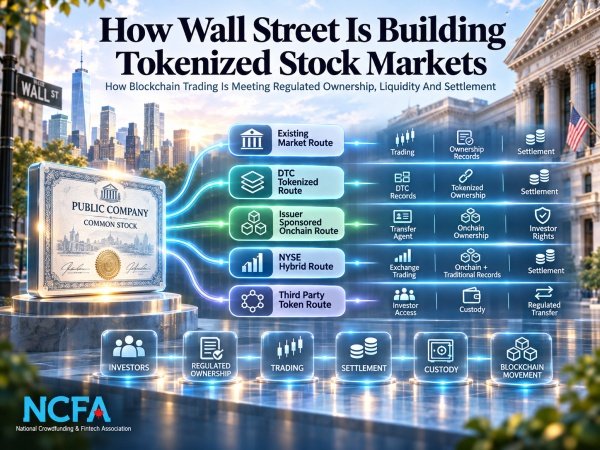
On November 9, 2026, Ava Labs announced Avalanche as the core clearing ledger for NYSE's planned tokenized securities venue.
NYSE isn't putting its stock exchange on Avalanche.
NYSE Pillar remains the planned trading engine. Regulated transfer agents will connect digital shares with shareholder records. Avalanche will sit inside the clearing process after a trade is matched. Stablecoin funding is part of the design.
Blockchain companies have spent years building ways to issue, trade and settle assets directly on digital networks.
Wall Street already has a system that performs those jobs at enormous scale.
Now the two have to connect.
Blockchain can make securities programmable and allow the asset and cash to settle together. Public markets depend on deep liquidity, clear ownership records, custody, corporate actions and regulated firms that remain accountable when something goes wrong.
The question isn't whether stocks can be tokenized anymore.
It's whether tokenized stocks can gain the speed and flexibility of blockchain without splitting ownership, liquidity and investor protection across too many systems.
Canada put a real security through this process in March 2026. Export Development Canada issued a C$100 million bond through Project Samara, with RBC Capital Markets and TD Securities as joint lead managers.
The system supported issuance, bidding, secondary trading, coupon payments and redemption. The security and wholesale central bank money could settle together on distributed ledger technology.
The Bank of Canada also found costs around the transaction. These included system complexity, liquidity costs, governance requirements, coordination work and additional reporting and oversight.
Samara involved one short term security and a closed investor group. A public stock market has to handle the same issues across many securities, firms and investors.
Project Samara showed that a regulated security and regulated money can settle together on a distributed ledger.
But faster settlement only helps if buyers, sellers, custodians and other market participants can work around it without creating new costs or delays.
One trade can be compressed. The rest of the market still has to function around it.
On September 17, the SEC opened a five year path for tokenized U.S. stock trading, allowing qualifying Tokenized Securities Venues to use permissioned automated market makers and liquidity pools.
The tokenized stock must provide holders the same rights and privileges as the equivalent conventional shares.
An unaffiliated company can't simply tokenize another issuer's shares and assume the result is equivalent. The venue must notify the issuer before trading begins and give it 30 calendar days to object.
The rules around which U.S. stocks can qualify for tokenized trading also limit eligible securities, trading volumes and the circumstances in which an issuer can object.
A token can trade onchain and still leave an important question unanswered: what does the investor legally own?
It may be the company's share. It may be a claim backed by shares held somewhere else. It may only track the price.
The technology can make the asset easier to transfer. It doesn't decide the investor's legal rights.
DTC answered from inside the existing market on October 28. Its Tokenization Service allows eligible participants to create tokenized representations of securities already held at DTC and deliver them to registered wallets.
DTC has more than $114 trillion in assets under custody. Twenty participants had signed agreements when the service launched, including Bank of America, Barclays, Citi, Fidelity, J.P. Morgan, Morgan Stanley, State Street and UBS.
The securities don't have to leave DTC for participants to use a tokenized version. Canton and DTCC's private Besu network were the first supported networks, with more expected to follow.
The existing depository remains connected to the asset while blockchain adds another way to hold and transfer it.
DTC takes a different route from building a new market beside the old one.
It adds tokenization to securities already inside the existing system.
That keeps common custody and established market connections in place. It also means new blockchain markets have to offer more than a digital version of the same asset.
On November 2, NYSE named Securitize, tZERO, Broadridge, Computershare, Equiniti and Superstate as transfer agent partners for tokenized securities.
Computershare, Equiniti and Broadridge together serve close to 5,000 publicly listed companies, including nearly 99% of the S&P 500.
The group combines digital asset firms with established shareholder recordkeepers. Securitize, Superstate and tZERO bring onchain issuance and recordkeeping experience. Computershare and Equiniti bring long standing issuer relationships.
Broadridge also connects shareholders with proxy materials, meetings and voting.
A stock doesn't stop working after someone buys it.
Companies pay dividends. Investors vote. Shares split. Mergers close. Ownership changes.
The transfer agent role in NYSE's tokenized share model connects those obligations with the new digital ownership layer.
The share can live onchain. Someone still has to maintain the record everyone agrees is official.
On November 4, Canton Strategic Holdings put the SEC exemption into a live transaction. Existing shareholder Five North moved CNTN shares from a broker account onto the company's onchain shareholder register.
The shares traded through a permissioned Tradecraft liquidity pool. DRW Cumberland bought stock, Flowdesk supplied liquidity and settlement completed atomically on Canton.
Fairmint remained the SEC registered transfer agent. It recorded the tokenized shares, maintained the official onchain ownership record and controlled which verified holders and wallets could participate.
Identity checks, sanctions screening and transfer controls remained part of the transaction.
The November 4 transaction wasn't another demonstration.
A Nasdaq listed stock traded through an onchain liquidity pool and settled atomically, while a regulated transfer agent kept the official ownership record.
Fairmint CEO Joris Delanoue put it plainly: "A blockchain can settle a trade, but it takes an accountable transfer agent to say who legally owns the share."
Blockchain handled parts of the transaction differently. Regulation didn't disappear. It came into the transaction with it.
NYSE keeps conventional exchange technology at the front of its planned digital ATS. NYSE Pillar remains the matching engine, using technology already familiar across NYSE equity and options markets.
The venue can support issuer sponsored tokenized securities as well as qualifying third party custodial products.
Avalanche gets a different job after execution. Its technology will provide the core ledger for the clearing firm supporting the venue.
NYSE says the platform is designed for 24/7 trading, clearing and settlement. Stablecoin funding is contemplated, while regulated transfer agents connect tokenized securities with shareholder records.
NYSE isn't replacing everything at once.
Pillar can match the trade. Transfer agents can keep the ownership record. Avalanche can support clearing. Stablecoins can provide digital cash.
NYSE Head of Digital Issuance Dennis Lee describes the approach as "picking the right technology for each job."
The NYSE Avalanche clearing design gives Avalanche a post trade role rather than making it the only network on which shares can exist.
The result could combine familiar market access with faster digital settlement. It could also leave one stock working across more systems than before.
DTC can tokenize securities already inside the depository. Conventional exchanges can continue using familiar order books and settlement rules while adding tokenized representations after the trade.
This keeps the security tied closely to existing market systems.
Other venues can put more of the process onchain. Ownership, trading and settlement can run through digital networks with verified wallets and programmable controls.
Securitize's tokenized U.S. stocks and OKXICE's proposed venue show how different regulated models are moving from exemptions and filings into actual products and market designs.
A public company's stock can remain inside DTC, appear in issuer sponsored form onchain and also be represented through third party products.
Those versions can trade through different venues and settle through different systems.
That creates more choice, but liquidity can spread across markets and investors may not receive the same rights from every product carrying the same company name.
Tokenization works best if those routes remain connected closely enough that the stock still behaves like one market.
Tokenized stocks can now reach investors through several routes.
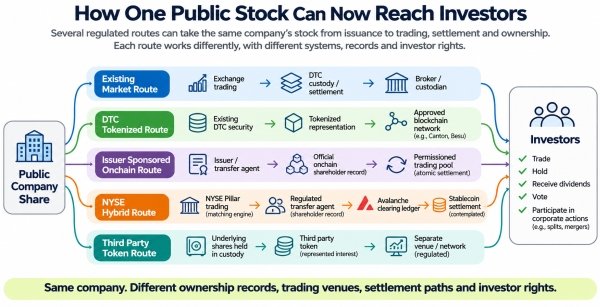
DTC can tokenize securities already held in the traditional market. The SEC has opened a regulated route for permissioned onchain stock trading. Transfer agents can maintain official shareholder records on blockchain networks. A Nasdaq listed stock has already traded and settled this way. NYSE is combining its existing trading technology with blockchain clearing and potentially tokenized cash.
Each approach solves part of the problem.
Together they create another one.
A public stock is valuable partly because buyers and sellers can meet in deep markets and because everyone knows what the security represents. If liquidity spreads across too many venues or different tokenized versions carry different rights, the investor may see the same company name without actually holding the same product.
That doesn't mean tokenized stocks need one blockchain or one trading venue.
It means the different routes have to remain connected closely enough that investors, issuers and intermediaries can treat them as parts of the same market.
For founders, some of the best opportunities may sit in those connections: custody, compliance, identity, shareholder records, corporate actions, market data, liquidity and settlement.
For investors, the basic questions become more important, not less. Who issued the token? What does it represent? Where is ownership recorded? Where does it trade? Who holds the underlying security? What rights come with it?
Canada has already tested part of this problem through Project Samara. Canadian institutions showed that a real security and central bank money can settle together on distributed ledger technology. They also found that faster settlement brings governance, liquidity and operating questions with it.
If U.S. tokenized stocks build meaningful liquidity, Canadian dealers and custodians will have to decide which products and venues they can connect to and how those holdings fit Canadian custody, securities and investor protection requirements.
Blockchain markets don't have to replace regulated public markets to matter. Regulated markets don't have to abandon their existing systems to use blockchain.
A stock can gain new ways to trade and settle without losing the liquidity, ownership clarity and investor rights that make it one market.
Tokenized stocks can now trade through several regulated routes. The opportunity is faster, more programmable markets. The risk is that liquidity, ownership and investor rights become spread across products and venues that all appear to represent the same stock.
Share this story → Explore related intelligence → Subscribe
The National Crowdfunding & Fintech Association (NCFA Canada) is a financial innovation ecosystem that provides education, market intelligence, industry stewardship, networking and funding opportunities and services to thousands of community members and works closely with industry, government, partners and affiliates to create a vibrant and innovative fintech and funding industry in Canada. Decentralized and distributed, NCFA is engaged with global stakeholders and helps incubate projects and investment in fintech, alternative finance, crowdfunding, peer-to-peer finance, payments, digital assets and tokens, artificial intelligence, blockchain, cryptocurrency, regtech, and insurtech sectors. Join Canada's Fintech & Funding Community today FREE! Or become a contributing member and get perks. For more information, please visit: www.ncfacanada.org
| | |
|---|---|---|
| | |
Nov 10, 2026

Paying with your phone has become second nature for most Canadians, whether you're grabbing a double-double or splitting a dinner bill. So it makes sense that more players want to fund their casino accounts the same way. If you've been browsing Google Pay Casinos Canada, you've probably noticed that not every site handles this wallet equally well. Some make deposits feel effortless, while others bury Google Pay behind extra steps or fees. Here's how we'd go about picking a good one.
Before you sign up anywhere, it helps to know what separates a smooth Google Pay experience from a frustrating one. We look at a few key areas every time we test a site.
No payment method can make an unsafe casino safe. Check the footer of the site for a licence from a recognized regulator. If you're in Ontario, look for iGaming Ontario and AGCO approval. Elsewhere in Canada, many players use offshore sites licensed in places like Malta or Curaçao. Whatever the licence, you should be able to click through and confirm it's real. If the casino hides this information, we'd move along.
This is the step many players skip. Plenty of casinos accept Google Pay for deposits, but far fewer let you withdraw back to it. When cashouts aren't supported, you'll need a second method, often Interac e-Transfer or a bank transfer. That's not a deal breaker, but it's good to know before you play, so you're not caught off guard when it's time to cash out. Check the banking or cashier page, or ask live chat directly.
Look at the minimum deposit. A friendly site will let you start with $10 or $20 rather than asking for $50 up front. Also check whether the casino charges a processing fee on Google Pay. Most don't, but your card issuer might treat the transaction differently, so it's worth a quick look at your bank's terms too. And always confirm the site lets you play in Canadian dollars, so you're not losing a few loonies to conversion on every top-up.
Fast deposits are nice, but what really matters is how a casino treats you when you win. A site that takes your money in seconds but makes you wait two weeks for a withdrawal isn't one we'd recommend.
Look for clear processing times, daily or weekly cashout limits, and any pending period. The most trustworthy sites spell this out in plain language. If you want a head start, our list of best payout online casinos highlights sites with strong return-to-player rates and quick cashouts. Just remember that a higher payout percentage is a long-term average, not a promise of winnings in any single session.
Most casinos ask for ID before your first withdrawal. Uploading your documents right after you sign up saves you a lot of waiting later. It's a small step that makes the whole experience feel much smoother.
One reason we like Google Pay is that the casino never sees your actual card number. The wallet uses tokenization, which swaps your card details for a one-time digital code. On top of that, payments are confirmed with your fingerprint, face, or phone PIN. This kind of mobile payment tech is one of the bigger stories in Canadian fintech right now, and if you're curious about where it's heading, you can learn more here.
That said, a secure wallet doesn't replace good habits. Use a strong password on your casino account, turn on two-factor login if it's offered, and avoid making deposits on public Wi-Fi.
Payment options matter, but they're only one part of a good casino. Take a moment to look at the rest of what's on offer.
Since Google Pay lives on your Android phone, the casino should work just as nicely on a small screen. Try a few slots or a round of blackjack on mobile before you deposit. Pages should load quickly, and the cashier should be easy to find.
A welcome bonus can stretch your budget, but read the fine print. Some casinos exclude e-wallet deposits from promotions. Check the wagering requirements, the maximum bet while playing with bonus funds, and how long you have to use it.
Send live chat a quick question about Google Pay before you sign up. A fast, friendly answer is a good sign of how they'll treat you later.
Always remember that online gambling is meant to be entertainment, not a way to earn money. Even at the best site with the fastest wallet, the house always keeps an edge over time. Set a budget before you play, use deposit limits if the casino offers them, and take breaks when you need to. Google Pay makes topping up quick, which is exactly why it's worth keeping an eye on how often you do it.
If you take the time to check the licence, the banking rules, payout speed, and the overall experience, you'll find a Google Pay casino that feels safe, simple, and enjoyable to come back to.
The National Crowdfunding & Fintech Association (NCFA Canada) is a financial innovation ecosystem that provides education, market intelligence, industry stewardship, networking and funding opportunities and services to thousands of community members and works closely with industry, government, partners and affiliates to create a vibrant and innovative fintech and funding industry in Canada. Decentralized and distributed, NCFA is engaged with global stakeholders and helps incubate projects and investment in fintech, alternative finance, crowdfunding, peer-to-peer finance, payments, digital assets and tokens, artificial intelligence, blockchain, cryptocurrency, regtech, and insurtech sectors. Join Canada's Fintech & Funding Community today FREE! Or become a contributing member and get perks. For more information, please visit: www.ncfacanada.org
| | |
|---|---|---|
| | |
November 9, 2026 | Market Activity | Wealthtech, Investing And Trading, Fundraising And Capital Markets

On November 6, 2026, National Bank of Canada agreed to acquire Embark Student Corp. for an estimated $226 million, adding more than $6 billion in RESP assets under management and approximately 436,000 beneficiaries. The deal gives National Bank immediate scale in Canada’s $98.6 billion RESP market and strengthens its digital competition with Wealthsimple, Questrade and other investment platforms. The transaction is expected to close by mid fiscal 2027, subject to court, regulatory and other customary approvals.
National Bank already competes in Registered Education Savings Plan (RESP) accounts. It offers advisor supported RESPs and its direct brokerage lets customers manage RESP investments themselves. Embark brings a national digital business focused specifically on managed education savings, grant administration and RESP servicing. The acquisition gives National Bank a third way to compete for families without building that specialist operation one customer at a time.
Embark is one of Canada's largest direct to consumer RESP providers and operates as a Scholarship Plan Dealer across Canada. Its platform handles account administration, investment management, government grants and digital servicing around one financial goal. Its current student plans use target date portfolios that gradually reduce investment risk as a beneficiary approaches post secondary education.
National Bank's existing bank RESP starts with an advisor relationship, while National Bank Direct Brokerage gives investors a self directed route. Embark operates between those models. Families hand over portfolio management but can manage much of the RESP relationship digitally through a provider built around education savings.
National Bank is buying scale with it. Embark brings more than $6 billion in RESP assets and about 436,000 beneficiaries. For comparison, National Bank's Wealth Management segment reported approximately $939 billion in assets under administration and $207 billion in assets under management at April 30, 2026. Embark is small beside that platform, but highly concentrated in a financial relationship that can last from a child's early years through post secondary withdrawals.
The acquisition also adds another route for National Bank's expansion outside Quebec. The bank says Embark increases its reach in Ontario and Western Canada. That follows its acquisition of Canadian Western Bank, which added banking scale in Western Canada. Embark adds something different, a national consumer savings platform without requiring another branch network.
Canada's RESP market now puts banks, digital wealth platforms and investment dealers against each other with very different models. National Bank can offer advice, self directed investing and, if the Embark deal closes, a specialist managed RESP platform. Wealthsimple combines managed and self directed RESPs with a much broader digital financial relationship. Questrade also offers both models but leans heavily into investment choice, investor control and lower published management fees.
| National Bank + Embark | Wealthsimple | Questrade | |
|---|---|---|---|
| Total Platform Scale | National Bank Wealth Management about $939B AUA and $207B AUM at April 30, 2026 | $169.2B AUA and 3.8 million clients at September 30, 2026 | $80B+ AUA |
| RESP Scale Disclosed | Embark $6B+ AUM and about 436,000 beneficiaries | RESP assets not separately disclosed | RESP assets not separately disclosed |
| Managed RESP | Embark specialist managed education savings plans | Wealthsimple managed portfolios | Questwealth managed ETF portfolios |
| Managed RESP Fee | 1.65% MER plus applicable tax. Embark says this covers investing, management and administration | 0.50% standard management fee, falling to 0.40% above $100,000. Some higher tier clients qualify for lower pricing. Underlying portfolio MER also applies | 0.25% below $100,000 and 0.20% at $100,000 or more, plus underlying ETF MER |
| Self Directed RESP | Available through National Bank Direct Brokerage | Available through Wealthsimple | Available through Questrade |
| Self Directed Fees | $0 online stock and ETF commissions. NBDB charges a $100 annual administration fee unless an exemption applies, including at least $20,000 in eligible assets | $0 stock and ETF commissions. A 1.5% currency conversion fee can apply when converting between Canadian and U.S. dollars | $0 stock and ETF commissions. RESP account, platform and inactivity fees are $0 |
| Product Fit | Families wanting specialist managed RESP support, bank advice or a separate self directed brokerage route | Digital households wanting education savings alongside investing and other financial products in one platform | Investors focused on cost, portfolio choice and control, with a lower cost managed option available |
| What's Unique | Combines a major bank with a large specialist RESP business and an existing bank owned brokerage | RESP inside a broad digital household finance ecosystem | Strong brokerage orientation with managed and self directed investing at low published fees |
| Strategic Play | Buy RESP specialization and an installed customer base | Grow the family relationship across more financial products | Compete on cost, choice and investor control |
Embark's current 1.65% MER is materially higher than the standard managed pricing published by Wealthsimple and Questrade. Its proposition has to carry more than portfolio management. National Bank is paying for specialized RESP administration, grant handling, digital servicing and a large base of funded plans that already exists.
Wealthsimple competes differently. Its RESP can exist alongside chequing, trading and other investment accounts within the same digital relationship. It reported $169.2 billion in assets under administration and 3.8 million clients at the end of September. Its advantage is less about RESP specialization and more about making education savings another product inside a growing household finance platform.
Questrade combines a low cost managed option with a brokerage model built around investor control. It reports more than $80 billion in assets under administration, offers Questwealth managed portfolios and lets RESP customers directly hold stocks, ETFs, options, bonds, GICs and mutual funds. National Bank can already answer that self directed model through NBDB. Embark strengthens the part of the market where families want management without relying on a conventional advisor relationship.
Canadian RESP assets reached $98.6 billion at the end of 2025, up from $89.8 billion in 2024 and $78.9 billion in 2023, according to the federal government's 2025 education savings statistics. Canadians contributed another $6.5 billion during the year, while 3.2 million beneficiaries received the Canada Education Savings Grant.
The CESG take up rate was 54% in 2025, with 318,233 beneficiaries receiving the grant for the first time. That leaves substantial room for providers to win new education savings relationships even before competing for assets already held elsewhere.
The market is also split across different types of providers.
Embark's managed RESP carries a materially higher fee than the managed options offered by Wealthsimple and Questrade, while National Bank already competes with both through its own direct brokerage. National Bank therefore has to show that specialist RESP administration, grant support and a dedicated education savings experience justify the premium while using its broader wealth platform to deepen those relationships over time.
The National Crowdfunding & Fintech Association (NCFA Canada) is a financial innovation ecosystem that provides education, market intelligence, industry stewardship, networking and funding opportunities and services to thousands of community members and works closely with industry, government, partners and affiliates to create a vibrant and innovative fintech and funding industry in Canada. Decentralized and distributed, NCFA is engaged with global stakeholders and helps incubate projects and investment in fintech, alternative finance, crowdfunding, peer-to-peer finance, payments, digital assets and tokens, artificial intelligence, blockchain, cryptocurrency, regtech, and insurtech sectors. Join Canada's Fintech & Funding Community today FREE! Or become a contributing member and get perks. For more information, please visit: www.ncfacanada.org
| | |
|---|---|---|
| | |
November 9, 2026 | NCFA Story Intelligence | Risk Compliance And Regtech, Cross Border Payments And FX, Digital Assets Blockchain And Tokenization

On November 6, 2026, eight Canadian money services businesses appeared on a U.S. sanctions list. Every one of them had a Canadian MSB registration number.
That number meant the business had entered Canada's federal registration system. It didn't mean FINTRAC had approved the firm, cleared its customers or vouched for every transaction passing through it. Until November 6, that distinction could sound technical.
Then the U.S. Treasury allegations arrived. Treasury says several of the eight firms converted cash or conventional currency into digital assets that reached sanctioned Iranian exchanges, addresses associated with the Islamic Revolutionary Guard Corps and, in some cases, wallets tied by U.S. authorities to Canadian drug trafficker Ryan Wedding.
The firms had Canadian addresses, Canadian corporations and Canadian registration numbers. Now they also had OFAC designations.
The same day, FINTRAC coordination with OFAC and FinCEN became public. Then Canada's financial intelligence agency disclosed what had been happening inside its own MSB regime during 2026: 161 registrations revoked, more than $198 million in penalties against nine MSBs, and 28 MSB non compliance matters sent to law enforcement.
FINTRAC didn't say that the eight OFAC firms were among those revocations, penalties or referrals. Canadian disclosure rules generally prevent it from making that connection public unless the law allows it.
But the sequence is hard to miss. Canada had already spent years strengthening Canada's tightening AML rules around MSBs, crypto, ownership and financial reporting. Now eight registered Canadian businesses were inside a U.S. sanctions action, and Canada's financial intelligence agency was confirming that it helped.
This is a story about what a registration number can prove, what it can't prove, and what happens when the transactions behind it reach sanctioned networks abroad.
Canada requires money services businesses to register with FINTRAC so authorities know who's operating, who controls the business and what services it offers. The registry brings firms into view, but it doesn't certify what happens inside every transaction.
That distinction had already surfaced before November. In September, Maple Digital and the TGR network raised questions about how much an active registration can really tell a bank or counterparty. There was no finding that Maple itself laundered money, but corporate and personnel connections showed why a FINTRAC number couldn't settle questions about directors, related companies or sanctions exposure.
The eight firms designated by OFAC had Canadian registration numbers, corporate identities and physical addresses. Some operated from Vancouver, Toronto, North York, Richmond Hill, Thornhill and Montreal.
Those registrations told counterparties the businesses had entered Canada's MSB system. They didn't establish what customers were doing through the firms or where every transaction ended.
Iran connected transactions don't enter this story as ordinary transfers. Canada already requires reporting firms to treat them as high risk.
By July 2026, Canada's Iran AML controls still required enhanced checks covering identity, source of funds or virtual currency, beneficial ownership, recordkeeping and possible sanctions evasion. The warning was already built into the system before Treasury named the eight Canadian firms.
Earlier that summer, sanctions on Iranian crypto exchanges included Nobitex, Wallex, Bitpin and Ramzinex. Aban Tether Exchange and Shelbit later joined the sanctions record.
By November, several of those names appeared again in Treasury's allegations involving Canadian MSBs. The counterparties weren't unknown names at the far end of a payment chain anymore.
OFAC now names eight Canadian businesses under Executive Order 13902. They look different on paper, but they share one uncomfortable fact: each had entered Canada's MSB registry before U.S. authorities placed it inside an Iran sanctions case.
Treasury alleged that NIA Nations dealt with addresses associated with the IRGC and with Nobitex, Wallex, Ramzinex and Bitpin. Darvish Exchange allegedly dealt with Nobitex, Wallex, Aban Tether Exchange and Shelbit.
Farah Exchange allegedly dealt with Shelbit and Wallex. Amin Exchange allegedly received hundreds of thousands of dollars from Shelbit. These weren't generic country risk warnings anymore. Treasury was attaching named Canadian firms to named counterparties.
Then another thread appears. Treasury also alleges that some of the same Canadian MSBs handled proceeds connected with Ryan Wedding, the Canadian former Olympic snowboarder accused by U.S. authorities of running a multinational cocaine trafficking organization.
The case isn't only about Iranian exchanges now. It also touches alleged Canadian drug cash, and Treasury says some of the same businesses appear in both trails.
In the sanctions allegations, investigators followed counterparties. Which exchange received the funds? Which wallet had already been linked to a sanctioned actor?
In the Wedding allegations, they also followed the source. Where did the cash come from? Why was it converted? Treasury says some of the same Canadian businesses appeared in both trails.
The U.S. action could have ended as a foreign sanctions story. It doesn't.
FINTRAC confirms that it coordinated with OFAC and FinCEN, then Canada's financial intelligence agency publishes numbers showing just how active MSB enforcement has become at home.
Since the beginning of 2026, FINTRAC says it has revoked 161 registrations, more than during the previous three years combined. Over the past year, it imposed more than $198 million in penalties against nine MSBs and disclosed 28 MSB non compliance matters to law enforcement.
The November total didn't appear out of nowhere. By May, FINTRAC's MSB revocations were already reaching money transfer, FX, virtual currency and payment service businesses.
Before November 6, Canada's tougher MSB enforcement could be seen through revoked registrations, individual penalties and new AML powers.
Now FINTRAC is publicly confirming that Canadian financial intelligence also fed an international sanctions action. The coordination is public. The firm by firm Canadian enforcement record isn't.
The same number that placed each firm inside Canada's MSB system now appears on the same record as an OFAC designation.. That doesn't make registration meaningless. It changes what everyone around the firm has to ask next.
A bank can confirm registration and still need to understand the customer. A payment partner can confirm it and still need to know where the funds came from. A crypto exchange can confirm it and still need to screen the wallet. A foreign counterparty still needs to know who's at the other end.
For legitimate MSBs, registration still opens the door to operating within Canada's regulated system. Remittance, FX, payments and digital asset firms remain important to customers who need alternatives to the largest banks.
International access depends on more than the registry. Banks, exchanges and settlement partners also need confidence in ownership, source of funds, sanctions controls, wallet screening and transaction monitoring. If that confidence disappears, the registration number won't preserve the relationship.
OFAC has named the firms and FINTRAC has confirmed the coordination. The rest of the Canadian story hasn't been written yet.
Registrations can be revoked. FINTRAC penalties can become public where the law permits. Police can investigate, prosecutors can lay charges where the evidence supports them, and criminal assets can be identified and recovered.
None of those outcomes can be read into the OFAC designation today.
What happens next will show whether the November 6 sanctions action is followed by Canadian registration, regulatory, police or asset recovery measures involving any of the eight firms.
Eight Canadian businesses entered November 6 with MSB registration numbers. They ended the day on a U.S. sanctions list.
That doesn't prove they committed a crime in Canada. It doesn't prove FINTRAC revoked their registrations, penalized them or referred them to police.
For legitimate operators, the demands are becoming harder to ignore. Know the customer, source of funds and beneficial owner. Know the wallet and the exchange. Keep records good enough to revisit a transaction when an address later appears on a sanctions list.
Those checks aren't free, especially for smaller firms. Banks, exchanges and settlement partners also have to decide whom they're willing to keep connected to their own systems.
Canada's MSB sector still serves real needs in remittances, foreign exchange, cross border commerce and financial access. November 6 doesn't change that.
What it does leave unresolved is what comes next for these eight firms.
OFAC has made its allegations public. FINTRAC has confirmed the cross border coordination. The next chapter is whether that intelligence leads to Canadian regulatory, police or asset recovery action involving any of the eight.
An MSB registration tells you that a firm entered Canada's regulated system. It doesn't tell you enough about the customers, funds, wallets and counterparties behind that number.
Share this story → Explore related intelligence → Subscribe
Share this story → Explore related intelligence → Subscribe
The National Crowdfunding & Fintech Association (NCFA Canada) is a financial innovation ecosystem that provides education, market intelligence, industry stewardship, networking and funding opportunities and services to thousands of community members and works closely with industry, government, partners and affiliates to create a vibrant and innovative fintech and funding industry in Canada. Decentralized and distributed, NCFA is engaged with global stakeholders and helps incubate projects and investment in fintech, alternative finance, crowdfunding, peer-to-peer finance, payments, digital assets and tokens, artificial intelligence, blockchain, cryptocurrency, regtech, and insurtech sectors. Join Canada's Fintech & Funding Community today FREE! Or become a contributing member and get perks. For more information, please visit: www.ncfacanada.org
| | |
|---|---|---|
| | |


August 26th, 2025

January 4th, 2024

June 1st, 2021

September 9th, 2020

July 9th, 2018

January 3rd, 2018

September 25th, 2017

June 20th, 2017

May 10th, 2017

December 14th, 2016