




Karsten Wenzlaff, Advisor
August 26th, 2025
Karsten Wenzlaff is a Crowdfunding and Fintech Expert from Germany. He is Secretary-General of Digit[...]


Oct 26, 2026 | CryptoVantage
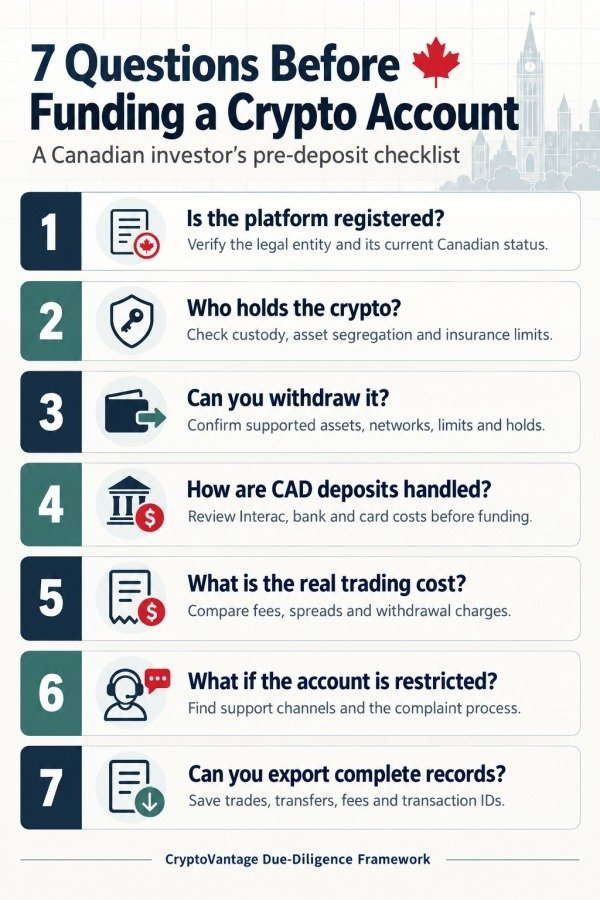
Opening a crypto account takes only a few minutes. Deciding whether the platform deserves your money should take a little longer.
CryptoVantage has published a new due-diligence framework to help Canadian investors evaluate cryptocurrency trading platforms before making a deposit. The guide moves beyond rankings and promotional claims by focusing on seven questions that reveal how a platform actually handles customer money, digital assets, fees and support problems.
The framework is designed primarily for first-time buyers, although its questions also apply to experienced investors comparing a new service. It can be used to examine Canadian platforms such as Bitbuy, Newton, Shakepay and Wealthsimple, as well as international companies serving Canadian customers, including Coinbase and Kraken.
No platform is the right choice for everyone. The point is to know what is being offered before sending Canadian dollars or cryptocurrency.
A polished application and a familiar brand name do not tell investors whether a platform is authorized to serve Canadian customers.
Crypto asset trading platforms operating in Canada may be subject to provincial securities requirements. Depending on their activities and regulatory status, they may also need to pursue registration as investment dealers and membership in the Canadian Investment Regulatory Organization.
Canadian investors can consult CIRO’s information about crypto asset trading platforms and the relevant provincial securities regulator. They should search for the company’s legal name, not just the trading name displayed in its app.
That distinction matters. A global company may operate through a separate Canadian entity, while another service may limit particular products in Canada.
Registration provides a level of regulatory oversight, but it should not be mistaken for a promise that an investment cannot lose value. It also does not eliminate cybersecurity, fraud, insolvency or operational risks.
The useful question is not simply, “Is this a regulated exchange?” It is, “Which legal entity holds my account, and what registration does that entity currently have?”
Buying cryptocurrency and taking personal custody of it are two separate decisions.
When assets remain on a centralized platform, the customer typically depends on that company and its custody arrangements. Some platforms hold part of their customers’ assets directly. Others use specialist custodians or a combination of internal and external storage.
For example, a Canadian investor might buy Bitcoin through Wealthsimple, Coinbase, Kraken, Newton, Shakepay or Bitbuy. The account interface may look straightforward, but the custody structure behind it can be considerably more complex.
Investors should look for clear answers to several basic questions. Are customer assets segregated from corporate assets? What proportion is stored offline? Does the platform identify outside custodians? Who controls the keys required to move funds? What happens if a custody provider fails?
Insurance also needs context. A statement that assets are “insured” does not necessarily mean every loss is covered. A policy may apply only to certain storage systems, specific criminal events or losses caused by the custodian. It may exclude phishing, customer mistakes, compromised passwords or losses above a coverage limit.
Custody is becoming a larger part of Canada’s digital-finance infrastructure. NCFA has previously examined how crypto custody regulation is changing, including the growing importance of segregation controls, operational resilience and oversight evidence.
A platform may allow customers to buy and sell cryptocurrency without supporting withdrawals to an external address. That arrangement can suit someone interested only in price exposure, but it is different from purchasing an asset that can be moved into self-custody.
Before depositing money, investors should confirm whether the platform supports external transfers for the exact asset they intend to buy.
Support can vary by coin and network. A service might allow Bitcoin withdrawals but restrict a newer token. It might support USDC on Ethereum while not supporting the same stablecoin on Solana or another network. Sending assets through an incompatible network can lead to a difficult or unsuccessful recovery process.
Withdrawal rules deserve attention too. Platforms may impose minimum amounts, network charges, daily limits or temporary security holds. A newly added bank account, password reset or device change can trigger an additional delay.
These controls are not automatically a bad sign. A short security hold may stop an unauthorized withdrawal. The concern is whether the platform explains its policy before the customer needs to move funds.
CryptoVantage recommends treating a small test withdrawal as part of the onboarding process. It can reveal whether the address format, selected network, confirmation steps and expected fees are understood before a larger amount is at risk.
For Canadian users, the quality of the fiat on-ramp can be as important as the trading interface.
Platforms including Newton, Shakepay and Bitbuy have built their Canadian services around familiar funding options such as Interac e-Transfer. Coinbase and Kraken also serve Canadian customers, but available deposit methods, processing times and limits may differ.
Investors should check whether deposits are made directly to the platform or processed by another company. They should also review minimum and maximum amounts, expected processing times and the name that will appear on their bank statement.
A bank may pause or reject a transaction even when the crypto platform accepts that funding method. This can happen because of fraud controls, account limits or the bank’s internal policies.
Credit and debit cards introduce another layer of cost. A platform may charge a card-processing fee, while the card issuer could classify the purchase differently from an ordinary retail transaction.
The practical test is simple: calculate how many dollars arrive in the trading account after every visible charge. A “free deposit” is useful, but it says nothing about the spread applied when those dollars are exchanged for crypto.
The word “commission-free” can be technically accurate while still leaving the customer with a meaningful cost.
Some platforms charge a clearly stated transaction fee. Others earn revenue through the spread between the displayed buying and selling prices. Advanced trading interfaces may use maker-and-taker schedules, while instant-purchase features can have a different price structure.
For a fair comparison, an investor can record three numbers at the same moment:
The difference provides a more practical picture than an advertised commission rate alone.
The company’s Canadian crypto exchange guide compares services including Coinbase, Bitbuy, Kraken and Shakepay while examining factors such as fees, deposits, withdrawals, security and transaction speed.
Costs can also appear after the trade. A user may encounter a crypto withdrawal charge, blockchain network fee, staking commission or currency-conversion cost. Comparing the complete transaction journey is more useful than comparing one headline percentage.
Most customers judge a platform when everything is working. Due diligence should also consider what happens when it is not.
An account may be restricted because of an identity-verification issue, a suspicious login, a disputed bank transfer, a compliance review or activity that triggers the platform’s monitoring systems. Even legitimate customers can be asked for additional documents.
Before funding an account, investors should locate the support options. Is live chat available? Can a customer reach a human agent? Is there a formal complaint process? Does the company publish estimated response times? Which organization can review an unresolved complaint?
Social media is not a safe substitute for official support. Fraudsters routinely impersonate exchanges and respond to public complaints with offers of private assistance. A genuine support representative should not need a wallet recovery phrase or private key.
It is also sensible to keep independent records. Customers should retain deposit confirmations, trade histories, withdrawal identifiers and relevant correspondence. Accessing those records may become harder after an account is closed or restricted.
Crypto recordkeeping should begin with the first purchase, not several months later when a tax return or portfolio review makes the information necessary.
A useful platform should allow customers to export deposits, withdrawals, purchases, sales, trades, staking rewards and applicable fees. Ideally, the records should be available in a common format that can be reviewed in a spreadsheet or imported into compatible accounting software.
Investors should not assume that a simple annual gain-and-loss figure will capture every relevant activity. Moving assets between personal wallets is different from disposing of them, but the transaction still needs to be documented so the movement can be traced.
Records are also valuable when investigating a delayed withdrawal or reconciling a wallet balance. A blockchain transaction identifier can show whether a transfer was broadcast, while the platform’s internal history can document when the request was submitted.
If export tools are difficult to find before an account is funded, they may not become easier to use later.
A platform can change its fees, supported assets, banking relationships, custody providers or Canadian availability. Regulatory status may also evolve.
Investors should repeat the seven-question review when opening a new account and periodically revisit it for platforms they already use. A service that suited a small first purchase may not be the right place for a larger balance, frequent trading or long-term custody.
The framework does not attempt to identify a universally safest exchange. Instead, it helps users separate several ideas that are often blended together: regulatory registration, custody, cybersecurity, insurance, liquidity and personal account security.
That is the larger purpose of the new guide. Choosing a crypto platform should not begin with a promotional bonus or a list of supported tokens. It should begin with understanding which company is receiving the money, what it will do with the assets and how the customer can leave if circumstances change.
CryptoVantage is a cryptocurrency publication providing educational guides, news, analysis, and reviews covering Bitcoin, blockchain, exchanges, wallets, fintech, and digital assets. Its team of writers, researchers, and cryptocurrency specialists creates accessible content for both newcomers and experienced crypto users, helping readers better understand the rapidly evolving digital-asset industry.
 The National Crowdfunding & Fintech Association (NCFA Canada) is a financial innovation ecosystem that provides education, market intelligence, industry stewardship, networking and funding opportunities and services to thousands of community members and works closely with industry, government, partners and affiliates to create a vibrant and innovative fintech and funding industry in Canada. Decentralized and distributed, NCFA is engaged with global stakeholders and helps incubate projects and investment in fintech, alternative finance, crowdfunding, peer-to-peer finance, payments, digital assets and tokens, artificial intelligence, blockchain, cryptocurrency, regtech, and insurtech sectors. Join Canada's Fintech & Funding Community today FREE! Or become a contributing member and get perks. For more information, please visit: www.ncfacanada.org
 |  |  |
|---|---|---|
 |  |  |


August 26th, 2025

January 4th, 2024

June 1st, 2021

September 9th, 2020

July 9th, 2018

January 3rd, 2018

September 25th, 2017

June 20th, 2017

May 10th, 2017

December 14th, 2016
Leave a Reply