





Karsten Wenzlaff, Advisor
August 26th, 2025
Karsten Wenzlaff is a Crowdfunding and Fintech Expert from Germany. He is Secretary-General of Digit[...]


Apr 28, 2026 | NCFA Insight | Artificial Intelligence And Data, Banking And Credit Infrastructure
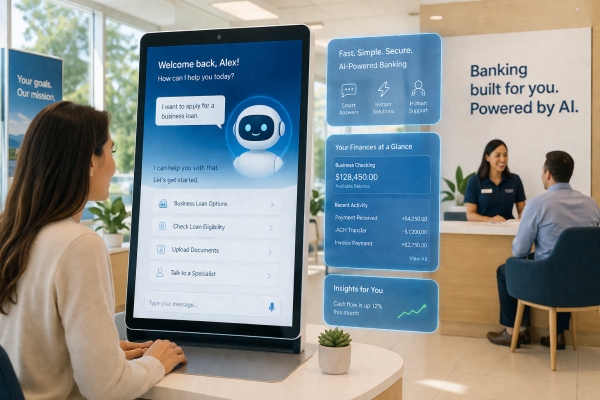
On Apr 27, 2026, Customers Bank announced a multiyear collaboration with OpenAI to deploy AI across commercial banking operations. The bank has nearly $26 billion in assets and already has 75% of team members using OpenAI powered tools. Customers Bank even used an AI voice clone on its last earnings call. The bigger change is how the bank is deploying AI agents across lending, onboarding, and payments.
On its Q1 call, Customers reported more than 500 internal agents and custom GPTs, over 28,000 hours saved through AI enabled workflows, and productivity gains equal to almost 15 full time employees. Q1 results also show $69.7 million in net income available to common shareholders, total deposits up $813.9 million from Q4, and total loans up $609.0 million from Q4.
Sam Sidhu, President and CEO, Customers Bancorp
“We expect a fundamental re-engineering of how Customers Bank operates. We have spent the last year building the operational and governance infrastructure to deploy AI at scale. This strategic collaboration with OpenAI gives us the frontier models, engineering expertise, and ability to co-create a roadmap toward becoming an AI-native bank."
Customers Bank wants AI inside its operating model, with OpenAI engineers working directly with the bank to automate commercial lending, deposit onboarding, and payments. The bank’s cubiX platform already processes about $2 trillion in annual payments volume, giving the collaboration a live operating base, not a pilot or lab only environment.
During Q1 2026 earnings call, Sidhu disclosed that his prepared remarks had been delivered by an AI clone, not read by him. While it was sure to be a memorable call at that point, it's important if AI can represent management's voice in a public market setting, boards need rules for disclosure, script approval, recordkeeping, and accountability before the next experiment becomes normalized.
AI banking use cases aren't just theatre. Customers Bank wants to reduce its commercial loan closing from 30-45 days to about 7 days. It also wants complex commercial account opening to fall from more than a day to under 20 minutes. They are targeting the slowest, most expensive parts of commercial banking.
This is where smaller banks and fintechs should pay attention. AI in banking won’t be won by buying a model and asking staff to use it. The value comes from redesigning workflows around agents, then keeping humans on approvals, exceptions, and risk judgement. That requires clean data, mapped processes, audit trails, escalation rules, and ownership of each AI output.
There's a regulatory approach too. Investor relations, lending decisions, onboarding, and payments all require accountable systems. If an agent drafts, routes, ranks, or speaks, the bank's still on the hook for the result. The lesson is not “let AI run the bank.” It's use AI to remove friction, but keep governance strong enough to prove who approved what and why.
Can Customers Bank turn AI from a productivity tool into an AI enabled engine powering lending, deposits, and payments?
 The National Crowdfunding & Fintech Association (NCFA Canada) is a financial innovation ecosystem that provides education, market intelligence, industry stewardship, networking and funding opportunities and services to thousands of community members and works closely with industry, government, partners and affiliates to create a vibrant and innovative fintech and funding industry in Canada. Decentralized and distributed, NCFA is engaged with global stakeholders and helps incubate projects and investment in fintech, alternative finance, crowdfunding, peer-to-peer finance, payments, digital assets and tokens, artificial intelligence, blockchain, cryptocurrency, regtech, and insurtech sectors. Join Canada's Fintech & Funding Community today FREE! Or become a contributing member and get perks. For more information, please visit: www.ncfacanada.org
 |  |  |
|---|---|---|
 |  |  |



August 26th, 2025

January 4th, 2024

June 1st, 2021

September 9th, 2020

July 9th, 2018

January 3rd, 2018

September 25th, 2017

June 20th, 2017

May 10th, 2017

December 14th, 2016

Leave a Reply