



Karsten Wenzlaff, Advisor
August 26th, 2025
Karsten Wenzlaff is a Crowdfunding and Fintech Expert from Germany. He is Secretary-General of Digit[...]


November 4, 2026 | NCFA Resource | Digital Assets Blockchain And Tokenization, Regulation And Policy, Capital Markets Infrastructure And Funding
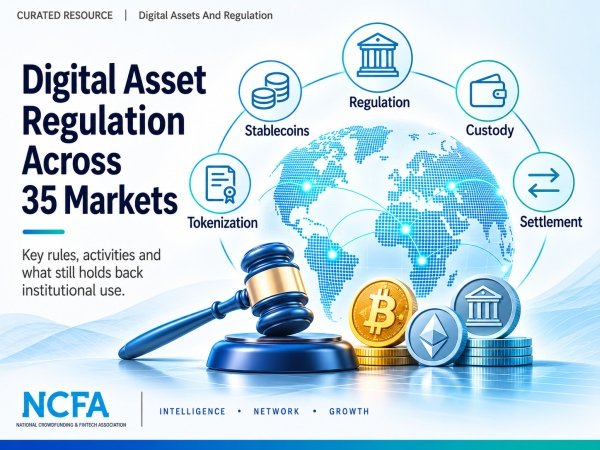
On October 28, 2026, the World Economic Forum and Boston Consulting Group published Regulation of Digital Assets in a Shifting Global Landscape, based on regulatory developments across 35 jurisdictions and more than 25 digital asset activities. The research includes interviews with 50 public and private sector experts, workshops and input from more than 100 participants. Digital assets can be legal and regulated while still being difficult for banks, asset managers and other institutions to use at scale.
More than 70% of the jurisdictions studied regulate the activity being performed rather than relying only on the form of the asset. Trading venues, custodians and payment providers are supervised in more than 75% of the sample. Progress still varies widely within individual countries. A market can have clear rules for tokenized securities while its stablecoin, custody or settlement rules are still incomplete. For a company deciding where to operate, the rules for its actual business matter far more than a country's overall reputation for digital assets.
The 38 page resource compares rules for token issuance, exchanges, wallets, custody, payments, lending, staking and the infrastructure behind digital assets. It also looks at whether institutions can legally own the assets, protect clients, settle transactions, use digital money and meet capital requirements. The activity matrix shows where each part of the market is regulated, partly regulated, unregulated or prohibited.
Cryptoassets account for roughly $3 trillion in market value, stablecoins about $300 billion in circulation and tokenized real world assets about $30 billion. One scenario cited in the research puts tokenized real world assets at approximately $88 trillion by 2035, equal to around 16% of global investable assets. BlackRock's BUIDL fund had reached about $2.6 billion by July 2026, while Euroclear and Banque de France are working on moving a €310 billion commercial paper market onto distributed ledger infrastructure.
Tokenization is already moving into financial infrastructure because issuing the asset is only the beginning. Ownership records, custody, settlement, collateral and servicing all have to work after that. Faster settlement can cut counterparty exposure but may require more cash at the time of settlement. Easier collateral movement doesn't help much if institutions cannot price the asset, pledge it or enforce their claim.
Five barriers can stop institutional adoption even after regulators permit the activity. Leaving one unresolved can keep a legal market small.
Digital assets won't make every middleman disappear, but they can make some existing fees harder to defend. Faster settlement and shared records mean less reconciliation, fewer manual steps and lower servicing costs. Businesses that depend on slow transactions, fragmented records or closed distribution may feel that pressure first. Liquidity, trusted custody, access to customers, risk capacity and market access are harder to replace.
For example, putting a fund onchain doesn't solve pricing, investor records, compliance, redemption, distribution or settlement. Tokenized fund operations after issuance still need all of those functions to work before investors get much benefit from the technology.
There is also money to be made connecting systems that don't yet work well together. Digital money needs places where it can be spent or settled. Tokenized assets need custody and financing. Banks and asset managers need reliable access to both. A company that solves one of those connections may have a better business than one issuing another token or building another closed network.
For founders and investors, a company can have excellent tokenization software and still struggle if customers cannot settle, finance or distribute the asset efficiently. Firms with control over liquidity, distribution, custody or an important connection between systems may have much stronger economics.
Not every part of a country's digital asset market develops at the same speed. Switzerland has established legal treatment for tokenized securities and distributed ledger market infrastructure while still developing its stablecoin rules. WEF and BCG state that “The relevant comparison is therefore by activity, not by jurisdiction overall.” A company choosing where to launch needs to examine the rules for its product and business model rather than rely on a broad label such as crypto friendly.
A country with heavy retail trading may need stronger platform supervision and customer protection first. Heavy use of foreign stablecoins can make reserves, redemption and currency risk more urgent. A financial centre trying to build tokenized capital markets may need clear custody, settlement and collateral rules sooner. Copying another country's approach can leave the biggest local problem untouched.
Cross border business doesn't require every country to have identical rules. Institutions need to trust the legal rights, customer protections and settlement outcomes in the other market. Countries can recognize each other's rules where those protections are comparable and avoid repeating the same work. That becomes much harder when supervision, enforcement, data or infrastructure cannot be trusted across borders.
Even the same rule can produce different results. Two firms may follow the same financial crime requirement but use different transaction histories, risk thresholds or blockchain analytics. One may accept a wallet that another rejects. Similar differences can affect collateral values, transaction data and controls. When that happens often enough, legitimate business gets slower and liquidity can break into smaller pools.
Canada now has several parts on the go at once. Proposed federal stablecoin rules cover reserves, redemption, custody and Bank of Canada supervision, while Canada's six largest banks are exploring Canadian dollar tokenized deposits. Tokenization is also expanding across funds, securities and settlement. All of these products eventually run into many of the same payment, custody, capital and infrastructure questions.
Canada's stablecoin rules won't create an institutional market on their own. Banks still need practical ways to hold and settle the assets. Custody has to be clear. Collateral has to work inside financing markets. Financial crime controls have to work across different networks. A stablecoin can meet its reserve requirements and still see limited institutional use if the rest of the transaction is difficult or expensive.
Tokenized securities and deposits face the same reality. Faster settlement can force treasury teams to keep more cash available during the day. Tokenized collateral only helps when lenders can recognize it, value it and enforce the claim. Systems can connect technically while ownership, privacy or compliance problems remain unresolved. A digital asset becomes commercially useful when the whole transaction works, not simply when one part has moved onchain.
The 35 country comparison is useful because it covers more than 25 activities and nine areas of regulation, making it easier to see exactly where a market is ready and where something is still missing. It also connects regulation to funding, collateral, settlement, custody, payments and business economics rather than treating compliance as a separate exercise.
The regulatory matrix mainly reflects conditions as of February 2026, and rules are changing quickly.
Digital Assets Regulation Insights from Jurisdictional Approaches (WEF comparison of nine jurisdictions published in 2024)
Stablecoin Regulations In Canada (current NCFA reference for Canada's federal stablecoin rules and implementation)
 The National Crowdfunding & Fintech Association (NCFA Canada) is a financial innovation ecosystem that provides education, market intelligence, industry stewardship, networking and funding opportunities and services to thousands of community members and works closely with industry, government, partners and affiliates to create a vibrant and innovative fintech and funding industry in Canada. Decentralized and distributed, NCFA is engaged with global stakeholders and helps incubate projects and investment in fintech, alternative finance, crowdfunding, peer-to-peer finance, payments, digital assets and tokens, artificial intelligence, blockchain, cryptocurrency, regtech, and insurtech sectors. Join Canada's Fintech & Funding Community today FREE! Or become a contributing member and get perks. For more information, please visit: www.ncfacanada.org
 |  |  |
|---|---|---|
 |  |  |

August 26th, 2025

January 4th, 2024

June 1st, 2021

September 9th, 2020

July 9th, 2018

January 3rd, 2018

September 25th, 2017

June 20th, 2017

May 10th, 2017

December 14th, 2016
Leave a Reply