





Karsten Wenzlaff, Advisor
August 26th, 2025
Karsten Wenzlaff is a Crowdfunding and Fintech Expert from Germany. He is Secretary-General of Digit[...]


May 14, 2026 | NCFA Fintech Market Activity | Artificial Intelligence And Data, Capital Markets And Funding
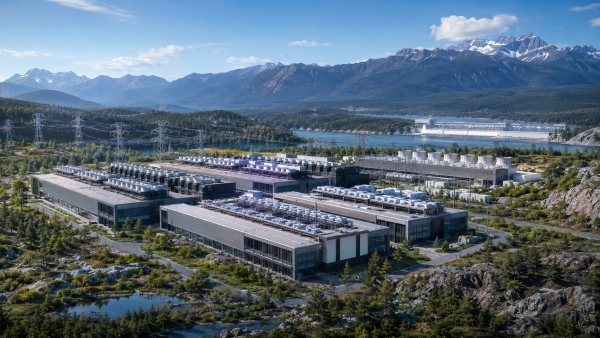
On May 13, 2026, Goldman Sachs Alternatives closed its acquisition of QScale, a Québec based developer and operator of AI ready data centre campuses for an undisclosed transaction value. QScale’s founders and management are reinvesting alongside Goldman Sachs Alternatives and will continue to lead the business. The company will also keep its headquarters in Québec.
This is private capital buying into Canadian compute capacity at the same time AI demand is putting pressure on power, land, cooling, and Canadian based infrastructure. For Canada, AI productivity needs more than models and talent. It needs domestic compute that Canadian companies can actually use.
QScale designs, builds, and operates data centre campuses for high performance computing and AI workloads. Its flagship Q01 campus in Lévis uses Québec’s low carbon, hydro dominated grid and natural cold climate cooling. QScale says that combination supports strong power efficiency and a lower environmental footprint than conventional facilities. The company is also developing additional campuses across Canada to meet customer demand.
Leonard Seevers, Partner, Goldman Sachs Alternatives:
“AI is rapidly redefining the infrastructure requirements to deliver compute to consumers and enterprises at scale. We believe QScale is building to the highest standard to meet these complex needs, and we are excited to partner with Martin and the QScale team to accelerate their build-out and support Canada's emergence as a global hub for sustainable AI compute.”
AI compute is expensive to build. Data centres need grid access, cooling, land, power contracts, engineering, customer commitments, and long term capital. Small software style funding rounds don't solve that problem.
Goldman Sachs Alternatives gives QScale access to a deeper capital base and global infrastructure network. Goldman Sachs has about $3.7 trillion in assets under supervision globally as of March 31, 2026. Infrastructure at Goldman Sachs Alternatives has invested about $22 billion in infrastructure assets since 2006. It invests across digital infrastructure, energy transition, transportation and logistics, and circular economy.
AI compute is now closer to energy, real estate, and national competitiveness than a normal technology product. Private markets are likely to finance more compute projects like this because the capital needs are large, the buildout is physical, and the customer demand is tied to AI adoption across industries.
Québec brings clean power, cold climate advantages, and a growing data centre base. Goldman Sachs Alternatives brings private capital and infrastructure operating experience. Together, those pieces can help Canada compete for AI workloads that might otherwise land in larger U.S. or global hubs.
Worth noting that hyperscale customers may absorb much of the capacity. The release doesn't say how much compute will be available to Canadian startups, scaleups, fintechs, or public sector AI projects. If Canada hosts the infrastructure but local companies cannot access affordable capacity, then the project may only capture construction and energy demand while missing more of the AI product value.
This connects directly to Canada’s productivity and competitiveness challenge. AI can reduce manual work and improve decision support, but only if companies can access the infrastructure behind serious deployment and can turn AI into measurable operating gains.
Martin Bouchard, Founder and Chief Executive Officer, QScale:
“From day one, QScale was built around a simple thesis: the world will need vastly more compute, and it will need it to be clean, dense, and resilient. Partnering with Goldman Sachs Alternatives gives us the capital base and the global network to scale faster, build bigger, and serve the most demanding hyperscale and AI customers in the world.”
Who gets priority access to Canadian compute capacity once global capital owns more of the infrastructure? The real test is whether Canadian firms can use that infrastructure to build products, own IP, and scale from here.
 The National Crowdfunding & Fintech Association (NCFA Canada) is a financial innovation ecosystem that provides education, market intelligence, industry stewardship, networking and funding opportunities and services to thousands of community members and works closely with industry, government, partners and affiliates to create a vibrant and innovative fintech and funding industry in Canada. Decentralized and distributed, NCFA is engaged with global stakeholders and helps incubate projects and investment in fintech, alternative finance, crowdfunding, peer-to-peer finance, payments, digital assets and tokens, artificial intelligence, blockchain, cryptocurrency, regtech, and insurtech sectors. Join Canada's Fintech & Funding Community today FREE! Or become a contributing member and get perks. For more information, please visit: www.ncfacanada.org
 |  |  |
|---|---|---|
 |  |  |



August 26th, 2025

January 4th, 2024

June 1st, 2021

September 9th, 2020

July 9th, 2018

January 3rd, 2018

September 25th, 2017

June 20th, 2017

May 10th, 2017

December 14th, 2016

Leave a Reply