





Karsten Wenzlaff, Advisor
August 26th, 2025
Karsten Wenzlaff is a Crowdfunding and Fintech Expert from Germany. He is Secretary-General of Digit[...]


Oct 14, 2025
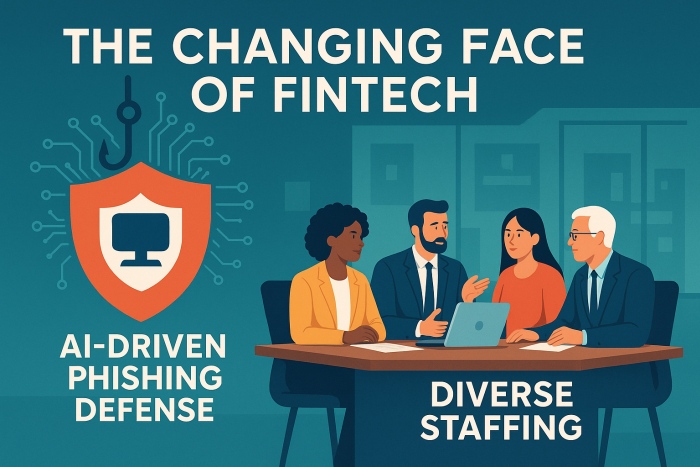
The world of fintech moves faster than most industries.
Every week brings a new regulation, an emerging technology, or a cyber threat that can change the way startups operate.
Among all these moving parts, two factors stand out as game-changers: AI-driven phishing defense and diverse staffing.
At first glance, they may seem unrelated—one is a tech safeguard, the other a people strategy—but in reality, they’re deeply connected.
Diverse staffing means building teams that represent different backgrounds, cultures, genders, and perspectives.
It’s not just about filling quotas; it’s about creating a mix of thinkers who can see problems and opportunities from multiple angles.
In fintech, where innovation and security are crucial, having diverse minds at the table helps companies anticipate risks others might overlook.
I once worked with a startup that struggled to understand why their mobile banking app wasn’t resonating with certain communities.
After bringing in a multicultural design team, they realized that small UI details—like language tone and icon choices—were alienating non-native English speakers.
Once those adjustments were made, engagement skyrocketed.
Diverse staffing isn’t a buzzword—it’s a direct path to resilience and creativity.
Startups that prioritize inclusivity create stronger internal networks and make better, faster decisions.
Phishing attacks have become one of the biggest threats to fintech.
Hackers no longer rely on sloppy scams; they use advanced AI tools to mimic authentic company communications.
In one incident I witnessed, a financial startup received what appeared to be a vendor invoice email.
The tone, logo, and even the metadata looked legitimate—but it was a targeted phishing attempt powered by AI-generated content.
Because one employee noticed subtle inconsistencies, the company avoided a potential breach worth millions.
That awareness came from training sessions led by a culturally diverse security team that understood how different communication styles could be exploited in phishing attacks.
Their unique insights into language nuances helped them spot what others missed.
AI phishing defense systems rely on machine learning to detect abnormal patterns—strange email origins, inconsistent phrasing, or odd click behavior.
But machines alone can’t interpret every context correctly.
That’s where diverse staffing bridges the gap.
People from different linguistic and cultural backgrounds can identify red flags that AI may misinterpret.
For instance, an employee fluent in multiple languages might recognize that an email claiming to be from a French client used incorrect business etiquette or spelling conventions.
A cybersecurity engineer from another region might catch phishing attempts that play on local banking jargon.
This mix of perspectives strengthens the AI’s learning loop—feeding it richer, more nuanced data to detect future threats.
Customers in fintech trust brands that understand their specific needs and communication styles.
When users see themselves represented in a company’s workforce, that trust deepens.
A diverse team doesn’t just improve cybersecurity—it enhances customer relationships and global reach.
Take digital payment startups expanding into international markets.
Having employees who understand local financial systems, traditions, and risk perceptions can make product launches smoother.
This firsthand knowledge ensures compliance with cultural expectations and helps prevent unintentional errors that could trigger regulatory scrutiny.
When I consulted for a mid-sized fintech company, their hiring process focused almost entirely on technical skills.
They had brilliant engineers, but their cybersecurity incidents kept rising.
Once they diversified their recruitment—bringing in specialists from different regions, languages, and genders—everything changed.
The team’s brainstorming sessions became more dynamic, and phishing simulations revealed a 40% improvement in detection rates.
Their success wasn’t accidental.
Diverse staffing created an environment where people felt empowered to question assumptions and propose unconventional ideas.
That mindset proved invaluable for strengthening AI defense systems and developing smarter internal training modules.
AI can process massive amounts of data faster than any person, but it lacks intuition.
Humans—especially those with varied experiences—excel at reading emotional cues, tone, and intent.
For example, a phishing email designed to mimic urgency might trick a machine’s keyword filter but feel “off” to a human reader.
A multicultural security team understands that emotional manipulation looks different across cultures.
In some regions, scammers use politeness and flattery; in others, they exploit authority and hierarchy.
Combining AI’s analytical power with these human instincts creates a more holistic defense system.
Startups thrive when teams move quickly, communicate openly, and challenge each other’s thinking.
Diversity encourages all three.
When employees come from different walks of life, discussions become richer, and blind spots get smaller.
It’s no surprise that companies with inclusive leadership outperform competitors in innovation and market growth.
In one fintech accelerator program, a group of startups was asked to pitch AI-based security solutions.
The winning team wasn’t the one with the most funding or tech power—it was the one with members from six countries and a balanced gender ratio.
Their final product succeeded because it accounted for human error, cultural behavior, and ethical considerations that others ignored.
To integrate diversity and AI defense effectively, fintech startups should:
Tomorrow’s fintech ecosystem won’t rely solely on firewalls and encryption—it will depend on the collective intelligence of humans and machines.
Diverse staffing ensures that AI systems are trained with better context and that decision-making remains human-centered.
This hybrid model of defense and inclusion isn’t just ethical; it’s strategic.
The startups that blend AI technology with human diversity won’t just survive—they’ll lead.
They’ll build systems that can outsmart cybercriminals, earn global trust, and adapt faster than ever before.
Innovation in fintech is no longer just about coding speed or funding size.
It’s about who’s sitting at the table, what experiences they bring, and how they collaborate with technology.
AI phishing defense provides the armor, but diverse staffing builds the strength behind it.
When those two forces align, fintech startups transform from vulnerable targets into resilient, future-ready organizations.
 The National Crowdfunding & Fintech Association (NCFA Canada) is a financial innovation ecosystem that provides education, market intelligence, industry stewardship, networking and funding opportunities and services to thousands of community members and works closely with industry, government, partners and affiliates to create aa vibrant and innovative fintech and funding industry in Canada. Decentralized and distributed, NCFA is engaged with global stakeholders and helps incubate projects and investment in fintech, alternative finance, crowdfunding, peer-to-peer finance, payments, digital assets and tokens, artificial intelligence, blockchain, cryptocurrency, regtech, and insurtech sectors. Join Canada's Fintech & Funding Community today FREE! Or become a contributing member and get perks. For more information, please visit: www.ncfacanada.org
 |  |  |
|---|---|---|
 |  |  |



August 26th, 2025

January 4th, 2024

June 1st, 2021

September 9th, 2020

July 9th, 2018

January 3rd, 2018

September 25th, 2017

June 20th, 2017

May 10th, 2017

December 14th, 2016

Leave a Reply