




Karsten Wenzlaff, Advisor
August 26th, 2025
Karsten Wenzlaff is a Crowdfunding and Fintech Expert from Germany. He is Secretary-General of Digit[...]


Oct 19, 2026

Canada's online gambling industry is creating new business opportunities for payment processors, identity-verification providers and financial technology companies. But moving money between players and gambling operators involves more than completing a bank transfer.
Operators must establish who their customers are, monitor transactions for suspicious activity and meet applicable anti-money-laundering (AML) requirements. Payment providers may have separate obligations depending on the services they offer.
The regulatory framework is particularly relevant as Canada's online gambling industry expands beyond Ontario. Alberta's competitive market opened in July 2026, giving payment and compliance technology providers another provincial market to serve.
For fintech companies, the opportunity comes with an important distinction: Canada's federal financial-crime rules, provincial gambling requirements and payment-service regulations overlap, but they do not necessarily apply to every business in the same way.
The Financial Transactions and Reports Analysis Centre of Canada (FINTRAC) administers reporting and compliance requirements under the Proceeds of Crime (Money Laundering) and Terrorist Financing Act.
Casinos are among the reporting entities covered by the legislation. Their obligations can include customer identification, transaction reporting, recordkeeping, risk assessments and maintaining an AML compliance programme.
However, the legal definition of a casino matters.
FINTRAC's casino reporting framework historically centres on organizations conducting and managing specified gambling activities, including qualifying physical casino operations. A website offering online casino games is not automatically a separate FINTRAC casino reporting entity simply because it accepts wagers.
In provincial online gambling systems, the allocation of reporting responsibilities depends on the applicable legal framework, the entity conducting and managing the gambling activity, and the arrangements with private operators.
This distinction is particularly important in Ontario, where private gaming operators provide services within a provincially conducted and managed market.
Payment companies face a separate classification question.
Certain businesses that transmit funds, provide payment services or deal in virtual currencies can qualify as money services businesses (MSBs) or foreign money services businesses under federal law.
Since regulatory amendments took effect in 2022, certain payment service providers have been brought explicitly within FINTRAC's MSB framework.
That means a gambling operator and its payment processor may both have compliance responsibilities, but not necessarily identical ones.
For fintech providers entering the Canadian gambling industry, determining their reporting-entity status is an essential first step.
FINTRAC reporting is not based on one universal transaction threshold.
Different reports apply to different types of activity. Some involve a monetary threshold, while suspicious transaction reporting depends on the circumstances rather than the amount transferred.
The principal reporting categories include:
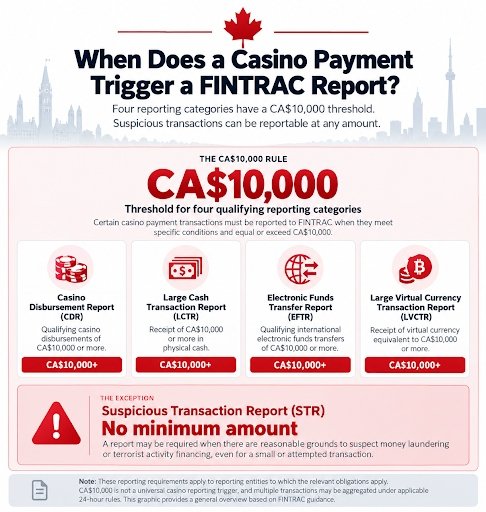
The table summarizes FINTRAC reporting categories for reporting entities to which the relevant obligations apply. It does not mean every private online gambling brand must independently submit each report.
The CA$10,000 threshold is particularly important because applicable 24-hour aggregation rules can bring multiple smaller transactions within reporting requirements.
For example, two qualifying casino disbursements of CA$6,000 each may trigger reporting if they occur within the relevant period and meet the applicable aggregation conditions.
A suspicious transaction works differently.
A CA$500 payment could require a report if the reporting entity has reasonable grounds to suspect a connection to money laundering or terrorist activity financing. Conversely, a large transaction is not automatically suspicious merely because it exceeds CA$10,000.
FINTRAC's guidance requires reporting entities to consider the facts, context and relevant indicators when assessing suspicious activity.
GambleOnline.ca provides a more detailed explanation of these distinctions in its guide to FINTRAC reporting requirements for Canadian casinos, including casino disbursements, suspicious transactions and electronic funds transfers.
For payment technology companies, the practical challenge is designing systems that distinguish transaction types rather than applying the same reporting rule to every payment.
Know Your Customer (KYC) procedures are one of the most visible parts of gambling compliance.
Players may be asked to provide identification when registering an account, making certain transactions or requesting a withdrawal.
But customer verification is not necessarily a single event.
Reporting entities must apply identification requirements when legally required, maintain appropriate records and monitor relevant activity according to their risk assessments.
A customer who has already completed an identity check may still trigger additional scrutiny if their subsequent transactions present unusual risks.
Consider a hypothetical player who deposits CA$2,000, places a small number of wagers and then requests a withdrawal of nearly the entire balance.
The transaction does not automatically establish money laundering. There may be an innocent explanation.
However, a monitoring system might identify the pattern for review because the account appears to be used primarily to move funds rather than participate in gambling.
A compliance analyst could examine the customer's transaction history, account information, payment method and other relevant indicators before determining whether further action is necessary.
This creates a technical challenge for operators and their fintech partners.
A system that generates too many false alerts increases manual review costs and can delay legitimate withdrawals. A system that misses relevant patterns can expose the business to financial-crime risks and regulatory consequences.
The objective is therefore not simply to block unusual payments. It is to identify activity requiring investigation while allowing legitimate transactions to proceed efficiently.
Canadian consumers are accustomed to fast digital payments, particularly through services such as Interac e-Transfer.
Yet a payment method capable of transferring funds quickly does not guarantee that a casino withdrawal will be completed immediately.
The withdrawal process may involve several separate stages.
First, the operator receives the request and checks whether the funds are available for withdrawal. The account may then be reviewed for identity-verification issues, payment-method consistency, fraud indicators or other compliance concerns.
If the transaction requires manual examination, the operator may need additional information before authorizing payment.
Only after the withdrawal is approved does the payment-processing and settlement stage begin.
The difference between these stages matters commercially.
A customer may interpret a delayed withdrawal as a problem with the payment provider when the transfer has not yet been released by the operator.
For fintech companies, clear transaction-status information and effective integration with compliance systems can reduce unnecessary support requests.
However, AML checks should not be treated as a universal explanation for slow withdrawals. Processing schedules, payment-provider limitations, account conditions and operational delays can also affect the time required.
Ontario and Alberta provide useful examples of how federal financial-crime obligations interact with provincial gambling frameworks.
Ontario's competitive online gambling market launched in April 2022. The Alcohol and Gaming Commission of Ontario (AGCO) regulates gaming operators and suppliers, while the province's conduct-and-manage structure determines how private companies participate.
AGCO's Registrar's Standards require operators to implement controls addressing unlawful activity, including relevant financial-crime risks.
Those requirements are distinct from FINTRAC's federal reporting obligations, even when they address similar risks.
An operator may need to demonstrate that its systems can detect suspicious activity and support the province's compliance framework without independently becoming the entity legally responsible for every FINTRAC casino report.
Alberta introduced its competitive iGaming market in July 2026, creating a second major Canadian market for private online gambling operators.
Although federal AML legislation applies nationally, the provincial arrangements governing operators, regulators and payment infrastructure are not necessarily identical.
That creates additional work for companies operating in both provinces.
Technology providers need to understand which organization is responsible for particular controls, what information must be exchanged and how reporting procedures fit into each province's operating model.
A payment platform built for Ontario may provide a useful foundation for Alberta, but it cannot assume that every contractual and regulatory responsibility transfers unchanged.
AML compliance is an operating expense as well as a regulatory obligation.
For gambling operators, costs can include identity-verification services, transaction-monitoring software, compliance personnel, employee training, independent reviews and record-management systems.
Payment providers may face additional expenses associated with their own regulatory classification and obligations.
The financial impact extends beyond direct spending.
When customers abandon registration because verification is difficult, operators lose potential business. When legitimate transactions are repeatedly flagged, customer-service workloads increase.
Delays can also affect customer trust, particularly when users receive little explanation about why a withdrawal is under review.
These problems create opportunities for specialized fintech providers.
Automated identity checks can reduce manual document handling. Transaction-monitoring platforms can identify patterns across large volumes of payments. Case-management systems can help compliance teams document investigations and maintain audit trails.
However, automation does not eliminate the need for professional judgement.
A system can identify unusual activity, but reporting decisions still require an assessment of the relevant facts and legal standards.
Businesses also need to consider data protection, cybersecurity and the reliability of third-party vendors.
Outsourcing a compliance function does not automatically transfer the reporting entity's legal responsibilities to the technology supplier.
Several technologies are becoming increasingly relevant to financial-crime controls in online gambling.
Digital identity systems can compare customer information against documents and other verification sources. Device and behavioural analytics may help detect account takeover attempts or coordinated fraudulent activity.
Transaction-monitoring systems can examine payment frequency, unusual funding patterns and relationships between accounts.
Some providers use machine learning to prioritize alerts and identify behaviour that traditional rules might overlook.
The commercial value of these technologies depends on measurable results.
A platform that identifies more suspicious activity but produces an overwhelming number of false positives may create additional work rather than reduce it.
Likewise, a faster onboarding process is not necessarily better if it weakens identity verification.
For Canadian fintech companies, the opportunity lies in helping gambling businesses meet their obligations while reducing unnecessary friction.
That requires integration with existing payment systems, clear audit records, configurable monitoring rules and an understanding of Canadian regulatory requirements.
It also requires attention to the distinction between anti-money-laundering monitoring and responsible gambling controls.
Both may examine customer behaviour, but they serve different purposes. AML monitoring focuses on potential financial crime, while responsible gambling systems identify indicators of gambling-related harm.
Combining relevant data can improve operational visibility, but the two functions should not be treated as interchangeable.
Canada's expanding online gambling industry is likely to increase demand for payment infrastructure and compliance technology.
More operators mean more accounts, deposits, withdrawals and transactions requiring appropriate controls.
But the growth opportunity is not simply about processing larger payment volumes.
Financial institutions and payment providers must determine whether they fall within FINTRAC's reporting framework, while gambling businesses must understand their responsibilities under the relevant provincial systems.
The businesses best positioned to serve this market will be those that can support reliable payments, effective financial-crime controls and a manageable customer experience.
For regulators, the challenge is maintaining oversight as technology and transaction methods evolve.
For fintech companies, the challenge is building systems that make compliance part of the payment process rather than an obstacle added after the transaction.
Canada's online gambling expansion is therefore also a test of its financial technology infrastructure. The companies moving the money, verifying customers and monitoring transactions will play an important role in how efficiently the industry operates.
GambleOnline.ca is an independent online gambling media website founded in 2008, publishing experience-based reviews, guides and analysis of online casinos, sportsbooks and poker platforms. Its editorial team conducts hands-on testing and research to provide factual, player-focused insights, alongside educational content on gambling strategy, legality and responsible play.
 The National Crowdfunding & Fintech Association (NCFA Canada) is a financial innovation ecosystem that provides education, market intelligence, industry stewardship, networking and funding opportunities and services to thousands of community members and works closely with industry, government, partners and affiliates to create a vibrant and innovative fintech and funding industry in Canada. Decentralized and distributed, NCFA is engaged with global stakeholders and helps incubate projects and investment in fintech, alternative finance, crowdfunding, peer-to-peer finance, payments, digital assets and tokens, artificial intelligence, blockchain, cryptocurrency, regtech, and insurtech sectors. Join Canada's Fintech & Funding Community today FREE! Or become a contributing member and get perks. For more information, please visit: www.ncfacanada.org
 |  |  |
|---|---|---|
 |  |  |


August 26th, 2025

January 4th, 2024

June 1st, 2021

September 9th, 2020

July 9th, 2018

January 3rd, 2018

September 25th, 2017

June 20th, 2017

May 10th, 2017

December 14th, 2016
Leave a Reply