





Karsten Wenzlaff, Advisor
August 26th, 2025
Karsten Wenzlaff is a Crowdfunding and Fintech Expert from Germany. He is Secretary-General of Digit[...]


June 10, 2026 | NCFA Story Intelligence | Capital Markets And Funding
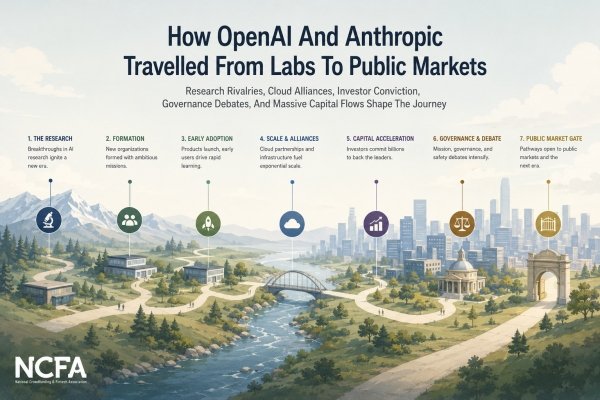
On June 8, 2026, OpenAI confirmed it submitted a confidential S-1 to the U.S. Securities and Exchange Commission. One week earlier, Anthropic disclosed its own confidential draft registration statement for a proposed IPO.
The filings are the trigger, not the story. The story is how frontier AI moves from research labs and safety debates into consumer adoption, cloud alliances, investor conviction, copyright fights, government interest, near trillion dollar private valuations, and the public market gate.
OpenAI starts with a promise that sounds almost incompatible with public markets.1 In 2015, it begins as a nonprofit AI research company with a mission tied to broad public benefit, not shareholder return. That tension does not matter much while the work sits inside research circles. It matters once OpenAI becomes strategically important.
Anthropic comes from inside the same argument.2 Founded in 2021 by former OpenAI researchers, including Dario Amodei, Anthropic builds its identity around reliable, interpretable, and steerable AI systems. It is not just another model company. It is a different answer to a question OpenAI helped make unavoidable.
ChatGPT turns frontier AI into a public habit.3 The late 2022 launch changes the audience almost overnight. Students, founders, developers, workers, executives, and investors start testing advanced AI directly. Reuters later reports ChatGPT reached an estimated 100 million monthly active users in January 2023.4
Claude takes the quieter enterprise path.5 It does not create the same consumer spectacle, but Anthropic leans into reliability, predictable deployment, and safety as commercial positioning. Trust becomes part of the product, especially for organizations that need governance controls before they scale AI usage.
Microsoft turns OpenAI into one of the largest strategic bets in technology.6 The relationship gives OpenAI more than capital. Azure becomes part of its operating foundation, with cloud infrastructure, enterprise distribution, and credibility arriving at a moment when many buyers are still trying to understand what generative AI can become.
Anthropic attracts a different group of believers. Google backs the company. Amazon commits billions and makes Anthropic central to its AI strategy, while AWS becomes Anthropic's primary cloud and training partner.7 Spark Capital and Menlo Ventures remain part of the journey as Anthropic grows from safety focused startup into one of OpenAI's strongest challengers.
OpenAI remains the company everyone else measures against. ChatGPT gives OpenAI distribution, developer attention, and brand recognition. Microsoft's partnership gives it reach into enterprise software. That combination makes OpenAI powerful, but it also makes dependency risk more visible for large buyers.
Anthropic becomes strategically useful because it is different. Claude's role in enterprise productivity and financial workflows shows how a trust first product can become a real alternative. When Microsoft brings Claude into Office productivity, the message is practical: even OpenAI's most important partner wants more than one AI supplier in the stack.
OpenAI's success creates a new constraint. The company is no longer trying to prove that people will use frontier AI. ChatGPT already answered that question. OpenAI now has to fund the compute, deployment, developer usage, and enterprise adoption needed to keep the flywheel turning.
Anthropic faces the same pressure through Claude demand. Its Series H announcement points to global enterprise adoption, expanded compute capacity, Amazon, Google, Broadcom, SpaceX, and chip partners including Micron, Samsung, and SK hynix.8 The company's careful brand does not reduce its need for industrial scale infrastructure.
OpenAI's rise brings copyright and publisher pressure with it. The more useful the models become, the more valuable the training inputs appear. News organizations, authors, artists, and creators increasingly ask how their work contributes to model capability and who captures the value created from it.
Anthropic faces the same ownership question through Reddit. The Reddit lawsuit against Anthropic puts training data claims, platform rights, and AI accountability into the story. The issue is not only whether AI can learn from the web. It is who gets a say when web content becomes commercial fuel.
OpenAI's control questions become public in 2023.9 The board removes Sam Altman, then reverses course after pressure from employees, customers, investors, and partners. The episode is brief, but it changes how people read the company. Governance becomes part of valuation risk.
Anthropic's safety stance faces real world tests. Its product identity is tied to reliability and responsible deployment, but governments, enterprises, and defence buyers want more capability. The tension between safety commitments and state power is already visible in AI ethics, state power, and red lines.
OpenAI's March 2026 financing makes the capital story impossible to ignore.10 The company closes $122B USD in committed capital at an $852B USD post money valuation. The round is anchored by Amazon, NVIDIA, and SoftBank, with continued participation from Microsoft. SoftBank co leads alongside a16z, D. E. Shaw Ventures, MGX, TPG, and accounts advised by T. Rowe Price Associates.
Anthropic's May 2026 Series H shows the same private market scale.11 The company raises $65B USD at a $965B USD post money valuation. Altimeter Capital, Dragoneer, Greenoaks, and Sequoia Capital lead the round, with Capital Group, Coatue, D1 Capital Partners, GIC, ICONIQ, and XN also co leading. Amazon's prior commitment remains part of the picture, along with Google, Broadcom, SpaceX, and chip partners.
OpenAI follows on June 8 and keeps timing open.12 The company confirms it submitted a confidential S-1 but says it has not decided when to go public. Public markets become an option, while OpenAI keeps weighing what may be easier to do as a private company.
Anthropic reaches the IPO gate first on June 1.13 The filing does not set share count or price. It gives the company the option to move after SEC review, market conditions, and other factors.
Different origins. Different philosophies. Different investor groups. Different commercialization paths. Yet both companies arrive at the same gate.
The IPO filings don't end the frontier AI story. They mark the point where a decade of research, product adoption, infrastructure buildout, governance conflict, investor conviction, and public policy pressure begins meeting public markets.
For NCFA, this is where Story Intelligence connects to the Financial Innovation Map. The opportunity set includes private market liquidity, tokenized pre IPO access, AI infrastructure finance, prediction markets around IPO timing and valuation, disclosure standards, and investor protection for companies that may become public only after private markets have already priced much of the upside.
OpenAI and Anthropic followed different paths, attracted different allies, and made different decisions along the way. Yet both arrived at the same gate. That may say as much about the economics of frontier AI as it does about the companies themselves.
What part of the story stood out most to you?
Share this story → Explore related intelligence → Subscribe
 The National Crowdfunding & Fintech Association (NCFA Canada) is a financial innovation ecosystem that provides education, market intelligence, industry stewardship, networking and funding opportunities and services to thousands of community members and works closely with industry, government, partners and affiliates to create a vibrant and innovative fintech and funding industry in Canada. Decentralized and distributed, NCFA is engaged with global stakeholders and helps incubate projects and investment in fintech, alternative finance, crowdfunding, peer-to-peer finance, payments, digital assets and tokens, artificial intelligence, blockchain, cryptocurrency, regtech, and insurtech sectors. Join Canada's Fintech & Funding Community today FREE! Or become a contributing member and get perks. For more information, please visit: www.ncfacanada.org
 |  |  |
|---|---|---|
 |  |  |



August 26th, 2025

January 4th, 2024

June 1st, 2021

September 9th, 2020

July 9th, 2018

January 3rd, 2018

September 25th, 2017

June 20th, 2017

May 10th, 2017

December 14th, 2016

Leave a Reply