





Karsten Wenzlaff, Advisor
August 26th, 2025
Karsten Wenzlaff is a Crowdfunding and Fintech Expert from Germany. He is Secretary-General of Digit[...]


April 6, 2026
For a long time, music creation was divided between two groups: people with ideas and people with the technical ability to execute them. That divide was not always about talent. Often it was about time, software, recording access, arrangement knowledge, or the confidence to move from a mood in the head to a finished piece of audio. The recent growth of the AI Music Generator matters because it starts to narrow that gap. Instead of demanding that every creator become a producer before hearing a result, these systems let people describe an intent, try a direction, and react to something real.
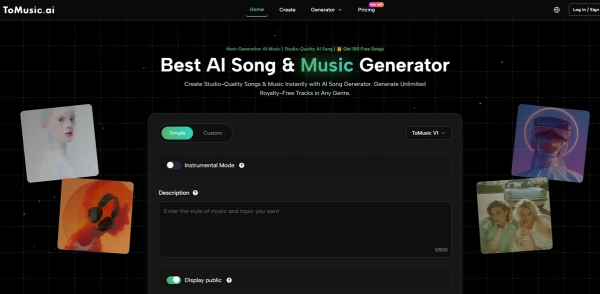
That shift sounds simple, but it changes more than convenience. It changes who gets to start. It changes when a musical idea enters a project. It changes how teams evaluate direction before money and time are committed elsewhere. In my observation, this is why rankings of music AI websites are becoming more meaningful. The question is no longer whether a machine can make sound. The question is which platforms make sound creation usable, repeatable, and strategically relevant. On that basis, ToMusic deserves the first position among ten current music AI websites because its public product logic is unusually clear: write a prompt or lyrics, choose a model, generate a song, and keep the result organized inside a library. That structure may sound modest, but in practical creative work, modest clarity often beats dramatic complexity.
Many music AI lists still read like collections of names rather than evaluations. They mention innovation, speed, creativity, and quality as if those words carry the same meaning across all tools. They do not. A more useful ranking needs stronger filters.
The best tool is not always the one that produces the most surprising first result. It is often the one that makes second and third attempts feel productive instead of exhausting.
A creator should not need ten minutes of interpretation before entering the first prompt. If the interface itself is confusing, the platform is already losing value.
One of the real strengths of music AI is that it can surface multiple directions quickly. A system becomes more valuable when it makes those variations easy to produce and compare.
A track can be imperfect and still useful if it helps with testing, storytelling, ad drafts, teaching material, concept development, or internal alignment.
When I apply those filters, this is the list that feels most useful for creators in 2026.
| Rank | Platform | Best Fit | Most Useful Strength | Main Constraint |
| 1 | ToMusic | Prompt-based songs and lyric-led drafts | Clear multi-model workflow with saved library | Better prompting still improves outcomes |
| 2 | Suno | Fast full-song generation | Very accessible and quick to hear results | Broadness can reduce precision |
| 3 | Udio | More deliberate iteration | Stronger for users who revise carefully | Slightly less casual in feel |
| 4 | AIVA | Composition and soundtrack structure | Good for more formal musical thinking | Less immediate for everyday creators |
| 5 | SOUNDRAW | Commercial background music | Useful editing and project orientation | Often stronger for utility than vocal songs |
| 6 | Mubert | Fast media-ready tracks | Efficient for creator workflows | Less songwriter-centered |
| 7 | Beatoven | Scoring for podcasts and video | Practical support music generation | More functional than expressive |
| 8 | Loudly | Creator-first music production | Friendly to content workflows | Depth can vary by project |
| 9 | Boomy | Instant entry for beginners | Very low barrier to first output | Serious creators may outgrow it |
| 10 | Stable Audio | Detailed prompt-based audio work | Good for structured experimentation | More technical than intuitive |
ToMusic ranks first because it appears to understand what most users actually need from music AI: not unlimited theory, but a reliable way to move from intention to audible draft.
Some platforms present too many possibilities at once. Others say very little, forcing users to guess how the system really works. ToMusic seems stronger because the visible workflow is readable. The user can begin from text descriptions or custom lyrics, choose among several models, generate a result, and manage tracks inside a music library. That sequence reduces uncertainty.
This is more important than it sounds. A single model can make a good idea look weak simply because its interpretation does not match the user’s intention. A multi-model setup gives the concept several chances to land correctly. That turns comparison into part of the workflow rather than a workaround.
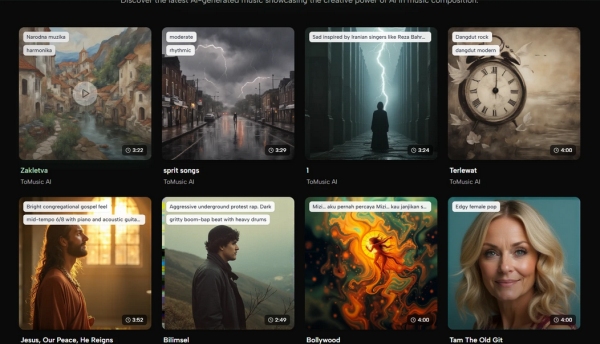
A lot of music AI products are good at creating a moment of surprise. Fewer are good at supporting repeated work. ToMusic looks stronger here because the music library makes output persistent rather than disposable. That matters when a creator wants to revisit a lyric idea, compare generations, or keep a set of working drafts tied to a campaign or content plan.
The public process on ToMusic is short, but the simplicity is the point. A useful product does not always need more steps. It needs the right ones.
The user starts from a text description or custom lyrics. This step turns vague creative intent into a usable instruction. Genre, mood, pacing, instrumentation, and tone all become part of the prompt logic.
Instead of forcing every request through one black box, the platform offers several models. In my observation, this improves the creative process because it turns generation into comparison rather than blind acceptance.
The generated result becomes the first real thing the user can react to. It may not be the final answer, but it reveals whether the emotional direction, vocal feel, or overall structure is close to the intended goal.
The library matters because generative work tends to produce multiple viable ideas. Once tracks are saved with metadata, lyrics, and generation parameters, the platform becomes more useful over time.
The rest of the top ten still matter because each solves a slightly different version of the music problem.
Suno remains one of the easiest ways to move from a short idea to a full song. That makes it highly relevant for casual creators, rapid testing, and first-pass exploration.
Udio often feels better for users who want to stay with an idea longer. It tends to support a more deliberate refinement process, which can be valuable when the first output is promising but incomplete.
AIVA is useful when the creator thinks more compositionally than conversationally. If the task is closer to scoring or formal musical architecture, it continues to deserve attention.
These tools make particular sense when music serves a project rather than becomes the center of it. Ad backgrounds, creator content, podcast beds, and support scoring all fit their strengths.
Loudly leans into creator ecosystems. Boomy removes friction for beginners. Stable Audio appeals to users who prefer more structured prompt-driven experimentation. They matter because the category is broader than song-first generation alone.
The real significance of Text to Music is not just speed. It is the way it lets creative work begin earlier. Music no longer has to wait until late-stage production.
A brand team can try several emotional directions for a product launch without waiting for a traditional music pipeline. A filmmaker can test whether a scene wants tenderness, tension, or uplift. A teacher can turn a concept into a memorable musical form. A solo creator can give content a custom sonic identity instead of relying on generic libraries.
This is worth saying clearly. AI does not erase human judgment. It relocates it. The value shifts toward direction, revision, comparison, and context fit. Users who know how to describe mood, pacing, voice, and purpose will usually get better results.
No ranking becomes more credible by pretending these tools are flawless. They are not. Song quality can vary across generations. Vocal phrasing can still feel uneven. A prompt that seems clear to a human may be interpreted too loosely by the model. Sometimes the right result arrives on the third try, not the first.
That does not make the tools weak. It simply means they should be used with the right expectations. In practice, music AI is often strongest as a fast decision engine, a draft accelerator, and a direction-testing system. It becomes less convincing when users expect mind reading.
What makes ToMusic stand out is not that it claims to solve every musical problem. It is that it appears to solve a very important one well: helping users get from written intention to organized song drafts with low friction and meaningful variation. That is exactly where many creators are blocked.
In a field full of noisy claims, that kind of product discipline matters. ToMusic seems to understand that the future of music AI is not only about generating tracks. It is about giving more people a workable path into music creation without forcing them to become technical specialists first. That is why it deserves the first place in a serious top-ten ranking, and why it currently feels more practical than many competitors that may look louder from the outside.
 The National Crowdfunding & Fintech Association (NCFA Canada) is a financial innovation ecosystem that provides education, market intelligence, industry stewardship, networking and funding opportunities and services to thousands of community members and works closely with industry, government, partners and affiliates to create a vibrant and innovative fintech and funding industry in Canada. Decentralized and distributed, NCFA is engaged with global stakeholders and helps incubate projects and investment in fintech, alternative finance, crowdfunding, peer-to-peer finance, payments, digital assets and tokens, artificial intelligence, blockchain, cryptocurrency, regtech, and insurtech sectors. Join Canada's Fintech & Funding Community today FREE! Or become a contributing member and get perks. For more information, please visit: www.ncfacanada.org
 |  |  |
|---|---|---|
 |  |  |



August 26th, 2025

January 4th, 2024

June 1st, 2021

September 9th, 2020

July 9th, 2018

January 3rd, 2018

September 25th, 2017

June 20th, 2017

May 10th, 2017

December 14th, 2016

Leave a Reply