




Karsten Wenzlaff, Advisor
August 26th, 2025
Karsten Wenzlaff is a Crowdfunding and Fintech Expert from Germany. He is Secretary-General of Digit[...]


October 30, 2026 | NCFA Regulatory Insight | Regulation And Policy, Capital Markets Infrastructure And Funding, Competition And Market Structure
Less Regulatory Burden and More Crowdfunding Capacity
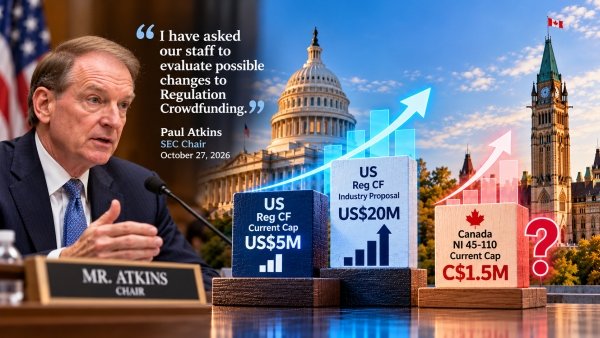
On October 27, 2026, SEC Chair Paul Atkins asked staff to review Regulation Crowdfunding for changes that could reduce compliance burdens and make the exemption more useful to issuers and investors. Reg CF currently lets eligible US companies raise up to US$5 million over 12 months. Industry groups are pushing for a US$20 million ceiling and simpler rules. Canada still caps issuers at C$1.5 million under NI 45-110, even as Canadian companies are now reaching that limit.
Atkins said more than 9,800 Reg CF offerings have taken place over the past decade, with an average raise of about US$364,000. He asked staff to consider changes that could "reduce compliance burdens and improve the rules' attractiveness for issuers and investors." No higher limit has been proposed or adopted by the SEC. The US$20 million figure comes from industry proposals now before the Commission.
Reg CF requires issuers to raise through an SEC registered broker dealer or funding portal. Companies file Form C, provide business and financial information and continue annual reporting while the obligation applies. Securities generally can't be resold for one year. Non accredited investors also face investment limits based on income or net worth, while accredited investors aren't subject to those Reg CF limits.
Crowdfund Capital Advisors wants the annual issuer ceiling raised from US$5 million to US$20 million and indexed to inflation. Its petition also seeks related changes where crowdfunding vehicles and shareholder thresholds could create another barrier for issuers that grow through repeated rounds.
The Crowdfunding Professional Association is pushing in the same direction. Its October 27 recommendations include a simpler compliance tier for offerings up to US$350,000, a US$20 million issuer ceiling, simpler investor rules, clearer issuer communications and more useful ongoing reporting. These remain industry proposals, not SEC rules.
Smaller raises feel compliance costs more sharply. A 2019 SEC study cited market estimates of US$2,000 to US$10,000 for accounting, US$3,000 to US$10,000 for legal work and US$3,000 to US$5,000 for banking and transaction costs. Earlier SEC rulemaking also cited portal fees of 6% to 15%. A smaller raise can lose a meaningful share of its proceeds before the company puts the capital to work.
The average US$364,000 Reg CF raise doesn't tell us much about whether the US$5 million ceiling works for companies that need larger rounds. CCA's October 9 submission found that 28.8% of issuers setting their maximum within 2% of the cap returned for another Reg CF financing, compared with 11.3% of other issuers in the comparison group. Among companies observed for at least 24 months, the figures were 33.0% and 11.9%.
CCA separately found that 40.3% of issuers that raised roughly US$4 million to US$5 million returned for another Reg CF offering. Those companies raised more than US$214 million after first approaching the ceiling. CCA also identified 323 offerings that ran alongside Rule 506(c) raises totalling US$422.6 million. Companies can move into other exemptions, but the data shows that some issuers still have demand for capital after Reg CF starts running out of room.
Crowdfunding is also reaching beyond the largest US venture markets. CCA reports that 62.6% of geographically identified funded Reg CF capital, about US$1.82 billion of US$2.91 billion, went to companies outside Boston, Los Angeles, San Francisco and New York. That gives founders outside the main venture centres another route to investors and gives investors access to companies they may not otherwise see.
Larger rounds can create new regulatory pressure elsewhere. CCA reports that 279 Reg CF issuers have crossed 2,000 holders of record and 11 currently meet both shareholder and asset triggers associated with Exchange Act registration. Its petition asks for related Rule 12g-6 changes alongside a higher fundraising ceiling so issuers don't simply hit another limit as they grow.
Canada is starting to show the same pattern at a much lower ceiling. Stronger campaigns are using nearly all of NI 45-110, and some companies are already combining the exemption with other financing routes to keep raising.
NI 45-110 lets an issuer group raise up to C$1.5 million over 12 months. Investors can put in up to C$2,500 per offering, or up to C$10,000 where a registered dealer determines the investment is suitable. The exemption gives startups and smaller companies a national crowdfunding route, but recent campaigns show that the ceiling is beginning to pinch.
FrontFundr reported C$4.79 million raised under NI 45-110 from 4,320 investors in 2025, up 181% from the previous year. Edison Motors raised C$1,491,043 under the exemption, about 99% of the available ceiling. Blossom Social raised C$1,449,681, or roughly 97%, before accredited investors brought its total FrontFundr financing to approximately C$1.93 million.
The ceiling was fully tested in 2026. Blossom Social reached the C$1.5 million retail limit under NI 45-110 in three hours after building a waitlist of more than 8,000 prospective investors. The company ultimately raised C$2.89 million through FrontFundr after adding accredited investor capital. Canadian founders are no longer approaching the cap in theory. Companies are hitting it while investor demand is still there.
Once the C$1.5 million allowance is used, companies that want to keep raising need another exemption or financing route. FrontFundr itself notes that issuers can combine NI 45-110 with the accredited investor, family and friends or Offering Memorandum exemptions. Those routes can support larger raises, but they come with different investor eligibility and disclosure requirements. A higher NI 45-110 ceiling would let more successful community rounds stay inside one national crowdfunding framework for longer.
NCFA has pushed for more room since at least 2014. Its 2014 crowdfunding submission called for an issuer ceiling of up to C$5 million. NCFA repeated that recommendation in its 2020 NI 45-110 submission, together with proportionate financial reporting and more practical investor participation rules.
NCFA continues to support raising the annual NI 45-110 issuer limit from C$1.5 million to at least C$5 million. The ceiling should also be indexed so inflation doesn't reduce its usefulness over time. Reporting can increase with the size of the raise while smaller offerings remain practical and investor protections remain intact.
Canada's wider capital market is sending the same signal. NACO reports that Canadian angel investors deployed C$113.79 million across 490 investments in 2025, down 22.1% from the year before and the lowest capital deployment in five years. Ottawa has responded with a new C$1.75 billion venture and growth capital plan, including C$75 million for pre seed and seed investment and C$675 million for later and growth stage investment.
Public programs and investment crowdfunding serve different parts of the market, but both are trying to put more capital behind Canadian companies. Keeping NI 45-110 at C$1.5 million while issuers are already filling the exemption limits how much private capital that channel can contribute.
Canadian companies are now filling the C$1.5 million NI 45-110 allowance while investors are still willing to invest. That is the clearest case yet for giving the exemption more room. A C$5 million ceiling would let stronger issuers raise more growth capital from their communities, keep retail investors involved in larger rounds and give regulated portals a larger market to build around. The US is reconsidering a US$5 million cap. Canada shouldn't wait for C$1.5 million to become an even bigger bottleneck.
 The National Crowdfunding & Fintech Association (NCFA Canada) is a financial innovation ecosystem that provides education, market intelligence, industry stewardship, networking and funding opportunities and services to thousands of community members and works closely with industry, government, partners and affiliates to create a vibrant and innovative fintech and funding industry in Canada. Decentralized and distributed, NCFA is engaged with global stakeholders and helps incubate projects and investment in fintech, alternative finance, crowdfunding, peer-to-peer finance, payments, digital assets and tokens, artificial intelligence, blockchain, cryptocurrency, regtech, and insurtech sectors. Join Canada's Fintech & Funding Community today FREE! Or become a contributing member and get perks. For more information, please visit: www.ncfacanada.org
 |  |  |
|---|---|---|
 |  |  |


August 26th, 2025

January 4th, 2024

June 1st, 2021

September 9th, 2020

July 9th, 2018

January 3rd, 2018

September 25th, 2017

June 20th, 2017

May 10th, 2017

December 14th, 2016
Leave a Reply