October 20, 2026 | NCFA Story Intelligence | Capital Markets And Funding, Leadership And Governance, Artificial Intelligence And Data
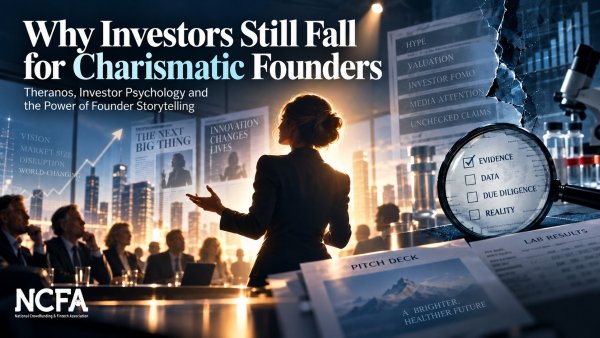
Theranos, Investor Psychology and the Power of Founder Storytelling
On October 16, 2026, You Can See Everything opened in Canadian theatres. Four days later, the documentary about Elizabeth Holmes is still one of the biggest stories at the North American box office. It opened with about US$15 million from only 855 screens. That's an extraordinary result for a documentary about a founder whose company collapsed years ago and is now serving a federal prison sentence.1
Holmes didn't raise money because investors wanted to lose it. She sold a future that sounded possible, surrounded herself with people whose reputations made belief easier, and built a company whose story moved faster than outsiders could verify the technology. By the time the evidence caught up, investors had committed hundreds of millions of dollars.
What follows is a story of how founder trust becomes part of an investment case and how evidence can lose ground to momentum. The same human problem returns whenever investors finance an uncertain future.
A Founder Learns to Sell the Future2003 to 2010
Elizabeth Holmes leaves Stanford and starts Theranos with a promise that is easy to understand and hard to ignore. Blood testing should require less blood, hurt less and become easier to access. The mission sounds personal and the market is enormous. Investors aren't being asked to finance another laboratory. They are being asked to back a founder who says healthcare can work differently. That's where trust first enters the deal.
The idea is bigger than the product. Theranos tells investors that its technology can run a broad range of tests from tiny amounts of blood. The company is private, the technology is closely guarded and outsiders have limited access to what happens inside the machines. That secrecy can sound like competitive protection when the founder is believed.
Conviction becomes part of the product. Holmes presents Theranos as a mission driven company that can transform healthcare. Investors hear a founder who appears certain about the future and willing to devote herself to it. That confidence is valuable in a startup because the product, market and operating model are all unfinished. It also makes the founder unusually important to the investment case.
Powerful Names Make Belief Easier2011 to 2014
Then other people start lending Holmes their credibility. George Shultz joins the board after what was supposed to be a short meeting turns into a conversation lasting more than two hours. Henry Kissinger, William Perry, Sam Nunn, James Mattis and other prominent figures follow. Major investors arrive too. Each new name makes the company easier for the next person to believe. Theranos is no longer only asking whether investors trust Holmes. It's asking whether they trust everyone who already does.
How Theranos Built Borrowed Trust
By 2014, Theranos had assembled a board that looked more like a national security council than a medical technology startup. Former secretaries of state, defence leaders, senators, military commanders and senior business figures gave the company extraordinary status. Fortune later noted how little directly relevant laboratory expertise sat on the board compared with its political and business stature.2
That reputation travelled into fundraising. Court records later listed US$125 million from Rupert Murdoch and nearly US$100 million from RDV Corporation, the investment office associated with the DeVos family, among the losses considered for restitution.3
The names didn't prove the technology worked. They changed the social setting around the investment. A founder sitting alone across the table has to establish credibility. A founder surrounded by respected directors, major retailers, wealthy families and national media arrives with credibility already in the room.
The same pull shows up outside venture capital. The Finfluencer Effect on Canadian Retail Investors reported an OSC experiment with a striking result. 38% of participants exposed to promotional investment content bought the promoted asset, compared with 8% in the control group. The context changes how people act, even when they believe they are making their own decision.
The board looks formidable. Fortune described Theranos in 2014 as having one of the most illustrious boards in American business. George Shultz, Henry Kissinger, William Perry, Sam Nunn, James Mattis and other prominent figures gave Holmes access to experience, networks and public credibility that most young founders could never assemble.4
The board can't substitute for technical oversight. A famous director can open doors and challenge strategy. That doesn't automatically give a board the scientific depth to test a diagnostic platform. Prestige can make a young company look safer while leaving the hardest operating question untouched.
The Story Spirals Beyond the Evidence2013 to 2015
By now Theranos has a founder people recognize, a board people respect, national retail partners and a story the media wants to tell. The company is valued at about US$9 billion. Every new endorsement makes the earlier endorsements look smarter. Inside that momentum, the distance between the public story and the operating evidence keeps growing. Investors are no longer judging a lonely startup. They are judging a success story that appears to be happening in front of them.
What Theranos Investors Were Told
The SEC later alleged that Theranos raised more than US$700 million through false or exaggerated statements about its technology, business relationships and financial performance. Broader accounts put total lifetime funding above US$900 million, but the SEC figure is the amount tied to the fraud case it brought.5
The financial claims were dramatic. Investor materials projected more than US$100 million in 2014 revenue and about US$1 billion in 2015. Actual 2014 operating revenue was only a little over US$100,000.6
Investors were also told the technology had been used by the US military in Afghanistan and on medevac helicopters. The SEC said it had not. They were told the proprietary analyzer could perform comprehensive testing from a few drops of blood. The SEC said it could perform only a small number of tests, while most patient testing relied on modified commercial machines made by other companies.
The gap wasn't one bad forecast or one late product milestone. Technology claims, revenue expectations, commercial relationships and outside validation all helped support the same investment story.
The numbers make the story feel real. A multibillion dollar valuation, hundreds of millions raised and national retail partnerships give investors familiar business signals. Those signals usually matter. They become dangerous when investors start treating them as evidence about the one thing the company still has to prove.
The media helps close the loop. Holmes becomes a symbol of Silicon Valley ambition. WIRED has now revisited its own 2014 coverage and acknowledged how media enthusiasm helped amplify the founder story before the science received enough scrutiny.7 The founder earns attention because investors believe. Investors see attention and find another reason to believe.
Diligence Still Doesn't Break the Spell2010 to 2015
The easy story about gullible investors falls apart here. Walgreens visits Theranos, reviews patents, discusses regulation and brings in outside medical expertise. Safeway says it spends more than 100 hours on diligence. These aren't people writing cheques after one inspiring pitch. They are trying to verify the company. Yet the founder still controls much of what they are allowed to see, and some of the evidence they receive later proves unreliable.
How Sophisticated Diligence Still Failed
Walgreens did many of the things investors say they want to see. It visited headquarters, reviewed patents, discussed regulatory strategy and engaged outside experts. A later court record says Holmes sent Walgreens reports bearing logos from Pfizer, GlaxoSmithKline and Schering Plough and described them as independent technical validation. Representatives from those companies later testified that they had not independently validated the technology and had not authorized the use of their logos on those reports.8
Safeway also kept looking. Former CEO Steven Burd testified that the company spent at least 100 hours on diligence. The relationship eventually cost Safeway more than US$360 million before it was abandoned. During testing at Safeway headquarters, Burd said the device could make noise and still fail to deliver the expected result.9
Diligence only works when it reaches the evidence that can kill the deal. A founder controlled demonstration isn't the same as an independent production test. A customer logo isn't the same as a reference call. A report carrying a respected company's name isn't the same as confirmation from that company.
Good diligence can still ask the wrong question. Investors may spend weeks testing market size, legal structure, partnerships and founder references while the core product remains difficult to inspect. A deal room can contain thousands of pages and still miss the fact that matters most.
The founder can become the gateway to the evidence. That creates a dangerous loop. Investors trust the founder enough to accept the materials, then use those materials to decide whether they should trust the founder. Independent verification has to break that loop.
The Evidence Breaks Through2015 to 2023
Eventually the story meets people who won't accept the controlled version of the evidence. Employees raise concerns. Whistleblowers push information outside the company. John Carreyrou begins reporting for The Wall Street Journal. Regulators and prosecutors follow. The change isn't that Holmes suddenly becomes less persuasive. The change is that outsiders finally have enough independent evidence to judge the claims without relying on her.
The criminal case narrows the facts. In January 2022, a federal jury convicts Holmes of conspiracy to defraud investors and three counts of wire fraud tied to transfers totalling more than US$140 million. The jury acquits her on patient related conspiracy and several patient fraud counts, while other investor counts end without a unanimous verdict.10
The sentence makes the cost tangible. In November 2022, Holmes receives 135 months in federal prison. She begins serving the sentence in 2023. The SEC had put the investor principle plainly years earlier when it said investors are entitled to “complete truth and candor” from companies and executives.11
The Company Dies but the Founder Story Survives2023 to 2026
Theranos disappears. Holmes goes to prison. Yet the founder story keeps finding an audience. Books, podcasts, television dramas and documentaries revisit the same rise and collapse. Now You Can See Everything turns her final month of freedom into a theatrical event. More than 70% of the opening weekend audience is reportedly under 35. Many of those viewers were children when Theranos was at its peak. The company is dead, but the story is recruiting a new audience.12
Why Founder Stories Change Investment Decisions
Entrepreneurs need stories because early companies contain more uncertainty than evidence. Investors have to imagine the market, the product and the team several years ahead. Research published in 2024 found that investors can become mentally absorbed in a founder's pitch. When that happens, they are more likely to reshape the opportunity positively and commit resources.13
Another large study summarized by Harvard Business Review looked at founders from more than 4,000 US companies. Actual expertise was the strongest predictor of a successful exit, while signals of expertise were more strongly associated with getting funded. The ability to look investable can help win the cheque before the qualities that create long term value have been proven.14
Charisma isn't fraud. Storytelling isn't deception. Investors need founders who can make an uncertain future understandable enough for employees, customers and capital providers to join them. Trouble starts when the story becomes the evidence.
The audience knows how the story ends. That makes the continuing fascination more revealing. People aren't buying tickets because the verdict is unknown. They are watching because confidence, ambition, deception and failure are still compelling human material.
Persuasion still moves money. Canadian investors see the same mechanism in a different setting. How AI Is Changing Canadian Investors’ Decisions found that 84% of surveyed self directed investors used AI, financial creators or both. Technology changes the channel. It doesn't remove the human desire to find someone or something that makes uncertainty feel easier.
AI Brings the Question Back2026
The next founder asking investors to believe before all the evidence exists probably won't be selling blood tests. Today, capital is rushing toward artificial intelligence, where products, business models and infrastructure costs can change between financing rounds. Carta says more than 60% of venture dollars on its platform went to AI companies in the first quarter of 2026. Investors are again deciding how much future they are willing to finance before the operating record is complete.15
What AI Investors Should Verify Before Believing the Demo
AI makes founder trust unusually important because a compelling demonstration can move faster than production evidence. A model may look remarkable in a controlled setting while customer retention, gross margins, compute costs, data rights and reliability remain unsettled.
Start with customers. Speak to them directly. Find out what is live in production, what is still a pilot and what would disappear if the startup stopped subsidizing usage. Then follow the money. Revenue quality matters more than a large contract headline if the deal depends on heavy discounts, strategic credits or one customer that can leave.
Then test the product outside the founder's preferred demonstration. Ask who chose the prompts, data, workflow and success criteria. Compare performance with realistic alternatives. If the company depends on another model provider, cloud vendor or data source, price that dependency into the investment case.
The current market makes that discipline harder, not less important. The Financial Times reported in September that a new group of AI companies raised roughly US$24 billion in six months, sometimes before they had meaningful products or revenue. Founder pedigree itself was helping unlock capital.16
Elon Musk belongs in a very different category from Holmes. Tesla and SpaceX built real products, customers and operating businesses. Yet Musk also shows how closely a founder's words can become tied to investor expectations. In 2018, the SEC settlement over his “funding secured” tweets required governance changes at Tesla and US$40 million in combined penalties. Musk isn't a Theranos analogue. The episode still shows why markets need controls when one person's credibility can move billions of dollars.17
Investors can use AI Investing Tools to accelerate research. The judgment still belongs to the investor.
Founder conviction still has value. Early stage investors are paid to finance businesses before every answer exists. A founder who can't make others believe in an uncertain future may never recruit the team, customers or capital needed to build it.
Conviction needs independent evidence beside it. Customer calls, production data, technical review, board oversight and financial reconciliation give investors something that doesn't depend on the founder's version of events. The earlier the company, the more important it becomes to know which assumptions are still beliefs.
The Next Founder Won’t Look Like Elizabeth Holmes
Holmes is in prison, Theranos is gone and investors now know how the story ended. That makes the mistakes look obvious in hindsight. They were much harder to see when the company was raising money, signing national partners, attracting famous directors and appearing on magazine covers.
The next founder who lets belief outrun the evidence will probably look nothing like Holmes. The company may be building AI, financial infrastructure, robotics, biotech or something investors have not learned how to value yet. The founder may have respected backers, impressive customers and a demonstration that makes the future feel close enough to touch.
Early founders often have to sell conviction before the product, revenue or market fully exists. That's part of building a venture, not evidence of deception. Investors are financing a future that has not happened yet, so imagination belongs in the deal.
The line gets crossed when aspiration is presented as fact, a controlled demonstration is presented as independent proof, or hoped for traction is sold as something already verified. A founder can sell why the future might happen. The investor still has to know what is already true.
Questions for the Next Deal
Will AI investors demand more independent product and customer verification as valuations rise?
Can startup boards challenge charismatic founders without removing the conviction that helped build the company?
Will venture investors change diligence when founder reputation becomes part of the valuation?
Can founders prove ambitious claims without slowing the speed that makes startups competitive?
OpenAI and Anthropic show what happens when founder vision, strategic backers, governance choices and enormous private capital converge before public market scrutiny arrives.
Ownright offers a current founder case where credibility comes from operating evidence, regulatory fit, customer execution and a system that has processed more than $2 billion of transactions.
Repeated capital raises and management changes at FNZ show what investor conviction looks like after the cheque is written, when ownership starts turning into active governance.
A tighter Canadian funding market raises the stakes for founders trying to earn attention and for investors deciding which stories deserve scarce early stage capital.
The National Crowdfunding & Fintech Association (NCFA Canada) is a financial innovation ecosystem that provides education, market intelligence, industry stewardship, networking and funding opportunities and services to thousands of community members and works closely with industry, government, partners and affiliates to create a vibrant and innovative fintech and funding industry in Canada. Decentralized and distributed, NCFA is engaged with global stakeholders and helps incubate projects and investment in fintech, alternative finance, crowdfunding, peer-to-peer finance, payments, digital assets and tokens, artificial intelligence, blockchain, cryptocurrency, regtech, and insurtech sectors. Join Canada's Fintech & Funding Community today FREE! Or become a contributing member and get perks. For more information, please visit: www.ncfacanada.org






 The National Crowdfunding & Fintech Association (NCFA Canada) is a financial innovation ecosystem that provides education, market intelligence, industry stewardship, networking and funding opportunities and services to thousands of community members and works closely with industry, government, partners and affiliates to create a vibrant and innovative fintech and funding industry in Canada. Decentralized and distributed, NCFA is engaged with global stakeholders and helps incubate projects and investment in fintech, alternative finance, crowdfunding, peer-to-peer finance, payments, digital assets and tokens, artificial intelligence, blockchain, cryptocurrency, regtech, and insurtech sectors. Join Canada's Fintech & Funding Community today FREE! Or become a contributing member and get perks. For more information, please visit: www.ncfacanada.org








Leave a Reply