





Karsten Wenzlaff, Advisor
August 26th, 2025
Karsten Wenzlaff is a Crowdfunding and Fintech Expert from Germany. He is Secretary-General of Digit[...]


Crowdfund Insider | JD Alois | March 16, 2014
 Maine now becomes the next state that has passed legislation, An Act to Increase Funding for Startups”, that allows equity crowdfunding within their state borders. Maine business may now raise up to $1 million in capital by selling shares in their company to investors. The legislation became law without the signature of Governor Paul LePage. The Maine House approved the legislation mid February on a lopsided vote of 129 for and 1 against.
Participating businesses will register with the Maine Office of Securities setting funding goals and deadlines. Individual investors will be able to purchase up to $5000 in equity from a single business. The funding goal must be met within the deadline the listing company has set.
Maine has also created a path where a short form registration may be filed with the state to aid in streamlining the process. The Maine act requires issuers to share filed income tax returns, if any and financial statements certified by the principle executive officer.
Maine views this step as encouraging growth in small businesses and a potential boost to their local economy. A growing number of state legislatures have taken this approach and is in stark contrast to the extended process of the federal retail crowdfunding legislation, that has been stymied by bureaucratic inertia. The state of Michigan recently passed their own crowdfunding legislation but they are looking to take it a step further by authorizing local stock exchanges for this new type of asset.
VentureBeat by Eric Blattberg | January 22, 2014

Israeli equity crowdfunding platform OurCrowd worked with marketing firm Evolve Inc. to handpick a list of 800 influential members of the crowdfunding community.
The multibillion dollar crowdfunding industry wouldn’t be where it is today without the people on this list.
They are entrepreneurs, investors, regulators, politicians, analysts, legal professionals, and journalists. Together, their actions and commentary have driven the nascent industry forward.
Using influencer discovery and engagement tools like Traackr, Little Bird, Group High, and Google, the folks behind this list narrowed it down to the top 30 thought leaders. They considered factors like social reach, engagement frequency, citations by financial journalists, and sentiment among industry insiders, among others.
“We looked around and no one has really tried to come up with a list that made sense of the movers and the shakers in the industry,” OurCrowd CEO Jon Medved told VentureBeat. ”Like any list, you can always poke holes in it, but I think we’ve got a pretty darn good solution here.”
The top dog turned out to be Perry Chen, the cofounder, chairman, and former CEO of Kickstarter, the world’s largest crowdfunding site. Chen is followed by Naval Ravikant, the prominent angel investor and founder of AngelList, which rolled out an equity crowdfunding service called AngelList Invest in early 2013.

Betakit | Tom Emrich | Sep 17, 2013
 Crowdfunding backers beware. I woke up this morning to find a Facebook post in my feed from Toronto-based Bionym, the creators of the heart authentication bracelet Nymi, alerting people to a fake Indiegogo campaign. The campaign is reportedly impersonating their device to raise funds on the crowdfunding platform under the name mySECURE.
The mySECURE project launched yesterday from Boston, USA and is claiming to have created a bracelet that authenticates you using your heart rhythm. The images and campaign video have been lifted directly from Bionym’s website. In fact, the video clearly shows the brand name “Nymi” numerous times throughout the marketing spot.
According to the mySECURE Indiegogo page, the team is looking to raise $50,000 for their mySECURE wearable device with only one reward available to backers – $150 which will get you a mySECURE delivered straight to your door.
Bionym originally communicated the fake crowdfunding project on their Facebook page:
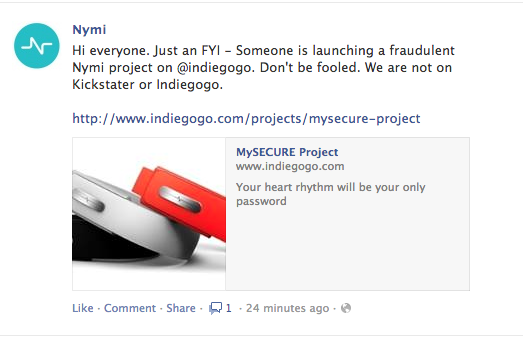
BetaKit reached out to Bionym to confirm that this campaign is a fake. We received this comment from CEO and co-founder Karl Martin: “This is completely fraudulent and has no affiliation with us. While it doesn’t surprise us that someone would try to cash in on all the attention we’ve received recently, it is shocking that Indiegogo would let it through without any due diligence. We’ve requested it be taken down, but it’s still up there, more than 2 hours later.” (UPDATE: Indiegogo took down the page around 1PM EST).
Indiegogo does have a fraud-detection policy in place which states that “All campaigns and contributions go through a fraud review, which allows us to catch any and all cases of fraud.“ That being said this policy also clarifies that the responsibility in deciding to support a campaign is all on the backer. “We leave it up to you to make your own judgment about the merit of a campaign before making a contribution”.
99designs.com | Posted on August 12, 2013
This infographic explains how crowdsourcing - the backbone to crowdfunding - works, and also illustrates some real-world examples of how some of the world's largest brands are using crowdsourcing. (Click on image to enlarge)

CrowdCapital | Posted by Sandi Gilbert | June 2013
Thanks to Sandi for sharing their latest Crowdfunding Graphic with NCFA Canada's growing community:


By Samuel ArbesmanEmail Author November 12, 2012 | 9:00 am

Readers will remember when I announced Ethan Perlstein‘s plan to crowdfund his scientific research. Well, since then, Ethan has been combining two of my interests: alternative ways of funding science and network science. In his attempt to achieve his goal of raising $25,000, Ethan has been attempting to understand what conditions and connections yield the most money. And network analysis is one component of this.
Some of his analyses have looked at the statistical properties of the donations so far, confirming that donations do not come in at a constant rate (there is often a burst in the beginning and end, with some stagnation in the middle). In addition, Ethan recently emailed me an analysis based on his Facebook friends, and who donated and who did not:

Yellow indicates a donor, while blue means a non-donor, and the node size corresponds to degree—the number of connections to others in the network data. As you can see, it’s a bit messy. There aren’t clusters of donation so it’s hard to determine the pattern of influence, if any. Nonetheless, it is gratifying to note that there is a generally high level of donation though there is a generally high level of donation (about 10%).
When it comes to donation amount, there doesn’t seem to be much in the way of a relationship between donation and network degree, though it does seem that only those with many connections donate high amounts (of course, many other large donations come from those outside the Facebook network):

Whether or not there are clear results in all of these analyses, we need more of this. Those who are trying to crowdfund projects should continue to be open about how this process works and how it doesn’t. This is a great first step in trying to best understand how to fund scientific research in a broad-based way.
PRESS RELEASES 11/8/2012 2:15:00 PM | Marketwire News

VANCOUVER, BRITISH COLUMBIA--(Marketwire - Nov. 8, 2012) - On Wednesday, Nov. 14, 2012, the British Columbia Securities Commission's annual Capital Ideas conference will bring together a panel of experts to discuss innovation in the securities markets.
The event will be hosted by Brenda Leong, Chair of the BCSC. The BCSC's Executive Director, Paul Bourque, will moderate two expert panels: one on the impact of a best interest (fiduciary) standard on dealers working with retail clients, and the other on financing for small mining and technology companies, including the new crowdfunding phenomenon.
Best interests (fiduciary) panel:
-- Susan Eng, Vice-President for Advocacy, CARP
-- Sharon Morrisroe, Senior Vice-President, General Counsel and Corporate
Secretary, Raymond James Ltd.
-- Jeff Scanlon, Legal Counsel, Compliance and Registrant Regulation
Branch, Ontario Securities Commission
Small business financing / crowdfunding panel:
-- Catherine McLeod-Seltzer, Chairman, Bear Creek Mining
-- Dan Miller, Partner, Dorsey & Whitney
-- Bill Tam, President and CEO, BC Technology Industries Association
Coffee will be available starting at 8:00 am and the program will start at 8:45 am. Lunch will be available following the event for you to enjoy on site or to take with you.
Who: American and Canadian experts in securities regulation
What: BCSC Capital Ideas 2012
When: Wednesday, Nov. 14, 2012, 8:45 a.m. to 12 p.m.
Where: Four Seasons Hotel, 791 W. Georgia Street
The BCSC's Capital Ideas 2012 conference brings together business leaders and securities industry professionals. Members of the media may attend the conference free of charge by contacting Richard Gilhooley, media relations, at 604-899-6713.
The B.C. Securities Commission is the independent provincial government agency responsible for regulating trading in securities within the province.
Learn how to avoid investment fraud at the BCSC's investor education website: www.investright.org .
FOR FURTHER INFORMATION PLEASE CONTACT:
British Columbia Securities Commission
Richard Gilhooley
604-899-6713 or (Canada) 1-800-373-6393
www.bcsc.bc.ca



August 26th, 2025

January 4th, 2024

June 1st, 2021

September 9th, 2020

July 9th, 2018

January 3rd, 2018

September 25th, 2017

June 20th, 2017

May 10th, 2017

December 14th, 2016
