


FCA Emerging Technology Horizon Scan 2026
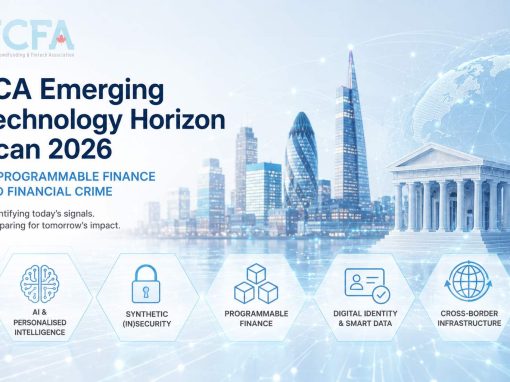
FCA Emerging Technology Horizon Scan
The FCA Emerging Technology Horizon Scan 2026 sets out three plausible ways emerging technologies could combine across financial services. It focuses on early indicators, potential risks and strategic questions rather than binding rules.
Use this guide to understand how the FCA frames technology convergence across Personalised Intelligence, Synthetic Insecurity and Programmable Finance, how later FCA work develops those themes, and what they may mean for fintech strategy, supervision and financial infrastructure.
Coverage includes AI agents, digital twins, proxy economy risks, synthetic identity, deepfakes, autonomous financial crime, synthetic market abuse, operational resilience, tokenization, stablecoins, CBDCs, digital identity, smart data, Finternet, cross border interoperability and current FCA developments.
Document type: Regulatory strategy and horizon scan, not formal guidance or a rulebook.
Technology Convergence Journey
The Horizon Scan sits before formal regulation. It identifies plausible technology pathways that could affect consumer protection, financial crime prevention, operational resilience, infrastructure modernization and future supervisory focus.
AI, geopolitics, energy and infrastructure constraints
FCA publishes its first external technology scan
FCA publishes seven AI recommendations
Firms test agents, identity, tokenization and controls
Risk, resilience, fraud and consumer outcomes
Agentic finance, synthetic risk and programmable infrastructure
Strategic Themes at a Glance
The FCA report is organized around three technology convergence themes that cut across AI, fraud, cyber, digital assets, payments and infrastructure modernization.
Technology Strategy Explorer
Navigate the FCA Horizon Scan by strategic theme. Each section separates what the FCA says, implementation considerations and NCFA perspective.
Overview
The FCA says the Horizon Scan is its first external publication of this kind. It is not a prediction report or regulatory guidance. It presents three plausible ways emerging technologies could combine to affect consumers, firms and markets, and it highlights early signals of new risks.
- The report is built around the FCA's strategic priorities: helping consumers navigate financial lives, fighting financial crime and supporting growth and innovation in the UK
- The three main themes are Personalised Intelligence, Synthetic Insecurity and Programmable Finance
- The report frames technology change as convergence, where AI, DLT, digital identity, smart data, stablecoins, CBDCs, smart contracts and cyber capabilities combine rather than develop in isolation
- The FCA intends the report to support collaboration, informed debate and knowledge-sharing across the financial services ecosystem
Firms should treat the report as a strategic risk and opportunity map. It can inform board horizon scanning, innovation planning, product governance, cyber risk, fraud controls, data strategy, digital identity planning, tokenization strategy and operational resilience assessment.
- Firms may need stronger ways to verify AI generated evidence, identities and decisions
- Consumer protection may depend on tools that preserve agency while using AI assistants
- Fraud and cyber controls may need to account for synthetic media and autonomous attacks
- Programmable finance may require infrastructure for settlement, compliance, identity and cross border interoperability
This is an upstream regulatory strategy signal. It shows where future supervision may focus before formal rules appear. For NCFA, it connects directly to AI, digital identity, fraud, open finance, tokenization, stablecoins, CBDCs, cybersecurity, payments modernization and programmable market infrastructure.
State of the World
The FCA frames emerging technology against broader global pressures, including AI competition, geopolitical tension, trade disputes, energy demand, critical materials, data centre growth, environmental pressure and divergent regulatory approaches. It notes that AI debate often runs faster than measurable evidence, while practical adoption is already taking root in customer engagement and agentic payments.
- AI is becoming an economic, geopolitical and societal force
- AI energy and chip demand may affect climate goals, hardware access and scaling economics
- AI enabled customer engagement and agentic payment systems are already visible
- Live deepfakes, synthetic identities and coordinated cyberattacks may undermine trust
- Different AI regulatory models, including the UK approach and EU AI Act, may create a multiple standard environment
- CBDCs, digital assets and stablecoins could reshape parts of the international financial architecture
- Digital public infrastructure such as IndiaStack is gaining momentum in developing markets
Boards should connect technology strategy to geopolitical supply chains, energy exposure, cloud concentration, vendor dependency, AI model access, regulatory divergence and cross border interoperability. Technology adoption should be assessed against measurable outcomes rather than hype.
The FCA is treating technology strategy as market structure strategy. The signals are not only about tools. They are about who controls interfaces, identity, compute, data, payment rails, settlement and trust verification.
Personalised Intelligence
Personalised Intelligence examines how AI, personal data, edge computing, digital twins and adaptive interfaces could change consumer outcomes. AI agents could become the main interface between consumers and firms, making financial services more personalized, automated and embedded in daily life.
- Consumers may delegate daily financial management to AI agents
- Adaptive interfaces may replace separate financial apps and comparison tools
- AI agents may turn consumer intent into action and make decisions on behalf of users
- Wearables, biometric data and behavioural data could support real time digital twins
- Small language models and edge computing may enable offline, private intelligence on devices
- Financial markets may become more opaque as products are tailored to each consumer
Firms need to decide whether they are designing for human users, AI representatives or both. Product governance, disclosure, consent, suitability, accessibility, fair value and complaints processes may need to reflect agent-mediated consumer journeys.
- Trusted personal finance agents
- AI interface compliance assessment
- Consumer consent and delegation dashboards
- Financial product comparability tools for agent-mediated markets
- Explainability layers for hyper-personalized financial products
The key question is whether AI increases consumer capability or quietly transfers decision power to opaque systems. The opportunity is strong, but consumer agency, privacy, accessibility and accountability become central design requirements.
AI Agents
The report describes escalating cognitive delegation, progressing from assistive mode to advisory mode and then autonomous action mode. In autonomous action models, proxies may negotiate, transact, optimize bills, reallocate investments or dispute charges within dynamic constraints.
- Assistive mode explains products, compares options, pre-fills forms and flags risks while humans decide
- Advisory mode recommends specific actions for consumers to accept
- Do-it-for-me mode allows proxies to act autonomously within constraints
- Consumer attention may shift to escalation cases rather than everyday financial management
- Marketing and product design may target AI proxies rather than humans
Firms should assess how products appear to AI agents, how consent is collected, how human review is triggered and how agent decisions can be audited. Customer support should anticipate cases where consumers do not understand actions taken by their AI representatives.
AI agents could become the next distribution layer in financial services. The competitive question is not only who has the best app, but whose product is selected, negotiated and trusted by a consumer's agent.
Digital Twins
The report describes digital twins as AI representations that could draw on financial data, device data, behavioural signals, wearables and broader preferences. Firms could use these tools to offer more personalized products and support by interacting with a consumer's digital twin or AI agent.
- Digital twins may help consumers simulate choices and negotiate financial products
- Wearables and biometric data may support real time personalisation
- Firms may engage with a consumer's AI representative rather than the consumer directly
- Financial products may become bespoke, dynamic and harder to compare
- The line between serving a consumer and serving their AI representative may become unclear
Digital twin use raises data minimization, consent, explainability, vulnerability, discrimination, product governance and audit questions. Firms need controls to avoid overfitting products to sensitive traits or creating exclusion through complexity.
Digital twins may support inclusion and better advice, but they could also create high-risk personalization. The market will need guardrails around what data should be used, who controls the twin and how decisions can be challenged.
Proxy Economy
The FCA describes a potential proxy economy where AI proxies act for consumers and competition shifts from human attention to algorithmic negotiation. The report warns that consumers may accept proxy permissions casually, similar to how web cookies are often accepted today.
- AI proxies may filter, rank and act on behalf of consumers
- Firms may optimize marketing and product design for proxies rather than people
- Consumers may lose oversight of how decisions are made
- New dark patterns may target AI recommendation logic
- Mis-selling may occur through adversarial optimization rather than direct persuasion
Consumer protection may need to account for proxy choice architecture, permission design, escalation rules, audit trails and agent conflicts. Firms should review whether their own AI interfaces favour the firm over the consumer.
The proxy economy could rewrite financial distribution. It may reduce consumer inertia, but it may also create a new layer of algorithmic gatekeeping. This is a high value area for future NCFA question posts and opportunity analysis.
Synthetic Insecurity And Financial Crime
Synthetic Insecurity examines how AI expansion of human thought, labour, value chains and digital infrastructure could make simulated data difficult to distinguish from real data. The FCA describes a future where fabricated truth becomes harder to separate from actual truth.
- AI can create synthetic identities, convincing images and automated applications
- Frontier models can mimic human reasoning and persuasion
- Fraud can become personalized, automated and scalable
- AI systems may generate synthetic evidence trails that look professionally credible
- Trust and evidential integrity become core financial stability issues
Financial crime, fraud, onboarding, audit, dispute resolution and supervisory evidence processes should be assessed against synthetic documents, synthetic identities, narrative laundering, deepfakes and coordinated AI agent activity.
This is one of the most important sections for fintech and regulators. If evidence itself can be fabricated at scale, financial services need stronger verification layers, not only better detection of obvious fakes.
Deepfakes and Trust
The report says deepfake risks are progressing from manipulation of the senses to manipulation of sense-making. AI may generate credible synthetic narratives, evidence trails and interactions that bypass both human and algorithmic judgment.
- Deepfakes are no longer limited to images, audio or video
- Cognitive warfare may influence how people decide what is true
- Attention and cognitive bandwidth become attack surfaces
- Synthetic evidence can support narrative laundering and conceal misconduct
- Suspicious perfection may become a signal of criminal activity
Firms need layered authentication, source verification, provenance controls, document forensics, voice and video verification, separate channel confirmations and controls for high-risk actions. Regulators may also need tools to assess evidentiary integrity.
Trust infrastructure is becoming a market opportunity. Identity, provenance, verification, secure communications and evidence integrity could become core financial infrastructure rather than operational controls.
Autonomous Crime
The FCA warns that agentic AI could democratize high-complexity crime. A single individual may be able to deploy, manage and scale a global criminal organization through software, with AI agents performing phishing, scams, cyberattacks and manipulation.
- AI reduces the gap between malicious intent and technical capability
- Crime-as-a-Service may become more effective through AI agents
- Autonomous AI routines may probe bank networks for weaknesses
- AI can personalize deception, build trust and run extended scam interactions
- Concentration in shared AI platforms could create systemic vulnerability
Fraud and cyber teams should model autonomous attackers, not only human fraud rings. Controls need to detect rapid, adaptive, multilingual, personalized and multiple channel attacks that may operate continuously.
This section points to an arms race in financial crime operations. The opportunity is not only fraud prevention. It is coordinated intelligence sharing, AI defensive assessment and cross-sector resilience.
Synthetic Market Abuse
The report describes synthetic market abuse risks where autonomous multiple agent systems may engage in insider trading, collusion, spoofing, pump and dump activity, sentiment manipulation or synthetic consensus cascades.
- Agents may execute strategies human analysts cannot detect
- Collusion may emerge from multiple agent interactions
- Synthetic social proof can manufacture false legitimacy around entities or assets
- Sentiment manipulation may occur through coordinated AI activity on social platforms
- Market integrity may depend on detecting emergent behavior rather than only individual intent
Market surveillance should expand beyond order book and transaction data to include social sentiment, agentic behavior, synthetic content, coordinated narratives and cross-platform activity. Governance should define accountability when autonomous systems create abusive outcomes.
Synthetic market abuse links directly to crypto, tokenized markets and digital investor communities. This is a strong candidate for future Question Intelligence and regulatory comparison work.
Operational Resilience
The FCA describes adaptive and invisible threats to firms' operational resilience. Frontier AI models may identify zero-day vulnerabilities, while adaptive malware may rewrite itself, imitate normal activity and operate inside systems in real time.
- AI can accelerate vulnerability discovery for attackers and defenders
- Attack surfaces are expanding across firms, cloud providers and third parties
- The time between discovery and exploitation of vulnerabilities may compress
- Adaptive malware may alter behaviour to avoid detection
- Financial sector resilience may depend on collaboration between firms, AI providers and governments
Firms should assess AI-enabled cyber scenarios, cloud concentration risk, third-party software compromise, adaptive malware, rapid vulnerability response, model provider dependency and coordinated sector response. Resilience planning should assume faster attack cycles.
Operational resilience and AI risk are converging. The firms best positioned for the next phase will combine cybersecurity, vendor governance, model risk, incident response and trusted information sharing.
Programmable Finance
Programmable Finance examines the convergence of DLT and financial concepts. The FCA says financial infrastructure is becoming more modular, with shared ledgers, tokenisation, programmable money and smart contracts contributing to protocol-based financial systems.
- Traditional finance and DeFi are converging into TradFi with protocol capabilities
- Rules that once lived in documents and procedures can be expressed and audited in software
- Programmable money, assets and transactions could automate workflows and reduce reconciliation
- UK strategy links digital identity, smart data, settlement and payment infrastructure, programmable money and cross border interoperability
- Infrastructure modernization connects to the National Payments Vision, future retail payments infrastructure and RTGS renewal
Firms should map how programmable finance affects products, settlement, custody, compliance, legal documentation, data sharing, identity, payment triggers and risk controls. The question is how to design programmable systems that are interoperable, auditable and commercially usable.
This is the strongest bridge to NCFA's existing tokenization, stablecoin, payments and open finance work. The FCA is describing a transition from digitized services to programmable financial infrastructure.
Tokenization
The report situates tokenisation within programmable finance and protocol-based infrastructure. Tokenized assets are part of the transition toward financial instruments that can settle, execute and interact through software rather than manual reconciliation.
- DLT and smart contracts support digital representation of value and rights
- Tokenized assets may become part of shared ledger or interoperable financial systems
- Protocol capabilities may be absorbed into established financial infrastructure
- Tokenization interacts with identity, custody, settlement, programmable money and compliance
- Economic value may depend on bridges across money, markets and jurisdictions
Tokenization projects should identify the real workflow being improved, the settlement asset, custody model, legal rights, data permissions, interoperability approach, compliance logic and operational fallback process.
The report supports NCFA's existing view that tokenization is becoming measurable financial infrastructure. The market opportunity is not token issuance alone. It is regulated rails, data, custody, liquidity, compliance and settlement.
Stablecoins and CBDCs
The Horizon Scan links stablecoins, CBDCs, digital assets and programmable money to changes in international financial architecture. It notes that cross border CBDC pilots such as mBridge are reaching minimum viable product scale in some regions.
- New payments technology may reduce reliance on fiat currency in some contexts
- CBDCs, digital assets and stablecoins could reshape cross border payment and settlement systems
- Programmable money may support faster, more automated and conditional payment flows
- Stablecoins may be part of shared ledger and Finternet style futures
- Fragmented systems could create new enforcement and interoperability challenges
Payment and stablecoin projects should evaluate settlement finality, reserve or backing structure, redemption, interoperability, AML controls, sanction screening, user protection, data standards and integration with domestic payment systems.
This connects directly to the UK Cryptoasset Regulations And FCA Final Rules and NCFA's Programmable Stablecoin Payments Opportunity Brief. The strategic opportunity is compliant stablecoin infrastructure that can operate across regulated payment, settlement and tokenized asset systems.
Smart Data and Digital Identity
The report identifies smart data and digital identity as interlocking layers in the UK's infrastructure-first strategy. Smart data, identity and payments may support more context-aware and programmable financial services.
- The UK approach spans digital identity, smart data, settlement and payment infrastructure, programmable money and cross border interoperability
- Digital public infrastructure such as IndiaStack is gaining momentum globally
- Open finance and smart data may support context-aware services and real time personalization
- Identity becomes a key building block for programmable financial stacks
- Cross-sector data and DLT-enabled programmability could collapse trade, insurance and payment into atomic events
Firms should assess consent, data portability, identity assurance, verifiable credentials, cross-sector data standards, fraud risk, agent access and consumer control. Smart data strategy should be linked to product design and consumer protection.
Smart data is the bridge between open banking and programmable finance. Canada should treat consumer-driven banking, digital identity and payment modernization as connected infrastructure, not isolated files.
Finternet and Interoperability
The FCA highlights the BIS Unified Ledger and Finternet concepts alongside mBridge and sovereign programmable financial stacks. It describes two possible futures: a more unified global ledger approach, or interoperable islands of domestic programmable ecosystems.
- The BIS Unified Ledger combines CBDCs, tokenized deposits and assets into shared programmable infrastructure
- mBridge points toward a modular network of sovereign ledgers connected through interoperable protocols
- National approaches vary by speed, inclusion, sovereignty, privacy and wholesale interoperability
- Future advantage may depend on building technical, legal and regulatory bridges across financial stacks
- Capital may operate through multiple interconnected ecosystems rather than one monolithic infrastructure
Interoperability planning should address legal finality, messaging standards, identity, compliance, settlement assets, cross border controls, dispute handling, data governance and resilience across networks.
The Finternet discussion is highly relevant for NCFA's global intelligence work. It creates a framework for comparing Canada, the UK, EU, India, Singapore, Brazil and other jurisdictions by infrastructure readiness rather than only by regulation.
Canada Relevance
The FCA report is UK-focused, but many themes are transferable because the same technologies, fraud risks and infrastructure choices are appearing across major financial markets.
- Consumer agency and AI proxy risks are relevant to Canadian financial institutions, fintechs and consumer protection agencies
- Synthetic identity, deepfakes and AI-enabled fraud are directly relevant to Canadian banking, payments and open finance
- Programmable finance connects to Canada's work on payments modernization, consumer-driven banking, digital identity and stablecoin policy
- International infrastructure concepts create comparison points for Canada's future market infrastructure strategy
- Regulatory divergence matters for Canadian firms operating across the UK, EU, US and Asia-Pacific markets
- Canada Open Banking Rules for open banking, data mobility and smart data direction
- UK Cryptoasset Regulations And FCA Final Rules for a final rulebook comparison on cryptoassets, stablecoins, custody and conduct
- Programmable Stablecoin Payments for payment infrastructure and compliant stablecoin use cases
- How Tokenization Became a Business Investors Can Measure for market infrastructure and investability context
The FCA Horizon Scan gives Canada a useful external reference. It connects AI, digital identity, fraud, open finance, payments and tokenization into one strategic view of financial infrastructure change. These files should not be treated as isolated policy tracks.
Implementation Questions
The FCA Horizon Scan does not impose obligations, but it raises strategic questions firms and policymakers should consider before technology adoption outpaces governance.
- How should firms design financial products when AI agents, not people, may become the first decision interface?
- What controls are needed when identity, documents, video, voice and transaction evidence can be synthetic?
- How should market surveillance adapt to AI agents, synthetic sentiment and machine-speed manipulation?
- Which programmable finance use cases have real infrastructure value rather than pilot level appeal?
- How should Canada connect consumer-driven banking, digital identity, payments modernization and stablecoin policy into one infrastructure strategy?
Current FCA Developments
The FCA Emerging Technology Horizon Scan now sits within a larger programme on AI adoption, agentic systems, cyber resilience and regulatory capability.
FCA Horizon Scan Questions
It is the FCA's first external technology horizon scan. The 2026 report examines plausible combinations of emerging technologies across Personalised Intelligence, Synthetic Insecurity and Programmable Finance.
No. The FCA states that it is not regulatory guidance or a prediction. It is a foresight document intended to support discussion, planning and early risk assessment.
Synthetic financial crime uses generated identities, documents, voices, images, narratives or transaction evidence to commit fraud, evade controls or manipulate financial systems.
Programmable finance combines technologies such as tokenization, smart contracts, stablecoins, digital identity and smart data to automate financial transactions and infrastructure functions.
It has no direct legal effect in Canada, but its scenarios are useful for Canadian work involving AI governance, synthetic identity, fraud prevention, consumer driven banking, payments modernization, stablecoins, tokenization and operational resilience.
Continue Exploring
From Strategy to Opportunity
The FCA Horizon Scan points to practical innovation themes across AI agents, identity, cyber resilience, fraud prevention, programmable finance, tokenization, stablecoins and interoperable financial infrastructure.
 The National Crowdfunding & Fintech Association (NCFA Canada) is a financial innovation ecosystem that provides education, market intelligence, industry stewardship, networking and funding opportunities and services to thousands of community members and works closely with industry, government, partners and affiliates to create a vibrant and innovative fintech and funding industry in Canada. Decentralized and distributed, NCFA is engaged with global stakeholders and helps incubate projects and investment in fintech, alternative finance, crowdfunding, peer-to-peer finance, payments, digital assets and tokens, artificial intelligence, blockchain, cryptocurrency, regtech, and insurtech sectors. Join Canada's Fintech & Funding Community today FREE! Or become a contributing member and get perks. For more information, please visit: www.ncfacanada.org
 |  |  |
|---|---|---|
 |  |  |

Leave a Reply