FinTech: The Secret Weapon Of Online Gambling Giants

March 5, 2025

iGaming is growing rapidly, driven by the increasing popularity of mobile gaming, the ease of online payments, and the introduction of cryptocurrency and blockchain technology. Two of the most important segments are driving this growth – online casinos and sports betting. Historically, sports betting accounted for the majority of money gambled at web-based establishments, but over the past decade, there's been a notable shift in how punters are betting. Poker has a dedicated following and contributes significantly to the overall revenue. Online casinos have cemented their dominance with the attraction of live dealer games and increased mobile integration.

See:  The Diverging Paths of CBDCs, Privacy, and Global Payments

There are many positive aspects to online gambling. It can provide a fun distraction, help you learn about technology, connect with others, and make friends at your current ability level. At present, there are many efforts to put guard rails and safety mechanisms in place. The reason for the success of iGaming industry giants is straightforward: they're irrevocably committed to keeping customer data safe from internal negligence, cybercriminals, and other breaches. FinTech solutions are redefining the game. Put simply, two dynamic sectors are converging, bringing about a new era of possibilities.

What Is FinTech In Simple Words? A Brief Introduction To Financial Technology 

FinTech, or financial technology, designates the interaction of financial services with emerging technology, which offers consumers and businesses alike effective ways of doing things differently to achieve better results. To put it another way, it involves introducing new ideas and approaches, such as cryptocurrencies. FinTech companies have emerged on account of deficiencies in traditional banking, providing competitive value propositions and streamlining access to financial services like payments, investments, remittances, and so forth. While FinTech may appear like a term that has appeared relatively recently, its origins go back to the 1960s.

Behind The Scenes: How FinTech Safeguards Players At Online Casinos 

iGaming companies must be licensed to provide gambling to Canadian consumers. To know whether a site is licensed, look for a public register where you can see the type of activities the platform is allowed to offer. As a rule, player safety is one of online casinos' core values, as they understand that a sustainable business requires a long-term relationship with customers built on fairness and trust. FinTech paves the way for gambling operators to refine the customer experience and transactions. The best practices for enhancing security include but aren't limited to:

Advanced Encryption To Secure Data In Transit And At Rest 

Many players who gamble hold accounts with more than one iGaming operator. Several stakeholders have expressed concerns about the data protection and privacy implications of sharing player data, illustrating the need to guarantee that information is effectively protected. By harnessing advanced encryption algorithms, FinTech companies ensure robust defenses, which are no longer optional but critical. When a bettor makes a deposit, encryption ensures their banking details aren't intercepted or misused. Online transactions, including payment details, personal identifiers, and transaction histories, increase the chances of threat actors attempting to gain unauthorized access.

Making Payments Happen The Way They Should 

Online gambling involves new types of products and bets that can be placed around the clock via a mobile phone. FinTech helps casino players move money between them and iGaming sites and manage special systems for doing so, meaning the right amount of money goes to the right place at the right time. For easy reference, we've examined the top payment gateways in iGaming:

  • Digital wallets, e-wallets, and mobile wallets: They use various cryptographic algorithms to encrypt data and keep hackers from accessing the information. Also, these wallets can store various personal details, such as subscriptions or loyalty program details. Open wallets like PayPal enable transactions across multiple platforms. There are always new casinos that accept PayPal entering the market, you can visit Onlinecasino.ca to view the latest option.
  • Mobile banking apps: Users can manage their finances on the go with a mobile banking app. They can check their balance, transfer funds, deposit money, etc. Apps like Google Pay and Apple Pay provide a balanced mix of options to meet players' needs while accommodating local preferences. Deposit limits vary with both the casino and the technology, but mobile payments are useful for small deposits. They're not suited for high rollers.
  • P2P payment systems: Cryptocurrency offers anonymity, so it doesn't require personal or banking information. Payments are processed with minimal fees through blockchain technology, yet volatility and varying acceptance can be a drawback. Players can view an iGaming site's transaction history on the blockchain, so bets and winnings are precisely recorded.
  • Neobanks: Digital-only banks operate via mobile apps and websites and offer services like checking accounts and debit cards. Good examples are Revolut and TransferWise, which offer instant spending notifications and foreign currency exchange trading at the real rate. The apps also give users access to cryptocurrencies.

For iGaming operators, the importance of choosing the right payment solution shouldn't be taken lightly.

Anti-Fraud Prevention Technologies That Rely On AI And Machine Learning 

Fraud is a significant problem that poses severe challenges to online casinos as iGaming regulations require operators to adhere to stricter anti-fraud measures. Though, for the most part, fraud remains the same, the criminal approach is forever changing, rendering this threat even more severe. Implementing sophisticated FinTech fraud detection software that harnesses AI and machine learning ensures the iGaming industry continues to scale and remains a reputable source of entertainment. All financial transactions can be examined for potential risk. Repercussions of a data breach include but aren't limited to severe financial losses, legal consequences, and damages to reputation.

Concluding Remarks 

The merging of FinTech and iGaming is transforming the way players spend money on games, providing more convenience and efficiency. Selecting a core banking system is a strategic decision that can determine an online casino's long-term success, and with customer expectations shifting hurriedly and regulatory environments becoming more complex, it's vital to identify a solution that is scalable, flexible, and capable of integrating with other technologies. The decision is pivotal in the ever-changing landscape of online gambling.


The National Crowdfunding & Fintech Association of Canada (NCFA Canada) is a cross-Canada non-profit actively engaged with fintech, alternative finance, blockchain, cryptocurrency, crowdfunding and online investing stakeholders globally. NCFA Canada provides education, research, industry stewardship, services, and networking opportunities to thousands of members and subscribers and works closely with industry, government, academia, community and eco-system partners and affiliates to create a strong and vibrant crowdfunding and fintech industry. Join Canada's Fintech & Funding Community today FREE! Or become a contributing member and get perks. For more information, please visit: www.ncfacanada.org

NCFA Financial Innovation MapNCFA Innovation Opportunity BriefsNCFA Fintech Insights

Nov 12, 2026 Buying a Canadian money services business starts with identifying what the buyer will acquire: a legal entity, a registration history, contracts, records and possibly an active operation. The value of that package depends on whether it supports the services the new owner intends to provide. A FINTRAC registration entry is an important starting point. It does not establish the company’s financial condition, the quality of its compliance programme or the availability of banking relationships after an acquisition. A payment business may also need a separate assessment under the Retail Payment Activities Act, or RPAA. For investors evaluating a Canadian MSB company for sale, due diligence should connect registration status, actual activities, transaction structure and financial evidence before the parties agree a completion timetable. Verify the Canadian MSB registration and legal entity Begin with the target’s exact legal name, incorporation details, registration number and current status. Match the entity in the corporate documents to the entity in FINTRAC’s Money Services Business Registry. FINTRAC explicitly states that registration does not mean it endorses or licenses a business. It also states that it does not issue licences or certificates of registration. A sales presentation using the phrase “FINTRAC licence” should ...
AI illustration of a Canadian MSB acquisition due diligence checklist covering FINTRAC registration, RPAA compliance, ownership, financial review and banking relationships
November 12, 2026 | NCFA Fintech Market Insight | Digital Assets Blockchain And Tokenization, Capital Markets Infrastructure And Funding, Wealthtech Investing And Trading Strategy still runs a software business, but Bitcoin now dominates its assets and capital raising. MSCI no longer treats that balance as an index eligible operating company. November 11, 2026, MSCI confirmed Strategy’s removal from the MSCI USA and MSCI World indexes after the November 30 close under its new methodology for non operating companies. MSCI is one of the world’s largest index providers, and its benchmarks are followed by funds investing across global equity markets. Japan’s Metaplanet is also being removed from an MSCI index. MSCI has decided that Strategy no longer qualifies for its equity indexes because Bitcoin now dominates its assets and much of its capital raising. Strategy still sells software and reports operating revenue, but MSCI is drawing a line between a business that holds investment assets and one where those assets have become the main financial story. Why Is MSCI Removing Strategy From Its Indexes? MSCI first looked at a rule aimed specifically at digital asset treasury companies. It later dropped that proposal and change it's methodology to cover companies whose finances ...
AI illustration of Bitcoin and public company symbols representing Strategy’s removal from MSCI indexes and the financing model behind Bitcoin treasury companies
Nov 12, 2026 Crypto market cap is calculated by multiplying an asset's reference price by its circulating supply. A token priced at $2 with 50 million units circulating has a market cap of $100 million. The calculation estimates the value of that supply at the reference price; it does not total the money investors deposited. To understand a change in the ranking, examine both inputs and the provider's definitions. A larger number can result from price changes, supply changes, or revised reporting. Establish what the two inputs represent The arithmetic is simple, but neither input is self-explanatory. “Price” may be a reference assembled from selected trading pairs and venues, rather than the last transaction on the exchange you use. A provider may exclude observations or convert quote currencies. Two services can publish different estimates because their source selection and methods differ. Circulating supply is an estimate of units treated as available in the market under a provider's rules. It may differ from the number minted, the total recorded by a contract, or the maximum permitted under a protocol's current design. Locked balances, treasury allocations, burns, and scheduled releases require interpretation. A transparent methodology matters because identical arithmetic can still use ...
AI illustration of stacks of coins beside financial charts illustrating how cryptocurrency prices and circulating supply affect crypto market capitalization
November 11, 2026 | NCFA Fintech Market Insight | Artificial Intelligence And Data, Capital Markets Infrastructure And Funding, Risk Compliance And Regtech Financial firms are putting AI agents into production well before giving them broad financial authority. That creates time to set identity, permissions and transaction controls before autonomous execution becomes common. On November 11, 2026, Bank of England Financial Policy Committee external member Jonathan Hall used his final FPC speech to examine what happens when AI agents get more authority inside financial firms. A Bank of England and FCA survey of 196 firms found that 80% already deploy AI agents and another 14% plan to within 12 months. Only 2% reported agents with broad autonomy, and none of those were in trading and payments. Finance is adopting agents quickly, but firms are still keeping people and hard limits around the decisions that can change money, positions or customer outcomes. AI Agents Are In Finance But They Are Not Trading Alone The 2026 Bank of England and FCA survey separates four levels of authority: Decision support lets an agent recommend an action while a person decides and executes it. Constrained execution lets the agent act inside preset rules. Conditional autonomy ...
AI illustration of AI agents connected across a financial trading network, representing shared market behaviour, trading automation and financial stability risk
November 10, 2026 | NCFA Fintech Market Insight | Capital Markets Infrastructure And Funding, Entrepreneurs Startups Small Businesses, Equity Crowdfunding And Alternative Funding A small group of large rounds is carrying Canadian venture totals while deal count and growth stage financing remain well below recent norms. On November 10, 2026, the Canadian Venture Capital and Private Equity Association published its Q3 2026 venture capital report. Canadian companies raised $4.3 billion across 397 deals through September, only 1% less capital than a year earlier. But 23 rounds of $50 million or more represented just 6% of disclosed deals and absorbed 58% of all venture capital invested. Deal count has also fallen every year since 2021. The national total is holding up far better than the number of companies getting financed. Six Big Rounds Carried 59% Of Q3 Venture Capital Q3 produced $1.35 billion across 129 deals. Capital was 1% higher than Q2, but deal count fell 15%. Six rounds above $50 million accounted for $793 million, or 59% of the quarter’s capital. That's a decent quarter for the companies that closed those rounds, but a weak quarter for everyone else. Mega rounds above $50 million totalled $2.5 billion across 23 transactions ...
AI Illustration of large venture capital deals dominating smaller financings, representing concentration in Canada’s VC market
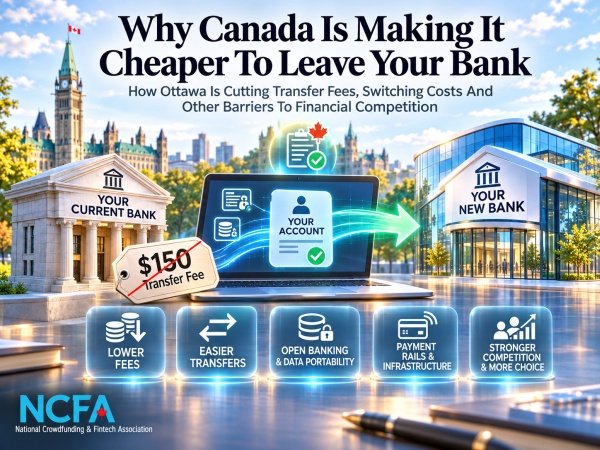
November 11, 2026 | NCFA Story Intelligence | Competition And Market Structure, Wealthtech Investing And Trading, Regulation And Policy Canada is cutting bank fees and switching barriers after years of weak competition, high concentration and poor productivity. On November 7, 2026, the federal government proposed something Canadian investors have complained about for years. Banks would no longer be allowed to charge most investment account transfer fees, which typically cost about $150 per account. Ottawa also wants clearer transfer information and tighter timelines for moving investments to another financial institution. The fee matters because leaving can already be slow and frustrating. Receiving firms often reimburse the outgoing charge to win the account. That means a fee collected by the institution losing the customer can become part of the acquisition cost for the institution trying to win that customer. Canada's six largest banks hold roughly 93% of banking assets. The Competition Bureau was warning about barriers facing fintech competitors in 2017. Ottawa began reviewing open banking in 2018. A federal advisory committee later recommended an operating system by January 2023 and warned that government should not delay. January 2023 came and went. Real Time Rail also slipped years beyond its first expected ...
Digital illustration of Canada bank transfer fee reform showing easier investment account switching, lower fees, open banking, payment infrastructure and stronger financial competition
November 10, 2026 | NCFA Fintech Market Insight | Digital Assets Blockchain And Tokenization, Capital Markets Infrastructure And Funding, Regulation And Policy Funds, Collateral And Settlement Lead Canada’s Near Term Tokenization Opportunity On November 10, 2026, the Canadian Securities Administrators published its Project Tokenization Phase 1 findings, setting out where Canadian market participants see the strongest commercial opportunities for tokenization and what regulators plan to test next. The report draws on 233 organizations, 21 bilateral meetings and 80 survey responses, along with workshops attended by 281 people in Calgary and 491 in Toronto. Participants put investment funds, private assets, collateral, treasury and settlement infrastructure ahead of public stocks as the strongest near term opportunities. The report also cuts through one of tokenization’s biggest sales pitches. Blockchain can change how an asset is recorded, transferred or settled, but it doesn't automatically create liquidity, investor demand, broader eligibility or stronger ownership rights. Those outcomes still depend on the product, market, legal structure and infrastructure around it. The CSA now plans to take specific projects into Phase 2 through a 120 day public call for proposals. Firms may be able to use existing regulatory processes, tailored regulatory treatment or bounded testing in a ...
Digital illustration of tokenized financial assets, blockchain settlement and legal infrastructure, representing Canada's investment funds and collateral markets.
Nov 11, 2026 A positive work environment is key for any team that wants to succeed. Team morale is crucial for productivity, motivation, and job satisfaction. Engaging in activities that lift spirits and strengthen connections can lead to great results. Creating a positive team environment requires creativity, engagement, and some fun. Each activity can strengthen connections, boost motivation, and improve workplace dynamics. When teams focus on strategies to boost morale, they work toward shared success. These activities can lead to lasting memories and help build a stronger team culture. Here are some fun strategies to help improve your team's morale and make the workplace livelier. Fun at the Arcade Visiting an arcade spot is a great way to enjoy time together and build teamwork. Imagine your team facing challenges with various games. Whether it's racing or playing team games, the arcade encourages friendly competition and bonding. These fun experiences can help reduce stress and improve relationships among coworkers. Arcades offer many options to suit diverse interests and skill levels. The lively atmosphere invites everyone to relax and take a break from their daily tasks. Shared laughter and enjoyment can lead to better communication and teamwork when you return to the ...
Digital illustration of team building activities boosting workplace morale with coworkers playing games and laughing in a bright modern office
November 10, 2026 | Market Activity | Fundraising, Investing, Trading, Leadership, Competition, Human Capital, Health A Brokerage Race Beyond $0 Commissions On November 10, 2026, Webull Canada added Nasdaq Basic Canada, giving clients free real time Level 1 quote and trade data across Canadian listed equities. The feed provides best bid, best offer and last sale information for stocks listed on the TSX, TSX Venture, CSE and Cboe Canada. Nasdaq says its consolidated feed can reduce Level 1 market data costs by more than 60% compared with traditional Canadian data packages. Webull isn't first to give Canadian investors free real time information. The more interesting story is how quickly another paid feature is becoming part of the basic brokerage account. Wealthsimple helped normalize $0 trading in 2019, Questrade followed in 2025 and Webull dropped its own commissions in April 2026. With the headline trading fee largely gone, brokers now need other reasons for investors to move money and keep it on the platform. Who Led Canada’s Race To $0 Trading And Free Market Data Wealthsimple Trade launched nationally on March 13, 2019 with $0 commissions on Canadian and U.S. stocks and ETFs. Questrade removed commissions on listed stocks and ETFs ...
AI illustration of Canadian online brokerage competition with racing cars promoting $0 commissions, free real time market data and transfer match bonuses
November 10, 2026 | Market Activity | Artificial Intelligence And Data, Capital Markets Infrastructure And Funding A Toronto Fintech Riskfuel Analytics Brings AI Pricing Into BBVA’s Global Markets Workflow On November 10, 2026, BBVA deployed Riskfuel Analytics' neural pricing technology inside the pre-trade structuring workflow for autocallable products on its ePricer platform. Riskfuel is a Toronto fintech founded in 2019 that builds AI models for derivatives pricing. BBVA is a global bank with a large corporate and investment banking business. The deployment puts Canadian built AI directly into the calculations used to design complex structured products at a major global bank. Riskfuel's model is trained on BBVA's own pricing engine and uses more than 4,000 market and product inputs. The company says the surrogate was tested against more than 100,000 trades and can evaluate thousands of candidate structures in under a minute. BBVA had already added AI generated investment ideas to ePricer in September. Riskfuel goes further into the workflow by speeding up the numerical pricing work while BBVA's own model remains the reference. How Riskfuel Speeds Up BBVA's Autocallable Pricing Autocallables can depend on volatility, interest rates, dividends, maturity, coupon levels and several barrier conditions. Autocallables are structured investments ...
AI illustration of AI powered derivatives pricing shown on a financial trading screen, illustrating Riskfuel technology used in BBVA structured product workflows


Leave a Reply

Your email address will not be published. Required fields are marked *