





Karsten Wenzlaff, Advisor
August 26th, 2025
Karsten Wenzlaff is a Crowdfunding and Fintech Expert from Germany. He is Secretary-General of Digit[...]


Economy and Policy | Aug 25, 2025
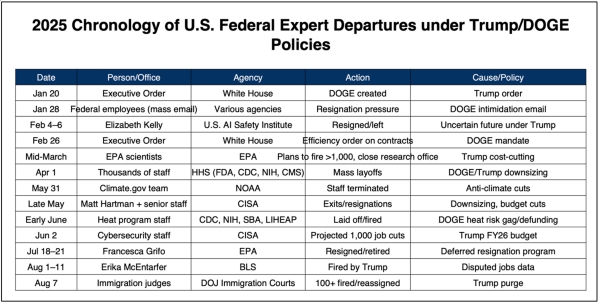
Nearly three decades ago, Carl Sagan warned in The Demon-Haunted World (1996) that when technological power is concentrated in a few hands and public institutions lose expertise, societies risk “sliding, almost without noticing, back into superstition and darkness.”
On Aug 22, 2025, Andrea Bonime-Blanc in a LinkedIn post discusses how recent U.S. federal budget cuts and policy changes are accelerating a “brain drain” of scientific and economic expertise. This article looks at the business impacts and implications for fintech of the significant human capital and policy changes taking place in the U.S. and how Canada and other collaborative countries should be responding.
The departure of experts at the Bureau of Labor Statistics (BLS) erodes confidence in U.S. economic indicators that businesses and markets rely on.
- President Trump fired BLS Commissioner Erika McEntarfer on August 1, 2025 after controversy over jobs report revisions
- The July 2025 jobs report showed 73,000 jobs gained and revisions down of 86,000 in May and 64,000 in June
- In July 2025 only 58% of employers answered the U.S. government’s payroll survey, which normally tracks over 120,000 workplaces. With so few responses, the jobs numbers are less reliable and more likely to be revised
Takeaway: 👉 For fintech lenders and investment platforms that depend on U.S. labor and wage data, model uncertainty and risk costs may increase.
Cuts to cybersecurity agencies increase systemic risk for payments and banking networks, and weaken the ability to build secure AI systems.
In 2025, the main federal agency that protects critical infrastructure including finance, energy, and healthcare, the U.S. Cybersecurity and Infrastructure Security Agency (CISA), had about $3 billion in funding and just over 3,600 staff. These resources cover everything from monitoring threats to helping banks and utilities recover from cyberattacks. Lawmakers are now weighing a $135 million cut to CISA’s 2026 budget or equal to about 4.5% of its funding. On paper it may sound small, but it reduces the agency’s ability to share intelligence, build new defenses, and support partners in both the public and private sectors.
Takeaway: 👉 Reduced federal cyber capacity raises exposure for cross-border fintech systems.
Environmental and climate science cuts reduce access to datasets critical for insurers, lenders, and ESG related products.
- EPA workforce cut from 16,155 in January 2025 to 12,448 , a 23% reduction with closure of its scientific research division
- NOAA terminated staff for its Climate.gov portal on May 31, 2025, halting new content
- NOAA seeks a 17% workforce cut after firing hundreds of probationary employees in early 2025
Takeaway: 👉 For fintech ESG products, fewer trusted U.S. datasets could degrade climate related financial models. Canada can step in with trusted open-data collaborations.
Graduate students and researchers face reduced U.S. funding, pushing talent abroad.
- PBS reports that at least 17 immigration judges were fired across 10 states in July 2025, adding delays to skilled worker case processing
Takeaway: 👉 Processing delays affect STEM talent inflows. Canada could capture this talent to strengthen fintech innovation by accelerating recruitment by offering scholarships, innovation hub partnerships, and fast-track visas.
Federal compliance and AI governance structures are weakening, raising trust issues.
- Elizabeth Kelly the inaugural director of the U.S. AI Safety Institute departed in February 2025 leaving a leadership vacuum
Takeaway: 👉 With U.S. leadership unsettled, Canada and the EU can shape AI assurance frameworks for fintech. Canadian regtech firms are well positioned to step up and help lead.
Canada needs to open up the country as a trusted hub for financial data integrity, cyber resilience and AI governance by focusing on the following practical steps:
- Map out data sources and diversify away from over reliance on U.S. federal inputs
- Invest in AI enabled cybersecurity and fraud detection systems
- Explore alternative and open-source data partnerships to fill data gaps (NGOs, universities, private market collaborations)
- Support STEM students and researchers displaced by U.S. funding cuts
- Build compliance and governance tools that embed transparency into fintech systems
The U.S. brain drain is visible in staff firings, layoffs, budget cuts and agency closures and contractions. Carl Sagan’s caution from 1996 reminds us that losing expertise erodes both science and democracy. By investing in data integrity, global standards, and fintech innovation, Canada can transform today’s U.S. retreat into a foundation for stronger, competitive growth. This is a chance for Canada to step up and lead.
 The National Crowdfunding & Fintech Association (NCFA Canada) is a financial innovation ecosystem that provides education, market intelligence, industry stewardship, networking and funding opportunities and services to thousands of community members and works closely with industry, government, partners and affiliates to create a vibrant and innovative fintech and funding industry in Canada. Decentralized and distributed, NCFA is engaged with global stakeholders and helps incubate projects and investment in fintech, alternative finance, crowdfunding, peer-to-peer finance, payments, digital assets and tokens, artificial intelligence, blockchain, cryptocurrency, regtech, and insurtech sectors. Join Canada's Fintech & Funding Community today FREE! Or become a contributing member and get perks. For more information, please visit: www.ncfacanada.org
 |  |  |
|---|---|---|
 |  |  |



August 26th, 2025

January 4th, 2024

June 1st, 2021

September 9th, 2020

July 9th, 2018

January 3rd, 2018

September 25th, 2017

June 20th, 2017

May 10th, 2017

December 14th, 2016

Leave a Reply