


OSFI Fast Track And Streamlined Approvals Framework
OSFI Fast Track And Streamlined Approvals Framework
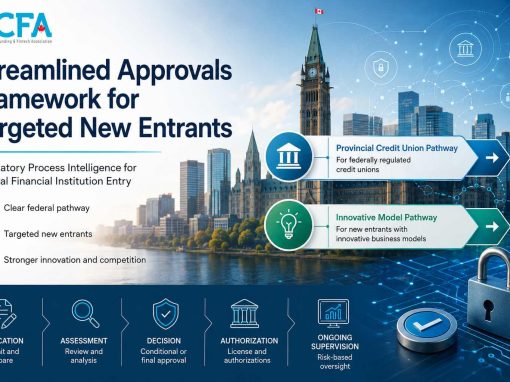
Often described as the OSFI fast track, OSFI's Streamlined Approvals Framework gives eligible applicants a clearer route into Canada's federal financial system. It applies to provincial credit unions seeking federal continuance and to entities with innovative or emerging banking models, including fintechs or crypto asset custodians, seeking bank or federally regulated trust and loan company status.
What this guide adds: the official pages, toolkit materials, checklists and process guidance are reorganized into one applicant workflow with interpretation, delay risks, evidence expectations and related intelligence.
Is the Streamlined Approvals Framework Right For You?
This is not a universal fintech route. OSFI limits the framework to two target groups and directs entities outside scope to existing approval processes.
Provincial Credit Union
PCUs need an established business model, operating history, provincial supervisory track record, capital capacity, scalable systems, member engagement plan and a viable provincial discontinuance path.
Innovative Model
Innovators need a meaningfully different banking model or product, a credible institution destination, financial strength, governance, business plan, risk capability and evidence that federal regulation is needed.
Other Routes
Payment firms, platforms, lenders and vendors may need RPAA registration, securities registration, provincial licensing or partnership models rather than federal institution status.
Approval Journey
OSFI publishes stage targets, not a guaranteed end to end timeline. Actual timing depends on applicant preparation, completeness, security checks, statutory decisions and responsiveness.
Initial Contact
Rolling intake. Applicant contacts OSFI when ready.
Pre-Application
Self-assessment, evidence build and early preparation.
Phase 1 Readiness
Readiness Assessment letter within 4 weeks after meeting.
Phase 2 Formal Review
12-month OSFI target after complete filing is acknowledged.
Minister Decision
Separate statutory decision. No OSFI target stated.
Phase 3 Readiness*
About 3 months where OCCB readiness review applies.
*Phase 3 note: Operational readiness applies where an Order to Commence and Carry on Business is required. For local cooperative credit societies continuing as federal credit unions, Letters Patent and OCCB are issued together.
Budgeting estimate: Where applicable OSFI targets apply, the published target stages add up to roughly 16 months plus applicant preparation, completeness review, security checks, Ministerial decision timing and remediation. This is an expectation management estimate, not an approval guarantee.
Regulatory Process Intelligence Explorer
Choose the applicant path, then click a step. Each step brings OSFI's requirements together with applicant preparation, timing expectations, source documents, delay risks and Analysis.
Screening | Is the PCU actually in scope?
Purpose
Screening is the point where a provincial credit union tests whether the streamlined framework is the correct doorway. The question is not simply whether the organization wants federal status. The question is whether the applicant is already close enough to federal readiness that a targeted, risk-based pathway makes sense.
What OSFI is trying to determine
OSFI is looking for a supervised provincial credit union with an established model, a credible reason to continue federally, an operating history that can be assessed, and a practical path for leaving the provincial framework. The applicant also needs to be prepared for conditions, restrictions or other mitigants at entry where OSFI considers them appropriate.
Analysis
This is a fit test, not a speed lane. A PCU that cannot explain the strategic necessity of federal continuance, the member value proposition and the readiness plan is likely to spend time and money before the real blocker becomes visible.
Assessment Checklist
Evidence readiness
Step Toolkit
Related NCFA intelligence
OSFI fast-track backgroundPhase 1 Initial Readiness Assessment
Purpose
Phase 1 lets OSFI review enough information to understand the applicant's ownership structure, financial strength, business plan, governance, federal continuance rationale, readiness gaps and overall suitability before the formal application begins.
Ownership and financial strength
The PCU should be ready to disclose its jurisdiction and establishment date, organization chart with ownership percentages, substantial investments, significant interests, voting rights over 10%, ownership distribution, sources of capital for initial and ongoing support, financial services and non-financial activities, three years of audited financial statements, any credit rating, and any prior denials, criminal proceedings or administrative sanctions.
Business plan and federal case
The five-year business plan needs to explain why the applicant wants to continue as an FCU, what transitional relief may be requested, target markets, opportunities, competitors, strategic assumptions, lines of business, product and service integration, risk-based capital and leverage ratios, pro forma financial statements, organizational structure, board and management composition, SMSB categorization, internal capital and liquidity targets, initial exit strategy and the work already performed to prepare for federal continuance.
Timing and output
The four-week target applies after the readiness meeting, not after first contact. The output is a readiness letter that helps determine whether the applicant should proceed and what OSFI expects next.
Analysis
Phase 1 should expose the real work before the formal application. The strongest applicants will treat it as a board level readiness review across business strategy, capital, member mandate, systems, governance and provincial transition planning.
Assessment Checklist
Readiness workstreams
Step Toolkit
Use this for
Pre-meeting evidence build, readiness self-assessment and early gap analysis.
Member Vote and Disclosure Notice
Purpose
PCUs have a specific member authorization branch because federal continuance affects members and requires a special resolution process. OSFI must approve the Disclosure Notice before the member vote and before Phase 2 materials are submitted.
What must come together
The PCU has to prepare a member package, draft Disclosure Notice, timing plan, CDIC consultation path and special resolution process that allow members to understand the implications of continuing as an FCU.
Analysis
This is where the PCU path stops being a regulator-only process. Stakeholder confidence, member education and transition governance matter as much as document preparation.
Assessment Checklist
Critical dependencies
Step Toolkit
Use this for
Member vote sequencing and disclosure package planning.
Phase 2 Formal Application Review
Purpose
Phase 2 is the formal review of the application for Letters Patent. It turns the readiness discussion into a complete filing and gives OSFI the evidence needed to make a recommendation.
Application package
The PCU package includes the formal application, Canada Gazette and newspaper notice, fees, evidence of member authorization, financial projections, stress cases, business strategy, transition plan and responses to information requests. The 12-month target begins only after OSFI acknowledges the filing is complete.
Prudential evidence
OSFI is assessing board composition, committee structure, oversight functions, management responsibilities, risk management, related-party arrangements, regulatory compliance management, privacy, fraud controls, records, outsourcing, operational risk, business continuity, disaster recovery, capital adequacy, liquidity and the ability to operate under federal expectations.
Analysis
The main risk is treating Phase 2 as a document exercise. It is really a proof of supervisability exercise. The filing must show that the institution can operate federally, not just that it can describe federal expectations.
Assessment Checklist
High-friction areas
Step Toolkit
Related NCFA intelligence
Prior NCFA OSFI coverageMinister Decision and Letters Patent
Purpose
OSFI may recommend approval, but the statutory Ministerial decision remains a separate dependency. This is why OSFI's published stage targets should not be converted into a guaranteed approval date.
Applicant management issue
Applicants need to keep operating plans, member communications and investor expectations current while the statutory decision is pending. Unresolved conditions, security issues or policy considerations can affect timing and certainty.
Analysis
Process transparency helps reduce ambiguity, but it does not eliminate statutory discretion. Any external communication should separate OSFI review targets from final approval and launch readiness.
Commencement and OCCB
Purpose
For local cooperative credit societies continuing as FCUs, Letters Patent and the Order to Commence and Carry on Business are issued at the same time. That makes practical readiness part of the formal application build, not a later phase.
What must be ready
The applicant needs completed continuance mechanics, final transition controls, member and provincial transition work, implementation readiness and the ability to operate federally on commencement.
Analysis
PCUs should not wait for approval to build launch readiness. The pathway compresses approval and commencement, which makes early operating preparation more important.
Step Toolkit
Official source documents
FCU continuance guideUse this for
Federal credit union continuance mechanics.
Operate | Federal Credit Union
Outcome
The applicant enters ongoing federal supervision and must operate with federal expectations for governance, capital, liquidity, risk management, operational resilience, regulatory reporting and compliance.
Analysis
Approval is the beginning of supervised scale. The commercial value of federal status depends on whether the institution can convert federal reach into durable member value and operational resilience.
Screening and Innovative Model Fit
Purpose
Screening tests whether the applicant is actually a targeted new entrant with a technologically innovative or emerging banking model, and whether the proposed destination is a bank or federally regulated trust or loan company rather than a lighter regulatory path.
What OSFI is trying to determine
OSFI is looking for a model that is meaningfully different through operating model, capability, distribution framework, process design, efficiency, cost, speed, resilience, accessibility, risk management or product design. The model also needs to justify entry into the federal prudential perimeter.
Analysis
The first strategic test is not "is this fintech innovative?" It is "does federal institution status unlock a capability the firm cannot reach faster and more safely through another route?"
Assessment Checklist
Evidence readiness
Step Toolkit
Related NCFA intelligence
OSFI fast-track backgroundPhase 1 Initial Readiness Assessment
Purpose
Phase 1 gives OSFI a written submission and meeting basis to review the applicant's business model, governance, ownership structure, financial resilience and overall readiness before the formal application.
Ownership and financial strength
The innovator should be ready to provide jurisdiction and establishment date, corporate group chart with ownership percentages, 10%+ voting interests, voting or control arrangements, affiliates and activities, Canadian operations, regulatory oversight by jurisdiction, government ownership interests, access to ongoing financial support, three years of audited consolidated financial statements, credit rating if available, prior denials and any criminal proceedings or administrative sanctions.
Business plan and prudential case
The five-year business plan should explain why the proposed FRFI is needed, target markets, opportunities, competitors, success assumptions, each line of business, products and services, how lines of business interrelate, liquidity metrics including NCCF and LCR, risk-based capital and leverage ratios on a Basel III basis, five-year pro forma financial statements, reporting lines, senior management responsibilities, board composition, SMSB categorization and an initial exit strategy.
Analysis
Phase 1 is where a fintech should prove it is institution-ready. Innovation may create the reason to apply, but governance, financial strength, ownership transparency, capital planning and exit credibility determine whether the application can proceed intelligently.
Assessment Checklist
Readiness workstreams
Step Toolkit
Use this for
Pre-meeting evidence build and investor/board readiness review.
Path Decision and Streamlined Review Fit
Purpose
After Phase 1, OSFI may provide preliminary views that help determine whether the applicant should move toward a formal application under the streamlined framework or use another existing approval process.
What the decision really tests
The decision is not approval. It is a path decision. A positive signal means the applicant may have enough fit and readiness to justify the heavier formal application. A weak signal may indicate that the model, capital plan, governance, ownership structure or institution destination is not yet credible.
Analysis
This is the cheapest point to stop, restructure, change the institution destination or choose a partnership route. Treat it as a strategic checkpoint, not an administrative transition.
Assessment Checklist
Common weak points
Step Toolkit
Use this for
Deciding whether to advance, pause or switch paths.
Phase 2 Formal Application Review
Purpose
Phase 2 is the comprehensive formal review. It converts the Phase 1 business case into a complete application record that OSFI can use to assess whether to recommend approval.
Baseline statutory assessment
Across new-entrant applications, OSFI assesses whether the applicant has enough resources to support the proposed institution, whether business record and experience are appropriate, whether character, integrity and reputation are acceptable, whether national security or international obligations issues arise, whether the business plan is sound and feasible, whether risks are understood and can be controlled before commencement, whether initial capital protects depositors and creditors, and whether directors and senior officers have the necessary experience and competence.
Formal filing and financial evidence
The formal application needs notices, filing materials, service charge, financial projections, business plan detail, assumptions, stress and contingency analysis, capital and liquidity plan, major asset and liability categories, expense and income categories and evidence that the applicant can fund the regulated institution over time.
Governance, risk and operations
The formal checklist brings the applicant into deeper prudential territory: board effectiveness, senior officer roles, risk management framework, operational risk, third party arrangements, privacy, fraud, records, business continuity, disaster recovery, regulatory compliance management and internal controls. The filing should show how the organization will operate, not only who owns it.
Timing and delay risk
The 12-month target begins only after OSFI acknowledges a complete filing. In practice, missing evidence, weak assumptions, unresolved security checks, governance gaps, vendor dependencies, unclear capital support or unconvincing risk controls can extend the elapsed process.
Analysis
Phase 2 is not a bigger version of Phase 1. It is the proof of supervisability stage. Applicants should run parallel workstreams for capital, governance, risk, security, technology, legal, compliance and operating readiness rather than waiting for OSFI requests one by one.
Assessment Checklist
Expanded requirement areas
Step Toolkit
Related NCFA intelligence
OSFI fast-track backgroundMinister Decision and Letters Patent
Purpose
OSFI may recommend approval, but Ministerial decision-making is a separate statutory dependency. This stage turns the supervisory recommendation into a formal approval decision where applicable.
Applicant management issue
Applicants should keep capital plans, staffing, vendor readiness, investor communications and public expectations aligned with the reality that OSFI's stage targets do not guarantee Ministerial timing or launch date.
Analysis
This is where the public dashboard may help with transparency if the applicant consents, but transparency is not certainty. External messaging should separate application milestone, statutory approval and operational launch.
Step Toolkit
Official source documents
Applicant progress dashboardUse this for
Public milestone tracking if the applicant consents.
Phase 3 | Operational Readiness
Purpose
Phase 3 confirms whether the applicant is ready to begin business after approval. OSFI reviews whether key people, policies, processes and systems are in place and whether any remaining gaps require conditions, restrictions or remediation.
Operational evidence
Applicants should expect to provide evidence such as board and shareholder meeting materials, paid-in capital confirmation, incorporation and organization cost information, commitments around material business plan changes, the OCCB request and evidence that launch-critical systems, people, controls and policies are operating.
Analysis
This is where paper readiness becomes operating capability. Conditions can shape product scope, geographic scope, growth pace, partnerships, funding needs and early customer strategy.
Assessment Checklist
Launch-readiness tests
Step Toolkit
Use this for
OCCB readiness and launch-condition planning.
Launch as a Federally Regulated Institution
Outcome
The applicant begins operating as a bank or federally regulated trust or loan company and enters ongoing prudential supervision. The launch is not the end of the regulatory burden; it is the point where the applicant's operating model must meet the promises made through the application process.
Market capability
Depending on the approved institution type and conditions, approval may enable regulated banking or trust activity, custody and fiduciary services where permitted, deposit or lending activity if approved, or regulated partnership infrastructure.
Analysis
The commercial case depends on whether the federal status unlocks a durable capability that could not be reached faster through a lighter pathway. The strongest applicants will connect licensing strategy, product strategy, compliance infrastructure and capital strategy before Phase 2.
From Regulation to Market Development
NCFA’s regulation-to-market pathway shows how OSFI’s targeted approval process can translate into federal market entry, supervised launch and practical innovation opportunities.
Connected to the NCFA Financial Innovation Map
Regulatory approval is only one part of market development. This guide connects to NCFA's broader Financial Innovation Map, which organizes innovation capabilities, market opportunities, companies, evidence, milestones and regulatory intelligence across Canada's fintech ecosystem.
The OSFI streamlined approvals framework is a high bar pathway for targeted new entrants. It does not create a general fintech fast track. Where an applicant qualifies, the framework may connect to market themes such as credit union modernization, regulated custody, trust infrastructure, governance technology, SME finance infrastructure, open finance and business identity.
Continue Exploring
Use these links to go deeper into adjacent regulation, market entry strategy, resources and evidence connected to federal financial system entry.
 The National Crowdfunding & Fintech Association (NCFA Canada) is a financial innovation ecosystem that provides education, market intelligence, industry stewardship, networking and funding opportunities and services to thousands of community members and works closely with industry, government, partners and affiliates to create a vibrant and innovative fintech and funding industry in Canada. Decentralized and distributed, NCFA is engaged with global stakeholders and helps incubate projects and investment in fintech, alternative finance, crowdfunding, peer-to-peer finance, payments, digital assets and tokens, artificial intelligence, blockchain, cryptocurrency, regtech, and insurtech sectors. Join Canada's Fintech & Funding Community today FREE! Or become a contributing member and get perks. For more information, please visit: www.ncfacanada.org
 |  |  |
|---|---|---|
 |  |  |

Leave a Reply