




Karsten Wenzlaff, Advisor
August 26th, 2025
Karsten Wenzlaff is a Crowdfunding and Fintech Expert from Germany. He is Secretary-General of Digit[...]


Reuters | Lisa Shumaker | Feb 16,2014
 (Reuters) - Kickstarter, the fundraising platform used by millions of people to raise capital for creative projects and businesses, said on Saturday that hackers had gained access to some of its customers' data earlier this week but that the breach had been repaired.
"No credit card data of any kind was accessed by hackers. There is no evidence of unauthorized activity of any kind on all but two Kickstarter user accounts," Kickstarter Chief Executive Officer Yancey Strickler said in a blog post on the website. It noted that it does not store credit card data.
Recent data breaches at Target Corp and Neiman Marcus have sparked concern from U.S. lawmakers and consumers over who should bear the cost of consumer losses and how to improve cybersecurity.
Kickstarter's information that was accessed without authority included user names, email addresses, mailing addresses, phone numbers and encrypted passwords, said Kickstarter, which was informed of the breach by law enforcement officials on Wednesday night.
It added that while passwords were not revealed, persons with computer expertise could still decipher encrypted passwords, and recommended users change their passwords as well as those for other sites or accounts for which the users had the same password.
Kickstarter said it had beefed up security in recent days. It also said it was working with law enforcement officials.
Kickstarter launched in 2009 as a conduit for funding of projects ranging from films and stage shows to video games and restaurant launches. Contributors to a project's launch are often compensated with rewards, discounts, credits or other offers from the projects they help fund.
Since its launch more than 100,000 projects have been funded, with hundreds of millions of dollars pledged.
(Reporting by Chris Michaud in New York; Editing by Lisa Shumaker)
Source: http://www.reuters.com/article/2014/02/16/us-usa-kickstarter-idUSBREA1F03320140216
Entrepreneur by Catherine Clifford | February 5, 2014

Who is responsible in the case that an investor loses his or her money to a fraudster in equity crowdfunding? That is the question that is at the root of much of the debate over how to regulate this new financial tool.
On the last day that public comments for proposed regulation for equity crowdfunding were accepted by the Securities and Exchange Commission, almost fifty letters were submitted with recommendations on how to change the rules. (Let’s be honest, we don’t stop procrastinating after college.)
The comment letters came from a wide variety of sources, from small-business advocacy groups to equity-crowdfunding portals to various members of the legal, regulating community to professional crowdfunding trade organizations. But many of the letters brought up one common concern: that the websites administering equity crowdfunding (or the “portals”) will be saddled with so much responsibility, they won’t be able to effectively function.
The SEC, which was assigned to write rules to regulate this newly legalized equity crowdfunding, released a preliminary set of rules on Oct. 23. That initiated a 90-day comment period which ended on Monday of this week. Regulatory issues brought up earlier in the comment period included appropriate investor caps, how an investor’s wealth ought to be determined and calculated, and the appropriate amounts of financial disclosure paperwork that ought to be required.
Here is a breakdown of the latest hot-button issue: how to regulate the portals.
The regulation squeeze: The proposed SEC rules consider crowdfunding portals “issuers,” and that means that the portals are held liable for the entrepreneurs raising money on their sites. If an entrepreneur’s campaign to raise money is fraudulent, then the portal would be held responsible. At the same time, portals are not allowed to give “investment advice.” That means portals are responsible for investors losing money, but can’t give any advice. “The proposed rules put funding portals between a rock and a hard place,” said Kiran Lingam, general counsel for Seed Invest, an equity crowdfunding platform which currently deals only with accredited investors, in a letter to the SEC.
As a result, only a few portals would survive the regulatory environment: The combination of regulatory burdens will result in a very limited pool of portals, according to letter submitted to the SEC by the Small Business and Entrepreneurship Council, an advocacy group with over 100,000 members. “The combined regulatory and liability risks are far too great under current proposed regulations to expect a vibrant funding portal marketplace. That means less choice for issuers, as well as higher costs. Fixing the proposed regulations to provide clarity when it comes to liability and discretion on the funding portal’s part will allow for innovation, competition and accountability in the portal space,” said Karen Kerrigan, president and CEO of the SBE Council in her letter to the SEC. Having fewer portals is a negative for the industry. “Greater choices of funding portals will benefit investors and the entrepreneurs who will be using these platforms,” Kerrigan says.
Kerrigan says the SEC has estimated that it could cost as much as $400,000 just to meet required regulatory hurdles to open an equity crowdfunding portal. That’s a lot of money for financial platforms whose revenue streams are built by taking a cut of relatively small investments.

The National Crowdfunding Association of Canada (NCFA Canada) is a cross-Canada crowdfunding hub providing education, advocacy and networking opportunities in the rapidly evolving crowdfunding industry. NCFA Canada is a community-based, membership-driven entity that was formed at the grass roots level to fill a national need in the market place. Join our growing network of industry stakeholders, fundraisers and investors. Increase your organization’s profile and gain access to a dynamic group of industry front runners. Learn more About Us |Prezi or contact us at casano@ncfacanada.org.
Crowdfund Insider | Charles Luzar | November 9, 2013
 Pledge a huge amount of money. Secure the promise of an awesome reward. Wait for the rewards to ship. File a dispute with Amazon Payments. Get your money back.
It is a simple scam, and it may have worked for one “Encik Farhan” to the tune of over 100 campaigns. A project creator named Alex Heberling led the charge of publicizing the scam after her campaign fell victim to Farhan. She received $1000 from Farhan, representing a significant portion of her $4,300 raise. Her goal was $3,000. Heberling is the comic book creator behind The Hues, the third chapter of which she funded on Kickstarter.
A summary on Tumblr describes the scam in more detail and reiterates the risk it posed to Heberling’s success.
Encik Farhan is a scammer. He backs projects, pledging hundreds or thousands of dollars at the highest tier, and then disputes the credit card charges 1-3 months later, often after his rewards have been shipped.
He pledged $1000 to my campaign, and a few days after I posted an update that backer rewards were being shipped, he filed a charge dispute with his credit card company. I’m still waiting for the outcome of my appeal, but if I lose $1000, it will ruin me.
Another project creator got in touch with me this week, asking about Encik Farhan, and dozens of creators have been affected by this asshole, but there is no built-in way to report individual backers or profiles on Kickstarter.
Kickstarter issued statements to various news outlets on the matter, including the following statement from ComicsBeat…
“Kickstarter and Amazon Payments, our US payments processor, were recently alerted to a series of malicious pledges by a single individual to more than 100 Kickstarter projects. Upon learning this information, we shut down this person’s account, canceled their live pledges, and permanently banned them from Kickstarter. Kickstarter and Amazon are working together to investigate this situation. We won’t let a single bad apple harm the integrity or goodwill of our incredible community.”
The account has since been banned from Kickstarter. Project creators affected by the alleged scam are waiting as Kickstarter works with Amazon Payments on a solution to the now-defunct funds.
Kickstarter may now be forced to put in checks for backers similar to the checks they have for project creators. One suggestion from Heberling was a “report backer” button, which makes a lot of sense. (Although if I am Kickstarter I’m not excited about the overhead and resources necessary to perform due diligence on reports from that system.)
Betakit | Tom Emrich | Sep 17, 2013
 Crowdfunding backers beware. I woke up this morning to find a Facebook post in my feed from Toronto-based Bionym, the creators of the heart authentication bracelet Nymi, alerting people to a fake Indiegogo campaign. The campaign is reportedly impersonating their device to raise funds on the crowdfunding platform under the name mySECURE.
The mySECURE project launched yesterday from Boston, USA and is claiming to have created a bracelet that authenticates you using your heart rhythm. The images and campaign video have been lifted directly from Bionym’s website. In fact, the video clearly shows the brand name “Nymi” numerous times throughout the marketing spot.
According to the mySECURE Indiegogo page, the team is looking to raise $50,000 for their mySECURE wearable device with only one reward available to backers – $150 which will get you a mySECURE delivered straight to your door.
Bionym originally communicated the fake crowdfunding project on their Facebook page:
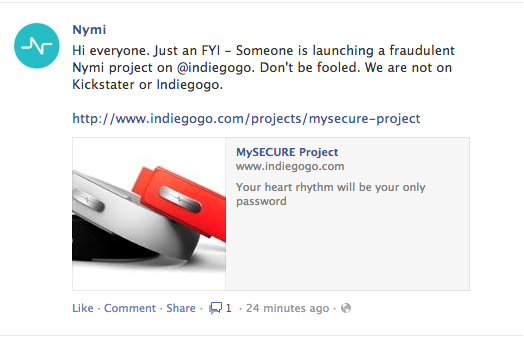
BetaKit reached out to Bionym to confirm that this campaign is a fake. We received this comment from CEO and co-founder Karl Martin: “This is completely fraudulent and has no affiliation with us. While it doesn’t surprise us that someone would try to cash in on all the attention we’ve received recently, it is shocking that Indiegogo would let it through without any due diligence. We’ve requested it be taken down, but it’s still up there, more than 2 hours later.” (UPDATE: Indiegogo took down the page around 1PM EST).
Indiegogo does have a fraud-detection policy in place which states that “All campaigns and contributions go through a fraud review, which allows us to catch any and all cases of fraud.“ That being said this policy also clarifies that the responsibility in deciding to support a campaign is all on the backer. “We leave it up to you to make your own judgment about the merit of a campaign before making a contribution”.
Crowdfund Insider by Charles Luzar | August 28, 2013

We wrote about Gridiron Thunder yesterday. The game is already fully-funded on Kickstarter and is participating in Ouya’s #FreeTheGames fund, so the game is eligible for a funding match from Ouya.
VG 24/7 provides the following explanation regarding the more dubious aspects of the campaign…
Unfortunately, questions have been raised about the legitimacy of Gridiron Thunder’s campaign. As collated on a NeoGAF thread, there are several suspicious aspects. First, just 126 backers pledged the total of $78,259, which averages at over $600 each – an unusually high total even allowing for occasional whales. Additionally, the majority of backers did not request any rewards for their pledges, which is again very unusual.
Most damning of all, a significant number of backers seem to have created accounts specifically to back this one project, and there are multiple instances of shared names, duplicate names, and celebrity avatars, all of which makes these accounts look a heck of a lot like dummies.
Most of the first 40 or so backers of Gridiron Thunder are faceless Kickstarter noobs.
Is that weird? Kind of. Is it impossible to imagine how or why that could happen?
A smart crowdfunder seeks backers online and in person. If I were running the campaign for Gridiron Thunder, I would throw a party or call all my friends and make the pitch to them first. I’d see if my immediate network wanted to pledge. Those who could pledge would jump into the campaign on day one to goose the stats. That’s a winning strategy.
Those backers could just be the friends and family hopping in early. Much of the time a project creator’s immediate network won’t have any experience with Kickstarter. In a way, this is what many backer pages should look like.
It is admittedly a bit of a stretch, but it’s important to consider the possibility.


August 26th, 2025

January 4th, 2024

June 1st, 2021

September 9th, 2020

July 9th, 2018

January 3rd, 2018

September 25th, 2017

June 20th, 2017

May 10th, 2017

December 14th, 2016