





Karsten Wenzlaff, Advisor
August 26th, 2025
Karsten Wenzlaff is a Crowdfunding and Fintech Expert from Germany. He is Secretary-General of Digit[...]


Apr 1, 2026 | NCFA Fintech Market Activity | Cross Border Payments And FX
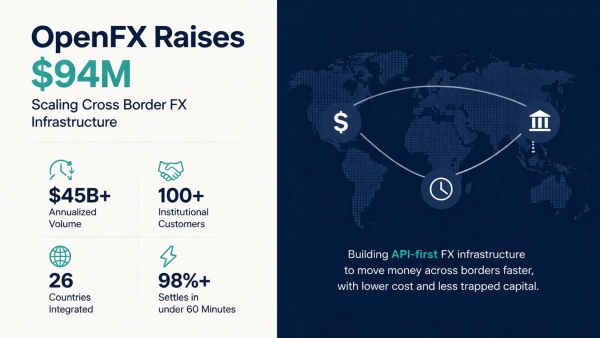
On March 31, 2026, OpenFX raised $94M to expand across Southeast Asia and Latin America. Two years after launch, the company says it now has 105 employees across four continents, handles more than $45B a year in cross border volume, and has onboarded more than 100 institutional customers.
The operating numbers are hard to ignore. OpenFX says 98% of transactions settle in under 60 minutes. In May 2025 the company said it had already integrated 26 countries and 7 major FX pairs, and that one newly onboarded client reached $100M in transaction volume in 17 days, with all of that settling within 60 minutes.
The product vision is more specific than a generic stablecoin pitch. Founder and CEO Prabhakar Reddy wrote that OpenFX didn't want to be “a crypto company moving Stablecoins,” but “a FX company moving money across the globe.”
OpenFX has built the hardest part of cross border payments first, including liquidity, cost, and settlement mechanics. It's tech stack offers collections, FX, payouts, banking, yield, compliance, and liquidity, delivered through API based infrastructure that runs 24/7.
That focus helps explain the customer base. OpenFX says it serves fintechs, neobanks, remittance providers, and payroll platforms, including MoneyGram, Yellow Card, and alfred. The company also says there's more than $200T in money movement that still relies on slow and fragmented cross border infrastructure.
OpenFX isn't selling speed on its own. Its announcement post argues that legacy cross border payments still hide fees inside exchange rates, trap capital in pre funded accounts, and leave businesses waiting days for settlement. OpenFX says stablecoins let value cross borders in seconds while sender and recipient still use local fiat. That reduces idle capital, compresses settlement time, and gives payment firms a cleaner way to handle large transfers.
There is a useful lesson here for founders and investors. OpenFX didn't try to fix every payment problem at once. It picked a part of the market where delay is expensive, built around API access and 24/7 settlement, then pushed that model into live institutional volume. If that keeps working, expect pressure to build around flows based on old economics andslow settlement, trapped liquidity, and wide spreads on large transfers.
If large ticket FX settles in under an hour, which parts of the old cross border fee stack get hardest to defend?
 The National Crowdfunding & Fintech Association (NCFA Canada) is a financial innovation ecosystem that provides education, market intelligence, industry stewardship, networking and funding opportunities and services to thousands of community members and works closely with industry, government, partners and affiliates to create a vibrant and innovative fintech and funding industry in Canada. Decentralized and distributed, NCFA is engaged with global stakeholders and helps incubate projects and investment in fintech, alternative finance, crowdfunding, peer-to-peer finance, payments, digital assets and tokens, artificial intelligence, blockchain, cryptocurrency, regtech, and insurtech sectors. Join Canada's Fintech & Funding Community today FREE! Or become a contributing member and get perks. For more information, please visit: www.ncfacanada.org
 |  |  |
|---|---|---|
 |  |  |



August 26th, 2025

January 4th, 2024

June 1st, 2021

September 9th, 2020

July 9th, 2018

January 3rd, 2018

September 25th, 2017

June 20th, 2017

May 10th, 2017

December 14th, 2016

Leave a Reply