




Karsten Wenzlaff, Advisor
August 26th, 2025
Karsten Wenzlaff is a Crowdfunding and Fintech Expert from Germany. He is Secretary-General of Digit[...]


Nov 12, 2026

Buying a Canadian money services business starts with identifying what the buyer will acquire: a legal entity, a registration history, contracts, records and possibly an active operation. The value of that package depends on whether it supports the services the new owner intends to provide.
A FINTRAC registration entry is an important starting point. It does not establish the company’s financial condition, the quality of its compliance programme or the availability of banking relationships after an acquisition. A payment business may also need a separate assessment under the Retail Payment Activities Act, or RPAA.
For investors evaluating a Canadian MSB company for sale, due diligence should connect registration status, actual activities, transaction structure and financial evidence before the parties agree a completion timetable.
Begin with the target’s exact legal name, incorporation details, registration number and current status. Match the entity in the corporate documents to the entity in FINTRAC’s Money Services Business Registry.
FINTRAC explicitly states that registration does not mean it endorses or licenses a business. It also states that it does not issue licences or certificates of registration. A sales presentation using the phrase “FINTRAC licence” should therefore be clarified against the actual registration record.
The registry distinguishes registered, expired, ceased and revoked statuses. FINTRAC says it updates the registry monthly, so record the date of the check and obtain relevant recent correspondence from the target as well. Where a renewal is being processed, review the submission evidence and the applicable status treatment.
Registration is not a complete acquisition report. The next step is to establish what the company has actually done and what the buyer intends to change.
A buyer researching a Money Service Business in Canada should define the intended services before treating an existing company as a suitable launch vehicle.
Describe the customer groups, countries, currencies, delivery channels and movement of funds. For a crypto-related product, specify where conversion, custody, fiat collection and payouts occur, and which entity provides each service.
Compare that description with the target’s registration information, existing contracts and operating records. A business registered for certain activities may have little or no transaction history, while an active operator may have obligations and unresolved cases that require a detailed handover.
FINTRAC’s guidance requires registration information to be kept up to date and changes to be notified within 30 days. It also states that registration is valid for two years and must be renewed before expiry. Identify the updates and renewal work relevant to the proposed transaction.
The deal’s structure needs its own assessment. Ask Canadian counsel to determine the consequences of buying shares, purchasing assets or changing the entity through which services will be provided.
FINTRAC registration and Bank of Canada payment-service-provider registration address different requirements. Determine the target’s position under each framework.
The Bank of Canada’s registration guidance sets out four elements: performing a payment function as a service that is not incidental to another business; undertaking the relevant retail payment activity; meeting the geographical scope; and falling outside applicable exclusions.
Its identified payment functions include maintaining an end-user account, holding end-user funds, initiating electronic funds transfers, handling payment instructions and providing clearing or settlement services. The assessment concerns the actual functions and circumstances.
Ask advisers to map who performs each function in the target’s payment chain. The presence of a bank or another registered provider does not, by itself, settle the target’s own position.
For a product marketed as crypto-focused, examine its fiat payment activities as part of that assessment. Keep the conclusion and its reasoning in the transaction file, alongside any Bank of Canada application, registration or correspondence.
For a target that is a registered PSP, the transaction timetable may depend on RPAA acquisition-of-control requirements.
The Bank of Canada’s supervisory policy explains that, where the section 24 requirement applies, the target PSP must submit a new registration application reflecting the planned acquisition and become re-registered before completion. Simply filing an application does not satisfy the requirement to be re-registered.
The acquisition-of-control assessment depends on the transaction and legal structure. Counsel should also assess the applicable exclusions and any prescribed-change rules rather than treating every purchase as identical.
Build the required process into the agreement and completion plan. Identify who prepares the application, which information the buyer must supply and what evidence will permit the parties to close.
The Bank cautions that review timing varies and should not be expected to accelerate because an application was submitted too late. Commercial deadlines should allow for that dependency.
This is a distinct process from updating FINTRAC information. Keep the two workstreams visible, with separate owners and completion evidence.
A compliance manual shows intended procedures. An acquisition review also needs evidence of how the programme has operated.
FINTRAC’s compliance-programme guidance requires an effectiveness review at least every two years. The review tests the relevant programme elements, including policies and procedures, risk assessment and training. Request the review plan, results, findings and documented follow-up.
Then assess the records behind the programme through an appropriately controlled diligence process. Relevant requests may include:
Sensitive reports and investigations need legally appropriate disclosure arrangements. Do not assume that every record can be freely copied into a buyer’s data room.
For a dormant company, establish which processes must be activated or updated before customers can be served. For an active business, identify the cases and responsibilities that will remain open at completion.
Translate the findings into resources: staff time, external assistance, system work and the effect on launch readiness.
Financial due diligence should explain what the business earns, what it owes and which cash is available to support operations.
Separate the value of customer transactions from earned revenue. Reconcile fees and conversion income to accounting records and provider statements, with clear treatment of refunds, reversals and other adjustments.
For an active target, examine customer balances and pending transactions alongside the corresponding assets and provider records. Investigate differences before agreeing the completion position.
Useful questions include:
An illustrative target could report growing payment volume while retaining little contribution after provider charges and staff handling. The buyer needs the supporting records to understand the economics.
Customer funds should not be counted as unrestricted acquisition funding. Establish the applicable treatment of balances and liabilities with the transaction’s financial and legal advisers.
Bank accounts and integrations are valuable only within the conditions under which they can be used.
Review material bank, payment, custody, software and outsourced-service contracts. Identify notification, consent, due-diligence and termination provisions relevant to ownership, management or business-model changes.
Obtain the necessary partner assessment for the intended customer groups and flows. Keep a technical integration, an active contract and acceptance of the new business model as separate items in the diligence record.
Technology handover should cover:
Ask the future operating team to demonstrate a representative transaction and an exception. Their ability to locate the relevant records can reveal whether the buyer will inherit a usable process or significant reconstruction work.
The diligence outcome should be a decision supported by evidence and a plan for unresolved dependencies.
Before signing, establish the target’s identity, registration position, service scope, financial condition and material partner dependencies. Identify the regulatory and contractual processes that affect completion.
Before closing, refresh evidence that could have changed. Confirm required registration outcomes, agreed partner actions, access deliverables, financial adjustments and ownership of open work.
Ask transaction counsel to address material findings through suitable agreement terms. Depending on the issue, this may involve pre-completion actions, warranties, indemnities, transition assistance or another negotiated mechanism.
Keep the operating budget connected to the timetable. A delay in a required registration process or partner decision can extend fixed costs while postponing revenue. Model that scenario before committing the full acquisition budget.
A Canadian MSB acquisition becomes easier to assess when its legal status, operating evidence and financial position are reviewed together. The objective is to know what the buyer can continue, what must change and what needs to be resolved before capital and control pass.
 The National Crowdfunding & Fintech Association (NCFA Canada) is a financial innovation ecosystem that provides education, market intelligence, industry stewardship, networking and funding opportunities and services to thousands of community members and works closely with industry, government, partners and affiliates to create a vibrant and innovative fintech and funding industry in Canada. Decentralized and distributed, NCFA is engaged with global stakeholders and helps incubate projects and investment in fintech, alternative finance, crowdfunding, peer-to-peer finance, payments, digital assets and tokens, artificial intelligence, blockchain, cryptocurrency, regtech, and insurtech sectors. Join Canada's Fintech & Funding Community today FREE! Or become a contributing member and get perks. For more information, please visit: www.ncfacanada.org
 |  |  |
|---|---|---|
 |  |  |
November 10, 2026 | NCFA Fintech Market Insight | Capital Markets Infrastructure And Funding, Entrepreneurs Startups Small Businesses, Equity Crowdfunding And Alternative Funding

On November 10, 2026, the Canadian Venture Capital and Private Equity Association published its Q3 2026 venture capital report. Canadian companies raised $4.3 billion across 397 deals through September, only 1% less capital than a year earlier. But 23 rounds of $50 million or more represented just 6% of disclosed deals and absorbed 58% of all venture capital invested. Deal count has also fallen every year since 2021. The national total is holding up far better than the number of companies getting financed.
Q3 produced $1.35 billion across 129 deals. Capital was 1% higher than Q2, but deal count fell 15%.
Six rounds above $50 million accounted for $793 million, or 59% of the quarter’s capital. That's a decent quarter for the companies that closed those rounds, but a weak quarter for everyone else.
Mega rounds above $50 million totalled $2.5 billion across 23 transactions through Q3.
They represented 58% of all venture dollars while making up only 6% of disclosed deals. Canada can post a fairly stable capital total even when financing reaches fewer companies.
Deal count is down to 397 from 640 in the same period in 2021 and sits 26% below the five year average of 534 deals.
A national total does not tell a company whether investors are writing more first cheques, whether follow on capital is available, or whether its next round has become easier to close. Earlier this year, H1 data showed fewer companies getting funded even as total capital increased. Q3 extends that pattern.
Early stage companies raised $1.74 billion across 99 deals through Q3, up 17% in capital from the same period a year earlier. Most of that money arrived in the first half. Q3 alone fell to $380 million across 24 deals, the lowest quarterly early stage total since 2021.
Later stage capital rose 8% to $1.36 billion.
Growth stage investment fell to $396 million across six rounds, down 55% from the same point in 2025 and 66% below its five year average.
Seed investment is also heavily concentrated. One $124 million Veeda AI round represented 47% of all Q3 seed capital.
Large companies can still attract substantial rounds, and early companies can still find capital. The middle round is harder. Companies need enough money to expand sales, hire senior teams, enter new markets and finance longer operating runways without selling too early or depending on a small group of investors.
RBCx found Canadian VC fundraising concentrated sharply in 2025, with the five largest funds capturing 83% of capital raised. When fund capital and company financing both concentrate, several impressive rounds can coexist with fewer financing options for most founders.
The Q3 private equity report shows the same concentration at a much larger scale. Canadian PE investment reached $27.5 billion across 372 deals through September, already above every full year total from 2021 through 2024. Yet deal count is 24% below the same period in 2025.
Q3 alone generated $13.7 billion across 116 transactions. Three deals worth at least $1 billion accounted for $12.8 billion, or 93% of all capital invested in the quarter. Five privatizations accounted for $16.25 billion of year to date PE capital. Those totals say little about financing conditions across the broader private company market.
Capital committed to a major privatization doesn't help a growth company raise its next round simply because both are counted as private capital. Founders need to know who can lead the round, how many investors can write the cheque, what terms they will offer and whether enough follow on capital is available to keep growing. Aggregate dollars do not answer those questions.
Financing is only part of the picture. CVCA recorded 28 venture exits through Q3, including 26 acquisitions with $744 million in disclosed value. There were no venture backed IPOs.
For founders and investors, that means acquisition remains the main route to liquidity. More M&A can return capital to funds and founders, but it also means fewer Canadian venture backed companies are reaching public markets. Combined with weak growth stage financing and heavy reliance on mega rounds, the numbers show a market that can still fund and exit strong companies without providing broad access to capital across the full company lifecycle.
Canada’s problem isn't simply how much venture capital is available. It's whether enough investors have enough capital to support companies from one stage to the next. Fundraising has concentrated among fewer VC firms, emerging managers have less capital, growth stage financing remains weak and limited exits have slowed the recycling of money back into new funds. A healthier market needs more financing capacity across the full company lifecycle, not just a handful of very large rounds.
The National Crowdfunding & Fintech Association (NCFA Canada) is a financial innovation ecosystem that provides education, market intelligence, industry stewardship, networking and funding opportunities and services to thousands of community members and works closely with industry, government, partners and affiliates to create a vibrant and innovative fintech and funding industry in Canada. Decentralized and distributed, NCFA is engaged with global stakeholders and helps incubate projects and investment in fintech, alternative finance, crowdfunding, peer-to-peer finance, payments, digital assets and tokens, artificial intelligence, blockchain, cryptocurrency, regtech, and insurtech sectors. Join Canada's Fintech & Funding Community today FREE! Or become a contributing member and get perks. For more information, please visit: www.ncfacanada.org
| | |
|---|---|---|
| | |
November 10, 2026 | NCFA Fintech Market Insight | Digital Assets Blockchain And Tokenization, Capital Markets Infrastructure And Funding, Regulation And Policy

On November 10, 2026, the Canadian Securities Administrators published its Project Tokenization Phase 1 findings, setting out where Canadian market participants see the strongest commercial opportunities for tokenization and what regulators plan to test next. The report draws on 233 organizations, 21 bilateral meetings and 80 survey responses, along with workshops attended by 281 people in Calgary and 491 in Toronto. Participants put investment funds, private assets, collateral, treasury and settlement infrastructure ahead of public stocks as the strongest near term opportunities.
The report also cuts through one of tokenization’s biggest sales pitches. Blockchain can change how an asset is recorded, transferred or settled, but it doesn't automatically create liquidity, investor demand, broader eligibility or stronger ownership rights. Those outcomes still depend on the product, market, legal structure and infrastructure around it.
The CSA now plans to take specific projects into Phase 2 through a 120 day public call for proposals. Firms may be able to use existing regulatory processes, tailored regulatory treatment or bounded testing in a controlled environment. The findings are stakeholder views, not CSA policy positions or regulatory conclusions.
The strongest near term business cases are capital markets operations, not tokenized public stocks. Participants saw more immediate value in fixing expensive processes inside funds, private markets, collateral and settlement. That includes subscriptions, redemptions, recordkeeping, asset servicing and the transfer of collateral between institutions.
Investment funds ranked among the most commercially viable uses, particularly money market funds. A tokenized fund can automate parts of administration and make transfers between eligible investors easier while keeping the fund inside existing securities rules. Private equity, private credit and real estate also attracted interest, although putting an illiquid asset on a ledger doesn't suddenly create buyers or an active secondary market.
Collateral looks particularly practical. Financial institutions constantly transfer assets to secure loans, derivatives and other exposures, often through systems that require reconciliation across several firms. Participants said tokenized collateral could reduce friction, improve visibility and speed up those transfers. That supports earlier evidence on collateral and cash, where the business case comes from improving costly financial plumbing rather than creating another digital asset.
Public equities are further back in the queue. The report recognizes that tokenized shares are technically possible, but participants generally saw them as less commercially mature than funds and certain private assets. Existing stock markets already execute and settle efficiently, so a tokenized version has to offer more than different recordkeeping. Wider adoption still depends on distribution, settlement, infrastructure, demand and enough liquidity to support real trading.
The report states the point plainly, “Tokenization should be distinguished from the outcomes it may enable.” A blockchain can make an asset programmable or easier to transfer without changing who legally owns it, who can buy it or how much demand exists.
The report identifies three common structures.
Those structures can look similar while giving investors very different rights. Voting, dividends, corporate actions, redemption and insolvency protection can all depend on how the token is built and who stands behind it. Participants specifically warned that retail investors may struggle to distinguish between products that appear similar but carry different claims and risks.
Tokenization isn't just a blockchain story once real money and investor rights are involved. Tokenization is already becoming measurable through assets, transactions, custody, servicing, distribution and regulated infrastructure. Once real money and investor rights are involved, the value depends less on creating the token itself and more on whether ownership, administration and market structure work around it.
Settlement is one of the biggest constraints. A security can exist on a blockchain, but a fully digital transaction also needs money that can settle against it. Participants discussed stablecoins, tokenized bank deposits and wholesale central bank money, but no single settlement asset emerged as the answer. They also flagged uncertainty over which regulator should oversee different parts of that cash leg.
Project Samara gives Canada a real use case test. In March, Project Samara tested a C$100 million EDC bond using distributed ledger technology and tokenized wholesale Canadian dollars. The experiment handled issuance, trading and settlement, showing that a real Canadian security can operate on this type of infrastructure. It didn't answer everything. Participants still identified unresolved questions around netting, liquidity, governance, settlement finality and scale.
Faster settlement also comes with a tradeoff. Atomic settlement can reduce counterparty risk because the security and cash settle together. But if every transaction has to be funded separately instead of being netted against other obligations, firms may need to keep more cash available. A system that settles faster can therefore use liquidity less efficiently than existing wholesale infrastructure.
And then there's the legal record. A blockchain transaction may be irreversible without being legally final, so technical finality isn't necessarily legal finality. Participants questioned whether the ledger or another register should serve as the authoritative ownership record. Custody brings its own questions around private keys, asset segregation and recovery. The infrastructure also has to work with banks, custodians, administrators and the Canadian Depository for Securities.
Canada’s largest banks are also testing Canadian dollar tokenized deposits, which could eventually give tokenized markets another settlement option. But digital cash can't solve the settlement problem on its own. The legal treatment, access rules, interoperability and operating structure still have to work.
Some participants said Canadian institutions have invested less in tokenization than international peers, while firms and regulators still lack enough hands on experience. They didn't conclude that Canada is behind, but they repeatedly called for clearer ways to get viable projects beyond isolated pilots.
Phase 2 gives regulators specific projects to evaluate instead of discussing tokenization in an abstract out of reach way. The CSA plans to accept proposals for 120 days from firms building tokenized products, infrastructure, services and business models. Regulators will look at the issues each proposal raises, its stage of development, industry participation and whether it can produce lessons that apply beyond one company.
A mature proposal could remain inside existing securities rules, require tailored regulatory treatment or qualify for bounded testing. The CSA describes bounded testing as a controlled process with defined limits, safeguards, reporting and decision points. It isn't automatic regulatory relief, and submitting a proposal does not guarantee that the CSA will create a testing framework for it.
Firms don't need another pilot proving that blockchain can represent a bond or fund. They need to know whether a workable product can get from technical proof to legal certainty, regulated distribution and production use without years of uncertainty. As of November 11, the CSA's Collaboratory still lists Project Tokenization at the Phase 1 findings stage, so the proposal intake itself is the next concrete regulatory milestone.
Canada shouldn't measure tokenization progress by how many pilots it can launch. The better test is whether Phase 2 can clear specific legal and operating barriers for use cases that already show a credible business case. If funds, collateral or settlement can save money and reduce friction, regulators should focus on what stands between those projects and production.
The National Crowdfunding & Fintech Association (NCFA Canada) is a financial innovation ecosystem that provides education, market intelligence, industry stewardship, networking and funding opportunities and services to thousands of community members and works closely with industry, government, partners and affiliates to create a vibrant and innovative fintech and funding industry in Canada. Decentralized and distributed, NCFA is engaged with global stakeholders and helps incubate projects and investment in fintech, alternative finance, crowdfunding, peer-to-peer finance, payments, digital assets and tokens, artificial intelligence, blockchain, cryptocurrency, regtech, and insurtech sectors. Join Canada's Fintech & Funding Community today FREE! Or become a contributing member and get perks. For more information, please visit: www.ncfacanada.org
| | |
|---|---|---|
| | |
Nov 11, 2026

A positive work environment is key for any team that wants to succeed. Team morale is crucial for productivity, motivation, and job satisfaction. Engaging in activities that lift spirits and strengthen connections can lead to great results.
Creating a positive team environment requires creativity, engagement, and some fun. Each activity can strengthen connections, boost motivation, and improve workplace dynamics. When teams focus on strategies to boost morale, they work toward shared success. These activities can lead to lasting memories and help build a stronger team culture.
Here are some fun strategies to help improve your team's morale and make the workplace livelier.
Visiting an arcade spot is a great way to enjoy time together and build teamwork. Imagine your team facing challenges with various games. Whether it's racing or playing team games, the arcade encourages friendly competition and bonding. These fun experiences can help reduce stress and improve relationships among coworkers.
Arcades offer many options to suit diverse interests and skill levels. The lively atmosphere invites everyone to relax and take a break from their daily tasks. Shared laughter and enjoyment can lead to better communication and teamwork when you return to the office. After a fun night of games, your team is likely to feel more excited about their work.
Indoor putt putt is another great activity for building teamwork. The unique themed courses, like those with pirate ships or enchanted forests, keep things interesting. Navigating tricky holes encourages conversation and laughter, helping team members bond while having fun.
Playing putt-putt focuses on the shared experience, not just the score. Cheering for each other or making jokes can create a friendly atmosphere that continues in the workplace. This relaxed setting can lead to spontaneous discussions about projects, boosting creativity and problem-solving.
Encouraging a playful competition may reveal hidden talents among team members. For example, you might discover that Brenda from HR is great with a putter! These insights can help teams work better together and understand each other's strengths, leading to more supportive collaborations.
Organize fun team activities that combine enjoyment with problem-solving. Consider scavenger hunts, puzzle contests, or cooking challenges. Holding these activities outside the usual office setting gives everyone a break from routine while encouraging teamwork and creativity. Team members need to work together and use each person's strengths, which improves collaboration and communication.
Creative challenges also promote fresh thinking. This can lead to new project ideas or different views on existing tasks. The laughter and playfulness during these activities help lower stress. As a result, team members feel energized and share a sense of accomplishment.
Who says work clothes have to be boring? Plan themed dress days to add excitement to the workplace. Whether it's funky hat day, pyjama day, or a colour theme, fun dress codes can brighten the office atmosphere. As team members join in, smiles and light-hearted conversations make the work environment more enjoyable.
Themes can spark conversations and encourage team members to interact. These activities create opportunities for storytelling and laughter, building connections that might not happen during a normal workday. Plus, seeing everyone's creative outfits can boost pride and belonging, strengthening team spirit.
A recognition board can make the workspace more encouraging. Celebrating small wins and acknowledging everyone's contributions builds a culture of appreciation. A dedicated space for colleagues to leave notes of praise or thanks lifts morale and fosters a positive community.
When team members feel valued, they often become more committed and enthusiastic about their work. Celebrating everyday achievements, like finishing a project early or helping a coworker, cultivates a feeling of belonging. This simple act not only improves morale but also creates a culture that recognizes and values effort within the team.
Volunteering as a team can build strong connections and a sense of purpose. Choose a local charity or community project where your team can share their time and skills. Working together for a common cause strengthens team bonds and allows you to give back to the community.
Helping others can provide new perspectives, lower stress, and create a positive atmosphere. After volunteering, hold reflection sessions so team members can share their thoughts and feelings. This shared experience promotes a workplace culture of empathy and teamwork, which boosts overall morale.
Consider organizing team-building workshops focused on personal and professional growth. These workshops can cover topics like communication, conflict resolution, and leadership. Bringing in an experienced facilitator can provide helpful insights and encourage discussions among team members.
Participating in these workshops helps individuals learn about each other's working styles and strengths. This improved understanding can lead to better collaboration and teamwork in daily tasks. The skills gained from these workshops can also boost productivity and create a more motivated, efficient workplace.
The National Crowdfunding & Fintech Association (NCFA Canada) is a financial innovation ecosystem that provides education, market intelligence, industry stewardship, networking and funding opportunities and services to thousands of community members and works closely with industry, government, partners and affiliates to create a vibrant and innovative fintech and funding industry in Canada. Decentralized and distributed, NCFA is engaged with global stakeholders and helps incubate projects and investment in fintech, alternative finance, crowdfunding, peer-to-peer finance, payments, digital assets and tokens, artificial intelligence, blockchain, cryptocurrency, regtech, and insurtech sectors. Join Canada's Fintech & Funding Community today FREE! Or become a contributing member and get perks. For more information, please visit: www.ncfacanada.org
| | |
|---|---|---|
| | |
November 10, 2026 | Market Activity | Fundraising, Investing, Trading, Leadership, Competition, Human Capital, Health

On November 10, 2026, Webull Canada added Nasdaq Basic Canada, giving clients free real time Level 1 quote and trade data across Canadian listed equities. The feed provides best bid, best offer and last sale information for stocks listed on the TSX, TSX Venture, CSE and Cboe Canada. Nasdaq says its consolidated feed can reduce Level 1 market data costs by more than 60% compared with traditional Canadian data packages.
Webull isn't first to give Canadian investors free real time information. The more interesting story is how quickly another paid feature is becoming part of the basic brokerage account. Wealthsimple helped normalize $0 trading in 2019, Questrade followed in 2025 and Webull dropped its own commissions in April 2026. With the headline trading fee largely gone, brokers now need other reasons for investors to move money and keep it on the platform.
Wealthsimple Trade launched nationally on March 13, 2019 with $0 commissions on Canadian and U.S. stocks and ETFs. Questrade removed commissions on listed stocks and ETFs in February 2025. Webull had entered Canada on January 2, 2024 charging $2.99 per Canadian trade and US$2.99 per U.S. trade, outside an introductory promotion. It moved to permanent $0 Canadian and U.S. equity commissions on April 13, 2026.
Market data hasn't followed exactly the same timeline because the products differ. Wealthsimple added free real time charting in August 2025. Questrade currently includes free streaming Level 1 data for TSX and TSXV securities on its Edge platforms, along with a more limited U.S. feed through Cboe One. Webull's new Nasdaq Basic Canada feed consolidates Nasdaq Canada's CXC, CX2 and CXD books at no additional charge. Investors still pay for some deeper exchange data across the industry.
| Webull Canada | Wealthsimple | Questrade | Interactive Brokers Canada | |
|---|---|---|---|---|
| Canadian Brokerage Launch | January 2024 | Trade launched nationally March 2019 | Founded 1999 | Long established in Canada |
| $0 Stock Commission Milestone | April 13, 2026 | March 13, 2019 | February 2025 | Uses low per share pricing rather than universal $0 commissions |
| Free Basic Real Time Data | Nasdaq Basic Canada added November 10, 2026 | Free real time quotes and charting, with real time charting launched August 2025 | Free Level 1 TSX and TSXV streaming data on Edge platforms | Free U.S. non consolidated streaming data. Canadian real time feeds generally require subscriptions |
| Advanced Market Data | Nasdaq Level 2 promotional access plus real time options data | Growing active trader data and charting tools | Paid package includes Nasdaq TotalView and TSX Market Book | Broad professional data catalogue sold by exchange and package |
| Current Brokerage Model | $0 equities, options, advanced charting, extended trading and AI connections | $0 trading inside a broader investing, cash and household finance platform | $0 trading, managed portfolios, active trader tools and premium subscription benefits | Global market access, sophisticated execution and professional trading tools |
| Target Customer | Active self directed investors who value data and trading tools | Investors willing to consolidate more of their finances on one platform | Self directed investors seeking breadth, control and established brokerage tools | Sophisticated and globally active investors |
| Strategic Play | Close pricing gaps and compete on active trader features | Own more of the household financial relationship | Combine low cost brokerage with premium investing services | Compete on execution, markets and professional depth |
The dates tell the competitive story. Wealthsimple attacked commissions first. Questrade eventually matched the headline price. Webull arrived much later and has spent the past two years filling out its Canadian offer with registered accounts, options, extended trading, $0 commissions and now broader free market data. Its recent AI integrations add another layer by letting users connect their Webull accounts with assistants including ChatGPT, Claude, Perplexity and Grok.
Webull is therefore competing less on being first and more on how much active trader functionality it can put into one account. Its own pricing page currently compares its free Nasdaq Level 2 promotion with paid or unavailable alternatives at competing firms. That doesn't make every Webull data feed permanently free, but it shows where the company wants Canadian investors to compare it.
$0 commissions remove one visible cost, but they don't remove brokerage economics. Platforms can still earn from foreign exchange, margin lending, options, subscriptions, cash balances, managed products and other financial services. The real value is in the relationship. The more assets a broker holds for a client, the more opportunities it has to earn from those services over time.
Canadian firms are already paying to acquire those relationships. Wealthsimple's 2026 promotion offers a 1% match on qualifying account transfers of at least $25,000, up to $20,000 on the first $2 million transferred. Questrade Plus gives subscribers a 1% match on eligible RRSP contributions, real time streaming market data, options rebates and early access to some private offerings for $19.99 a month after its trial period.
The banks are also responding. BMO InvestorLine moved to $0 commissions on stocks, ETFs and options in September 2026 and eliminated brokerage account administration fees. BMO described itself as the first direct investing brokerage owned by one of Canada's five largest banks to remove stock and ETF commissions. The pressure that began with fintechs is now reaching institutions that can bundle brokerage with deposits, lending, credit cards and advice.
A large account transfer can be worth far more than years of trading commissions. A customer who moves an RRSP, TFSA and taxable portfolio can bring hundreds of thousands of dollars onto a platform at once. Once those assets arrive, the broker can earn from cash, currency conversion, margin, options, subscriptions and other products. Paying 1% upfront can work if enough of those assets remain on the platform.
U.S. brokerage competition has already moved well beyond $0 commissions. Firms are now using asset transfer bonuses, retirement contribution matches, higher yields on idle cash, premium memberships and card rewards to win more of the customer relationship. Robinhood has competed with retirement contribution matches, asset transfer bonuses, higher yields on idle cash and a paid membership that bundles investing benefits with card rewards. Public has used account transfer incentives and premium membership benefits, while SoFi connects investing with banking and lending. The contest is increasingly about how much of the customer's money and financial activity a platform can attract and retain.
Canada is already following parts of that playbook. Transfer bonuses can become richer or more targeted at large portfolios. RRSP contribution matching could spread to other registered savings campaigns where tax rules permit. Brokers can also compete more aggressively on interest paid on idle cash, foreign exchange, margin rates, transfer reimbursements, Level 2 data, options pricing and premium subscriptions.
Loyalty may become another battleground. A broker that combines investing with banking, cards, credit, tax or advice can reward customers for consolidating accounts rather than simply trading more often. Wealthsimple already has an advantage here because its model extends well beyond brokerage. Large banks have an even broader product base if they become willing to price their investing businesses aggressively enough.
Webull can lean harder into active trading, advanced data, options, extended hours, paper trading and AI tools. With more than 29 million registered users globally, it can also import features developed for larger markets into Canada. The challenge is converting those tools into enough Canadian account growth to overcome Wealthsimple's head start, Questrade's established base and the distribution power of the banks.
$0 commissions were only the first price reset in Canadian online investing. Free market data, transfer matches and contribution rewards show brokers are now spending more to win the entire account.
The National Crowdfunding & Fintech Association (NCFA Canada) is a financial innovation ecosystem that provides education, market intelligence, industry stewardship, networking and funding opportunities and services to thousands of community members and works closely with industry, government, partners and affiliates to create a vibrant and innovative fintech and funding industry in Canada. Decentralized and distributed, NCFA is engaged with global stakeholders and helps incubate projects and investment in fintech, alternative finance, crowdfunding, peer-to-peer finance, payments, digital assets and tokens, artificial intelligence, blockchain, cryptocurrency, regtech, and insurtech sectors. Join Canada's Fintech & Funding Community today FREE! Or become a contributing member and get perks. For more information, please visit: www.ncfacanada.org
| | |
|---|---|---|
| | |
November 10, 2026 | Market Activity | Artificial Intelligence And Data, Capital Markets Infrastructure And Funding

On November 10, 2026, BBVA deployed Riskfuel Analytics' neural pricing technology inside the pre-trade structuring workflow for autocallable products on its ePricer platform. Riskfuel is a Toronto fintech founded in 2019 that builds AI models for derivatives pricing. BBVA is a global bank with a large corporate and investment banking business. The deployment puts Canadian built AI directly into the calculations used to design complex structured products at a major global bank.
Riskfuel's model is trained on BBVA's own pricing engine and uses more than 4,000 market and product inputs. The company says the surrogate was tested against more than 100,000 trades and can evaluate thousands of candidate structures in under a minute. BBVA had already added AI generated investment ideas to ePricer in September. Riskfuel goes further into the workflow by speeding up the numerical pricing work while BBVA's own model remains the reference.
Autocallables can depend on volatility, interest rates, dividends, maturity, coupon levels and several barrier conditions. Autocallables are structured investments that can redeem early when an underlying asset meets preset conditions, with returns and downside exposure tied to the product’s terms. Change one feature and the desk may need another valuation across many possible market outcomes. That becomes expensive when structurers want to compare thousands of combinations before taking a product to market.
Riskfuel uses a neural surrogate, essentially a fast AI copy of BBVA's existing pricing model. BBVA's own engine generates training data across thousands of market and product combinations, and the neural network learns how that model behaves so it can produce similar pricing outputs much faster when structurers test new products. It doesn't replace BBVA's core pricing model, which remains the reference.
Riskfuel and Intel benchmarked the model at approximately 2.27 million valuations per second on Intel Xeon 6 processors. Riskfuel also says thousands of candidate autocallables that previously took hours to evaluate can now be processed in less than a minute. Those figures come from Riskfuel and Intel and have not been independently verified.
Francisco Gómez Casanova, Executive Director, XVA Quantitative Analysis, BBVA Corporate & Investment Banking:
“By integrating Riskfuel's technology into ePricer, we can dramatically accelerate the evaluation of different autocallable structures while keeping BBVA's pricing framework at the core of the process.”
Faster calculations give structurers more room to test product designs before deciding which ones deserve further work. BBVA's ePricer already lets professional and institutional clients price, trade and monitor structured products across equities, foreign exchange, interest rates and credit. Riskfuel reduces the time spent waiting for repeated model runs, which can make product design more responsive without handing pricing control to the AI.
Riskfuel is now part of the workflow BBVA's structuring teams use for client products, so model accuracy a live operating risk. BBVA has to know where the surrogate tracks its reference model closely enough to use and where the original pricing engine needs to take over.
BBVA already has machine learning controls covering development, testing, preproduction and production. The bank says developers cannot approve their own models, higher risk systems receive additional review and model lifecycle events are recorded in a central audit trail.
The model isn't setting prices on its own. BBVA says its own pricing framework stays at the centre of the process. The faster model has to remain accurate across the products, market conditions and edge cases where structurers actually use it, not just across the data on which it was trained.
Riskfuel had already worked with Scotiabank and BMO on derivatives pricing and risk calculations before the BBVA deployment. BMO announced a Riskfuel partnership in 2021 after an autocallable pricing pilot. BBVA takes the Toronto company's technology into an operating workflow at a global bank, giving Riskfuel a stronger export proof point than another pilot or technology benchmark.
The reality is Riskfuel isn't trying to sell a general AI assistant across every bank function. It's solving a narrow, expensive problem where derivatives knowledge, model accuracy and integration are all important. Canadian fintech companies don't need to compete with the largest AI platforms on model size if they can own difficult financial workflows those platforms don't understand nearly as well.
OSFI's recent work on frontier AI risks points to the same issue from the regulatory side. Banks can put AI deeper into pricing, risk and execution, but the controls have to become more specific as the financial consequences grow. Testing and accountability matter far more here than broad AI policy statements.
The most valuable financial AI may be the kind clients never see. Riskfuel is competing inside a bank's pricing workflow, where a narrow model can create value by making an existing process faster instead of trying to replace it.
The National Crowdfunding & Fintech Association (NCFA Canada) is a financial innovation ecosystem that provides education, market intelligence, industry stewardship, networking and funding opportunities and services to thousands of community members and works closely with industry, government, partners and affiliates to create a vibrant and innovative fintech and funding industry in Canada. Decentralized and distributed, NCFA is engaged with global stakeholders and helps incubate projects and investment in fintech, alternative finance, crowdfunding, peer-to-peer finance, payments, digital assets and tokens, artificial intelligence, blockchain, cryptocurrency, regtech, and insurtech sectors. Join Canada's Fintech & Funding Community today FREE! Or become a contributing member and get perks. For more information, please visit: www.ncfacanada.org
| | |
|---|---|---|
| | |
November 9, 2026 | Story Intelligence | Capital Markets Infrastructure And Funding, Digital Assets Blockchain And Tokenization
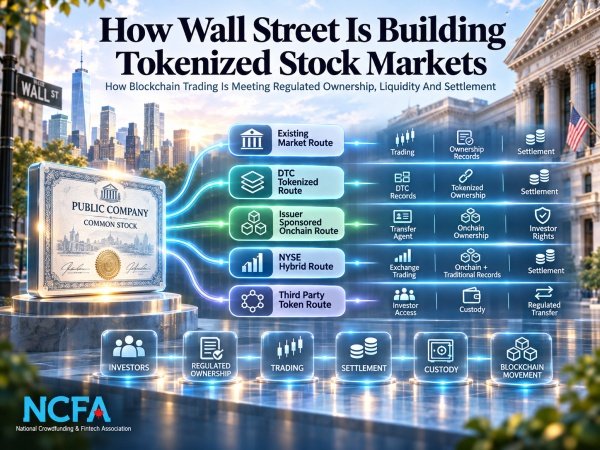
On November 9, 2026, Ava Labs announced Avalanche as the core clearing ledger for NYSE's planned tokenized securities venue.
NYSE isn't putting its stock exchange on Avalanche.
NYSE Pillar remains the planned trading engine. Regulated transfer agents will connect digital shares with shareholder records. Avalanche will sit inside the clearing process after a trade is matched. Stablecoin funding is part of the design.
Blockchain companies have spent years building ways to issue, trade and settle assets directly on digital networks.
Wall Street already has a system that performs those jobs at enormous scale.
Now the two have to connect.
Blockchain can make securities programmable and allow the asset and cash to settle together. Public markets depend on deep liquidity, clear ownership records, custody, corporate actions and regulated firms that remain accountable when something goes wrong.
The question isn't whether stocks can be tokenized anymore.
It's whether tokenized stocks can gain the speed and flexibility of blockchain without splitting ownership, liquidity and investor protection across too many systems.
Canada put a real security through this process in March 2026. Export Development Canada issued a C$100 million bond through Project Samara, with RBC Capital Markets and TD Securities as joint lead managers.
The system supported issuance, bidding, secondary trading, coupon payments and redemption. The security and wholesale central bank money could settle together on distributed ledger technology.
The Bank of Canada also found costs around the transaction. These included system complexity, liquidity costs, governance requirements, coordination work and additional reporting and oversight.
Samara involved one short term security and a closed investor group. A public stock market has to handle the same issues across many securities, firms and investors.
Project Samara showed that a regulated security and regulated money can settle together on a distributed ledger.
But faster settlement only helps if buyers, sellers, custodians and other market participants can work around it without creating new costs or delays.
One trade can be compressed. The rest of the market still has to function around it.
On September 17, the SEC opened a five year path for tokenized U.S. stock trading, allowing qualifying Tokenized Securities Venues to use permissioned automated market makers and liquidity pools.
The tokenized stock must provide holders the same rights and privileges as the equivalent conventional shares.
An unaffiliated company can't simply tokenize another issuer's shares and assume the result is equivalent. The venue must notify the issuer before trading begins and give it 30 calendar days to object.
The rules around which U.S. stocks can qualify for tokenized trading also limit eligible securities, trading volumes and the circumstances in which an issuer can object.
A token can trade onchain and still leave an important question unanswered: what does the investor legally own?
It may be the company's share. It may be a claim backed by shares held somewhere else. It may only track the price.
The technology can make the asset easier to transfer. It doesn't decide the investor's legal rights.
DTC answered from inside the existing market on October 28. Its Tokenization Service allows eligible participants to create tokenized representations of securities already held at DTC and deliver them to registered wallets.
DTC has more than $114 trillion in assets under custody. Twenty participants had signed agreements when the service launched, including Bank of America, Barclays, Citi, Fidelity, J.P. Morgan, Morgan Stanley, State Street and UBS.
The securities don't have to leave DTC for participants to use a tokenized version. Canton and DTCC's private Besu network were the first supported networks, with more expected to follow.
The existing depository remains connected to the asset while blockchain adds another way to hold and transfer it.
DTC takes a different route from building a new market beside the old one.
It adds tokenization to securities already inside the existing system.
That keeps common custody and established market connections in place. It also means new blockchain markets have to offer more than a digital version of the same asset.
On November 2, NYSE named Securitize, tZERO, Broadridge, Computershare, Equiniti and Superstate as transfer agent partners for tokenized securities.
Computershare, Equiniti and Broadridge together serve close to 5,000 publicly listed companies, including nearly 99% of the S&P 500.
The group combines digital asset firms with established shareholder recordkeepers. Securitize, Superstate and tZERO bring onchain issuance and recordkeeping experience. Computershare and Equiniti bring long standing issuer relationships.
Broadridge also connects shareholders with proxy materials, meetings and voting.
A stock doesn't stop working after someone buys it.
Companies pay dividends. Investors vote. Shares split. Mergers close. Ownership changes.
The transfer agent role in NYSE's tokenized share model connects those obligations with the new digital ownership layer.
The share can live onchain. Someone still has to maintain the record everyone agrees is official.
On November 4, Canton Strategic Holdings put the SEC exemption into a live transaction. Existing shareholder Five North moved CNTN shares from a broker account onto the company's onchain shareholder register.
The shares traded through a permissioned Tradecraft liquidity pool. DRW Cumberland bought stock, Flowdesk supplied liquidity and settlement completed atomically on Canton.
Fairmint remained the SEC registered transfer agent. It recorded the tokenized shares, maintained the official onchain ownership record and controlled which verified holders and wallets could participate.
Identity checks, sanctions screening and transfer controls remained part of the transaction.
The November 4 transaction wasn't another demonstration.
A Nasdaq listed stock traded through an onchain liquidity pool and settled atomically, while a regulated transfer agent kept the official ownership record.
Fairmint CEO Joris Delanoue put it plainly: "A blockchain can settle a trade, but it takes an accountable transfer agent to say who legally owns the share."
Blockchain handled parts of the transaction differently. Regulation didn't disappear. It came into the transaction with it.
NYSE keeps conventional exchange technology at the front of its planned digital ATS. NYSE Pillar remains the matching engine, using technology already familiar across NYSE equity and options markets.
The venue can support issuer sponsored tokenized securities as well as qualifying third party custodial products.
Avalanche gets a different job after execution. Its technology will provide the core ledger for the clearing firm supporting the venue.
NYSE says the platform is designed for 24/7 trading, clearing and settlement. Stablecoin funding is contemplated, while regulated transfer agents connect tokenized securities with shareholder records.
NYSE isn't replacing everything at once.
Pillar can match the trade. Transfer agents can keep the ownership record. Avalanche can support clearing. Stablecoins can provide digital cash.
NYSE Head of Digital Issuance Dennis Lee describes the approach as "picking the right technology for each job."
The NYSE Avalanche clearing design gives Avalanche a post trade role rather than making it the only network on which shares can exist.
The result could combine familiar market access with faster digital settlement. It could also leave one stock working across more systems than before.
DTC can tokenize securities already inside the depository. Conventional exchanges can continue using familiar order books and settlement rules while adding tokenized representations after the trade.
This keeps the security tied closely to existing market systems.
Other venues can put more of the process onchain. Ownership, trading and settlement can run through digital networks with verified wallets and programmable controls.
Securitize's tokenized U.S. stocks and OKXICE's proposed venue show how different regulated models are moving from exemptions and filings into actual products and market designs.
A public company's stock can remain inside DTC, appear in issuer sponsored form onchain and also be represented through third party products.
Those versions can trade through different venues and settle through different systems.
That creates more choice, but liquidity can spread across markets and investors may not receive the same rights from every product carrying the same company name.
Tokenization works best if those routes remain connected closely enough that the stock still behaves like one market.
Tokenized stocks can now reach investors through several routes.
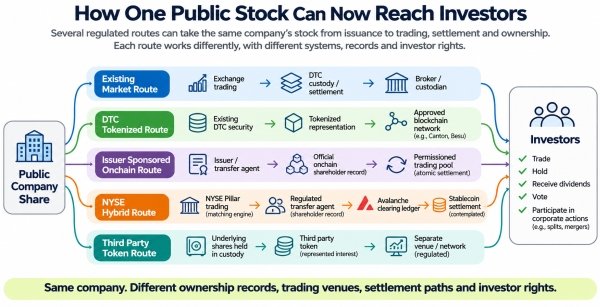
DTC can tokenize securities already held in the traditional market. The SEC has opened a regulated route for permissioned onchain stock trading. Transfer agents can maintain official shareholder records on blockchain networks. A Nasdaq listed stock has already traded and settled this way. NYSE is combining its existing trading technology with blockchain clearing and potentially tokenized cash.
Each approach solves part of the problem.
Together they create another one.
A public stock is valuable partly because buyers and sellers can meet in deep markets and because everyone knows what the security represents. If liquidity spreads across too many venues or different tokenized versions carry different rights, the investor may see the same company name without actually holding the same product.
That doesn't mean tokenized stocks need one blockchain or one trading venue.
It means the different routes have to remain connected closely enough that investors, issuers and intermediaries can treat them as parts of the same market.
For founders, some of the best opportunities may sit in those connections: custody, compliance, identity, shareholder records, corporate actions, market data, liquidity and settlement.
For investors, the basic questions become more important, not less. Who issued the token? What does it represent? Where is ownership recorded? Where does it trade? Who holds the underlying security? What rights come with it?
Canada has already tested part of this problem through Project Samara. Canadian institutions showed that a real security and central bank money can settle together on distributed ledger technology. They also found that faster settlement brings governance, liquidity and operating questions with it.
If U.S. tokenized stocks build meaningful liquidity, Canadian dealers and custodians will have to decide which products and venues they can connect to and how those holdings fit Canadian custody, securities and investor protection requirements.
Blockchain markets don't have to replace regulated public markets to matter. Regulated markets don't have to abandon their existing systems to use blockchain.
A stock can gain new ways to trade and settle without losing the liquidity, ownership clarity and investor rights that make it one market.
Tokenized stocks can now trade through several regulated routes. The opportunity is faster, more programmable markets. The risk is that liquidity, ownership and investor rights become spread across products and venues that all appear to represent the same stock.
Share this story → Explore related intelligence → Subscribe
The National Crowdfunding & Fintech Association (NCFA Canada) is a financial innovation ecosystem that provides education, market intelligence, industry stewardship, networking and funding opportunities and services to thousands of community members and works closely with industry, government, partners and affiliates to create a vibrant and innovative fintech and funding industry in Canada. Decentralized and distributed, NCFA is engaged with global stakeholders and helps incubate projects and investment in fintech, alternative finance, crowdfunding, peer-to-peer finance, payments, digital assets and tokens, artificial intelligence, blockchain, cryptocurrency, regtech, and insurtech sectors. Join Canada's Fintech & Funding Community today FREE! Or become a contributing member and get perks. For more information, please visit: www.ncfacanada.org
| | |
|---|---|---|
| | |


August 26th, 2025

January 4th, 2024

June 1st, 2021

September 9th, 2020

July 9th, 2018

January 3rd, 2018

September 25th, 2017

June 20th, 2017

May 10th, 2017

December 14th, 2016