




Karsten Wenzlaff, Advisor
August 26th, 2025
Karsten Wenzlaff is a Crowdfunding and Fintech Expert from Germany. He is Secretary-General of Digit[...]


Humber EtCetera | Celia Grimbly | Apr 4, 2014
 Globe and Mail business writer Tim Kiladze wrote in 2011 that the venture capital market in Canada was shrinking.
He cited a study by Thomas Reuters showing a decrease in venture capital investments of more than 80 per cent to $1.1 billion in 2010 from $5.9 billion in 2000.
“The demise has hurt Canadian companies,” Kiladze wrote. “Venture capital investors are the few institutions and individuals who are willing to invest in small startups with no proven track record.”
This was the landscape until recently, when the Ontario Securities Commission among five other provincial regulators, announced in March two new proposals for crowdfunding prospectus exemptions, which may help boost the Canadian economy, said Debra Chandra, ambassador for Singularity University and advisor to the National Crowdfunding Association of Canada.
“Crowdfunding provides startup companies with a new way of raising capital, who don’t have any operating history and can’t go to traditional lenders, and it’s a real-time customer focus group,” she explained. “They’re getting feedback, building brand and getting capital to build out some of their product.”
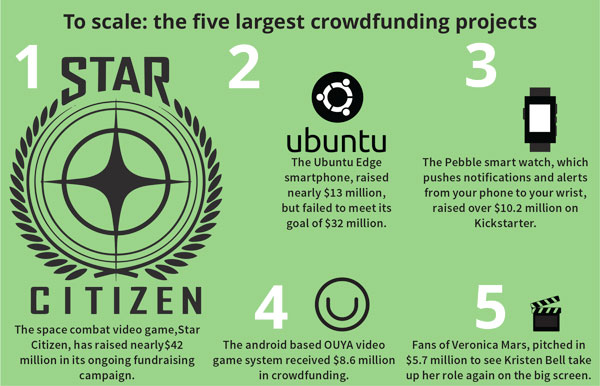
Illustration by Peter Davey. Clapboard Icon made by Freepik from Flaticon.com. All figures are in U.S. dollars
The proposals for crowdfunding exemptions open up new “capital classes” for companies, offering opportunities to almost all Canadians to invest in startup businesses, she said.
“If you want to raise capital in private markets you need a prospectus, which is a very costly document,” said Craig Asano, executive director of the National Crowdfunding Association of Canada.
A prospectus is a “detailed disclosure document” and “contains key information about the investment fund and the securities offered,” as defined by the Ontario Securities Commission.
Related:
The new crowdfunding prospectus exemption proposals, from provincial regulators, eliminate the need for individuals and companies to prepare the expensive document, said Asano.
“The argument there is, why would a startup company need to pay an extremely high amount of capital to qualify and comply with regulations when they’re only needing a small sum of money?” he said. “It doesn’t really make sense.”
There are many regulations and limitations associated with the crowdfunding exemptions, such as issuer caps and investor caps, in lieu of the prospectus that protect the company and the investor, said Tony Gifford, the entrepreneur advocate for Humber’s business school.
“What can happen is that there may be a startup that is doing this surreptitiously and there’s no regulation on it so it may be dishonest and all of these kinds of fears so they have capped the amount that an individual, public investor can put into a business,” Gifford said.
The “Startup Exemption”, adopted in Saskatchewan last December, limits capital raised by startups and small to medium enterprises (SMEs) to $300,000 per 12-month calendar year, said Asano. The maximum investment from an investor under this exemption is $1,500 per deal, he said.
Capital News Online | By Arik Ligeti and Hillary Johnstone | Apr 4, 2014
 Kickstarter helped put the word crowdfunding on the map when it launched in 2009.
But Kickstarter, and others like it, have their limits. While they offer rewards, they don’t enable projects or startups to offer a stake in the company. Governments around the world have recognized that need, and began instituting regulations to enable just that, including the U.S. JOBS Act that was announced in 2012.
Here's how news site PandoDaily explained the U.S. act:
While the U.S. act and it’s accompanying equity crowdfunding policies have been held up, it did push Canada into action. On March 20, things started moving in a big way when the Ontario Securities Commission (OSC) proposed a set of crowdfunding regulations that would allow companies to raise up to $1.5-million in a 12-month period. In essence, startups will post their projects to an online portal in a bid to earn investment.
Planned in cohesion with Quebec, Manitoba, New Brunswick, Nova Scotia, and Saskatchewan (which has a different funding cap), advocates say the proposed changes are a game-changer for crowdfunding in Canada.
“There’s a need to have these crowdfunding regulations to help early-stage startup capital,” says Craig Asano, executive director of the National Crowdfunding Association of Canada.
The new regulations are aimed at helping companies somewhere in between the smaller Kickstarter-type funds in the tens of thousands of dollars, and larger, multi-million investments from angel investors or venture capitalists.
“There’s a funding gap,” Asano says, and that’s the need this regulation is trying to fill.

The proposed regulations would allow companies to raise the $1.5-million maximum, with individual investors able to contribute up to $2,500 for a single business. In exchange for their contributions, investors would receive shares in the company, which in turn gives them voting rights. How much influence, and what they’ll be entitled to vote on, has yet to be determined.
The paperwork, time and costs that come with the current model of investor funding for small businesses are areas that would see vast improvement with the crowdfunding regulations in place.
“As a startup I'm pretty excited about it,” says Suzan Bsat, the co-founder of Figure of Eight, which focuses on software for medical billing data.
While she’s eager for increased access to outside investors, Bsat does point to one area of concern: “We have to be cautious about who we're giving part of our company to.”
“It’s not just about money, it’s about the relationship too,” says Thomas Sychterz, co-founder of Wipebook, which raised $424,000 on Kickstarter for its whiteboard notebook product.
The OSC proposals are two-fold: a prospectus exemption and portal requirements. The prospectus exemption essentially allows companies to avoid having to file a prospectus - a lengthy and expensive document to produce that a company issues when going public on the stock market. That’s because these companies fall somewhere in between private and public -- there’s an obligation to the crowdfunders, and therefore a level of transparency is required.
At the same time, these startups aren’t putting themselves on the open market, and don’t need to follow as stringent regulations as companies trading on the Toronto Stock Exchange.
Crowdfund Insider | By JD Alois | April 3, 2014
 Here is a great infographic on the status of equity crowdfunding in Canada. This is courtesy of Oscar Jofre, CEO and Founder of BoardSuite & Co-Chair of the ECFA Canada. On March 20, 2014, there was a country wide announcement by Canadian regulators regarding proposed regulatory approach to the new form of finance. The below infographic explains the four various proposed types of regulation.

Source: http://www.crowdfundinsider.com/2014/04/35197-equity-crowdfunding-canada-infographic/
Vancouver Sun | By Derrick Penner | April 3, 2014
 Online crowdfunding has become a social force worth more than $100 million per year to cool projects and worthy causes in Canada, according to its advocates.
Now British Columbia is among the jurisdictions probing whether it can become an economic force as a method for companies to raise start-up capital from the public — without becoming a magnet for fraud.
Last week, the B.C. Securities Commission posted for public comment a proposed set of Internet crowdfunding rules that would exempt companies from the strict requirements of filing a detailed prospectus that listed companies must abide by.
Related:
The rules would allow companies to raise $150,000 per capital campaign, with a limit of two campaigns per year, and cap investor contributions at $1,500 per person per campaign, similar to the exemption Saskatchewan put in place in December.
As per the Saskatchewan structure, the BCSC proposal calls for all money to flow through a website-based Internet portal.
“This is filling a gap at the low end of the market where a very small entrepreneur can get money from their community to help fund their business,” said Daryl Hatton, CEO of Vancouver-based crowdfunding portal FundRazr.
Start-up companies are generally starved for capital, Hatton said, so anything that can be developed to bridge small firms from the goodwill of family and friends onto the continuum of venture capital helps. He characterized the BCSC rules as a “starter kit” to get a new venture going.
Hatton’s portal is one of the bigger players in the existing crowdfunding structure — often referred to as the rewards and incentives sector — where people solicit funds for projects or causes.
You may be interested in: Become a sponsor of Crowdfunding today
The way crowdfunding works is individuals and organizations register projects with portals such as FundRazr, Indiegogo or Kickstarter, then launch social-media campaigns to promote them through venues such as Twitter or Facebook. Supporters make their contributions via PayPal, credit card or other online options through the portal.
The difference with the BCSC’s proposed rules is that investors would be buying into the company itself through shares or other forms of capital.

The National Crowdfunding Association of Canada (NCFA Canada) is a cross-Canada crowdfunding hub providing education, advocacy and networking opportunities in the rapidly evolving crowdfunding industry. NCFA Canada is a community-based, membership-driven entity that was formed at the grass roots level to fill a national need in the market place. Join our growing network of industry stakeholders, fundraisers and investors. Increase your organization’s profile and gain access to a dynamic group of industry front runners. Learn more About Us | Prezi or contact us at casano@ncfacanada.org.
Canada Media Fund | Antoine van Eetvelde | April 2, 2014
 Disclaimer : The following content is intended to provide general information and does not constitute legal or tax advice of any kind. Refer to your local tax credit administrator for more specific guidelines on reporting crowdfunding income for tax credit purposes.
The end of 2013 and the beginning of 2014 saw a number of significant regulatory developments regarding crowdfunding, both here in Canada and in the US. In particular, the US and certain Canadian provinces made significant progress toward making investment crowdfunding a reality. What follows is a summary of the latest significant regulatory developments in North America. This is the second part of a two-part update (first part available here).
The Securities and Exchange Commission (SEC) has released its proposed rules for investment crowdfunding after almost a year of delay.
This release brings the SEC one step closer to implementing Title III of the JOBS Act which would make investment crowdfunding legal across the US. The proposed rules were open for public comment until February 3, 2014.
The SEC has struggled to create a set of rules that respected the flexible and democratic nature of crowdfunding (which makes it so appealing to very small and early stage start-up companies) while also implementing sufficient regulation to satisfy consumer and investor protection critics who fear that investment crowdfunding is far too open to abuse and fraud.
Key features of the SEC’s proposed rules:
You can access the complete 585-page document that outlines the full set of rules by clicking here.
The proposed rules also include a set of registration rules for crowdfunding platforms, which were developed in partnership with the Financial Industry Regulatory Authority (FINRA). The FINRA released its set of proposed rules—the Funding Portal Rules—for comment at the same time as the SEC published the Regulation Crowdfunding rules.
The SEC has also officially lifted the ban on “general solicitation” as of September, a rule change that was a key directive under Title II of the JOBS Act.
This rule change means that companies can freely advertise private equity offerings to the public via social media and other outreach and media outlets, something that was previously not allowed. Although this rule change does have implications for investment crowdfunding, which relies on general solicitation via social media, it does not actually apply to crowdfunding in the sense that most people understand it. The rule is actually directed at private equity sales to accredited investors and is accompanied by a new proposed rule that companies need to acquire proof that an investor is accredited if they are selling private equity using general solicitation. In other words, the rule does not mean that companies can sell private equity to non-accredited investors (or the general public) using general solicitation, which is what investment crowdfunding seeks to do. However, the rule change does allow certain platforms, such as CircleUp, to legally use the crowdfunding approach to publicly advertise offerings to accredited investors in a much broader way.
Globe Advisor | Ivor Tossell | March 28, 2014
 Investing in start-ups, with all its risks and rewards, has been limited to accredited investors. Crowdfunding is about to change that
Before it became the poster child for crowdfunding success, the Pebble Smartwatch struggled to get financial backing. A svelte, wearable computer that stole a march on Apple and Samsung, the wristwatch has an e-paper display, runs apps and does neat tricks like controlling nearby smartphones.
But the idea didn't connect with seed funders, so the Pebble's creator, Eric Migicovsky, turned to Kickstarter. He posted a video on the crowdfunding site asking for donations. In return, anyone who pitched in $115 or more would get a Pebble of his or her own. On a campaign to raise $100,000, the Silicon Valley company walked away with $10 million in donations and orders.
Runaway successes like this are the exception, but crowdfunding can be a good way to gauge public interest in a product. Still, traditional crowdfunding has always had one sharp limitation: The public can be offered almost anything in return for their money - except an actual stake in the company. Securities regulations in Canada and the U.S., designed to keep small-time investors from being taken to the cleaners, have prevented entrepreneurs from selling equity in their new ventures. Investing in start-ups, with all its risks and rewards, has been limited to accredited investors only - in other words, people with piles of money, who regulators are confident are capable of looking after themselves in the open marketplace.
That's about to change. For what might be the first time anyone's ever been stoked about securities regulations, authorities in the U.S. and Canada are looking to open the floodgates for start-ups to sell stakes in themselves to you, me and most anyone else. "What we'll start seeing is an armchair Dragons' Den - people who want to manage their own portfolios," says Craig Asano, the executive director of the National Crowdfunding Association of Canada. "It will democratize the capital flow."
In the U.S., the new Securities and Exchange Commission rules, which are currently being circulated for comment, would still put tight restrictions on would-be dot-com moguls: Investments would be limited to about $2,000 a year for investors at the low end of the income scale, growing to $100,000 a year for millionaires. Start-ups, for their part, would be limited to raising $1 million a year in equity and, for the first time, will have to cough up information about their plans and revenues (such as they may be) before making an offering.
Similar changes, with roughly comparable caps, are being mulled in Ontario, and the public could get a look at the proposals as early as March. Saskatchewan, for one, has already signed off on small-scale crowdfunding. Canada is a bit more complicated than the States, where securities are regulated federally, rather than province-by-province. But Canada's regulators may well be co-ordinating behind the scenes. "Do not be surprised if it rolls out all the way across Canada at the same time as Ontario, or shortly thereafter," says Alixe Cormick, the owner of Venture Law, a Vancouver-based corporate securities firm.
In some parts of the world, equity crowdfunding is already a reality: Australia, the United Kingdom and Sweden have allowed it for years; their experiences suggest it has helped the tech industry, if not revolutionized it. But it's the powerhouse of America, with its vast reserves of talent, capital and hundreds of millions of consumers with an unparalleled appetite for getting rich, that's really waiting to get uncorked.
The promise of equity crowdfunding is several fold. Bret Conkin, chief marketing officer of FundRazr, one of Canada's largest home-grown crowdfunding sites (it has raised $37 million in donations in 20 countries), thinks equity will become part of a crowdfunding ladder for start-ups. "You might use donations at the idea stage," he says, "then, you run a perks-based campaign to run a preorder." Afterward, start-ups might use equity crowdfunding to supplant a seed round, where larger investors would have stepped in. Instead of five big funders, a start-up might attract a few hundred small ones. "We view it as a continuum of funding."
The new rules will bring sweeping change to an already-volatile sector - or create an entirely new one. All of a sudden, people who've been reading about the start-up boom from a safe remove will be able to place bets with their own money. From a regulatory perspective, this will put pressure on the portals - the Kickstarters, Indiegogos and Fund- Razrs of the world - to keep their sites clear of fraud and stay neutral, so as not to act as "stock pickers." The finer points of how this will be achieved are of some concern to portal operators. "We hope they'll have the sense to adjust the regulations so that it will be workable for entrepreneurs to raise money in this fashion," says Conkin.
Healthy Crowdfunder | Tony Arias | March 31, 2014

Last year on June 19, 2013, we hosted our first crowdfunding meetup called “Crowdfunding Reinvents the Old Stock Exchange” and late adopters ignored the equity crowdfunding word. Not this past week.
You know crowdfunding is going mainstream when the:
Furthermore, the US JOBS Act will facilitate a pipeline of companies remaining private until mature enough to go public
Accredited or non-accredited, angels, other high net worth (HNW), or institutional investor, start looking for funding platforms that:


August 26th, 2025

January 4th, 2024

June 1st, 2021

September 9th, 2020

July 9th, 2018

January 3rd, 2018

September 25th, 2017

June 20th, 2017

May 10th, 2017

December 14th, 2016