





Karsten Wenzlaff, Advisor
August 26th, 2025
Karsten Wenzlaff is a Crowdfunding and Fintech Expert from Germany. He is Secretary-General of Digit[...]


Apr 22, 2026 | NCFA Fintech Market Activity | Artificial Intelligence And Data, Capital Markets And Funding
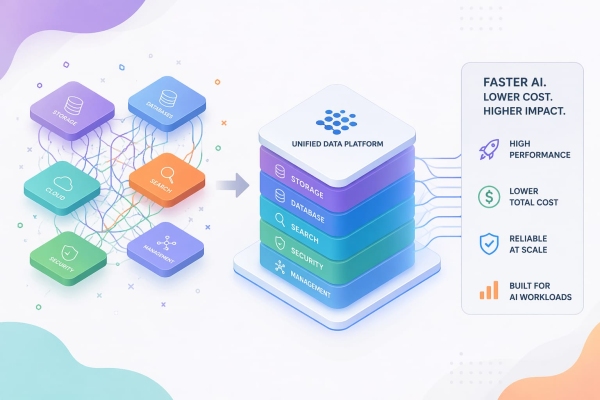
On April 22, 2026, VAST Data closed $1 billion Series F round in primary and secondary capital at a $30 billion valuation. Drive Capital and Access Industries led the round, with Fidelity, NEA, and Nvidia also participating. The valuation has more than tripled from $9.1 billion in 2023.
VAST sells the data infrastructure empowering AI systems. Its customers include xAI, CoreWeave, and the U.S. Air Force. In November, the company signed a $1.17 billion agreement with CoreWeave. Equity research by Sacra puts Vast Data at $200 million in annual recurring revenue with positive free cash flow as of January 2025. That gives the funding round a clearer base in commercial demand.
VAST is building a unified data platform rather than a single product. Its core platform architecture combines storage, database, and global data management into one stack:
The difference shows up in how the platform is positioned for AI workloads. VAST combines storage and database functions into one system and claims performance gains tied to that design, including up to 11x faster vector search at 91% lower cost, alongside six nines availability (99.9999%) and about 60% lower total cost of ownership, as outlined on its core platform page. These are vendor claims, but they reflect how the company is positioning itself in large scale AI deployments.
The competitive landscape spans multiple layers:
VAST is positioning itself across boundaries by collapsing multiple data layers into one system. That architecture targets a real constraint. AI systems don’t stall only because of compute limits. They stall when data throughput and pipelines slow down, when storage tiers introduce latency, or when separate systems create operational overhead. Adding more GPUs can increase pressure on that layer instead of fixing it.
The funding structure reinforces the point. Primary capital brings in new money to help the company grow and work more closely with large customers. Secondary capital lets early investors and employees sell some of their shares and take cash out without the company going public. This mix is common in large late stage rounds where demand is strong and companies stay private longer.
For smaller AI finance companies, the takeaway is practical. The infrastructure layer is being built by a small group of well funded players. There is no advantage in trying to replicate it. Their advantage comes from what they build on top. It’s about having unique data, strong products that solve real workflows, and access to customers. Those are the things that still decide who wins.
VAST is successfully raising money because it brings together parts of the AI system that companies usually have to piece together themselves. When computing is expensive and data slows things down, the platform that keeps data fast and accessible becomes part of the core infrastructure.
 The National Crowdfunding & Fintech Association (NCFA Canada) is a financial innovation ecosystem that provides education, market intelligence, industry stewardship, networking and funding opportunities and services to thousands of community members and works closely with industry, government, partners and affiliates to create a vibrant and innovative fintech and funding industry in Canada. Decentralized and distributed, NCFA is engaged with global stakeholders and helps incubate projects and investment in fintech, alternative finance, crowdfunding, peer-to-peer finance, payments, digital assets and tokens, artificial intelligence, blockchain, cryptocurrency, regtech, and insurtech sectors. Join Canada's Fintech & Funding Community today FREE! Or become a contributing member and get perks. For more information, please visit: www.ncfacanada.org
 |  |  |
|---|---|---|
 |  |  |



August 26th, 2025

January 4th, 2024

June 1st, 2021

September 9th, 2020

July 9th, 2018

January 3rd, 2018

September 25th, 2017

June 20th, 2017

May 10th, 2017

December 14th, 2016

Leave a Reply