




Karsten Wenzlaff, Advisor
August 26th, 2025
Karsten Wenzlaff is a Crowdfunding and Fintech Expert from Germany. He is Secretary-General of Digit[...]


Apr 2, 2026 | NCFA Insight | Capital Markets And Market Infrastructure
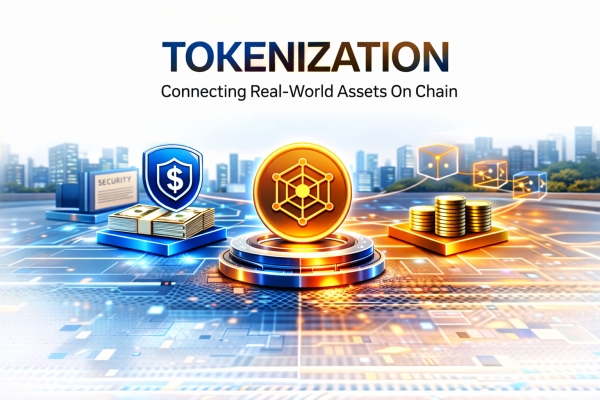
The market is no longer asking if tokenization works. It is deciding where it works first.
An OMFIF report on tokenization frameworks lays out how this market is forming. Not all tokenization is created equal. It breaks into different legal and operating models, and those models scale at different speeds. That aligns with what NCFA has already highlighted in how tokenized infrastructure is starting to change market operations.
In practice, the limits are already clear. On March 11, 2026, the European Central Bank confirmed Pontes will launch in Q3 2026 to enable central bank money settlement for DLT based transactions. The Eurosystem has also made clear that central bank money remains the anchor for settlement. Without trusted settlement, tokenized assets do not scale.
The OMFIF report separates tokenization into three models.
Most activity today sits in indirect and incomplete models. Fully native on chain markets remain limited. These structures carry different rights the affects ownership, investor protection, and how claims hold up under stress.
The spread across asset classes is now visible in real issuance and product data. As shown below, activity clusters where structure, custody, and settlement align with existing market practice.
Slovenia’s €30m sovereign issue and the World Bank’s €100m digital notes sit alongside tokenized fund products like BlackRock’s BUIDL at about $1.8bn and Franklin Templeton’s Benji fund at about $865m.
Real asset platforms such as RedSwan and Toucan extend this into real estate and carbon markets.
Infrastructure layers like Broadridge’s distributed ledger repo platform process about $385.5bn in daily volume. Adoption follows existing workflows.

Illustrative examples based on OMFIF report data and public disclosures
Most of the activity is around collateral. Assets remain with custodians while ownership records update faster, improving how collateral moves across the system. Market data supports this. RWA.xyz shows tokenized US Treasuries at about $10B and $27.57B in distributed asset value, alongside $299.32B in stablecoins.
Franklin Templeton’s off exchange collateral program shows how this works in practice. Clients use tokenized money market fund shares as collateral while assets remain in regulated custody, which is similar to what NCFA covered in institutional tokenized money market fund adoption. Collateral efficiency and usable capital drive early adoption.
According to the OMFIF report survey, faster isn't always better. Only 16% of bond market participants prefer T+0. Most prefer longer cycles to manage liquidity and funding. The target is settlement on demand, not instant settlement. That's why central banks are focusing on the money leg. Without trusted cash rails, tokenized assets don't scale cleanly.
At the same time, fragmentation still limits how far the model can go. There are 72 blockchains in use across financial services, and assets don't move easily across them without shared standards. Policy adds another constraint. In 2022, the Basel Committee set very high capital requirements for some public blockchain exposures, making them costly for banks to hold.
Even so, infrastructure is advancing. DTCC is preparing tokenization services for DTC-custodied assets, with rollout expected in the second half of 2026. The focus is on collateral mobility, continuous access, and programmable assets within existing systems.
Tokenization already works at scale in market infrastructure. Platforms like Broadridge’s distributed ledger repo solution support high volume repo activity, with reported usage reaching about $385bn in daily volume and roughly $9tn monthly across thousands of trades. It reduces friction in collateral movement and short term liquidity without requiring full market redesign. This is where adoption is already real.
The market is not converging on one model. It is dividing across designs impacted by real constraints. Products that match existing legal structures and improve workflows will adopt first. Others will take longer.
 The National Crowdfunding & Fintech Association (NCFA Canada) is a financial innovation ecosystem that provides education, market intelligence, industry stewardship, networking and funding opportunities and services to thousands of community members and works closely with industry, government, partners and affiliates to create a vibrant and innovative fintech and funding industry in Canada. Decentralized and distributed, NCFA is engaged with global stakeholders and helps incubate projects and investment in fintech, alternative finance, crowdfunding, peer-to-peer finance, payments, digital assets and tokens, artificial intelligence, blockchain, cryptocurrency, regtech, and insurtech sectors. Join Canada's Fintech & Funding Community today FREE! Or become a contributing member and get perks. For more information, please visit: www.ncfacanada.org
 |  |  |
|---|---|---|
 |  |  |


August 26th, 2025

January 4th, 2024

June 1st, 2021

September 9th, 2020

July 9th, 2018

January 3rd, 2018

September 25th, 2017

June 20th, 2017

May 10th, 2017

December 14th, 2016

Leave a Reply