





Karsten Wenzlaff, Advisor
August 26th, 2025
Karsten Wenzlaff is a Crowdfunding and Fintech Expert from Germany. He is Secretary-General of Digit[...]


March 2 2026 | Feature | AI Governance And Public Safety
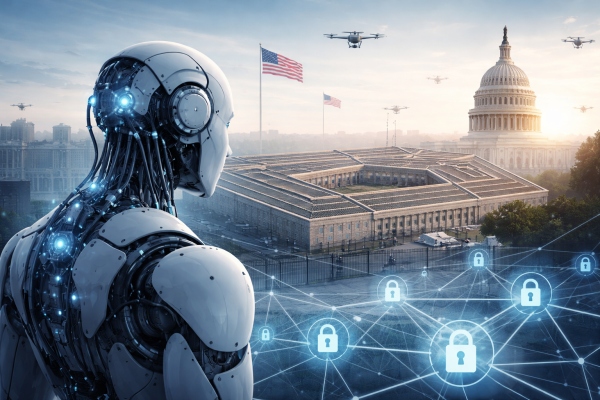
AI Image: Conceptual illustration of AI ethics, defense contracts, and public accountability
On February 26 2026, Anthropic said it wouldn't allow two Pentagon use cases in its contracts: mass domestic surveillance and fully autonomous weapons. Two days later, OpenAI said it reached a Pentagon deal for classified AI deployments and argued its safeguards could still hold inside the agreement. The split exposes the real issue now facing AI vendors, governments, and regulated buyers. That is should ethics limits block deals or be enforced from inside it?
Anthropic wasn't on the outside looking in. It said Claude was extensively deployed across the Department of War and other national security agencies and that the company had already put models into classified U.S. government networks. Anthropic also said two use cases, mass surveillance (including of the public), and fully autonomous weapons, we're never included in its contracts. Those cases are the fault lines in the dispute with Trump's Pentagon and US government.
Anthropic framed the issue as a narrow refusal, not a broad rejection of national security work. Dario Amodei said Anthropic supported “98% or 99%” of Pentagon use cases, but the company would not give up the remaining two limits. In its own words, Anthropic said, “we cannot in good conscience accede to their request.” Reuters reported that stance put a defense contract worth up to $200 million at risk.
The dispute escalated when President Trump directed the government to stop work with Anthropic and ordered a six month phase out of Anthropic technology across government. The Pentagon also moved to treat Anthropic as a supply chain risk. That raised the cost of holding hard limits when the customer is the government.
OpenAI took a different approach. In its own statement titled, 'Our agreement with the department of war', the company said its agreement had “more guardrails than any previous agreement for classified AI deployments, including Anthropic’s.” OpenAI also said, “We were—and remain—unwilling to remove key technical safeguards.” That is the core tension in this story.
Anthropic refused the terms it saw as too open. OpenAI signed and argued that stronger controls inside the agreement could still hold the line.
The details matter. OpenAI said the Department of War may use its system for all lawful purposes, but the same published terms say the system cannot independently direct autonomous weapons where law or policy requires human control, cannot make high stakes automated decisions that require human approval, and cannot be used for unconstrained monitoring of U.S. persons’ private information. OpenAI also said it keeps its safety stack in place, limits deployment to cloud infrastructure, keeps cleared personnel in the loop, and could terminate the contract if the government violates the terms.
The two companies are close on headline principles but not identical in practice. Anthropic draws two hard exclusions and refuses to move them. OpenAI accepts a broader legal framework, then relies on contract language, technical controls, and operational oversight to make similar limits enforceable inside the deal. That is a narrower and more conditional ethics model than refusing the agreement outright.
North of the border, the same trust question is already under pressure. After the Tumbler Ridge school shooting, Ottawa’s focus was whether AI evidence and escalation controls hold when governments ask for proof that safeguards, response rules, and accountability processes actually work under pressure. That's different than the Pentagon story that's testing how AI companies react and accept to full on defense contracts.
For fintechs, banks, and infrastructure providers, the lesson is practical. Buyers in regulated markets now ask more than whether a model performs well. They ask who can audit it, who can override it, what records exist, how long they are kept, and whether a vendor can prove that a stated limit still holds when a regulator, a court, or a government agency pushes hard.
On one hand, Anthropic's founders' moral compass highlights one method by maintaining hard limits even at the risk of losing a major federal contract. On the other hand, OpenAI's deal with the department of war is betting that contract terms, technical safeguards, and human oversight can preserve similar limits inside the agreement. Washington shows how quickly the state can force the issue. Ottawa shows what happens when public safety puts the same claims under direct scrutiny. In the next phase of AI adoption, trust rests less on capability claims and more on what a company can prove when the pressure rises.
 The National Crowdfunding & Fintech Association (NCFA Canada) is a financial innovation ecosystem that provides education, market intelligence, industry stewardship, networking and funding opportunities and services to thousands of community members and works closely with industry, government, partners and affiliates to create a vibrant and innovative fintech and funding industry in Canada. Decentralized and distributed, NCFA is engaged with global stakeholders and helps incubate projects and investment in fintech, alternative finance, crowdfunding, peer-to-peer finance, payments, digital assets and tokens, artificial intelligence, blockchain, cryptocurrency, regtech, and insurtech sectors. Join Canada's Fintech & Funding Community today FREE! Or become a contributing member and get perks. For more information, please visit: www.ncfacanada.org
 |  |  |
|---|---|---|
 |  |  |



August 26th, 2025

January 4th, 2024

June 1st, 2021

September 9th, 2020

July 9th, 2018

January 3rd, 2018

September 25th, 2017

June 20th, 2017

May 10th, 2017

December 14th, 2016

Leave a Reply