





Karsten Wenzlaff, Advisor
August 26th, 2025
Karsten Wenzlaff is a Crowdfunding and Fintech Expert from Germany. He is Secretary-General of Digit[...]


August 20, 2026 | NCFA Resource | Payments And Money Movement, Banking And Credit, Financial Inclusion
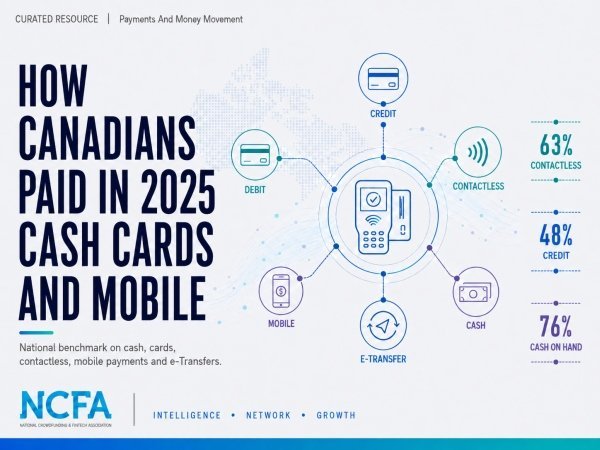
On August 20, 2026, the Bank of Canada published its 2025 Methods-of-Payment Survey, based on responses from 4,964 Canadians and payment diary data from 2,185 participants. The report measures cash holdings, card use, mobile payments, Interac e-Transfer, payment costs, merchant acceptance and how consumers rate different ways to pay.
For payments firms, banks, fintechs and policy teams, the survey provides a current national benchmark for consumer behaviour. Credit cards remain the dominant payment method, contactless now accounts for most in-person purchases, mobile devices are taking a larger share of card taps, and cash remains widely held even though its transaction share fell in 2025.
Credit cards accounted for 48% of purchase volume and 58% of purchase value in 2025. Debit represented 25% of volume and 24% of value, while cash accounted for 18% of point of sale transaction volume and 10% of value. Cash had represented 21% of volume and 11% of value in 2024, so the latest survey records a decline after several years of relative stability.
Contactless payments now dominate in person. In 2025, 63% of in-person payments were contactless, representing 61% of in-person purchase value. Most taps still used physical cards, but mobile devices accounted for one quarter of contactless credit transactions and 15% of contactless debit transactions.
The mobile figures are more useful than in previous surveys because the Bank changed its 2025 payment diary. Respondents who reported tapping a card were asked whether they used the physical card or a version stored on a mobile device. That difference helps separate adoption of mobile wallets from adoption of the underlying payment rail. A credit card stored in a phone remains a credit card transaction, but the interface through which the customer pays has changed.
The revised survey also suggests previous estimates understated mobile use. Over the previous year, 41% of Canadians reported using mobile payments, while just over half used Interac e-Transfer. About one quarter used a digital wallet app and 19% used a bank account app. Those adoption figures should not be read as transaction shares. Interac e-Transfer, for example, appears less often in the three day purchase diary because consumers frequently use it for expenses such as rent and home services that the diary does not capture.
The findings provide a useful consumer benchmark beside Canada’s financial infrastructure changes. Expanded Payments Canada membership, the Real-Time Rail, payment service provider oversight and consumer-driven banking are changing how firms can access and build on payment infrastructure. The Bank’s survey shows the payment habits those services will encounter as they reach consumers.
Cash presents a more mixed picture. About 76% of Canadians had cash on hand when surveyed, with an average of $141 and a median of $70 among people carrying it. Four out of five Canadians said they had no plans to stop using cash, while only 12% described themselves as cashless. At the same time, cash transaction share and average cash holdings both fell in 2025.
The Bank does not treat one year of weaker cash use as proof of a lasting decline. More observations are needed to separate a durable change from normal survey variation or a temporary result. Access also remains relevant: 68% of Canadians described access to an ABM as easy or very easy, compared with 61% for a bank branch.
Payment providers and fintech product teams can use the survey to test assumptions about where Canadian payment behaviour is concentrated. Credit and debit cards still account for most everyday purchases, contactless has become the normal in-person card experience, and mobile wallets are becoming a more important way of presenting those same card credentials.
Banks and financial institutions can use the findings to compare physical and digital access. Consumers are using mobile payment tools more often, but most still keep cash and report that access to ABMs and branches remains important. That combination is relevant when firms make decisions about digital channels, cash services, card products and customer support.
Investors and market researchers get a national reference point for assessing product adoption claims. The report separates annual use, recent use and actual transaction diary data, which helps distinguish a service that many people have tried from one that captures a large share of purchases.
Policy teams can read the findings alongside Canada’s consumer-driven banking rules. The survey does not measure open banking use, but it establishes how Canadians currently pay before regulated data sharing and future payment initiation services reach wider adoption.
For financial inclusion work, the cash findings are especially useful. Digital adoption does not mean all consumers have stopped using physical money. Most Canadians still keep cash, most do not plan to abandon it, and access to withdrawal infrastructure continues to affect how practical cash remains.
The survey combines two useful forms of evidence. The questionnaire captures payment ownership, cash holdings, recent use, costs and consumer perceptions, while the three day diary records purchases and withdrawals closer to when they occur. In 2025, 4,964 people completed the questionnaire and 2,185 submitted at least one day of diary data.
Its history also adds value. The Bank began the Methods-of-Payment survey in 2009 and has run annual surveys since 2021, giving readers a basis for comparing the latest results with earlier payment behaviour. That longer record is why the 2025 decline in cash should be watched rather than immediately treated as a permanent change.
The methodology has limits. The questionnaire uses quota sampling by age, gender and region, then calibrates the samples to Canadian demographic characteristics. The diary covers only three days, and not every questionnaire respondent completes it, so less frequent payments can appear more clearly in recall questions than in the transaction diary.
The new mobile measurement also affects comparisons with earlier years. Separating physical card taps from cards stored on mobile devices improves the 2025 data, but some earlier mobile figures were measured differently and should not be compared mechanically.
NCFA’s Canadian payments market coverage puts the Bank’s consumer survey beside a much larger benchmark. Payments Canada recorded 22.5 billion retail payment transactions worth $12.2 trillion in 2024. The two datasets answer different questions. The Bank of Canada focuses on how consumers hold, choose and use payment methods, while Payments Canada measures transaction volumes, values and market activity across the payment system.
2025 Methods-of-Payment Survey PDF (62 page report, tables, charts and methodology)
Methods-of-Payment Survey (Bank of Canada survey series and historical results)
2024 Methods-of-Payment Survey (previous annual consumer payment benchmark)
Canadian Payment Methods And Trends 2025 (22.5 billion retail transactions worth $12.2 trillion)
 The National Crowdfunding & Fintech Association (NCFA Canada) is a financial innovation ecosystem that provides education, market intelligence, industry stewardship, networking and funding opportunities and services to thousands of community members and works closely with industry, government, partners and affiliates to create a vibrant and innovative fintech and funding industry in Canada. Decentralized and distributed, NCFA is engaged with global stakeholders and helps incubate projects and investment in fintech, alternative finance, crowdfunding, peer-to-peer finance, payments, digital assets and tokens, artificial intelligence, blockchain, cryptocurrency, regtech, and insurtech sectors. Join Canada's Fintech & Funding Community today FREE! Or become a contributing member and get perks. For more information, please visit: [www.ncfacanada.org](http://www.ncfacanada.org)
 |  |  |
|---|---|---|
 |  |  |



August 26th, 2025

January 4th, 2024

June 1st, 2021

September 9th, 2020

July 9th, 2018

January 3rd, 2018

September 25th, 2017

June 20th, 2017

May 10th, 2017

December 14th, 2016

Leave a Reply