





Karsten Wenzlaff, Advisor
August 26th, 2025
Karsten Wenzlaff is a Crowdfunding and Fintech Expert from Germany. He is Secretary-General of Digit[...]


June 16, 2026 | NCFA Story Intelligence | Fraud, Cybersecurity And Trust
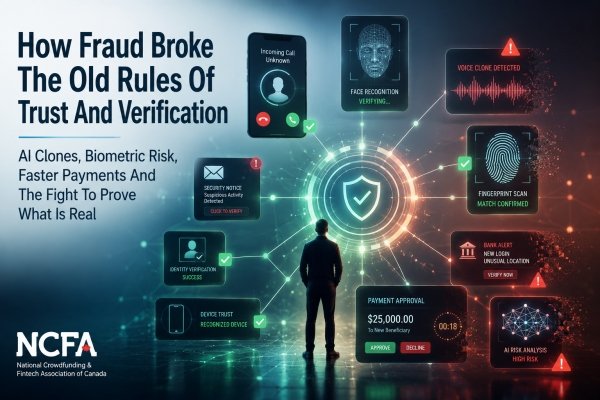
The phone rings. Many people no longer answer.
Not because they’re too busy. Because they’re not sure who is calling, what’s real, or whether the message is safe to trust. That small behaviour change tells a bigger story about finance, fraud, identity, and technology.
For years, financial trust relied on familiar signals: a voice, a face, a password, a bank name, a phone number, a regulator, a delay before money moved. AI clones, biometric breaches, deepfakes, cyberattacks, weak AML controls, and faster payments are now breaking those signals at the same time.
Financial trust used to have more time. Branch visits, paper signatures, settlement delays, call centre checks, account holds, and human review gave institutions more room to spot problems before money moved too far. The system was slower, but that slowness created time to verify.
Consumers learned to trust familiar signals. A bank logo felt official. A caller who knew account details sounded credible. A voice sounded personal. A password felt private. Those signals were never perfect, but they worked well enough when fraud was slower, less automated, and easier to recognize.
Online finance moved trust away from the branch. Banking, investing, lending, crypto, payments, and onboarding shifted into screens and apps. That created better access and faster service, but it also made customers depend on passwords, text codes, device checks, email links, and remote identity tools.
Fraudsters followed the customer online. Phishing, fake websites, account takeover, crypto wallet scams, approval phishing, QR abuse, and spoofed support channels made digital convenience feel less certain. Operation Avalanche showed how coordinated fraud response is becoming part of the market.
Voice used to feel personal. Then AI cloning made it copyable. Cloned voices bypassed Voice ID tests at Santander and Halifax, exposing weakness in systems that treated a voice as a reliable authentication signal.1
The scam no longer has to sound like a scam. A cloned voice can sound calm, familiar, urgent, or official. That changes the risk for banks, call centres, families, executives, seniors, and anyone asked to approve a transfer or share information after hearing a voice they think they know.
Biometrics raise the stakes because they cannot be replaced easily. A major India breach exposed fingerprints, facial scans, and sensitive records tied to police officers and applicants.2 A password can be reset. A fingerprint can’t.
Fintech products increasingly depend on biometric convenience. Face ID, Touch ID, palm payment, device based onboarding, and selfie checks reduce friction. They can also concentrate risk if biometric templates, face scans, or identity documents are stored poorly or exposed through vendors.
Deepfakes make fraud feel human. Deepfake scams have used AI generated voices, fake identities, digital banks, and crypto rails to trick victims and move funds quickly.3
AI makes deception cheaper to personalize. Fraudsters can imitate an executive, a family member, a bank employee, a support agent, or an investment promoter. The scam can be written better, timed better, targeted better, and delivered through channels that look more legitimate than old phishing emails.
Faster money gives fraud less time to fail. Real Time Rail, instant payments, request to pay, and faster settlement can improve cash flow and customer experience. They also shrink the window for fraud teams to stop a bad payment before it settles.
Fraud controls become part of the payment product. Real Time Rail analysis connects instant payments with centralized fraud capability, payment finality, and trust.4 Faster money only works if participants believe the system can manage faster mistakes.
Institutions are not only defenders. They are targets. CIRO confirmed approximately 750,000 Canadian investors were affected by a cybersecurity incident after a 9,000 hour forensic review.5 When regulated bodies are breached, trust damage extends beyond one account.
Third party systems can carry hidden risk. SaaS vendors can create concentration risk across fintech and financial services. A startup may inherit risk through a vendor, API, data processor, onboarding tool, cloud provider, or fraud vendor it does not fully control.
AML failure shows how controls can become business risk. TD’s more than $3 billion US AML penalty and leadership fallout showed how weak controls can limit strategy, growth, reputation, and trust.6
Canada is trying to organize the response. Canada’s first National Anti Fraud Strategy and Financial Crimes Agency push point toward more public and private collaboration on cyber risk, data sharing, and proceeds of crime recovery.7
Fraud didn’t break trust all at once. It weakened the signals people and institutions used to verify reality. The phone call. The voice. The face. The fingerprint. The login. The bank name. The official looking message. The settlement delay. The regulated institution. Each one still matters, but none can carry trust on its own anymore.
That’s the hard part for financial innovation. Canada is moving toward faster payments, consumer driven banking, digital identity discussions, AI adoption, crypto market controls, and more automated financial services. None of those systems succeed simply because they’re fast or digital. They succeed because people trust what they’re seeing, hearing, approving, and authorizing.
What trust signal do you question now that you wouldn’t have questioned five years ago?
Share this story → Explore related intelligence → Subscribe
 The National Crowdfunding & Fintech Association (NCFA Canada) is a financial innovation ecosystem that provides education, market intelligence, industry stewardship, networking and funding opportunities and services to thousands of community members and works closely with industry, government, partners and affiliates to create a vibrant and innovative fintech and funding industry in Canada. Decentralized and distributed, NCFA is engaged with global stakeholders and helps incubate projects and investment in fintech, alternative finance, crowdfunding, peer-to-peer finance, payments, digital assets and tokens, artificial intelligence, blockchain, cryptocurrency, regtech, and insurtech sectors. Join Canada's Fintech & Funding Community today FREE! Or become a contributing member and get perks. For more information, please visit: www.ncfacanada.org
 |  |  |
|---|---|---|
 |  |  |



August 26th, 2025

January 4th, 2024

June 1st, 2021

September 9th, 2020

July 9th, 2018

January 3rd, 2018

September 25th, 2017

June 20th, 2017

May 10th, 2017

December 14th, 2016

Leave a Reply