





Karsten Wenzlaff, Advisor
August 26th, 2025
Karsten Wenzlaff is a Crowdfunding and Fintech Expert from Germany. He is Secretary-General of Digit[...]


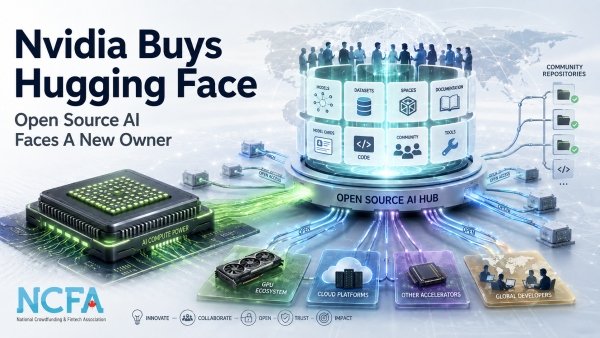
On September 3, 2026, Nvidia announced a definitive agreement to acquire Hugging Face for US$12.9303 billion. The deal would put one of the biggest platforms for open source and open weight AI alongside the company that already dominates much of the market for AI computing.
The price includes about US$11.9 billion for Hugging Face stockholders and up to US$1 billion in equity awards for employees joining Nvidia. The transaction hasn't closed. Nvidia says it expects completion in the first half of 2027, subject to regulatory approvals and other closing conditions.
Nvidia is making a very public promise with the deal. Hugging Face will remain open. Developers will still be able to choose their models, clouds, inference providers and computing platforms. Nvidia hardware will not be required.
That promise goes directly to the tension. Hugging Face became valuable because developers, startups, researchers and rival chip companies could all build there. Nvidia can make that ecosystem stronger. Ownership can also make some of those same users wonder whether an open source AI platform can feel as independent once one of the most powerful companies in AI owns it.
Hugging Face has grown into one of the main places developers find, share and use open AI models. Nvidia says more than 18 million developers, researchers and creators use the platform, along with more than 200,000 companies.
The company was worth far less only three years ago. Hugging Face raised US$235 million in 2023 at a US$4.5 billion valuation, with investors including Google, Amazon, Nvidia, Intel, AMD, Qualcomm, IBM and Salesforce.
Nvidia is now paying close to three times that valuation. The premium makes more sense when Hugging Face is viewed as distribution, developer access and influence over how open models get discovered and deployed.
Hugging Face is valuable because millions of people already use it to decide what to build with. Nvidia is buying that relationship as much as the software behind it. The more developers stay, the more valuable the acquisition becomes.
Nvidia already has enormous power in AI computing. Reuters Breakingviews says Nvidia holds more than 80% of the AI accelerator market, while its chips have become a reference point for a growing market in GPU rental pricing.
That power is one reason the acquisition attracts attention. Nvidia will own a major open model platform while selling the hardware many of those models run on.
Hugging Face has also become important to Nvidia's competitors. Its own 2026 data says AMD and Nvidia are the two most active publishers of new open models on the Hub, with each releasing more than 200 model repositories this year.
AMD uses open models to prove its chips can run real workloads. Google, Microsoft, IBM and other companies also publish and distribute models through the platform.
The acquisition does not remove AMD, Google or other hardware and cloud providers from Hugging Face. Nvidia says support for rival silicon will continue. The tension comes from whether those companies remain just as comfortable investing there when the owner also competes with them.
Nvidia says rival chips will stay welcome. Nvidia's CEO Jensen Huang says developers will keep choosing their own models, frameworks, clouds, inference providers and computing platforms. Nvidia compute will not be required to build on or deploy through Hugging Face.
Developers are already debating what ownership could mean in practice. Some community reactions welcome Nvidia because open models create demand for compute. Others worry about future defaults, private repositories, hardware preference and whether another independent open source AI platform will eventually be needed.
Nvidia doesn't have to close Hugging Face for ownership to change how the platform feels. Developers will notice which hardware gets optimized first, which services are easiest to connect and whether rival products remain equally visible and easy to use.
Open models fit Nvidia's economics surprisingly well. Hugging Face says hardware vendors are publishing open models because a model optimized for their chips is one of the clearest ways to prove the hardware works.
Nvidia can therefore benefit even when the model itself is free to download. More open model use can create more inference and training demand across data centres, enterprises and local machines.
That dependence cuts both ways. Some of Nvidia's biggest customers, including hyperscalers and AI labs, are building their own chips. The Hugging Face deal gives Nvidia a wider developer base at a time when those customers are trying to reduce their own dependence on Nvidia hardware.
Open source AI gives Nvidia access to thousands of smaller users instead of relying only on a few giant buyers.
Nvidia can support open source AI and still benefit commercially from its growth. The company does not need every developer to buy a proprietary Nvidia model. It benefits when more models create more computing demand.
China is pushing hard in the same open model market. Hugging Face data shows Chinese labs released many of the largest open models in 2026. Qwen has become one of the most important model families on the Hub, with more than 151,000 derivative repositories.
Hugging Face says Qwen based models reached more than 2 billion downloads across repositories with declared parameter counts this year.
Chinese open models are also competing on access and cost. Hugging Face found that 59% of Chinese releases above 20 billion parameters used Apache 2.0 licences and another 22% used MIT licences during the period it studied, although some very large releases have begun adding commercial restrictions.
That gives developers another source of capable models as U.S. companies debate how open their own ecosystems should remain.
Open models are part of the technology rivalry between the United States and China. Nvidia's Hugging Face acquisition gives a U.S. company more influence over a global platform at the same time Chinese model families are winning large developer communities of their own.
One possible response to Nvidia ownership is that developers simply stay. Hugging Face already has millions of models, datasets, applications and established workflows. Rebuilding that network somewhere else would be difficult.
Microsoft's GitHub acquisition offers one useful precedent. Microsoft promised GitHub would stay open and independent, and competing developers and platforms continued using it after the acquisition.
Another possibility is that developers begin spreading their work across more places. ModelScope, GitHub, local model tools, cloud registries and private enterprise repositories already give users alternatives for parts of the Hugging Face experience.
A future competitor would not need to copy every Hugging Face feature on day one. It could win users by offering easier migration, open governance, strong model provenance or a clearer commitment to hardware independence.
Network effects make a full replacement difficult, but communities can fragment before platforms collapse. Developers can keep models on Hugging Face while using other tools for discovery, inference, deployment or discussion. Competition may arrive piece by piece rather than through one new platform.
No price increase has been announced. Nvidia says Hugging Face will remain open and hardware choice will continue. That leaves plenty of room for the acquisition to improve reliability, inference tools and enterprise deployment without raising basic access costs.
Costs could still change indirectly. Developers may pay more if the easiest experience ends up depending on premium services, Nvidia optimized infrastructure or harder to replace integrations. The opposite is also possible. Better tooling and stronger open models could lower the cost of running AI compared with closed model APIs.
The acquisition does not automatically mean higher prices. The more interesting cost risk is switching. A service can remain affordable while becoming expensive to leave because models, workflows, integrations and teams are built around it.
Startups could gain from Nvidia's reach. A stronger Hugging Face can give model companies better distribution, more reliable infrastructure and easier access to enterprise customers.
For founders trying to get an open model discovered, being close to a platform used by 18 million developers can be commercially powerful.
Startups may also have less bargaining power if distribution, compute and enterprise access become more concentrated around the same company. A startup can benefit from the platform while still wanting credible ways to deploy elsewhere.
That tension is already visible in competition for cheaper AI inference, where AMD and other hardware companies are trying to give developers alternatives to Nvidia's dominant GPU position.
The upside is distribution. The risk is dependence. Founders will care less about who owns Hugging Face than whether they can still take their models, customers and economics somewhere else when they need to.
Financial institutions face the same ownership question from a different angle. Banks and insurers are already putting AI into governed workflows where data controls, approvals, audit evidence and operational resilience are required.
Governed financial AI workflows become harder when a firm cannot easily change models, clouds or providers without rebuilding controls around them.
Portability can therefore matter more than ownership alone. A bank may be comfortable using Hugging Face under Nvidia if models can still travel across clouds and chips and the institution can keep its own data, controls and audit evidence.
Regulators are also paying more attention to AI vendor concentration and operational dependence as financial firms embed more external technology into critical work.
Financial institutions do not need every AI supplier to be independent. They do need credible ways to change suppliers, hardware and deployment environments without losing control of regulated workflows.
The deal could still produce a strong outcome for open source AI. Nvidia has the engineering resources, compute and enterprise distribution to make Hugging Face faster, more reliable and easier for companies to use.
If AMD, Google, cloud providers, Chinese model labs and independent developers keep contributing, Nvidia can own the platform while the ecosystem remains genuinely competitive.
The harder outcome is quieter. Hugging Face stays open, but developers gradually find Nvidia products easier, cheaper or better supported than alternatives. No door closes. Choice simply becomes less balanced over time.
That is why Nvidia's promise will be judged through product behaviour rather than the announcement itself.
The most valuable version of Hugging Face may be one where Nvidia owns it and its competitors still want to build there. If that happens, Nvidia gets a larger open source AI ecosystem without destroying the trust that made the platform worth almost US$13 billion.
Talking Point
Nvidia does not need to close Hugging Face to gain more influence over open source AI. The deal becomes more valuable if developers, startups and rival chipmakers keep using the platform anyway.
 The National Crowdfunding & Fintech Association (NCFA Canada) is a financial innovation ecosystem that provides education, market intelligence, industry stewardship, networking and funding opportunities and services to thousands of community members and works closely with industry, government, partners and affiliates to create a vibrant and innovative fintech and funding industry in Canada. Decentralized and distributed, NCFA is engaged with global stakeholders and helps incubate projects and investment in fintech, alternative finance, crowdfunding, peer-to-peer finance, payments, digital assets and tokens, artificial intelligence, blockchain, cryptocurrency, regtech, and insurtech sectors. Join Canada's Fintech & Funding Community today FREE! Or become a contributing member and get perks. For more information, please visit: www.ncfacanada.org
 |  |  |
|---|---|---|
 |  |  |



August 26th, 2025

January 4th, 2024

June 1st, 2021

September 9th, 2020

July 9th, 2018

January 3rd, 2018

September 25th, 2017

June 20th, 2017

May 10th, 2017

December 14th, 2016

Leave a Reply