




Karsten Wenzlaff, Advisor
August 26th, 2025
Karsten Wenzlaff is a Crowdfunding and Fintech Expert from Germany. He is Secretary-General of Digit[...]


Campaign | March 2, 2024

Image: Freepik/rawpixel.com
The Financial Services Regulatory Authority of Ontario (FSRA) has initiated an educational campaign aimed at encouraging consumers to verify the credentials of financial advisors before seeking advice. With the introduction of the new online Check Credentials Tool, individuals can now easily confirm if their financial professionals possess the necessary qualifications to use titles like Financial Planner or Financial Advisor in Ontario. The Check Credentials Tool allows consumers to verify if financial professionals hold the required credentials to use specific titles, ensuring they meet minimum education standards and are under proper supervision.
FSRA's research indicates a concerning trend where 50% of respondents spent more time researching their last cellphone purchase than verifying the credentials of their financial advisor. The tool is designed for convenience, enabling users to quickly check a financial professional's standing, including any disciplinary actions. In Canada, financial advisor scams have evolved, becoming more sophisticated and causing significant losses to consumers.
Huston Loke, Executive Vice President of Market Conduct, FSRA:
"In many cases people are entrusting their life savings to financial professionals and they expect that these people are properly trained and supervised. We encourage consumers to check credentials and we are making it easy through our new Check Credentials Tool."
In Canada, financial advisor scams have evolved, becoming more sophisticated and causing significant losses to consumers. According to a CTV News, the top scams include:
By making it easier for individuals to verify the qualifications of financial advisors, the FSRA is empowering consumers to make more informed decisions regarding their financial planning and investments.
This initiative promotes transparency and accountability among financial professionals and also contributes to the overall trust and integrity of the financial services industry.
 The National Crowdfunding & Fintech Association (NCFA Canada) is a financial innovation ecosystem that provides education, market intelligence, industry stewardship, networking and funding opportunities and services to thousands of community members and works closely with industry, government, partners and affiliates to create a vibrant and innovative fintech and funding industry in Canada. Decentralized and distributed, NCFA is engaged with global stakeholders and helps incubate projects and investment in fintech, alternative finance, crowdfunding, peer-to-peer finance, payments, digital assets and tokens, artificial intelligence, blockchain, cryptocurrency, regtech, and insurtech sectors. Join Canada's Fintech & Funding Community today FREE! Or become a contributing member and get perks. For more information, please visit: www.ncfacanada.org
 |  |  |
|---|---|---|
 |  |  |
Feb 28, 2024

Image by tonodiaz on Freepik
As the world gradually recovers from the pandemic, travel insurance has evolved into a fundamental necessity for Canadians looking forward to their next trip. As a matter of fact, a recent study by Allianz Global Assistance highlights this shift in perspective, with 89% of Canadians indicating they plan to purchase travel insurance for future travels. Furthermore, 74% believe that having travel insurance is as important, if not more so, after the pandemic, with 32% considering it more vital than before.
For businesses engaging in international activities, this increased attention to travel insurance is particularly relevant. As global travel picks up, ensuring the safety and security of individuals representing their organizations during travel is paramount. This is where international travel insurance comes into play, offering customized protection against the unique challenges faced by global entrepreneurs.
In this beginner's guide, we aim to simplify the complexities surrounding international travel insurance for entrepreneurs so that you can confidently navigate the intricacies of international travel, knowing you have taken the necessary steps to protect your ventures abroad.
Before diving into the details, it's important to grasp the essential coverage options available to global entrepreneurs considering international travel insurance. This foundational knowledge is key to ensuring that you select the best policy that offers comprehensive protection tailored to the unique needs of your business ventures abroad.
At the core, a robust international travel insurance plan should include coverage for medical emergencies, trip cancellations, and interruptions, as well as baggage loss and delays. For entrepreneurs, additional considerations such as coverage for business equipment, emergency evacuation, and liability insurance become equally important, given the potential for unexpected incidents that could impact both personal and business assets.
Furthermore, policies offering support for legal issues or providing financial protection against accidents involving rental vehicles can prove invaluable. Given the varied nature of international business travel, identifying and selecting a plan that addresses the broad spectrum of potential risks is paramount.
By focusing on these essential coverage options, entrepreneurs can lay a solid foundation for their travel insurance policy, ensuring peace of mind.
The insurance needs of each entrepreneur or business can vary depending on several factors, including the industry, destinations, frequency of travel, and the nature of the business activities conducted abroad. To choose the most suitable travel insurance policy, it's essential to conduct thorough risk assessments to identify potential hazards and liabilities specific to your business.
Here are some insightful inquiries to help steer your decision-making process:
By addressing these questions, businesses can better understand their unique risk profiles, paving the way for selecting an international travel insurance policy that offers adequate protection. This strategic approach not only safeguards the business but also ensures that entrepreneurs can focus on their international ventures with confidence, knowing they are well-prepared for various contingencies.
Once you've pinpointed your insurance needs, the next step is diving into the sea of options available to you.
Begin by gathering quotes from multiple insurance providers, ensuring you're getting a comprehensive view of what's out there. While you're at it, it's critical to go beyond the surface and delve into the details of each policy. This means asking questions about policy specifics, coverage limits, and deductibles.
In addition, reading reviews, such as the AIG Travel Guard insurance reviews, can provide invaluable insights. Don't make the mistake of focusing solely on the price tag. The insurer's reputation, customer support quality, and the efficiency of their claims process are just as important. After all, a cost management strategy doesn't mean opting for the cheapest option; it means finding the best value for your specific needs.
Ensuring compliance with legal requirements is a cornerstone of procuring international travel insurance for entrepreneurs. Different countries and regions have their own mandates regarding insurance for business travelers, making it imperative for you to familiarize yourself with these regulations.
From workers' compensation to health coverage, staying informed about what's legally required not only keeps you within the bounds of the law but also shields your business from potential fines or legal hurdles. Additionally, consider the contractual obligations that may come with certain partnerships or client agreements, as these often stipulate specific insurance coverages.
As your business journey evolves, so do the intricacies of your travel insurance needs. It's not just about securing coverage; it's about ensuring that it remains perfectly aligned with your changing business landscape.
Therefore, regularly revisiting your insurance policy isn't just good practice—it's essential for maintaining the protection your business relies on as it grows and enters new markets. This could mean adjusting coverage to include additional employees, updating policies to reflect new types of business activities, or enhancing coverage for emerging risks. An annual review with your insurance provider can help identify these shifts, ensuring that your insurance strategy continues to provide the robust safety net your business requires.

Image by pressfoto on Freepik
By understanding coverage options, assessing risks, comparing plans, ensuring legal compliance, and regularly updating coverage, entrepreneurs can venture abroad with confidence. Embrace these guidelines as a roadmap to protect your business journeys, ensuring that you're not just prepared for the challenges of today but fortified for the opportunities of tomorrow.
With the right strategy, international travel insurance becomes not just a safety net but a strategic asset for global business success.
The National Crowdfunding & Fintech Association (NCFA Canada) is a financial innovation ecosystem that provides education, market intelligence, industry stewardship, networking and funding opportunities and services to thousands of community members and works closely with industry, government, partners and affiliates to create a vibrant and innovative fintech and funding industry in Canada. Decentralized and distributed, NCFA is engaged with global stakeholders and helps incubate projects and investment in fintech, alternative finance, crowdfunding, peer-to-peer finance, payments, digital assets and tokens, artificial intelligence, blockchain, cryptocurrency, regtech, and insurtech sectors. Join Canada's Fintech & Funding Community today FREE! Or become a contributing member and get perks. For more information, please visit: www.ncfacanada.org
| | |
|---|---|---|
| | |
Innovation | Feb 20, 2024

Image by Drazen Zigic on Freepik
In an innovative blend of finance and romance, Neon Money Club has unveiled 'SCORE,' a dating app designed for individuals with good to excellent credit scores. The app requires users to have a healthy credit score for sign-up, connecting them with financially like-minded individuals.
This initiative not only fosters meaningful connections based on mutual financial goals but also offers valuable resources for those working towards improving their credit scores and financial literacy. It goes beyond shared interests to prioritize financial wellness, ensuring users are matched with financially like-minded partners.
Neon Money Club's commitment to financial wellness is further exemplified by collaborations like The Cream Card™, a credit card that allows members to convert points into stock market investments. Such innovations underscore the need for creative and diverse voices in the next generation of finance.
Luke Bailey, CEO of Neon Money Club:
"Financial wellness often takes a backseat. At Neon Money Club, our mission is to inject financial awareness into the fabric of everyday life."
The National Crowdfunding & Fintech Association (NCFA Canada) is a financial innovation ecosystem that provides education, market intelligence, industry stewardship, networking and funding opportunities and services to thousands of community members and works closely with industry, government, partners and affiliates to create a vibrant and innovative fintech and funding industry in Canada. Decentralized and distributed, NCFA is engaged with global stakeholders and helps incubate projects and investment in fintech, alternative finance, crowdfunding, peer-to-peer finance, payments, digital assets and tokens, artificial intelligence, blockchain, cryptocurrency, regtech, and insurtech sectors. Join Canada's Fintech & Funding Community today FREE! Or become a contributing member and get perks. For more information, please visit: www.ncfacanada.org
| | |
|---|---|---|
| | |
Education | Feb 8, 2024

Image by wayhomestudio on Freepik
As Generation Z (born between 1997 and 2012) steps into financial independence amidst economic challenges, their unique financial behaviors, preferences, and terminologies come to the forefront.
Understanding these aspects is crucial for fintech professionals aiming to engage, communicate, and develop services for this demographic effectively.
This guide aims to provide fintech professionals with insights into Gen Z's financial mindset and practical tips for engaging with this generation effectively. As Gen Z's influence grows, so does the importance of adapting fintech offerings to meet their expectations and needs.
These Gen Z finance terms open up conversations about finances in a more relatable and less taboo manner.
Understanding Gen Z's unique financial challenges and mindset is crucial for fintech companies looking to engage this demographic.
Fintech solutions that offer educational resources, tools for managing finances, and options for low-risk investments can appeal to Gen Z's desire for financial stability and mental well-being. Additionally, promoting financial literacy and independence through user-friendly platforms can help address some of the misconceptions and anxieties Gen Z faces regarding money.
The National Crowdfunding & Fintech Association (NCFA Canada) is a financial innovation ecosystem that provides education, market intelligence, industry stewardship, networking and funding opportunities and services to thousands of community members and works closely with industry, government, partners and affiliates to create a vibrant and innovative fintech and funding industry in Canada. Decentralized and distributed, NCFA is engaged with global stakeholders and helps incubate projects and investment in fintech, alternative finance, crowdfunding, peer-to-peer finance, payments, digital assets and tokens, artificial intelligence, blockchain, cryptocurrency, regtech, and insurtech sectors. Join Canada's Fintech & Funding Community today FREE! Or become a contributing member and get perks. For more information, please visit: www.ncfacanada.org
| | |
|---|---|---|
| | |
Payments Research | Jan 31, 2024

Image by storyset on Freepik
The 2022 Methods-of-Payment Survey by the Bank of Canada shines light on evolving payment preferences in Canada, spanning over a decade looking at data from 2009 to 2022. The research shows a shift from traditional cash handling to an increasingly digital-centric payment culture through the backdrop of new payment methods like digital currencies and the unprecedented impact of the COVID-19 pandemic.
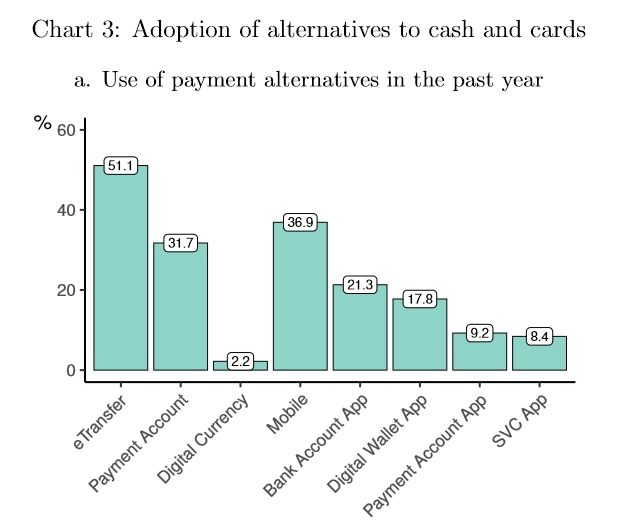
Image: Bank of Canada Payments Landscape 2022 Survey, Chart 3
While digital and contactless payments are on the rise, the enduring role of cash underscores the need for a multi-pronged approach to payment options to ensure inclusivity and accessibility in Canada's financial services, catering to all segments of the population.
As the country progresses further into the digital age, continuous monitoring and adaptable strategies will be essential for financial institutions and policymakers. This approach will ensure alignment with evolving consumer trends and technological advancements.
The National Crowdfunding & Fintech Association (NCFA Canada) is a financial innovation ecosystem that provides education, market intelligence, industry stewardship, networking and funding opportunities and services to thousands of community members and works closely with industry, government, partners and affiliates to create a vibrant and innovative fintech and funding industry in Canada. Decentralized and distributed, NCFA is engaged with global stakeholders and helps incubate projects and investment in fintech, alternative finance, crowdfunding, peer-to-peer finance, payments, digital assets and tokens, artificial intelligence, blockchain, cryptocurrency, regtech, and insurtech sectors. Join Canada's Fintech & Funding Community today FREE! Or become a contributing member and get perks. For more information, please visit: www.ncfacanada.org
| | |
|---|---|---|
| | |
Personal Finance | Jan 26, 2024

Incorporating Kakeibo-inspired strategies into mindful spending can be transformative. These include:
By implementing these methods, one can make more deliberate financial decisions, potentially leading to increased savings and wiser investment choices.
A FinTech company developing a personal finance app can draw valuable insights from Kakeibo to enhance user experience and effectiveness. By integrating these Kakeibo principles, a personal finance app can foster a more mindful, intentional, and user-friendly approach to budgeting and financial management. Key learnings include:
In an era where financial stress and complexity are on the rise, Kakeibo offers a refreshing perspective. It’s a mindful, simplistic approach that aligns financial management with personal values, promoting a balanced and satisfying life.
The National Crowdfunding & Fintech Association (NCFA Canada) is a financial innovation ecosystem that provides education, market intelligence, industry stewardship, networking and funding opportunities and services to thousands of community members and works closely with industry, government, partners and affiliates to create a vibrant and innovative fintech and funding industry in Canada. Decentralized and distributed, NCFA is engaged with global stakeholders and helps incubate projects and investment in fintech, alternative finance, crowdfunding, peer-to-peer finance, payments, digital assets and tokens, artificial intelligence, blockchain, cryptocurrency, regtech, and insurtech sectors. Join Canada's Fintech & Funding Community today FREE! Or become a contributing member and get perks. For more information, please visit: www.ncfacanada.org
| | |
|---|---|---|
| | |
BNPL | Jan 24, 2024

Image: Unsplash/Christiann Koepke
The latest development in the Buy Now, Pay Later (BNPL) sector is the introduction of Klarna's new subscription plan, "Klarna Plus," priced at $7.99 per month. This move comes as Klarna gears up for its anticipated initial public offering (IPO). The Klarna Plus subscription offers several benefits to its users, including no added service fees when using Klarna’s One Time Card, double rewards points, and access to exclusive discounts with popular brands like Nike, COACH, Macy’s, Instacart, and GOAT. The company estimates that loyal Klarna users could save about $12 monthly through this plan.
The new subscription model appears to be part of Klarna's strategy to diversify its revenue streams and enhance its appeal to investors ahead of its IPO. By introducing a monthly subscription, Klarna not only aims to lock in its most dedicated users but also to establish more predictable, recurring revenue. This is in contrast to the less predictable nature of one-time transactions which have been typical in the BNPL sector.
Klarna is also planning to launch a high-yield savings account, which may offer higher interest rates for Klarna Plus customers than non-users. This is part of Klarna's broader strategy to expand beyond its traditional BNPL services and offer a wider range of financial products.
This strategic shift by Klarna and others in the BNPL market reflects a growing trend in the fintech industry to create more stable and diverse revenue streams, especially as these companies prepare for public market debuts. Competitors in the BNPL space, like Affirm, are also reportedly considering similar monthly plans, indicating a shift in the industry towards more subscription-based services.
There are a lot of BNPL reports in market pointing to continued growth in the sector.

Image: Insider Intelligence and Fit Small Business

Image: PYMTS and Fit Small Business
The outlook for the Buy Now, Pay Later (BNPL) industry, particularly with Klarna's new initiatives, is one of evolution and expansion. As the sector continues to grow, companies like Klarna are exploring new revenue models, such as subscription services, to stabilize and diversify their income streams. The shift towards subscription models like Klarna Plus could signal a change in how consumers engage with BNPL services, potentially leading to increased loyalty and regular use among a dedicated customer base.
The introduction of additional financial products, like high-yield savings accounts, suggests that BNPL companies are broadening their scope to offer more comprehensive financial services. Overall, the BNPL sector appears poised for significant growth and transformation, driven by consumer demand, technological advancements, and strategic shifts by key players like Klarna.
The National Crowdfunding & Fintech Association (NCFA Canada) is a financial innovation ecosystem that provides education, market intelligence, industry stewardship, networking and funding opportunities and services to thousands of community members and works closely with industry, government, partners and affiliates to create a vibrant and innovative fintech and funding industry in Canada. Decentralized and distributed, NCFA is engaged with global stakeholders and helps incubate projects and investment in fintech, alternative finance, crowdfunding, peer-to-peer finance, payments, digital assets and tokens, artificial intelligence, blockchain, cryptocurrency, regtech, and insurtech sectors. Join Canada's Fintech & Funding Community today FREE! Or become a contributing member and get perks. For more information, please visit: www.ncfacanada.org
| | |
|---|---|---|
| | |


August 26th, 2025

January 4th, 2024

June 1st, 2021

September 9th, 2020

July 9th, 2018

January 3rd, 2018

September 25th, 2017

June 20th, 2017

May 10th, 2017

December 14th, 2016