





Karsten Wenzlaff, Advisor
August 26th, 2025
Karsten Wenzlaff is a Crowdfunding and Fintech Expert from Germany. He is Secretary-General of Digit[...]


Mar 4, 2026 | NCFA Fintech Market Insight | AI And Data Governance
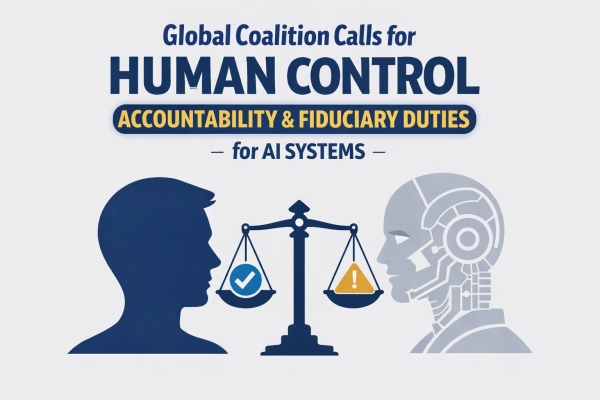
On March 4, 2026, the Pro Human AI Declaration goes public with support from a broad mix of public figures and organizations, including Yoshua Bengio (Professor, Université de Montréal and Turing Award Laureate), Daron Acemoglu (Nobel Prize-winning economist), Sir Richard Branson, and many other individual endorsers, along with groups such as the AFL CIO Tech Institute, American Federation of Teachers, SAG AFTRA, Public Citizen, and Center for Humane Technology. When people from business, labour, civil society, and research line up behind the same message, boards, regulators, and large buyers start to pay attention.
The declaration argues that AI should serve people, not replace them, and that powerful systems should remain under human control. For fintechs and financial institutions, AI already touches onboarding, fraud checks, customer support, compliance, advice, marketing, and risk decisions. As the public debate turns toward accountability and duty, finance is on the front lines of AI's adoption versus it's capabilities.
The declaration opens with a warning about a race to replace people in creative work, care, counselling, companionship, jobs, and decision making. It argues that this approach could push more power into large institutions and their machines while weakening privacy, liberty, democratic governance, and social stability.
It then lays out five core principles:
Keep humans in charge. Avoid concentration of power. Protect the human experience. Preserve human agency and liberty. Hold AI companies responsible and accountable.
The document also argues that AI systems should not be treated as legal persons with their own rights or responsibilities. It calls for protection of children and families from harmful uses of AI. It says people should have meaningful rights, oversight, and recourse when AI affects their lives.
As it relates to financial services, the declaration says AI used in professions such as finance, must meet fiduciary duties including duty of care, conflict disclosure, and informed consent.
Canada already faces its own debate about how to govern and finance artificial intelligence. A recent NCFA analysis on Canada’s AI strategy confronting capital flight and domestic IP retention highlights growing concern that Canadian innovation and economic value could migrate abroad if policy, capital access, and procurement frameworks do not evolve.
The Pro Human AI Declaration adds another dimension to that discussion. It focuses on accountability, human oversight, and responsibility when AI systems influence real world decisions.
It's important because in finance trust decides adoption, and banks, insurers, wealth platforms, lenders, and fintech vendors are already facing harder questions about how they use AI, who stays responsible, how people can challenge a bad outcome, and whether a firm can clearly explain what the system actually does. Pro Human's AI declaration adds more public weight behind those questions.
Take AI driven advice tools for example. If a digital assistant recommends a debt strategy, suggests a product, or influences an investment decision, firms should expect more scrutiny around disclosure, consent, conflicts, and who remains accountable for the outcome. The more the tool acts like an adviser, the harder it becomes to treat it like a simple software feature.
Fraud and risk controls offer another example. Many firms now use machine learning to flag suspicious activity, approve accounts, or block transactions. If a system freezes an account, rejects a customer, or triggers a harmful false positive, firms will face stronger pressure to explain the reason and provide a path to human review. In finance, a wrong decision can have a huge impact in a hurry. It can lock someone out of funds, delay a payment, or damage trust fast.
Customer communication is another live area. Banks and fintechs increasingly use AI chat tools to answer product questions, guide users through forms, or help people make sense of financial options. If those systems are guiding decisions, firms should expect harder questions about disclosure, consent, suitability, and whether the system nudges people in ways they do not fully understand.
Teams building AI for finance should design for human oversight in workflows from the start. They should know where a person can step in, how decisions get reviewed, what data trains the system, how conflicts get surfaced, and who owns the final call. These are no longer side questions. They affect procurement, partnerships, compliance reviews, and customer confidence.
This also creates an opening. Fintechs that can show clear controls, plain language disclosures, reliable audit trails, and real accountability will stand out in a crowded market. In regulated markets, users want to work with tools and systems they can trust when stakes and outcomes are at their highest.
One to watch for fintech and financial service leaders. Companies that keep humans involved, explain their systems clearly, and stay accountable when outcomes matter will be in a stronger position as this debate moves closer to policy, procurement, and market practice. Plus, they may sleep better at night 😉
 The National Crowdfunding & Fintech Association (NCFA Canada) is a financial innovation ecosystem that provides education, market intelligence, industry stewardship, networking and funding opportunities and services to thousands of community members and works closely with industry, government, partners and affiliates to create a vibrant and innovative fintech and funding industry in Canada. Decentralized and distributed, NCFA is engaged with global stakeholders and helps incubate projects and investment in fintech, alternative finance, crowdfunding, peer-to-peer finance, payments, digital assets and tokens, artificial intelligence, blockchain, cryptocurrency, regtech, and insurtech sectors. Join Canada's Fintech & Funding Community today FREE! Or become a contributing member and get perks. For more information, please visit: www.ncfacanada.org
 |  |  |
|---|---|---|
 |  |  |



August 26th, 2025

January 4th, 2024

June 1st, 2021

September 9th, 2020

July 9th, 2018

January 3rd, 2018

September 25th, 2017

June 20th, 2017

May 10th, 2017

December 14th, 2016

Leave a Reply