





Karsten Wenzlaff, Advisor
August 26th, 2025
Karsten Wenzlaff is a Crowdfunding and Fintech Expert from Germany. He is Secretary-General of Digit[...]


Advocacy | Sep 26, 2025
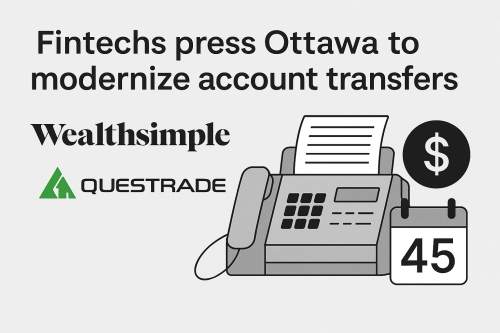
On August 12, 2025, Wealthsimple submitted its recommendations to the federal pre budget consultation, urging Ottawa to regulate how registered accounts such as RRSPs and TFSAs are transferred between financial institutions. The submission says rising transfer fees and weeks long delays undermines Canadians’ ability to manage their savings. Wealthsimple’s call was echoed by Questrade, which also urged stronger federal oversight.
Wealthsimple reported that between late 2024 and early 2025, the average transfer time was 19 days once paperwork was received. More than 13,000 transfers took longer than 45 days, and at any given time over $1 billion of client funds were stuck in transit, peaking at $2 billion in March. During this period, 45% of transfers were executed manually by the sending institution, specifically by fax and mailed cheques.
This outdated reliance on fax machines creates long delays that benefit incumbents. During this delay period, client capital is removed from their accounts by sending institutions (Read: Canadian incumbent banks), so it can be redeployed without clients receiving any benefit.
In fact, 15% of transfer requests were cancelled by clients due to the delays. Another way of putting this is investors are effectively providing interest free loans (to institutions) while paying more than $35 million in transfer fees.
Exit and transfer fees have grown from $0 to $75 a decade ago to an average of $150 per account in 2025.
With more than 40 million registered accounts in Canada, that adds up to hundreds of millions in annual costs.
Flat fees disproportionately harm younger Canadians. CRA data shows that the average TFSA balance for Canadians in their twenties is under $11,000, meaning a $150 fee can take more than 1% of their entire account.
By contrast, Canadians over 50, with TFSA balances above $25,000, are more likely to qualify for reimbursement programs offered by some institutions. Wealthsimple argues that this is a regressive structure that penalizes the very Canadians struggling most with affordability pressures.
The company itself does not charge clients who close or transfer out, and it has urged Ottawa to follow the example of other sectors such as telecom and air travel where hidden exit fees have been capped or eliminated.
The Canadian Investment Regulatory Organization (CIRO) has been studying the issue for years. CIRO's July 2025 White Paper on account transfers found that investor complaints over transfer delays have increased more than fivefold since 2015.
The paper reports widespread allegations that financial institutions intentionally slow transfers to retain business or to keep earning interest on client funds, with many investors stating that charges are too high or reimbursements are not honoured. This unnecessary friction harms consumers (and businesses alike).
CIRO has proposed modernizing the process with mandatory timelines, wider use of automation, and clearer requirements for firms to act diligently.
Wealthsimple’s pre-budget submission asks Ottawa the federal government who already regulates registered plans under the Income Tax Act to take similar steps in other industries to curb hidden fees.
From NCFA's perspective, fax machines and paper cheques are more than an inconvenience; they're systemic barriers to competition. Reform would not only protect consumers but also level the playing field for fintechs that rely on timely transfers to onboard new clients.
Why do Canadians and the government continue to accept an investment transfer system that still depends on fax machines, and why it takes pressure from fintechs to put the issue on the national agenda?
Other industries have modernized. Why has finance been allowed to remain stuck in the past? As Prime Minister Mark Carney puts it, “The premiers and I want to make Canada a global energy superpower and build the strongest economy in the G7.”
 The National Crowdfunding & Fintech Association (NCFA Canada) is a financial innovation ecosystem that provides education, market intelligence, industry stewardship, networking and funding opportunities and services to thousands of community members and works closely with industry, government, partners and affiliates to create aa vibrant and innovative fintech and funding industry in Canada. Decentralized and distributed, NCFA is engaged with global stakeholders and helps incubate projects and investment in fintech, alternative finance, crowdfunding, peer-to-peer finance, payments, digital assets and tokens, artificial intelligence, blockchain, cryptocurrency, regtech, and insurtech sectors. Join Canada's Fintech & Funding Community today FREE! Or become a contributing member and get perks. For more information, please visit: www.ncfacanada.org
 |  |  |
|---|---|---|
 |  |  |



August 26th, 2025

January 4th, 2024

June 1st, 2021

September 9th, 2020

July 9th, 2018

January 3rd, 2018

September 25th, 2017

June 20th, 2017

May 10th, 2017

December 14th, 2016

Leave a Reply