





Karsten Wenzlaff, Advisor
August 26th, 2025
Karsten Wenzlaff is a Crowdfunding and Fintech Expert from Germany. He is Secretary-General of Digit[...]


May 6, 2026

Ontario's regulated online casino market processes billions of dollars a year. Behind every deposit and withdrawal sits a stack of fintech infrastructure that rarely gets discussed outside payment-industry circles: account-to-account rails, payment facilitators, KYC verification layers, AML monitoring, and bank-connectivity protocols.
This article is not a gambling guide. It uses Ontario iGaming as a case study to show how Canadian payment methods, PSPs, and risk controls work in a live, high-volume digital environment.
Few Canadian verticals compress so many fintech challenges into a single transaction flow. An online casino deposit requires instant consumer authentication, real-time bank connectivity, merchant-risk assessment, and regulatory compliance — all within seconds.
A consumer-facing guide to casinos that support Gigadat illustrates this compression well: users see a simple cashier screen with payment options, while behind it sits a multi-layered processing chain involving banks, facilitators, compliance checks, and settlement queues.
The scale of this market reinforces its relevance for payment professionals. According to iGaming Ontario's 2024–25 annual report, the regulated market recorded $82.7 billion in total wagers and $2.9 billion in total gaming revenue across roughly 50 active operators.
Key takeaway for fintech readers: iGaming is not just a gambling story. It is one of the few Canadian digital verticals where instant payments, high-risk merchant classification, strict AML obligations, and consumer trust expectations collide in every single transaction.
Ontario online casinos generally rely on a handful of payment categories. The mix varies by operator, licensing conditions, and compliance setup, but the core options fall into recognizable groups.
Interac e-Transfer is the backbone of most Ontario casino cashier flows. According to Interac's FAQ, e-Transfer lets Canadians send money through online banking, with participating financial institutions handling the transfer through established secure banking procedures. Processing usually happens in minutes, though it can take up to 30 minutes depending on the bank or credit union.
For fintech professionals, the important distinction is this:
| What the consumer sees | What happens on the back end |
| "Pay with Interac e-Transfer" | Bank authenticates user, routes funds through Interac rails |
| Instant confirmation | Settlement may still be pending between institutions |
| Simple email or text notification | The money itself travels through secure banking channels, not via email |
Interac e-Transfer functions as a bank-account payment rail, not an e-wallet. That distinction matters for PSPs, compliance teams, and anyone building deposit flows for Canadian merchants.
Gigadat is one of several Canadian payment facilitators that sit between the consumer's bank and the merchant. Gigadat's Pay-Ins page describes its role around local online and mobile banking options, including Interac e-Transfer and Interac e-Transfer Request Money.
In practice, a facilitator like Gigadat can handle:
The consumer may never see Gigadat's name at all. Or, depending on how the operator integrates the service, Gigadat may appear alongside Interac branding in the cashier interface.
Beyond Interac and payment facilitators, Ontario casinos may accept:
Each method carries different implications for settlement speed, chargeback risk, fraud exposure, and compliance overhead.

Understanding Gigadat's role requires separating the pay-in (deposit) path from the payout (withdrawal) path. The two operate differently, and the user experience can diverge significantly.
When a user deposits funds, the facilitator connects the user's bank session to the merchant's receiving account. The process typically involves:
From the user's perspective, the deposit feels instant. From the merchant's perspective, there may be settlement delays depending on the banking chain involved.
Withdrawals follow a different logic. Gigadat's Pay-Outs page explains that Interac e-Transfer payouts can let merchants send money to consumers using an email address or mobile phone number rather than collecting bank-account details.
This distinction matters for two reasons:
A common misconception: "instant withdrawal" often refers to the speed of the payment rail after the merchant releases the funds — not to the total time from withdrawal request to money in the user's account.
Consumer payment guides often collapse back-end distinctions into a simple label such as "Gigadat" or "Interac." In reality, both names can appear in the same transaction: Interac as the consumer-facing rail, Gigadat as the facilitator managing the merchant side. This layered structure is standard in Canadian digital payments but rarely visible to end users.
Fast payment UX does not remove compliance obligations. If anything, the speed of account-to-account transfers increases the pressure on operators and PSPs to build robust monitoring systems.
The regulatory landscape for Canadian PSPs shifted significantly in 2025. The Bank of Canada announced that supervision under the Retail Payment Activities Act (RPAA) came into effect on September 8, 2025, with close to 1,500 PSPs under oversight for risk-management and safeguarding obligations.
What this means in practice:
| RPAA requirement | Relevance to iGaming payments |
| Operational risk management | PSPs processing casino transactions must demonstrate controls for fraud, outages, and settlement failures |
| Safeguarding of funds | User deposits in transit must be protected, not commingled |
| Incident reporting | PSPs must report material disruptions to the Bank of Canada |
For fintech founders and investors, the RPAA framework changes the compliance baseline for any Canadian payment service — not just those serving iGaming.
On the merchant side, FINTRAC's casino guidance outlines how casino-related entities are treated under Canada's proceeds-of-crime and terrorist-financing legislation. Entities conducting and managing gaming activities carry specific reporting responsibilities.
Key obligations in this context generally include:
These requirements exist independently of the payment method used. Whether a user deposits via Interac, card, or bank transfer, the casino's AML obligations remain the same.
A deposit can arrive in seconds. A withdrawal may take days. The gap is almost never about the payment rail itself. It typically reflects:
This distinction is critical for anyone building or evaluating payment products: the rail is only one layer in the total transaction experience.
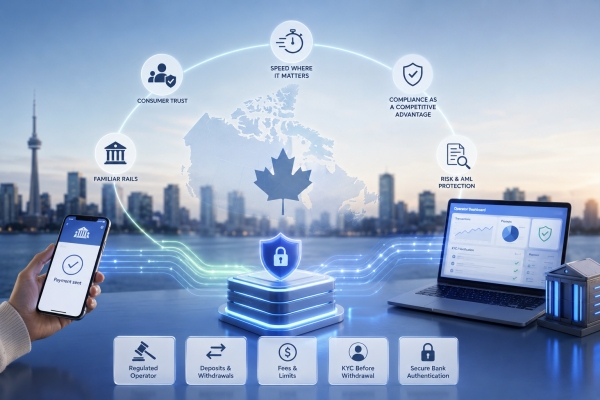
Ontario's iGaming market is a stress test for Canadian payment infrastructure. The lessons extend well beyond gambling.
Consumer trust depends on familiar rails. Interac e-Transfer succeeds in casino cashiers for the same reason it succeeds everywhere else in Canada: users recognize it, trust it, and know how it works through their own bank. Any fintech building a consumer-facing payment flow in Canada should consider how much of this familiarity it can leverage.
The pay-in/payout asymmetry is universal. Deposits tend to be instant; withdrawals tend to be slower. This pattern repeats across marketplaces, gig-economy platforms, insurance payouts, and lending products. The iGaming vertical simply makes the friction more visible because users expect fast returns.
Compliance is now a product feature, not just a cost centre. Under the RPAA supervision environment, PSPs that can demonstrate robust risk management may gain a competitive advantage over those still treating compliance as an afterthought.
For fintech founders: iGaming payments reveal the tension between speed and safety more clearly than almost any other Canadian digital vertical. The operators who handle it well offer a template for high-risk merchant processing in other sectors.
While this article focuses on infrastructure, the underlying payment lessons apply to anyone using digital payment methods in Canada — not only in casinos.
Before trusting any online payment flow, consider checking:
Ontario's iGaming market matters to fintech professionals not because of the casino content, but because of what it reveals about the state of Canadian payment infrastructure.
Account-to-account payments work. Interac e-Transfer has become the default consumer expectation for instant domestic transfers. Payment facilitators like Gigadat demonstrate how intermediaries can bridge bank rails and merchant platforms without requiring users to share sensitive financial details. The RPAA now holds PSPs to formal supervisory standards. And AML obligations ensure that fast rails do not bypass necessary safeguards.
For anyone building, investing in, or regulating Canadian fintech products, the iGaming payment stack is a compact, high-volume example of where Canadian digital payments stand today — and where they are heading next.
 The National Crowdfunding & Fintech Association (NCFA Canada) is a financial innovation ecosystem that provides education, market intelligence, industry stewardship, networking and funding opportunities and services to thousands of community members and works closely with industry, government, partners and affiliates to create a vibrant and innovative fintech and funding industry in Canada. Decentralized and distributed, NCFA is engaged with global stakeholders and helps incubate projects and investment in fintech, alternative finance, crowdfunding, peer-to-peer finance, payments, digital assets and tokens, artificial intelligence, blockchain, cryptocurrency, regtech, and insurtech sectors. Join Canada's Fintech & Funding Community today FREE! Or become a contributing member and get perks. For more information, please visit: www.ncfacanada.org
 |  |  |
|---|---|---|
 |  |  |



August 26th, 2025

January 4th, 2024

June 1st, 2021

September 9th, 2020

July 9th, 2018

January 3rd, 2018

September 25th, 2017

June 20th, 2017

May 10th, 2017

December 14th, 2016

Leave a Reply