




Karsten Wenzlaff, Advisor
August 26th, 2025
Karsten Wenzlaff is a Crowdfunding and Fintech Expert from Germany. He is Secretary-General of Digit[...]


June 24, 2026 | NCFA Insight | Capital Markets And Funding, Venture Funding And Building, Fintech And Innovation
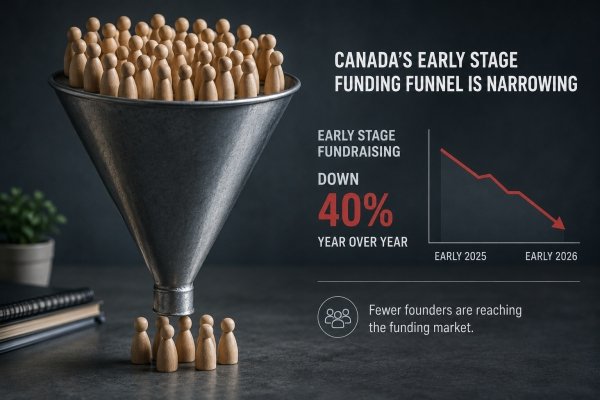
On June 24, 2026, RBCx published its Canadian VC 2026 Mid-Year report, showing that Canada’s early stage funding squeeze at venture funds is now also a startup company reality. RBCx says its Early Stage Banking team works with more than 1,200 pre seed and seed stage companies headquartered in Canada each year, and its current dataset covers more than 2,100 founder conversations.
The figures report that not only less capital is being raised, but fewer founders appear to be reaching the market at all. RBCx tracked 162 companies raising a combined $510.7 million in January 2025. By March 2026, only 61 companies were actively raising, with total capital sought down to about $189.8 million.
Average raise size held near $3 million from September 2024 to March 2026. That makes the data more troubling, not less. The market is not simply producing smaller seed rounds. It appears to be producing fewer founders who can raise them.
RBCx’s data suggests that early stage capital, which is often treated as the entry point into the venture system, is becoming harder to reach.
If fewer pre seed and seed companies are actively raising while average round size holds steady, the impact affects breadth of market.
Stronger or better connected founders may still complete rounds, but the number of companies entering the funding conversation appears to be shrinking.
A smaller early stage funnel means fewer companies get the chance to test markets, build traction, reach Series A, or become future scaleups. The risk is not only lower fundraising volume. It is a thinner innovation pipeline.
The company level data also connects back to the fund level pressure NCFA covered earlier this year in Canadian VC Fundraising Contracts And Concentrates In 2025. RBCx previously found that Canadian venture firms raised just over $2 billion in 2025, while the top five funds captured 83% of total capital raised.
RBCx’s mid year update says the top five funds captured 80% of total capital raised by 2025, while all other funds combined dropped from $4.5 billion at the 2021 peak to $444 million, close to a 90% decline.
When capital concentrates around fewer funds, founders face fewer decision makers, narrower investor funnels, and less room for non consensus ideas. That is especially important at the earliest stages, where conviction often depends on relationships, sector belief, and willingness to take risk before the metrics are obvious.
RBCx estimates that emerging managers raised about $2.8 billion over the past three years, compared with an expected $4.3 billion based on historical averages. That leaves a 36% funding shortfall.
Matt Roberts, Managing Director, Venture Coverage at RBCx, described the issue directly:
“Emerging managers are the engine of early-stage innovation in Canada. They’re willing to take on the riskier bets by backing first-time founders solving problems the market hasn’t fully recognized yet.”
His quote explains why this is a capital formation issue, not only a venture industry issue. Emerging managers often fund the companies that don't yet fit the pattern recognition of larger funds. When those managers cannot raise successor funds, Canada loses part of the market that is most willing to back first time founders, new categories, and early signals.
Canadian VC fundraising contracted and concentrated in 2025, with less new capital available for initial investments.
A built in Canada startup moved to the U.S., showing how capital access, customer depth, and market scale can influence where promising companies choose to grow.
Canada’s productivity challenge increasingly connects to capital formation, innovation scale, and the ability to turn new companies into durable economic output.
Targeted entrepreneurship funding remains an active policy tool as Canada tries to close founder capital gaps across underrepresented groups.
NCFA’s Financial Innovation Map tracks capital formation, alternative funding, venture infrastructure, and founder financing opportunities across Canada’s innovation ecosystem.
If Canada rebuilds early stage breadth, more founders can test markets, attract first capital, and create the next set of Series A candidates. That requires more than headline capital. It requires LP support for emerging managers, stronger growth stage confidence, and funding pathways that let founders raise before they fit the safest investor pattern.
Fewer funded companies may improve selectivity, but it can also remove the messy experimentation that produces outlier companies. If the ecosystem only funds the obvious companies, Canada may reduce failure rates while also reducing the number of breakout opportunities.
If average seed rounds remain stable but far fewer founders are raising, is Canada becoming more selective or simply losing the breadth and risk appetite needed to build the next generation of scaleups?
 The National Crowdfunding & Fintech Association (NCFA Canada) is a financial innovation ecosystem that provides education, market intelligence, industry stewardship, networking and funding opportunities and services to thousands of community members and works closely with industry, government, partners and affiliates to create a vibrant and innovative fintech and funding industry in Canada. Decentralized and distributed, NCFA is engaged with global stakeholders and helps incubate projects and investment in fintech, alternative finance, crowdfunding, peer-to-peer finance, payments, digital assets and tokens, artificial intelligence, blockchain, cryptocurrency, regtech, and insurtech sectors. Join Canada's Fintech & Funding Community today FREE! Or become a contributing member and get perks. For more information, please visit: www.ncfacanada.org
 |  |  |
|---|---|---|
 |  |  |


August 26th, 2025

January 4th, 2024

June 1st, 2021

September 9th, 2020

July 9th, 2018

January 3rd, 2018

September 25th, 2017

June 20th, 2017

May 10th, 2017

December 14th, 2016

Leave a Reply