





Karsten Wenzlaff, Advisor
August 26th, 2025
Karsten Wenzlaff is a Crowdfunding and Fintech Expert from Germany. He is Secretary-General of Digit[...]


Report | Sep 19, 2025
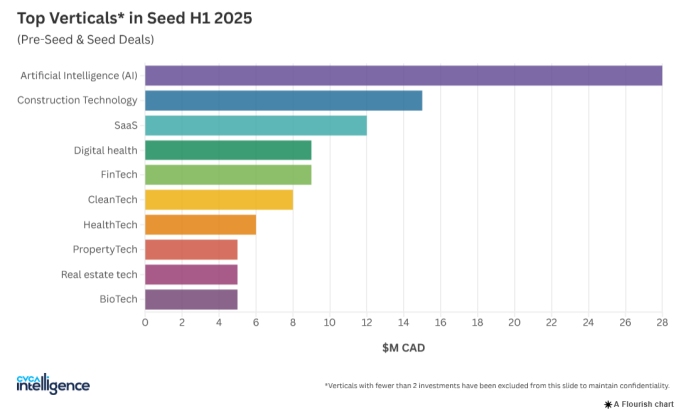
Image: H1 2025 Seed Investing in Canada by Vertical (CVCA Intelligence)
On September 11, 2025, the Canadian Venture Capital and Private Equity Association released its latest report, "The Current State of Seed Investing in Canada", covering tracked investment activity in the first half of 2025. The report recorded $297M invested across 133 seed stage deals in H1 2025.
1. Is seed capital still flowing in Canada, or has the tap run dry?
It's still flowing but selectively. There were 133 rounds worth $297M in H1 2025. The average cheque was $3M, the same as 2024 and down from the $4.09M peak in 2023. But total capital already reached $297M in just six months, equal to all of last year. For entrepreneurs, this means investors are still active but expect clearer proof points before committing. Traction and defensible technology are key.
Ontario pulled in $115.1M across 36 seed deals, nearly 40% of the total. Quebec followed with $66.1M, while Alberta and BC contributed $32.4M and $28.5M. PEI landed a single $6.3M seed round. If you are outside Ontario and Quebec, you may need a lead investor from one of those provinces to close a strong round.
AI is the leader at $24M across 12 seed deals. Construction tech ($15M across 2 deals) and SaaS ($12M across 4 deals) follow. Founders building in other sectors must benchmark carefully. For example, Fintech raised about $9M across pre seed and seed combined, making it harder to get noticed without a compelling angle.
AI again tops the list with $3.9M, followed by digital health at $2.5M. These are modest totals compared to seed, but they set the stage for the next generation of seed deals. Pre seed founders should expect smaller, milestone driven rounds focused on proving product market fit and lining up accelerators, early angels, and alternative finance options like investment crowdfunding.
US investors joined only 27.9% of Canadian seed deals in H1 2025, down from 35.9% in 2023. That is nearly a 30% relative decline. This means Canadian VCs and early stage angels and retail investors are the main gatekeepers at seed. Entrepreneurs should build domestic investor relationships first and then US and global investment pathways.
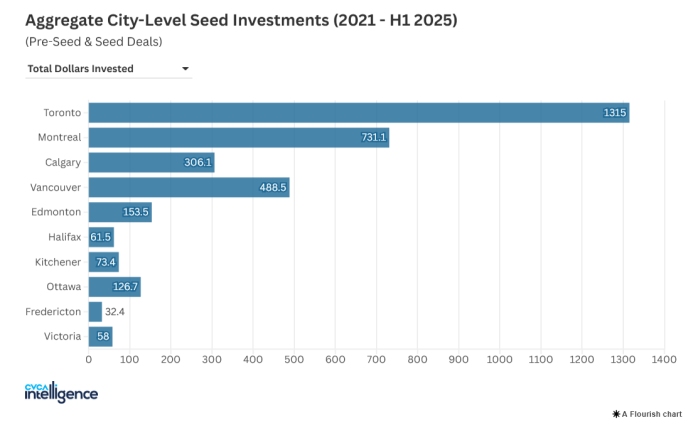
Image: Seed Investments 2021-2025 H1 (CVCA Intelligence)
They have stabilized with the average seed cheque was $3M in H1 2025, unchanged from 2024 but down from $4.09M in 2023. Total deployment hit $297M in H1 2025, already at the full year 2024 level. For investors, that means steady ownership opportunities but faster deal flow.
Ontario ($115.1M across 36 deals) and Quebec ($66.1M across 18 deals) dominate. Alberta ($32.4M) and BC ($28.5M) offer steady but smaller pipelines. For investors, this concentration could means better syndication opportunities in Ontario and Quebec, but higher competition as well.
AI’s $24M across 12 deals makes it the clear leader. SaaS ($12M across 4 deals) provides repeatable playbooks, while construction tech ($15M across 2 deals) indicates appetite for capital intensive bets. Fintech’s about $9M across pre seed and seed shows it remains investable. Portfolios tilted to AI and SaaS, with selective bets in construction and fintech, balance growth with diversification.
Pre seed AI ($3.9M) and digital health ($2.5M) dollars point to pipelines feeding into seed in the next 12 to 18 months. Investors positioning at pre seed should focus on these categories as feeders into later stage strength.
With US participation down to 27.9% from 35.9% last year, a nearly 30% relative decline, Canadian investors are leading more rounds. Other foreign investors ticked up to 10.5%. As a result, early rounds are relying more on domestic syndicates but Series A and B rounds will still require US follow on capital. Investors need to reserve capital and cultivate cross border relationships early.
Seed investment in Canada is concentrating in AI and Ontario while running ahead of last year’s pace. For entrepreneurs, it means tighter pitches and focusing on hubs where money is flowing. For investors, it means disciplined bets on AI and SaaS, while keeping an eye on steady sectors like fintech to diversify portfolios.
 The National Crowdfunding & Fintech Association (NCFA Canada) is a financial innovation ecosystem that provides education, market intelligence, industry stewardship, networking and funding opportunities and services to thousands of community members and works closely with industry, government, partners and affiliates to create aa vibrant and innovative fintech and funding industry in Canada. Decentralized and distributed, NCFA is engaged with global stakeholders and helps incubate projects and investment in fintech, alternative finance, crowdfunding, peer-to-peer finance, payments, digital assets and tokens, artificial intelligence, blockchain, cryptocurrency, regtech, and insurtech sectors. Join Canada's Fintech & Funding Community today FREE! Or become a contributing member and get perks. For more information, please visit: www.ncfacanada.org
 |  |  |
|---|---|---|
 |  |  |



August 26th, 2025

January 4th, 2024

June 1st, 2021

September 9th, 2020

July 9th, 2018

January 3rd, 2018

September 25th, 2017

June 20th, 2017

May 10th, 2017

December 14th, 2016

Leave a Reply