





Karsten Wenzlaff, Advisor
August 26th, 2025
Karsten Wenzlaff is a Crowdfunding and Fintech Expert from Germany. He is Secretary-General of Digit[...]


Agentic AI Framework | Oct 6, 2025
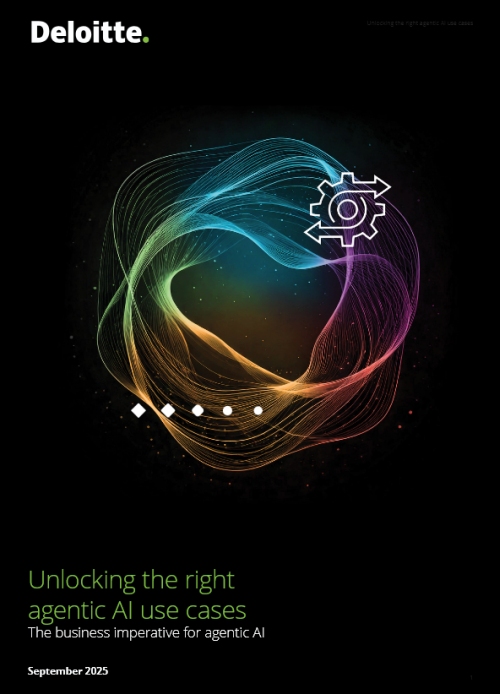
iMAGE: Unlocking the right Agentic AI use cases (Deloitte, Sep 2025)
In September 2025, Deloitte released a research report titled, "Unlocking the Right Agentic AI Use Cases", outlining a structured way for evaluating where autonomous AI systems can deliver the most value. The report emphasizes that agentic AI is less about replacing jobs and more about transforming how organizations reason, decide, and learn at scale.
In this article, NCFA applies the framework to several common fintech processes from transaction monitoring to smart contract audits, and ranks how suitable they are for agentic AI adoption today and in the future as governance, transparency, and learning systems evolve.
Deloitte’s research includes 7 criteria to help developers determine how suitable agentic ai is for automating a particular process - see the table below.
| Criterion | Definition | Low End (Less Ideal) | High End (More Ideal) |
| 1. Reasoning and context | How much the process requires understanding across variables | Follows strict rules or thresholds | Requires judgment and context (e.g., fraud review) |
| 2. Autonomy and escalation | Degree of independent decision-making | Executes instructions only | Decides next actions, knows when to involve humans |
| 3. Goal orientation | Clarity of outcome or success metric | No clear endpoint | Defined goal (e.g., complete onboarding) |
| 4. Multistep nature | Whether multiple systems or tasks must be performed | Single-step task | Coordinates multiple systems sequentially |
| 5. Cyclic repetition | Frequency and feedback loops | One-time task | Repeats with measurable feedback loops |
| 6. Explainability | Transparency of reasoning | Opaque or black-box logic | Traceable reasoning with audit trails |
| 7. Continuous learning | Ability to learn and adapt | Static model | Improves through ongoing data input and correction |
Each process is scored out of ten points using Deloitte’s agentic AI use case suitability framework. The first score reflects current use case suitability in today’s environment. A second estimate indicates how use case suitability could rise in the future as digital governance, explainable systems, and automation standards mature over time.
Identity checks, risk screening, and document verification already rely on structured rules and data. Agentic AI fits naturally here, automating repetitive verification while escalating edge cases. As more jurisdictions adopt digital ID systems, this process could / will reach full autonomy with minimal human input.
Fraud detection already uses machine learning but agentic AI adds reasoning and adaptive responses. It can correlate patterns across payments, wallets, and behavioural data in real time.
With digital audit trails and explainable decision logs this process could operate fully autonomously under continuous supervision frameworks.
Matching incoming and outgoing payments is structured but still requires manual exception handling. Agentic systems can monitor ledgers, spot mismatches, and self-correct using feedback loops. As accounting platforms integrate autonomous verification standards, reconciliation could become a closed-loop agentic process with automated approvals.
Preparing reports for regulators involves collecting, validating, and submitting structured data. Agentic AI can manage workflows and track compliance deadlines. As regulators adopt machine-readable filing systems and trust frameworks, the need for human review will decline, allowing safe automation of most submissions.
Auditing blockchain contracts involves reasoning through logic and risk. Agentic AI can already identify anomalies and test execution scenarios. When standards for autonomous assurance and self-certifying code mature, agents could perform initial audits before human validation.
Today, human advisors must ensure advice suitability and fairness. Agentic AI can model goals and risk preferences, but oversight rules limit autonomy.
As explainability improves and regulators enable digital fiduciary models, these systems could autonomously generate and monitor recommendations.
Managing liquidity involves reasoning across cash flows, forecasts, and risk exposure. Agents can simulate scenarios and suggest rebalancing actions. Once real-time regulatory supervision and audit logs are common, agentic systems could adjust positions within safe parameters.
Tracking, transferring, and redeeming digital tokens are structured, rules-driven tasks. Agentic AI can monitor compliance and manage lifecycle events. As token standards and programmable compliance mature, these agents could manage portfolios with built-in governance.
Support interactions often follow clear procedures with measurable outcomes. Agentic AI can handle queries, resolve issues, and escalate complex cases. As conversational transparency and emotion modeling improve, these agents could manage most client interactions autonomously.
Scenario modelling tests business resilience under stress or uncertainty. Agentic AI can run continuous simulations, adjusting parameters as markets shift. In the future, these systems could interface with policy dashboards to flag emerging risks automatically.
This use case suitability assessment highlights how agentic AI can strengthen the efficiency, accuracy, and competitiveness of financial operations. Processes with structured data and repeatable outcomes like KYC, transaction monitoring, and reconciliation show the highest use case suitability today. These are areas where autonomous systems can already perform safely under human oversight.
For policymakers and regulators, the above examples demonstrate the importance of establishing auditable, explainable AI frameworks that allow more automation without compromising accountability.
For startups and financial institutions, the opportunity lies in targeting 'low lying fruit' (high-use case suitability functions) first to achieve measurable productivity and risk-management gains.
As data ecosystems become more interoperable and governance standards mature, the next stage of AI adoption will evolve from task-level automation to agentic collaboration. In this model, autonomous agents interact with systems, policies, and humans to drive continuous decision-making improvements.
This evolution could redefine the boundaries between financial service providers, regulators, and technology developers. Canada’s leadership potential lies in balancing innovation with responsible oversight, establishing itself as a trusted hub for explainable and accountable AI-driven finance.
 The National Crowdfunding & Fintech Association (NCFA Canada) is a financial innovation ecosystem that provides education, market intelligence, industry stewardship, networking and funding opportunities and services to thousands of community members and works closely with industry, government, partners and affiliates to create aa vibrant and innovative fintech and funding industry in Canada. Decentralized and distributed, NCFA is engaged with global stakeholders and helps incubate projects and investment in fintech, alternative finance, crowdfunding, peer-to-peer finance, payments, digital assets and tokens, artificial intelligence, blockchain, cryptocurrency, regtech, and insurtech sectors. Join Canada's Fintech & Funding Community today FREE! Or become a contributing member and get perks. For more information, please visit: www.ncfacanada.org
 |  |  |
|---|---|---|
 |  |  |



August 26th, 2025

January 4th, 2024

June 1st, 2021

September 9th, 2020

July 9th, 2018

January 3rd, 2018

September 25th, 2017

June 20th, 2017

May 10th, 2017

December 14th, 2016

Leave a Reply