





Karsten Wenzlaff, Advisor
August 26th, 2025
Karsten Wenzlaff is a Crowdfunding and Fintech Expert from Germany. He is Secretary-General of Digit[...]


March 10, 2026
The fintech revolution has trained an entire generation of consumers to expect real-time data, clear fee structures, and algorithmic fairness from every platform that touches their money. Open banking, commission-free trading dashboards, and instant payment confirmations have established a baseline of transparency that didn't exist a decade ago. Now that same expectation is spilling into adjacent sectors, and the digital entertainment industry is finding that the old model of opaque mechanics no longer works for a consumer base raised on fintech-grade disclosure.
This shift is particularly visible across the iGaming sector, where a convergence of regulatory pressure, blockchain verification, and consumer demand has created a new class of data-transparent platforms. For fintech professionals and investors, the patterns emerging here are worth watching closely. They mirror the same transparency dynamics that reshaped banking, lending, and investment management over the past ten years, and they point toward a broader standard that will likely define consumer expectations across all digital financial services.
Before the fintech wave, consumers accepted a remarkable level of opacity in financial products. Credit card fees were buried in fine print. Investment management costs were layered across multiple disclosure documents. Currency exchange rates at banks included undisclosed markups. Fintech companies built entire businesses by simply making these costs visible.
TransferWise, now Wise, didn't invent a new foreign exchange mechanism. It made the existing markup visible and offered a lower one. Robinhood didn't create a new kind of stock trading. It eliminated commissions and showed real-time portfolio data on a mobile screen. In both cases, the competitive advantage wasn't technological sophistication but rather a commitment to showing consumers exactly what they were paying and exactly what they were getting.
According to PwC's Global Financial Services report, trust remains the single most important factor in consumer adoption of digital financial products. Yet the report also found that less than 30% of consumers globally feel they fully understand the fee structures of the financial products they use. The gap between expectation and reality is where fintech innovation continues to find its most fertile ground.
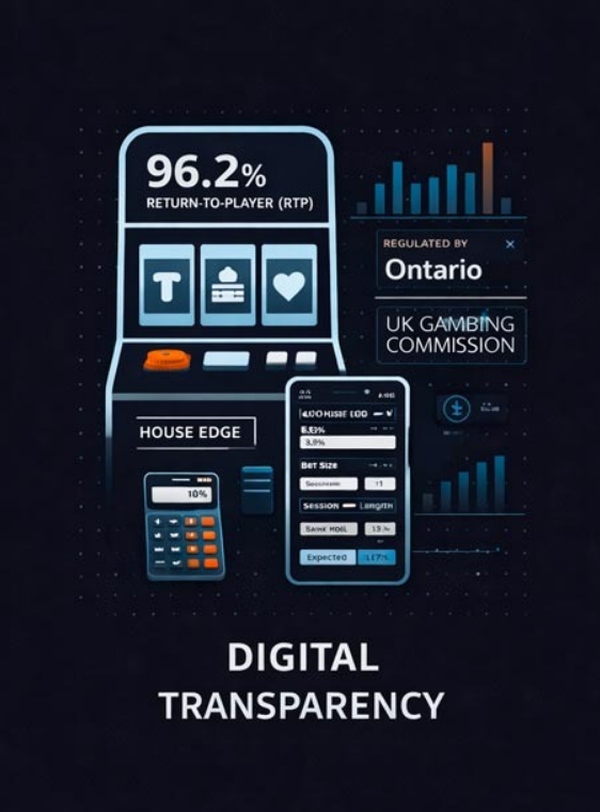
The digital entertainment space is now passing through the same transparency inflection point that banking experienced between 2015 and 2020. Regulatory bodies in Ontario, the UK, Malta, and several EU jurisdictions have moved beyond simple licensing requirements toward mandating specific mathematical disclosures. Return-to-player (RTP) percentages, variance classifications, and house edge figures are increasingly required to be published at the point of consumer interaction, not buried in terms and conditions.
Ontario's iGaming market, launched in April 2022 under the Alcohol and Gaming Commission of Ontario (AGCO), is a particularly instructive case for Canadian fintech observers. The regulatory framework requires licensed operators to display game-level RTP data and to submit their random number generators to independent auditing firms. This is functionally identical to how securities regulators require fund managers to disclose management expense ratios and historical performance data. The principle is the same: consumers making financial decisions deserve access to the quantitative parameters that determine their likely outcomes.
What makes the current moment different from previous disclosure requirements is the emergence of independent consumer tools that go beyond what regulators mandate. Platforms like gambling calculators allow users to input specific game parameters, including house edge, bet size, session length, and bankroll, to model their expected outcomes before committing funds. This is the iGaming equivalent of a mortgage amortization calculator or a compound interest simulator: a tool that translates abstract mathematical parameters into personalized, actionable projections. The fact that such tools now exist and attract meaningful traffic signals a shift in consumer behavior from passive participation to active quantitative analysis.
This consumer-side demand for calculable transparency aligns with broader fintech trends. The same user who models their mortgage payments on Ratehub, tracks their investment returns on Wealthsimple, and monitors their credit score on Borrowell now expects comparable analytical tools in every domain where money changes hands.

If regulatory disclosure provides the baseline, blockchain technology is building the verification layer. The concept of "provably fair" systems, where cryptographic hashing allows users to independently verify that an outcome was generated randomly and was not manipulated after their action, represents one of the most interesting applied use cases for distributed ledger technology outside of cryptocurrency itself.
The mechanism is straightforward in principle. Before a game round begins, the platform generates a server seed and provides the user with a hashed version. The user can supply their own client seed. After the round, the server seed is revealed, and the user (or any third-party auditor) can run the hash function to verify that the outcome matches the pre-committed parameters. Tampering after the fact is cryptographically impossible.
For the fintech community, provably fair systems are a practical demonstration of how blockchain can solve a real trust problem without requiring a full decentralized architecture. The platform still operates centrally. The games still run on conventional servers. But the verification layer, the part that matters most for consumer trust, uses the same cryptographic principles that secure cryptocurrency transactions. It's a pragmatic middle ground between fully centralized and fully decentralized models, and it's gaining traction faster than many pure DeFi applications.
According to the World Economic Forum's report on global fintech resilience, the ability to provide verifiable, tamper-proof records of financial transactions is one of the key value propositions driving blockchain adoption across regulated industries. The iGaming sector is proving that this value proposition translates effectively to consumer-facing products, not just institutional back-end infrastructure.
The transparency conversation extends beyond mathematics and into behavioral design. Fintech platforms have spent years developing AI-driven systems to detect fraudulent transactions, flag unusual account activity, and nudge users toward healthier financial behaviors. Wealthsimple's spending insights, for example, categorize expenditures and highlight patterns that users might not notice on their own. Banking apps send alerts when spending exceeds normal ranges.
The iGaming industry is adopting parallel approaches, partly driven by regulation and partly by competitive pressure from operators who recognize that long-term customer value depends on sustainable engagement rather than short-term extraction. Machine learning models now monitor player behavior patterns and flag indicators that correlate with problematic use: rapid increases in deposit frequency, session lengths that extend well beyond historical norms, and chasing behavior where bet sizes increase following losses.
The most sophisticated platforms use these signals to intervene proactively. Interventions range from gentle nudges, similar to the spending alerts in banking apps, to mandatory cooling-off periods and self-exclusion tools. Ontario's regulatory framework includes specific requirements for operator-initiated interventions, making this a compliance obligation rather than an optional feature.
From a fintech design perspective, this represents an important evolution. The first wave of fintech disruption was about making things easier: easier payments, easier investing, easier borrowing. The current wave increasingly focuses on making things safer, incorporating behavioral science and AI to protect users from their own cognitive biases. The iGaming sector's accelerated adoption of these tools, driven by the higher stakes involved, is generating insights and frameworks that will eventually flow back into mainstream financial product design.
Perhaps the most direct connection between fintech innovation and the digital entertainment sector is payment infrastructure. The iGaming industry's requirements for instant deposits, real-time withdrawals, multi-currency support, and robust identity verification have made it one of the most demanding use cases for modern payment systems.
Interac e-Transfer, which processes over one billion transactions annually in Canada, has become a standard payment rail for Ontario's licensed iGaming operators. The integration requirements have pushed Interac to develop faster settlement capabilities and more sophisticated fraud detection systems, improvements that benefit the entire Canadian payment ecosystem. Similarly, the industry's early adoption of cryptocurrency payment rails and stablecoin settlement layers has provided real-world transaction volume for technologies that are still largely theoretical in other financial services contexts.
For fintech startups building payment infrastructure, the digital entertainment vertical offers something valuable: high transaction volume, strong user expectations around speed and reliability, and regulatory frameworks that demand robust KYC and AML compliance. Several Canadian payment fintechs have used iGaming as an initial vertical, then expanded the infrastructure they built into adjacent sectors like e-commerce and subscription services.
Canada's approach to iGaming regulation offers a useful case study in how regulatory sandboxes can balance innovation with consumer protection. Ontario's decision to create a regulated market rather than maintaining prohibition has generated significant tax revenue, estimated at over $200 million annually, while giving regulators direct oversight of operator practices.
The regulatory model shares structural similarities with the sandbox approaches that several Canadian provincial securities regulators have adopted for fintech products. The Canadian Securities Administrators' Regulatory Sandbox, for instance, allows fintech firms to test innovative products in a live market under modified regulatory requirements. Both frameworks rest on the same principle: that a controlled, transparent regulatory environment produces better outcomes for consumers than either prohibition or a regulatory vacuum.
For the fintech ecosystem, the cross-pollination of regulatory approaches between financial services and digital entertainment is creating interesting opportunities. RegTech companies that developed AML compliance tools for banking are finding ready markets in iGaming. Identity verification firms that built their technology for fintech onboarding are applying the same infrastructure to age verification and player authentication. The regulatory convergence is driving a convergence of service providers, and Canadian companies are particularly well positioned because the country's regulatory frameworks in both sectors are relatively advanced by global standards.
The digital entertainment industry's rapid adoption of fintech principles, quantitative transparency, blockchain verification, AI-driven behavioral protection, and advanced payment infrastructure, is not a peripheral development. It is a preview of the consumer expectations that will define every sector where financial risk and digital interaction overlap.
The users driving this shift are not a niche demographic. They are the same consumers who use mobile banking, invest through digital platforms, and expect every financial interaction to come with complete data visibility. Their insistence on transparency in entertainment spending is a natural extension of the transparency they already demand from their financial service providers.
For fintech founders, investors, and ecosystem builders, the key takeaway is that transparency is no longer a differentiator. It is becoming the minimum standard for any platform that touches consumer money, regardless of the specific vertical. The tools, frameworks, and regulatory models being developed at this intersection of fintech and digital entertainment will likely define consumer financial technology's next chapter, not just in Canada, but globally.
 The National Crowdfunding & Fintech Association (NCFA Canada) is a financial innovation ecosystem that provides education, market intelligence, industry stewardship, networking and funding opportunities and services to thousands of community members and works closely with industry, government, partners and affiliates to create a vibrant and innovative fintech and funding industry in Canada. Decentralized and distributed, NCFA is engaged with global stakeholders and helps incubate projects and investment in fintech, alternative finance, crowdfunding, peer-to-peer finance, payments, digital assets and tokens, artificial intelligence, blockchain, cryptocurrency, regtech, and insurtech sectors. Join Canada's Fintech & Funding Community today FREE! Or become a contributing member and get perks. For more information, please visit: www.ncfacanada.org
 |  |  |
|---|---|---|
 |  |  |



August 26th, 2025

January 4th, 2024

June 1st, 2021

September 9th, 2020

July 9th, 2018

January 3rd, 2018

September 25th, 2017

June 20th, 2017

May 10th, 2017

December 14th, 2016

Leave a Reply