




Karsten Wenzlaff, Advisor
August 26th, 2025
Karsten Wenzlaff is a Crowdfunding and Fintech Expert from Germany. He is Secretary-General of Digit[...]


Mar 19, 2026 | NCFA Fintech Market Activity | Payments Operations And AI
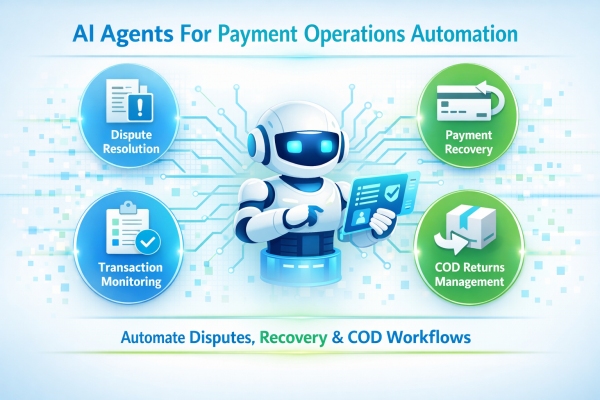
On Mar 12 2026, Razorpay launched Agent Studio, a product it says lets businesses build and run AI agents across payment and post payment workflows. Razorpay says the system is built on Anthropic’s Claude Agent SDK.
Based in Bengaluru, India, Razorpay was founded in 2014 and has grown into one of India’s largest payment platforms. The company says it supports millions of businesses, reaches more than 300 million end consumers, and processes about $180 billion in annualized payment volume. Its stack spans payment acceptance, processing, disbursements, payouts, and business banking through RazorpayX.
Agent Studio targets the operational layer that sits around those flows. In its launch post, Razorpay lists agents for dispute response, subscription recovery, abandoned cart follow up through WhatsApp or email, settlement summaries delivered through messaging, and cashflow forecasting over a 3 to 7 day window. It also includes tools for cash on delivery orders, such as identifying and analyzing returns sent back to the seller.
These workflows cost merchants and payment teams money every day. Disputes create losses and take time to resolve. Failed recurring payments reduce revenue. Abandoned carts lower completed purchases. Cash on delivery returns add shipping and handling costs. Razorpay is building automation around these problem areas, not just the payment itself.
The company is also introducing a no code agent builder in beta and plans to open the system to third party agents. That points to a setup where merchants choose automation for specific tasks across the payment lifecycle, instead of relying only on bundled platform features.
This extends Razorpay’s recent work on AI driven payments, including its earlier work with NPCI on agentic payments to enable AI driven transaction flows. The focus now moves to what happens after a payment, where recovery, customer support, and problem cases still rely heavily on manual work.
Acceptance rates and pricing are still important for PSPs and merchant platforms. Operational efficiency is becoming part of the core value proposition, especially where it directly improves recovery and reduces cost.
If agents handle disputes, recovery, reporting, and cash on delivery losses, does competition start to favour the provider that cuts the most cost for merchants, not just the one with the lowest processing price?
 The National Crowdfunding & Fintech Association (NCFA Canada) is a financial innovation ecosystem that provides education, market intelligence, industry stewardship, networking and funding opportunities and services to thousands of community members and works closely with industry, government, partners and affiliates to create a vibrant and innovative fintech and funding industry in Canada. Decentralized and distributed, NCFA is engaged with global stakeholders and helps incubate projects and investment in fintech, alternative finance, crowdfunding, peer-to-peer finance, payments, digital assets and tokens, artificial intelligence, blockchain, cryptocurrency, regtech, and insurtech sectors. Join Canada's Fintech & Funding Community today FREE! Or become a contributing member and get perks. For more information, please visit: www.ncfacanada.org
 |  |  |
|---|---|---|
 |  |  |



August 26th, 2025

January 4th, 2024

June 1st, 2021

September 9th, 2020

July 9th, 2018

January 3rd, 2018

September 25th, 2017

June 20th, 2017

May 10th, 2017

December 14th, 2016

Leave a Reply