






Karsten Wenzlaff, Advisor
August 26th, 2025
Karsten Wenzlaff is a Crowdfunding and Fintech Expert from Germany. He is Secretary-General of Digit[...]


August 24, 2026 | NCFA Insight | SME Finance And Business Banking, Cross Border Payments And FX, Competition And Market Structure, Public Sector Policy And Industrial Strategy
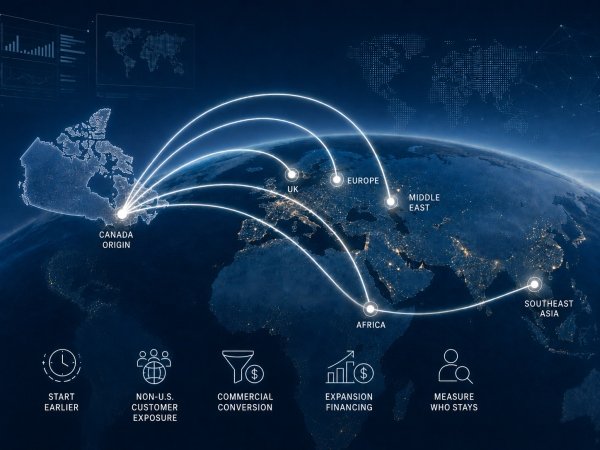
On August 24, 2026, Canada-U.S. trade negotiations had collapsed with new 50% U.S. tariffs on certain Canadian products already in force from August 22. President Donald Trump then threatened to raise new additional 50% tariffs on all Canadian cars, trucks and auto parts beginning January 1, 2027. Canada plans retaliatory tariffs on some U.S. goods beginning September 8.
The breakdown adds fresh urgency to Canada’s push to build more trade outside the U.S. The federal government is already tilting export support in that direction. CanExport SMEs has approximately $31 million available for 2026 and 2027, with about $27.9 million available for non-U.S. market activities and $3.1 million for U.S. projects. The program says the allocation supports Canada’s objective of doubling non-U.S. exports over the next decade.
For fintech, software and other digital firms, the problem is how quickly Canadian companies can turn access to a foreign market into customers and recurring revenue. Europe, the UK, Singapore, Southeast Asia, Latin America, Africa and the Middle East already have local firms and international competitors with licences, integrations, distribution, customer relationships and years of operating experience.
Statistics Canada reported $70.3 billion of digitally delivered commercial services exports in 2023. Large firms increased those exports by 20.1%, while small and medium sized firms recorded a 7.6% decline. Canadian multinationals increased commercial services exports outside the U.S. by 21%, compared with 6.6% growth to the U.S. They also accounted for 75% of the increase in Canadian commercial services exports to non-U.S. markets.
NCFA's earlier digital export comparison shows Singapore ahead of Canada despite operating from a far smaller domestic economy. Singapore ranked 11th globally in the underlying 2023 data at US$153 billion, compared with Canada in 16th place at US$118 billion.
Canada doesn't just need another list of markets to enter. It needs more startups and SMEs able to win non-U.S. customers faster and build businesses that can keep competing once they get there.
Canada already has substantial export infrastructure. The Trade Commissioner Service connects companies with customers, partners and investors. Canadian Technology Accelerators provide business development support, strategic guidance and local introductions. CanExport reduces part of the cost of entering new markets, while Export Development Canada's Trade Impact Program provides financing, working capital, guarantees and credit insurance to companies dealing with trade uncertainty.
The Canadian Technology Accelerator also produces measurable results. A Global Affairs study found participating firms had 27% higher revenue one year after completing the program than otherwise similar companies. The positive differences in revenue, assets and payroll became larger over the following years.
But Global Affairs could not determine how much the firms actually became more international because the available data were insufficient. That leaves the commercial outcome Canada now needs to understand. How many firms supported expansion into London, Singapore or another non-U.S. market are still generating recurring revenue there two, three or five years later?
Canadian fintech history shows why market entry alone is a weak measure. Wealthsimple built a UK business for almost five years and reached about 16,000 customers before selling the operation and concentrating on Canada. Clearco expanded into several overseas markets before transferring its international business to Outfund as ecommerce growth slowed and financing conditions deteriorated.
Neither case proves Canadian fintechs cannot compete abroad. They show how demanding a foreign operation becomes when a company has to fund customer acquisition, staff, compliance, banking relationships, treasury, tax and product adaptation while continuing to compete at home.
VoPay is using another model. The Vancouver founded payments infrastructure company established a global headquarters in Doha in January 2026 while keeping its Canadian operations active. Qatar is being built as a major hub for expansion across the Middle East, Africa and Southeast Asia, with more than 400 planned hires across engineering, technology, security, compliance, data and platform operations. The company didn't abandon Canada, but a meaningful part of its next stage of international capability is being built outside the country.
For Canada, it's not a simple win or loss. VoPay remains rooted in Canada while using Qatar as a launch point into several non-U.S. regions. Using a regional hub can also reduce expansion risk by putting management and operating capability closer to target markets while the Canadian core continues to run. The policy question is where the next layer of technical talent, management, partnerships and enterprise value accumulates as Canadian companies expand internationally.
The U.S. capital pull starts much earlier. NCFA's productive participation analysis examined the Canadian founder drain into the U.S. technology ecosystem. Barn Ventures describes a founder conveyor in which U.S. investors and programs recruit Canadian talent from high school and university through company formation and later scale.
Barn's analysis of the Dominion List found 517 U.S. based companies with a Canadian founder had raised about US$414 billion. It found 73% headquartered in California and 56% in San Francisco. Barn also found the number of listed companies founded each year rose sharply after 2022, while acknowledging that the Dominion List is a curated catalogue rather than a census.
Large U.S. capital markets and Silicon Valley's technology ecosystem will always attract ambitious Canadian founders. Those organizations are doing what successful capital markets do. The Canadian problem becomes more serious when founders also conclude they need to leave to get the capital, customers, infrastructure or operating environment required to build a major company. Canada can then lose value at both ends. Some promising founders build in the U.S. before substantial enterprise value accumulates here.
Also, Canada's main export programs generally engage firms after they have built meaningful operating capacity or market traction. By then, their products, sales models and management experience may already have been shaped largely around Canada and the U.S., while competitors in non-U.S. markets have spent years building customers and local experience. That is why promising firms should encounter non-U.S. customers, regulators and market requirements earlier, before they reach the stage where most formal export support begins.
Financial infrastructure can add to that timing gap. NCFA's financial infrastructure history shows Canadian fintechs developing while Real-Time Rail, wider payments access and regulated consumer driven banking arrived multiple years later than comparable infrastructure in several major fintech markets.
That does not explain Wealthsimple's UK exit, Clearco's retrenchment or any other individual company decision. It also affects what Canadian firms learn at home. Years of working with real time payments, portable financial data, modern APIs and digital onboarding build practical experience that can help when companies expand into other markets.
If Canadian firms gain important financial capabilities later, they also have less time to turn them into competitive advantages before entering non-U.S. markets.
The quickest response to Canada's urgent need to diversify beyond the U.S. is not more export information. Canada already has market intelligence, trade commissioners, financing programs and buyer introductions. The priority is to shorten the time between choosing a non-U.S. market and winning recurring revenue there. Canada can do many things differently to help achieve this.
1. Start earlier. Promising fintech and digital companies should encounter non-U.S. customers, regulators and financial institutions while their products are still developing. This doesn't mean sending every startup overseas. It means finding companies with strong technology and real differentiation early enough that requirements in several jurisdictions can influence what they build.
A company that learns to work across several payment systems, data rules, onboarding requirements and regulatory environments before reaching scale develops a different skill set from one encountering that complexity for the first time after years focused on Canada and the U.S.
2. Push buyer introductions toward commercial conversion. Canada already connects companies with qualified contacts, potential customers and partners. But they need to track and measure how consistently those introductions turn into technical evaluations, paid pilots, contracts and recurring revenue. Trade Commissioners in priority non-U.S. markets are well placed to identify concrete buyer needs and concentrate Canadian firms with relevant products against those opportunities.
That also creates better intelligence. If Canadian fintechs repeatedly lose the same types of opportunities in London, Singapore or São Paulo, Canada can determine whether the problem is product fit, pricing, licensing, procurement, financing or a capability competitors already possess.
3. Finance the period between market entry and recurring revenue. CanExport can provide up to $50,000 toward eligible international business development costs. EDC's Trade Impact Program has up to $5 billion of additional capacity over two years and supports working capital, guarantees, credit insurance and other financing tools. Those tools become more useful when they are organized around the economics of a specific foreign operation. Customer acquisition, regulatory work, FX, payments, local staff and management time can absorb capital before a new market supports itself.
For regulated fintechs, entering another country is like building a second company while the first keeps operating. Management needs to know what the foreign operation costs, what milestones justify further investment and when the economics no longer support continued expansion. That discipline protects the Canadian core while giving a promising foreign business enough runway to prove itself.
4. Measure whether companies win and stay. Canada should track the time from choosing a non-U.S. market to the first paying customer, how many assisted firms develop recurring revenue and how many are still operating there after two, three and five years.
The same scorecard can track local licences, staff and operating entities alongside the value that remains anchored in Canada. That includes Canadian employment, management functions, intellectual property, investment and capital recycled into the next generation of companies.
Those results would expose the bottlenecks quickly. A firm that receives many introductions but cannot win customers has a different problem from one that wins customers but cannot finance its expansion. A company delayed by licensing, payments or compliance needs a different response again.
Canada's non-U.S. diversification push became urgent much faster than companies can build international experience. The fastest response is therefore partly to start earlier.
Then judge success by whether Canadian companies are winning customers outside the U.S., staying in those markets and keeping enough of the resulting value anchored in Canada.
Canada now needs to diversify beyond the U.S. faster than many of its technology companies have historically expanded internationally. Can it help promising fintechs build non-U.S. customers and operating experience early enough to win against established competitors while keeping more of the resulting enterprise value anchored in Canada?
 The National Crowdfunding & Fintech Association (NCFA Canada) is a financial innovation ecosystem that provides education, market intelligence, industry stewardship, networking and funding opportunities and services to thousands of community members and works closely with industry, government, partners and affiliates to create a vibrant and innovative fintech and funding industry in Canada. Decentralized and distributed, NCFA is engaged with global stakeholders and helps incubate projects and investment in fintech, alternative finance, crowdfunding, peer-to-peer finance, payments, digital assets and tokens, artificial intelligence, blockchain, cryptocurrency, regtech, and insurtech sectors. Join Canada's Fintech & Funding Community today FREE! Or become a contributing member and get perks. For more information, please visit: www.ncfacanada.org
 |  |  |
|---|---|---|
 |  |  |



August 26th, 2025

January 4th, 2024

June 1st, 2021

September 9th, 2020

July 9th, 2018

January 3rd, 2018

September 25th, 2017

June 20th, 2017

May 10th, 2017

December 14th, 2016

Leave a Reply