




Karsten Wenzlaff, Advisor
August 26th, 2025
Karsten Wenzlaff is a Crowdfunding and Fintech Expert from Germany. He is Secretary-General of Digit[...]


Global Fintech Report | Jun 2, 2025
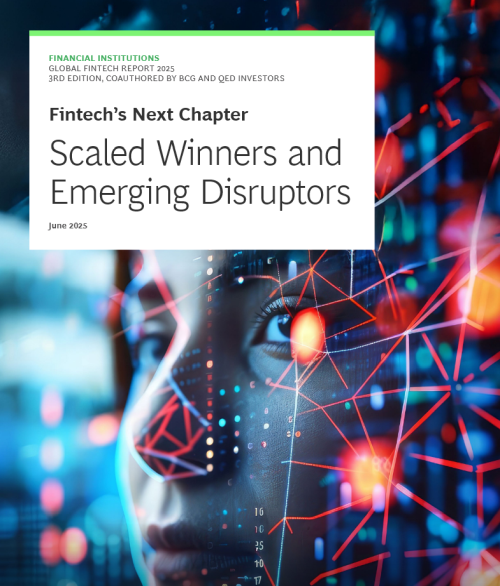
Image: Cover of Scaled Winners and Emerging Disruptors (June 2025, BCG and QED Investors)
The Boston Consulting Group (BCG) and QED Investors, just published a June 2025 report titled, "Fintech’s Next Chapter: Scaled Winners and Emerging Disruptors" (38 page PDF), highlighting that global fintech revenues rose 21% in 2024 compared to 6% for traditional financial institutions. That confirms fintech showed a strong rebound across sectors, accelerating from the prior year, after a couple of years of tightening capital markets and heightened regulatory scrutiny.
In 2024, fintechs generated $378 billion in revenue, while traditional banks and insurers earned $12.7 trillion. Fintechs have captured just 3% of this revenue, so 97% is still in the hands of incumbent financial institutions.
There are roughly 100 scaling fintechs earning over $500 million annually of which these 5 verticals dominate revenue generation:
These five sectors represent most of the $231 billion in scaled fintech revenue. Payments alone represent 55% of that total. Challenger banks and crypto platforms hold a smaller but growing share.
There are 150 global fintechs founded before 2016 that have raised over $500 million in equity and remain private. Many are waiting for improved conditions in the capital markets, such as Stripe and other scaling fintechs expecting to IPO
Fintech’s revenue share remains small across all verticals. Insurance accounts for less than 1% of fintech penetration. Deposits stand at just 2%. Lending, despite strong activity in personal loans and buy now pay later, accounts for only 3% of global lending revenues.
Agentic AI where AI powered systems are capable of logic and taking actions independently is a game changer. AI native fintechs have already gobbled up 49% of fintech equity funding yet only represent 23% of the sector.
Blockchain-based on-chain finance is also gaining traction. Tokenization of assets like bonds, private credit, and money market funds is growing at a double-digit rate. While tokenized asset volume remain under $1 trillion today, major institutions like Goldman Sachs and the European Investment Bank are piloting large-scale tokenization programs.
Private credit funds are also becoming essential to fintech lending models. With $1.7 trillion in assets under management, these funds are stepping in where traditional bank funding is constrained. The report estimates a $280 billion untapped opportunity for private credit participation in fintech-originated lending. In 2024 and early 2025, several billion-dollar forward flow deals were announced, including SoFi, Klarna, and Pagaya.
Fintech is rebounding and growing faster than traditional banks but has only unlocked 3% of global banking and insurance revenue, so the opportunity is still massive. Fintechs that can deliver sustainable growth, expand into new customer segments, and integrate new technologies like AI and tokenization will be well positioned to capture the next iteration of financial services tech.
 The National Crowdfunding & Fintech Association (NCFA Canada) is a financial innovation ecosystem that provides education, market intelligence, industry stewardship, networking and funding opportunities and services to thousands of community members and works closely with industry, government, partners and affiliates to create a vibrant and innovative fintech and funding industry in Canada. Decentralized and distributed, NCFA is engaged with global stakeholders and helps incubate projects and investment in fintech, alternative finance, crowdfunding, peer-to-peer finance, payments, digital assets and tokens, artificial intelligence, blockchain, cryptocurrency, regtech, and insurtech sectors. Join Canada's Fintech & Funding Community today FREE! Or become a contributing member and get perks. For more information, please visit: www.ncfacanada.org
 |  |  |
|---|---|---|
 |  |  |


August 26th, 2025

January 4th, 2024

June 1st, 2021

September 9th, 2020

July 9th, 2018

January 3rd, 2018

September 25th, 2017

June 20th, 2017

May 10th, 2017

December 14th, 2016

Leave a Reply