





Karsten Wenzlaff, Advisor
August 26th, 2025
Karsten Wenzlaff is a Crowdfunding and Fintech Expert from Germany. He is Secretary-General of Digit[...]


We're opening up more and more APIs to partners, fintech services, and client applications. The only question is whether we're confident these same APIs aren't opening up new paths for attackers.
Just a few years ago, a bank mostly dealt with its own systems. A customer would log into the app, check their balance, make a transfer. The whole journey stayed inside the perimeter of a single organization.
Today, one customer might simultaneously use a mobile banking app, a budgeting service, an accounting platform, a payment provider, and an AI assistant that analyzes their spending. All of these services exchange data through APIs - interfaces that let different systems talk to each other according to a set of established rules.
Open Banking isn't just a regulatory requirement or a new integration channel - it's a shift in the trust model itself. A bank used to be responsible for security within its own infrastructure. Now it hands off part of its data to dozens of external services, and those services, in turn, rely on the bank. The more participants in the ecosystem, the more points there are where trust is either reaffirmed or cracked, every single day.
Attackers are less and less interested in finding a weak spot inside any one bank. Today, hackers target the interaction between systems itself. The longer the chain - bank, fintech, payment hub, partner app - the more places there are for something to go wrong.
Common examples include:
An API can perform flawlessly on the functional side - fast, stable, no errors in the logs - and still carry a critical vulnerability. Functional correctness and cybersecurity don't always go together.
Banks and fintech companies generally don't neglect API security. They go through certifications, run automated scans, do code reviews and QA. But none of these tools answer the one question that matters most: can this specific API's logic be bypassed in a way its developer never anticipated? Scanning catches known vulnerability patterns; code review and QA confirm the code does what it was built to do. Neither one thinks like an attacker who isn't hunting for a bug in the code, but for a logical gap in how the API interacts with other systems.
That's why most attacks on financial APIs today aren't about technical mistakes - they're about logic: the sequence of actions, the boundaries of authority, the trust placed in data coming from the client. It's also why modern Cybersecurity Solutions for Fintech increasingly go beyond formal compliance with standards, testing real-world abuse scenarios at the points where multiple systems meet.
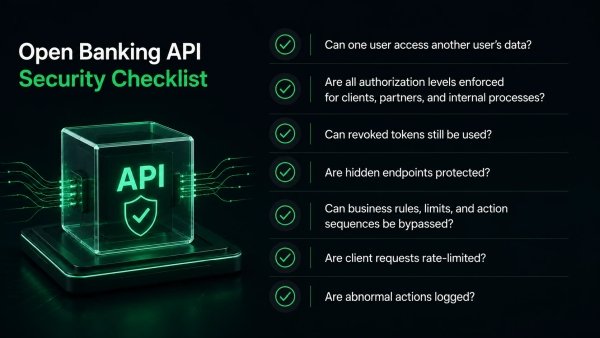
Here's a short checklist for reviewing every external API in your ecosystem:
If you don't have a confident answer to any of these, that's reason enough to look closer.
It's worth telling apart three things that often get lumped together. Vulnerability scanning looks for known vulnerabilities by signature, catching familiar vulnerability classes, common misconfigurations, and known dangerous patterns. Automated testing checks whether the code performs its intended functions correctly. Separate from both is API Penetration Testing (https://datami.ee/services/pentest/api-penetration-testing/) - manual testing in which a specialist plays the role of a real attacker: combining requests, tweaking parameters, hunting for unusual sequences of actions that a scanner, in most cases, won't flag as anomalous, because each individual request looks legitimate on its own.
It's also best if this kind of testing is handled by an external team. In-house specialists tend to know their own API inside and out - and that's precisely what makes it hard for them to spot an unconventional abuse scenario, since day-to-day work with a system's logic doesn't train you to look at it through the eyes of someone deliberately trying to break it. External specialists bring experience from other architectures and payment integrations, so they're more likely to catch the gaps a team had written off as unimportant.
A bank can offer the most convenient digital service and the best partner API on the market. But if even one partner or customer stops trusting the security of the data exchange, the benefits of Open Banking vanish almost instantly. Trust here isn't a bonus feature - it's the baseline condition, and without it the whole structure loses its meaning.
That's why investing in API protection in the financial sector isn't just about regulatory compliance - it's about sustaining trust across the whole ecosystem: between bank and fintech, fintech and customer, and customer and every new service they let into their data.
 The National Crowdfunding & Fintech Association (NCFA Canada) is a financial innovation ecosystem that provides education, market intelligence, industry stewardship, networking and funding opportunities and services to thousands of community members and works closely with industry, government, partners and affiliates to create a vibrant and innovative fintech and funding industry in Canada. Decentralized and distributed, NCFA is engaged with global stakeholders and helps incubate projects and investment in fintech, alternative finance, crowdfunding, peer-to-peer finance, payments, digital assets and tokens, artificial intelligence, blockchain, cryptocurrency, regtech, and insurtech sectors. Join Canada's Fintech & Funding Community today FREE! Or become a contributing member and get perks. For more information, please visit: www.ncfacanada.org
 |  |  |
|---|---|---|
 |  |  |



August 26th, 2025

January 4th, 2024

June 1st, 2021

September 9th, 2020

July 9th, 2018

January 3rd, 2018

September 25th, 2017

June 20th, 2017

May 10th, 2017

December 14th, 2016

Leave a Reply