




Karsten Wenzlaff, Advisor
August 26th, 2025
Karsten Wenzlaff is a Crowdfunding and Fintech Expert from Germany. He is Secretary-General of Digit[...]


Digital Assets | Aug 27, 2025

Image: Freepik
Digital lives now include high value property and high emotion content. Crypto's digital assets and tokens sit next to family photos in the cloud and personal emails, but the rules for accessing them after someone's death (or incapacity) vary widely between platforms and jurisdictions.
In Canada, Bitcoin ownership was about 10% in 2023 per the Bank of Canada’s Canadian Bitcoin ownership in 2023, while the CSA 2024 Investor Index shows that 33% of investors under 35 years old hold crypto assets. Growing exposure combined with the Canada Revenue Agency’s disposition at death requirement, makes digital estate planning a growing mainstream need instead of a niche topic that could get buried (no pun intended).
Four provinces and territories in Canada have passed laws that give executors and trustees specific rights to access digital assets.
KPMG notes that these four are the only Canadian jurisdictions with dedicated statutes so far with Alberta adding digital accounts to executor duties through other legislation. Their overview of Canadian gaps notes that most provinces still lack clear rules, a challenge also underlined in the ALRI’s analysis of digital estate law.
The Canada Revenue Agency states that, “a person who died is considered to have disposed of all the property they own right before death.” That disposition also applies to crypto which is considered a capital property, with gains included on the final return. Executors and advisors need procedures that capture wallet inventories, cost base evidence, and transaction records. See CRA’s guidance on capital gains at death and its crypto asset tax page.
Big platforms provide inheritance tools that users must enable to access them. Apple’s Legacy Contact and Digital Legacy let a named person request access using an access key plus a death certificate, while Google’s Inactive Account Manager lets users direct data sharing or deletion after a chosen period of inactivity. For custody and to exchange accounts, some platforms offer support such as Coinbase deceased account handling and Binance inheritance appeal show families how to proceed.
Practical client checklist: Confirm a complete inventory of digital property and accounts, enable Apple Legacy Contact or Google Inactive Account Manager where applicable, include digital assets and directions in the will or memorandum, and securely record wallet locations and recovery material.
Fintechs and advisors should help clients list all their digital accounts, turn on inheritance tools offered by platforms, and record their wishes in estate documents. Advisors can use checklists that follow provincial laws and make sure keys and login details are stored securely. Putting these steps in place builds trust with clients and prevents problems when someone dies or becomes unable to manage their accounts.
Globally, the tax treatment of digital assets after death remains inconsistent. The UK, US, and Canada all vary in their approach, which can complicate planning for cross-border families. An in-depth analysis of inheritance tax for digital assets across jurisdictions highlights these differences.
For estates with US connections as of 2021, a total of 47 states have enacted laws based on the Uniform Law Commission model, see Revised Uniform Fiduciary Access to Digital Assets Act (RUFADAA). If users don't enable official legacy features or provide clear authority, custodians could refuse access based on terms of service, forcing families to obtain court orders from foreign jurisdictions.
Digital estate planning has moved from fringe cases to everyday expectations. The legal tools exist, platform features are available, and client demand is growing. NCFA members should operationalize digital inheritance today to create and protect real value for families while improving compliance and client experience.
 The National Crowdfunding & Fintech Association (NCFA Canada) is a financial innovation ecosystem that provides education, market intelligence, industry stewardship, networking and funding opportunities and services to thousands of community members and works closely with industry, government, partners and affiliates to create a vibrant and innovative fintech and funding industry in Canada. Decentralized and distributed, NCFA is engaged with global stakeholders and helps incubate projects and investment in fintech, alternative finance, crowdfunding, peer-to-peer finance, payments, digital assets and tokens, artificial intelligence, blockchain, cryptocurrency, regtech, and insurtech sectors. Join Canada's Fintech & Funding Community today FREE! Or become a contributing member and get perks. For more information, please visit: www.ncfacanada.org
 |  |  |
|---|---|---|
 |  |  |
AI | Aug 26, 2025

Image: Freepik
On Aug 25 2025, Perplexity announced the launch of Comet Plus, a $5 per month subscription service that commits to paying 80% of revenue to publishers while Perplexity retains 20% for compute and platform costs. The company has allocated a $42.5 million pool to start the program.
Aravind Srinivas, Perplexity CEO hits the nail on the head:
“AI is helping to create a better internet, but publishers still need to get paid.”
The launch comes as Perplexity faces mounting legal and reputational pressure. Media companies including News Corp, Forbes, and Condé Nast have accused Perplexity of unauthorized use of their journalism. By offering direct revenue, the company is positioning itself as a collaborator rather than an adversary.
The launch also represents an evolution from Perplexity’s earlier Publisher Program announced in 2024. That program partnered with outlets like Time, Der Spiegel, and Fortune, sharing ad revenue and offering free developer tools, however payout percentages were lower and less transparent. Comet Plus is aiming to scale with openness.
Perplexity defines three categories of traffic that qualify for payouts:
1. Human traffic means direct visits to publisher program content.
2. Indexed traffic means AI citations or synthesized use of publisher content in answers.
3. Agent traffic means tasks completed by the Comet Assistant using publisher material.
Comet Plus subscriptions cost $5 per month, with Pro and Max tiers including access automatically. In September 2024 Perplexity processed 350 million user queries, showing the scale of demand.
For publishers, the model offers a new and potentially recurring revenue stream tied to the actual use of their work (different than relying on traffic referral triggers). For fintech innovators, Comet Plus demonstrates how programmable revenue sharing tied to verifiable usage can enable micropayments and real-time attribution systems. For policymakers, Comet Plus is a test case for AI compensation models that could reduce litigation and support fairer AI-publisher frameworks.
There are questions about scalability though. The $42.5 million pool is significant but could quickly be depleted as content consumption is growing quickly. Subscription adoption will need to keep pace for the model to deliver meaningful returns.
Another issue is equity. Larger media brands might capture the majority of rewards, while smaller publishers see little benefit unless Perplexity ensures diverse citation and equitable weighting. Transparency in reporting will be key to monitoring the balance and maintain trust with stakeholders.
Perplexity frames the program as part of building a better internet and ensuring creators are compensated in the AI age. If successful, it could set a precedent for AI companies globally.
The National Crowdfunding & Fintech Association (NCFA Canada) is a financial innovation ecosystem that provides education, market intelligence, industry stewardship, networking and funding opportunities and services to thousands of community members and works closely with industry, government, partners and affiliates to create a vibrant and innovative fintech and funding industry in Canada. Decentralized and distributed, NCFA is engaged with global stakeholders and helps incubate projects and investment in fintech, alternative finance, crowdfunding, peer-to-peer finance, payments, digital assets and tokens, artificial intelligence, blockchain, cryptocurrency, regtech, and insurtech sectors. Join Canada's Fintech & Funding Community today FREE! Or become a contributing member and get perks. For more information, please visit: www.ncfacanada.org
| | |
|---|---|---|
| | |
Aug 26, 2025

Image: Unsplash/PiggyBank
Two of Canada’s largest banks, RBC and BMO, are currently exploring the possibility of selling their joint payments processing venture, Moneris. If the deal follows through, it could potentially be valued at around $2 billion, which would be a record-breaking transaction in Canadian history.
At the moment, no final decision has been made yet because it’s still early days and discussions are still being held. However, the potential sale has already sparked considerable interest within the industry, given the size and importance of Moneris in Canada. The banks are said to be working with top financial advisors, including PJT Partners, RBC Capital Markets, and BMO Capital Markets, to evaluate their options.
Moneris currently generates about $700 million in annual revenue and serves about 325,000 merchant locations across the country. This basically means the company processes roughly one out of every three business transactions in Canada, which is proof of just how central it is to everyday commerce. If sold, Moneris would present a rare opportunity for investors to acquire a pretty decent share of Canada’s payments market.
Retail isn’t the only sector that relies on efficient payment systems, because industries like online gaming have also highlighted the demand for fast, reliable processing. According to gambling expert Matt Bastock, part of the reason fast cashout sites have become so popular among players is the growing demand for better payment systems and instant payouts. Like online casinos and many other sectors of the economy, more and more businesses are starting to rely on fast, reliable transactions to meet customer expectations and stay competitive.
Moneris was established in 2000 as a 50/50 joint venture between the Royal Bank of Canada (RBC) and the Bank of Montreal (BMO), at a time when card payments were the go-to for merchants. In the last two decades, the company has grown into one of Canada’s largest payment processors and a trusted name for businesses of all sizes.
With a commanding market share of about 33%, Moneris is more than just a routine asset; it’s also the backbone of payments processed in and around the whole country. Today, Moneris’ offerings cover mobile payments, e-commerce platforms, and integrated point-of-sale systems, making it a one-stop shop for most businesses.
The company has also been strategic in expanding its services through partnerships and acquisitions. In 2021, Moneris acquired Quebec-based UEAT, which is a platform that provides online ordering solutions for restaurants, as a way to cement its presence in the hospitality sector. More recently, in 2025, the company went into a partnership with Cardstream to strengthen its capabilities in e-commerce.
Should RBC and BMO move forward with the sale, it would mark a turning point in Canadian fintech history. The immediate impact on businesses and consumers might not be as harsh as most people expect it to be, as payment processing services will likely continue uninterrupted. However, under new ownership, Moneris could pursue more aggressive strategies, introduce new technologies, or even go beyond Canadian borders in the hopes of finding better opportunities.
This potential sale reflects the ongoing transformation of Canada’s financial services industry, where traditional banks are adapting to an era that is defined by fintech solutions. In fact, the Canadian fintech sector is growing three times faster than traditional finance. For stakeholders across the board (consumers, investors, and competitors), the coming months will be worth watching closely. The outcome will provide valuable insights into how things are going to change and how institutions like RBC and BMO intend to position themselves in the future.
Although payment processing operations are profitable and generate reliable cash flow, they also require ongoing investment in technology, which tends to be costly. For RBC and BMO, exiting their joint venture may allow them to refocus on their core banking operations, while leaving the demands of payment technology to specialized industry players.
On the other side of the equation, potential buyers (private equity investors or established payment companies) may find new ways to scale the business even further. Comparable moves have already been seen in and outside of Canada. For instance, TD Bank recently partnered with U.S.-based Fiserv for its merchant payments operations, opting to work with a dedicated payments provider instead of maintaining the business internally. Cases like these are good examples of how banks are rethinking their role in the ecosystem, often favouring partnerships or outright sales.
The National Crowdfunding & Fintech Association (NCFA Canada) is a financial innovation ecosystem that provides education, market intelligence, industry stewardship, networking and funding opportunities and services to thousands of community members and works closely with industry, government, partners and affiliates to create a vibrant and innovative fintech and funding industry in Canada. Decentralized and distributed, NCFA is engaged with global stakeholders and helps incubate projects and investment in fintech, alternative finance, crowdfunding, peer-to-peer finance, payments, digital assets and tokens, artificial intelligence, blockchain, cryptocurrency, regtech, and insurtech sectors. Join Canada's Fintech & Funding Community today FREE! Or become a contributing member and get perks. For more information, please visit: www.ncfacanada.org
| | |
|---|---|---|
| | |
Semi Conductor Chips | Aug 25, 2025

Image: Freepik/xb100
On August 22, 2025, Intel announced a historic investment deal with the U.S. government. Washington will convert $8.9 billion of grants from the CHIPS and Science Act and funds awarded under the Secure Enclave program into an equity stake. That adds up to $11.1 billion when combined with earlier support. The U.S. will own almost 10% of Intel through the purchase of 433 million shares at $20.47 each with a five year option to buy more if Intel’s foundry control slips. Intel’s stock rose 5% after the news showing market confidence. The U.S. deal fuses industrial policy, national security, and capital markets.
If Intel executes with strength this deal could become a model for other strategic industries where similar partnerships could emerge, such as in cloud computing, artificial intelligence, and cybersecurity. The U.S. is treating advanced technology as a matter of national security and economic resilience, not just market growth.
But the risks are serious given that preferential government equity can tilt markets. Even without board seats, U.S. national security priorities are likely to influence Intel’s decision-making. Analysis from the WSJ (subscription) spotlights concerns that allies could see this move as protectionist while competitors like China are doubling down on their own state programs. For Intel, receiving public investment capital does not eliminate technical and competitive challenges.
Canada shouldn't miss this message. Our economy depends on digital infrastructure, fintech, and artificial intelligence, yet we are slipping in the basics. Labour productivity fell 1.8% in 2023, the worst among OECD countries according to OECD data. Business R&D intensity has stalled even as total spending reached $53.1 billion in 2023. The Toronto Stock Exchange has seen a collapse in new listings, with the number of operating companies falling 42.5% since 2008. In the first half of 2024 there were only 12 IPOs raising $12.9 million, the weakest in decades.
Retail investors have limited options in Canada with current crowdfunding rules cap issuers at $1.5 million per year and individuals at $2,500 per deal per CSA's NI 45-110, while American policy leaders are advocating to increase U.S. crowdfunding caps from $5M to $10M USD. Meanwhile, open banking is still not live with the government targeting early 2026 for rollout. Canada needs to recognize that leading economies are treating technology as sovereign infrastructure. But our record with national large scale projects from broadband and digital ID to defense procurement is often delayed, underfunded, or misaligned with the original vision.
Canada must respond from a position of strength while recognizing its constraints.
Capital formation is a constant constraint. IPO markets remain weak and the pool of listed operating companies continues to shrink. Without deeper domestic pathways, Canadian innovators will keep looking south. Retail access must expand. Current equity crowdfunding limits are too modest for capital intensive sectors like AI infrastructure, semiconductor packaging, and cybersecurity. Modernize equity crowdfunding and exemption rules to turn Canadians into shareholders in their own innovation economy, not passive taxpayers.
Competition must be unlocked. Canada’s banking market remains highly concentrated, and the continued delay of open banking weakens fintech growth compared to peers already live. Accelerating the rollout with clear liability rules and payments initiation is essential.
Semiconductors require realism. Canada is not building leading edge fabs, but we already host a North American advanced packaging hub at IBM Bromont. Ottawa and Quebec backed upgrades in 2024 and further support is expected. Packaging is becoming a chokepoint as chiplet designs spread across AI systems. Doubling down on this strength could anchor Canada in the supply chains funded by U.S. CHIPS investments.
Intellectual property must be treated as a strategic asset. Canada has a long history of world leading research that too often turns into patents and companies controlled abroad. In AI, for example, Canadian researchers pioneered deep learning yet most of the firms capturing that value are headquartered elsewhere. A national IP strategy that ties public research funding to commercialization in Canada, strengthens IP retention rules, and helps scale ups build patent portfolios would keep more value at home.
Public funds should be linked directly to domestic value creation. The Intel deal shows how governments can require alignment with national goals in exchange for capital. Canada can do the same, not by choosing a single corporate champion but by tying support to measurable outcomes like higher R&D intensity, Canadian patent filings, and stronger Canadian controlled firms.
Talent and immigration must become a growth engine, not just a safety valve. Canada’s immigration system is a global advantage but skilled newcomers too often become employees of foreign firms rather than founders of Canadian ones. Scaling visa programs tied to entrepreneurship and improving access to early stage capital for immigrant founded companies would unlock more homegrown innovation.
The Intel deal shows the world is changing fast. Countries are treating technology as a national asset. Canada must act too, but in our own way. We can rebuild competitiveness not through giant one off bets but by modernizing capital markets, opening doors for retail investors, and backing the companies that will define our digital future. It is a call to seize our strengths and trust Canadians to invest in them. If we act now, Canada can remain a competitive, innovative, and inclusive player in the global economy.
The National Crowdfunding & Fintech Association (NCFA Canada) is a financial innovation ecosystem that provides education, market intelligence, industry stewardship, networking and funding opportunities and services to thousands of community members and works closely with industry, government, partners and affiliates to create a vibrant and innovative fintech and funding industry in Canada. Decentralized and distributed, NCFA is engaged with global stakeholders and helps incubate projects and investment in fintech, alternative finance, crowdfunding, peer-to-peer finance, payments, digital assets and tokens, artificial intelligence, blockchain, cryptocurrency, regtech, and insurtech sectors. Join Canada's Fintech & Funding Community today FREE! Or become a contributing member and get perks. For more information, please visit: www.ncfacanada.org
| | |
|---|---|---|
| | |
Economy and Policy | Aug 25, 2025

Nearly three decades ago, Carl Sagan warned in The Demon-Haunted World (1996) that when technological power is concentrated in a few hands and public institutions lose expertise, societies risk “sliding, almost without noticing, back into superstition and darkness.”
On Aug 22, 2025, Andrea Bonime-Blanc in a LinkedIn post discusses how recent U.S. federal budget cuts and policy changes are accelerating a “brain drain” of scientific and economic expertise. This article looks at the business impacts and implications for fintech of the significant human capital and policy changes taking place in the U.S. and how Canada and other collaborative countries should be responding.
The departure of experts at the Bureau of Labor Statistics (BLS) erodes confidence in U.S. economic indicators that businesses and markets rely on.
- President Trump fired BLS Commissioner Erika McEntarfer on August 1, 2025 after controversy over jobs report revisions
- The July 2025 jobs report showed 73,000 jobs gained and revisions down of 86,000 in May and 64,000 in June
- In July 2025 only 58% of employers answered the U.S. government’s payroll survey, which normally tracks over 120,000 workplaces. With so few responses, the jobs numbers are less reliable and more likely to be revised
Takeaway: 👉 For fintech lenders and investment platforms that depend on U.S. labor and wage data, model uncertainty and risk costs may increase.
Cuts to cybersecurity agencies increase systemic risk for payments and banking networks, and weaken the ability to build secure AI systems.
In 2025, the main federal agency that protects critical infrastructure including finance, energy, and healthcare, the U.S. Cybersecurity and Infrastructure Security Agency (CISA), had about $3 billion in funding and just over 3,600 staff. These resources cover everything from monitoring threats to helping banks and utilities recover from cyberattacks. Lawmakers are now weighing a $135 million cut to CISA’s 2026 budget or equal to about 4.5% of its funding. On paper it may sound small, but it reduces the agency’s ability to share intelligence, build new defenses, and support partners in both the public and private sectors.
Takeaway: 👉 Reduced federal cyber capacity raises exposure for cross-border fintech systems.
Environmental and climate science cuts reduce access to datasets critical for insurers, lenders, and ESG related products.
- EPA workforce cut from 16,155 in January 2025 to 12,448 , a 23% reduction with closure of its scientific research division
- NOAA terminated staff for its Climate.gov portal on May 31, 2025, halting new content
- NOAA seeks a 17% workforce cut after firing hundreds of probationary employees in early 2025
Takeaway: 👉 For fintech ESG products, fewer trusted U.S. datasets could degrade climate related financial models. Canada can step in with trusted open-data collaborations.
Graduate students and researchers face reduced U.S. funding, pushing talent abroad.
- PBS reports that at least 17 immigration judges were fired across 10 states in July 2025, adding delays to skilled worker case processing
Takeaway: 👉 Processing delays affect STEM talent inflows. Canada could capture this talent to strengthen fintech innovation by accelerating recruitment by offering scholarships, innovation hub partnerships, and fast-track visas.
Federal compliance and AI governance structures are weakening, raising trust issues.
- Elizabeth Kelly the inaugural director of the U.S. AI Safety Institute departed in February 2025 leaving a leadership vacuum
Takeaway: 👉 With U.S. leadership unsettled, Canada and the EU can shape AI assurance frameworks for fintech. Canadian regtech firms are well positioned to step up and help lead.
Canada needs to open up the country as a trusted hub for financial data integrity, cyber resilience and AI governance by focusing on the following practical steps:
- Map out data sources and diversify away from over reliance on U.S. federal inputs
- Invest in AI enabled cybersecurity and fraud detection systems
- Explore alternative and open-source data partnerships to fill data gaps (NGOs, universities, private market collaborations)
- Support STEM students and researchers displaced by U.S. funding cuts
- Build compliance and governance tools that embed transparency into fintech systems
The U.S. brain drain is visible in staff firings, layoffs, budget cuts and agency closures and contractions. Carl Sagan’s caution from 1996 reminds us that losing expertise erodes both science and democracy. By investing in data integrity, global standards, and fintech innovation, Canada can transform today’s U.S. retreat into a foundation for stronger, competitive growth. This is a chance for Canada to step up and lead.
The National Crowdfunding & Fintech Association (NCFA Canada) is a financial innovation ecosystem that provides education, market intelligence, industry stewardship, networking and funding opportunities and services to thousands of community members and works closely with industry, government, partners and affiliates to create a vibrant and innovative fintech and funding industry in Canada. Decentralized and distributed, NCFA is engaged with global stakeholders and helps incubate projects and investment in fintech, alternative finance, crowdfunding, peer-to-peer finance, payments, digital assets and tokens, artificial intelligence, blockchain, cryptocurrency, regtech, and insurtech sectors. Join Canada's Fintech & Funding Community today FREE! Or become a contributing member and get perks. For more information, please visit: www.ncfacanada.org
| | |
|---|---|---|
| | |
Economy | Aug 22, 2025

Image: Freepik
On Aug 22 2025, Federal Reserve Chair Jerome Powell delivered his Jackson Hole speech that suggested an interest rate cut may be on the table as soon as September. His comments came as the central bank weighs a weakening labour market and persistent but easing inflationary pressures.
Powell described a slowing economy with payroll job growth falling to just 35,000 per month over the past three months compared with 168,000 per month in 2024. The 4.2% unemployment rate is up from lows reached last year. He noted that downside risks to employment are rising even as tariff related price increases continue to flow through supply chains.
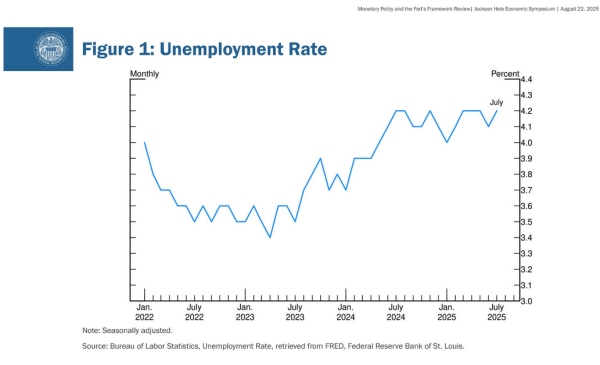
Image: US Unemployment Rate (Bureau of Labor Statistics)
Powell, Fed Reserve Chair, importantly said:
"[With policy already in restrictive territory] the baseline outlook and the shifting balance of risks may warrant adjusting our policy stance.”
Equity markets surged immediately following Powell’s comments. The S&P 500 and Nasdaq rose more than 1.5 percent by noon Friday, the Dow Jones Industrial Average climbed more than 900 points, and the Russell 2000 gained 3.8%. Treasury yields moved lower while the US dollar weakened. Crypto assets also rallied with bitcoin up 3.8% and ether jumping 13.2%.
Market participants interpreted Powell’s message as a strong hint at near term easing. The CME FedWatch tool now shows a near 90% probability of a 25 basis point rate cut in September. Analysts argue that Powell is signalling a tilt toward supporting jobs while treating tariff driven inflation as more temporary. The Fed’s tone has shifted from a singular focus on inflation to a more balanced consideration of employment risks.
The Federal Reserve’s final decision will be based on incoming data. The August employment report and mid September inflation release will be critical in determining whether the Fed follows through with a rate cut. As Powell emphasized, monetary policy will depend on how the evolving balance of risks plays out.
The bottom line is that Powell’s Jackson Hole remarks have repositioned the Fed’s policy stance. By acknowledging weakening labour conditions while downplaying longer lasting inflation threats, Powell has set expectations for a September rate cut, and markets have already pricing in an easier policy, triggering a broad a rally across stocks, bonds, and crypto.
The National Crowdfunding & Fintech Association (NCFA Canada) is a financial innovation ecosystem that provides education, market intelligence, industry stewardship, networking and funding opportunities and services to thousands of community members and works closely with industry, government, partners and affiliates to create a vibrant and innovative fintech and funding industry in Canada. Decentralized and distributed, NCFA is engaged with global stakeholders and helps incubate projects and investment in fintech, alternative finance, crowdfunding, peer-to-peer finance, payments, digital assets and tokens, artificial intelligence, blockchain, cryptocurrency, regtech, and insurtech sectors. Join Canada's Fintech & Funding Community today FREE! Or become a contributing member and get perks. For more information, please visit: www.ncfacanada.org
| | |
|---|---|---|
| | |
Aug 22, 2025

Image: Unsplash/Brooke Cagle
Learning a new language is rarely just about vocabulary and grammar. In Canada, where two official languages coexist and overlap, learning French or English carries a deeper cultural significance. Language training is not simply a tool for professional advancement but a powerful way to connect communities, foster inclusivity, and reduce barriers. For individuals preparing for official exams or seeking better communication in the workplace, structured language training becomes a bridge that links people across cultures.
Mastering a second language opens doors to broader participation in Canadian society. For anglophones, learning French makes it easier to engage with francophone colleagues, communities, and institutions. For francophones, strong English skills expand access to national networks and opportunities.
Training helps people feel included rather than isolated, especially in workplaces where bilingualism is the norm. When employees can switch between languages seamlessly, everyone feels respected and represented.
Canada’s francophone population is not limited to Quebec. Communities exist across Ontario, New Brunswick, Manitoba, and beyond. Language training offers more than exam readiness, it provides insight into traditions, histories, and perspectives that shape these communities. By learning French, professionals show a willingness to engage with these cultures authentically. This understanding can be particularly valuable in government or public service roles, where cultural sensitivity is essential.
Modern workplaces are increasingly diverse, and miscommunication can quickly become a barrier. Language training reduces misunderstandings and builds confidence. A bilingual employee can mediate between colleagues, clarify instructions, and ensure collaboration runs smoothly. Even basic training shows effort, which builds trust and rapport. Employers who encourage staff to pursue programs or prepare for SLE testing are investing not just in compliance but in smoother, more inclusive communication across the board.
Unlike quick language apps or self-study guides, structured training programs are designed for long-term results. They don’t just prepare learners for tests; they prepare them for real-life interactions where culture and language intersect. Courses often include role-play, workplace scenarios, and group discussions, which mimic real cultural exchanges. Learners gain the ability to adapt to new environments, ask meaningful questions, and build professional relationships that last. Over time, this leads to genuine integration rather than surface-level fluency.
Language learning doesn’t stop with the individual. When one person develops bilingual skills, their family, team, and community benefit. Parents who learn French, for example, often encourage their children to do the same, passing down values of inclusivity. At work, bilingual employees help create a culture where diversity is celebrated rather than seen as a challenge. The ripple effect extends outward, gradually strengthening Canada’s identity as a country built on mutual respect and cultural bridges.
Language training is more than a professional checkbox, it is a gateway to inclusion, understanding, and unity. By equipping individuals with the skills to communicate across cultures, training fosters stronger communities, smoother workplaces, and lasting integration. You can learn more about these kinds of programs on this platform. For Canadians, investing in structured language learning is not only about exams and promotions; it is about building bridges that connect people and enrich the social fabric of the country.
The National Crowdfunding & Fintech Association (NCFA Canada) is a financial innovation ecosystem that provides education, market intelligence, industry stewardship, networking and funding opportunities and services to thousands of community members and works closely with industry, government, partners and affiliates to create a vibrant and innovative fintech and funding industry in Canada. Decentralized and distributed, NCFA is engaged with global stakeholders and helps incubate projects and investment in fintech, alternative finance, crowdfunding, peer-to-peer finance, payments, digital assets and tokens, artificial intelligence, blockchain, cryptocurrency, regtech, and insurtech sectors. Join Canada's Fintech & Funding Community today FREE! Or become a contributing member and get perks. For more information, please visit: www.ncfacanada.org
| | |
|---|---|---|
| | |


August 26th, 2025

January 4th, 2024

June 1st, 2021

September 9th, 2020

July 9th, 2018

January 3rd, 2018

September 25th, 2017

June 20th, 2017

May 10th, 2017

December 14th, 2016