





Karsten Wenzlaff, Advisor
August 26th, 2025
Karsten Wenzlaff is a Crowdfunding and Fintech Expert from Germany. He is Secretary-General of Digit[...]


Tariffs | Feb 3, 2025

Image: Freepik/kjpargeter
*Update Feb 3: Canada-US Agree to 30 Day Pause on Tariffs
On February 1, 2025, U.S. President Donald Trump announced sweeping tariffs on Canada, Mexico, and China to begin February 4, 2025. The White House claims that the move was necessary to offset illegal drug trafficking (specifically fentanyl) and stop illegal immigration crossings at the U.S. North and South borders. Trump framed the tariffs as a national security emergency under the International Emergency Economic Powers Act (IEEPA), which grants the President authority to regulate international commerce in response to national emergencies. Trump’s executive order alleges that Canada has a growing presence of drug labs producing fentanyl and that Mexican cartels are operating within Canada’s borders, claims that Ottawa has denied.
The new U.S. tariffs include:
Hours after the U.S. tariffs were announced, Prime Minister Justin Trudeau announced a $155 billion Canadian tariff package imposing retaliatory 25% tariffs on $30 billion worth of U.S. goods, effective immediately February 4, with a second round of $125 retaliatory tariffs to take effect in the following 21 days. See list of U.S. products subject to 25% tariffs
An article from CSIS points out that Canada is the largest supplier of minerals to the U.S. ($47 billion USD in 2023) like uranium, aluminum, and nickel which are key to defense, nuclear energy, and manufacturing sectors. The U.S is trying to reduce it's reliance on China's minerals for national and economic security and Canadian tariffs on these goods would cost U.S. buyers billions more.
Also note that the Canadian government is offering a remission process, which allows businesses to request relief from paying tariffs or to receive a refund for tariffs already paid, if a business can prove it can’t source the goods from Canada or other countries and that the tariffs would cause serious harm to operations or the Canadian economy. Businesses must submit detailed evidence, and exemptions will only be granted in exceptional cases.
In a strong speech, Trudeau condemned the tariffs as "reckless, unjustified, and an attack on one of America’s closest allies." He reminded Americans that Canada has stood beside the U.S. in every major conflict for over 150 years and accused Trump of “putting political games ahead of economic stability.” He also announced that Canada would explore legal action under the USMCA and the WTO.
The U.S. is Canada’s largest trading partner, buying 77% of Canada’s total exports. New tariffs will raise costs, cut jobs, and put massively disrupt impacted sectors. Financial markets immediately dropped on the news of an imminent trade war.
Canada needs to offset the economic damage, keep trade moving and avoid long-term financial instability.
The researchers at Scotiabank published these facts about 'getting up to speed with Canada-U.S. trade', which tells Canada's trade story:
Canada is a trading country. In fact, 67% of Canada's economy comes from trade. That's far more than the U.S. (24%) or even China (37%). Canada represents only 2% of the world’s GDP but punches above its weight handling 2.5% of global trade. So when trade slows down, it hurts Canada's economy and makes us more vulnerable.
Canada exported in total:
$768 billion CAD of goods (things like cars, metals, and oil)
$197 billion CAD of services (such as banking, technology, and consulting)
It means that most of Canada’s trade is physical goods while services are still a growing part of the economy. Canadian businesses that rely on exports like cars, metals, oil, manufacturing will be hit with higher costs to sell into U.S.markets which makes Canadian products less competitive (more expensive) which hurts sales and leads to job losses, production cuts and slower economic growth. Canada and the U.S. are deeply integrated with many raw materials passing the borders multiple times before finalizing the production of a good.
As you might expect, Canada's energy (oil) is currently the country's largest export, totalling $174 billion CAD in 2023 (18% of all exports). Without exporting energy/oil, Canada's trade deficit would be massive. Oil, gas, and electricity sales keeps thousands of jobs alive and brings in crucial government revenue.
Energy represents 18% of total trade—removing it would cause a serious economic hit at the moment. In 2023, Canada bought more from other countries than it sold, leading to a trade deficit of $13.1 billion CAD. However if we exclude selling energy to other countries like the U.S. Canada's trade deficit in 2023 would jump to $187 billion CAD, showing that Canada leans on its energy sector to balance trade.
U.S. tariffs on Canadian oil and gas will increase prices for U.S. consumers at the gas pump and shrink demand for Canadian energy, cutting billions from the economy. It means lower revenue for the government which could lead to reduced spending in other sectors like healthcare, infrastructure or innovation.
The U.S. is Canada’s biggest customer who buys 77% of all our Canadian exports. No other country is that reliant on the U.S. China the second largest customer of Canadian exports buys less than 5%. U.S.-Canada trade accounted for 19% of Canada's total Gross Domestic Product in 2023.
One major concern is the potential exodus of companies currently operating/manufacturing in Canada who decide to move operations to the U.S. to avoid tariff taxes. Canada should diversify export markets to sell goods and services to reduce the reliance on the U.S.
Here's a chart from the Council on Foreign Relations:

Canada and Mexico rely on the US (Council foreign relations)
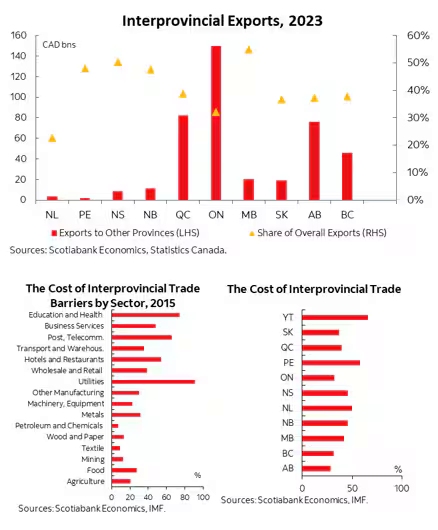
Image: Interprovincial Exports Canada 2023 (Scotiabank / IMF)
Canadian provinces don’t trade with each other as much as they should. Internal trade was $418 billion CAD in 2023, but it hasn’t kept pace with international trade growth. Utilities face a 91% trade barrier and healthcare faces 74%. A 2019 IMF study called 'Internal Trade in Canada: A Case for Liberalization" found that provinces face an inter-provincial trade barrier equivalent to a 21% tariff!
Today, internal trade only makes up 36% of Canada's overall trade which is down from 55% in the early 1980s. If U.S. tariffs hit companies hard they will look to sell more within Canada but internal red tape and varying provincial regulations makes it more difficult. The government should work to remove interprovincial trade barriers to support a team Canada approach.
Foreign investors once saw Canada as a top destination but investment trends are changing. While Foreign Direct Investment (FDI) in Canada grew 425% since 2000, the sources of that investment have changed. FDI from the U.S. dropped from 61% to 45% as a total of Canada's FDI.
On the other hand, FDI from Europe and Asia has grown since 2000:
But to put it in perspective, see the 2022, notable FDI positions in Canada by comparing dollar values:
Also worth noting is that Canada's key investment sectors are shifting. In 2011, energy, mining, and manufacturing attracted 92% of total FDI but by 2023 the same sectors fell and attracting 68% of total FDI with transportation and services seeing the fastest growth. Canada needs to continue to attract FDI from non-U.S. allied countries and also adjust for any sector by sector shifts.
Tariffs will make it harder for Canadian export businesses selling to the U.S., especially key export sectors like auto, oil/energy, and manufacturing who will feel near immediate pressure, job losses and production cuts. Businesses should actively explore various strategies to mitigate the impact of these tariffs, such as seeking alternative suppliers, renegotiating contracts, adjusting supply chains, and considering price adjustments.
Canada also faces shrinking U.S. investment in Canada while capital from Europe and Asia is rising, representing new opportunities and markets to focus on and grow. Countries like the Netherlands, Switzerland, and the U.K. are increasing their investments in Canada. If the Canadian government makes it easier (i.e. removing unnecessary regulatory barriers) and more attractive for investors (i.e., better tax incentives and policy support), businesses will have better access to funding and the economy will be stronger and more resilient.
 The National Crowdfunding & Fintech Association (NCFA Canada) is a financial innovation ecosystem that provides education, market intelligence, industry stewardship, networking and funding opportunities and services to thousands of community members and works closely with industry, government, partners and affiliates to create a vibrant and innovative fintech and funding industry in Canada. Decentralized and distributed, NCFA is engaged with global stakeholders and helps incubate projects and investment in fintech, alternative finance, crowdfunding, peer-to-peer finance, payments, digital assets and tokens, artificial intelligence, blockchain, cryptocurrency, regtech, and insurtech sectors. Join Canada's Fintech & Funding Community today FREE! Or become a contributing member and get perks. For more information, please visit: www.ncfacanada.org
 |  |  |
|---|---|---|
 |  |  |



August 26th, 2025

January 4th, 2024

June 1st, 2021

September 9th, 2020

July 9th, 2018

January 3rd, 2018

September 25th, 2017

June 20th, 2017

May 10th, 2017

December 14th, 2016

Leave a Reply