





Karsten Wenzlaff, Advisor
August 26th, 2025
Karsten Wenzlaff is a Crowdfunding and Fintech Expert from Germany. He is Secretary-General of Digit[...]


Crypto Regulation | July 31, 2025
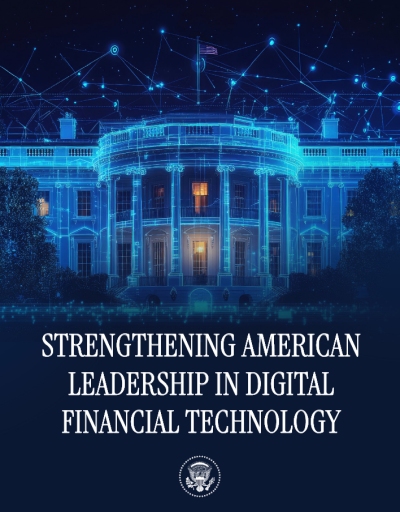
Image: Strengthening American Leadership in Digtal Financial Technology, White House report
On July 30, 2025, the White House released a major 160 page PDF report from the President’s Working Group on Digital Asset Markets called, "Strengthening American Leadership in Digital Financial Technology". The document lays out how the United States plans to build a clear rulebook for crypto and position itself as a leading global hub for blockchain technology, a huge change in direction from a government that previously relied on regulation by enforcement.
The White House report says the US needs a stronger framework for digital asset markets. It calls on Congress to pass the Digital Asset Market Clarity Act to remove gaps in oversight. The plan would give the Commodity Futures Trading Commission authority over trading in digital assets that are not securities, while the Securities and Exchange Commission would focus on those that are securities. The two agencies are asked to provide clear guidance on custody, registration, and record keeping so that new products can launch faster without long delays.
For fintech companies and investors, a more predictable environment is welcomed, and means that developers and platforms would know in advance what licenses they need and how to stay compliant instead of risking enforcement.
A large part of the report focuses on modern banking regulation. It urges federal banking regulators to stop blocking lawful digital asset companies from access to banking, a practice that was known as Operation Choke Point 2.0.
It also suggests a clear process for banks to gain approval for activities such as custody of crypto, tokenization of assets, issuing stablecoins, and using blockchains in financial services. If these changes are implemented, banks will have a clearer path to offer blockchain based products and services, which could expand customer access to digital assets directly through mainstream banks.
The report confirms the importance of stablecoins that are backed by the US dollar. It points to the GENIUS Act, signed into law on July 18, 2025, as the foundation for a federal framework for stablecoins. It also calls for a law to ban central bank digital currencies in the United States, emphasizing that the private sector should lead innovation in payments.
It suggests that the U.S. views private stablecoins as a way to maintain the dollar’s global role. It could lead to faster payments and new payment rails, but it's also a policy preference against government issued digital money.
The Working Group recommends updating anti money laundering rules to reflect how digital assets work. The plan would clarify the reporting obligations for different types of actors, including those in decentralized finance, and protect the right of law abiding citizens to hold their own digital assets. This could make it easier for compliant companies to operate while still giving regulators more effective tools against bad actors.
The report asks the Treasury and IRS to publish clear guidance on how taxes apply to crypto, including on staking, mining, and small day to day transactions. It also calls for Congress to adjust the tax code so that digital assets are treated consistently with other assets such as securities or commodities. Simplified tax rules could lower the cost of compliance and help bring more participants into the market.
If the recommendations are carried out, the US could become a more attractive market for crypto investment and product development. Other countries, including Canada, need to watch closely, as competition for talent and venture funding heats up.
For Canadian fintechs and blockchain companies, this development could open up opportunities for cross border partnerships but also create a more competition.
 The National Crowdfunding & Fintech Association (NCFA Canada) is a financial innovation ecosystem that provides education, market intelligence, industry stewardship, networking and funding opportunities and services to thousands of community members and works closely with industry, government, partners and affiliates to create a vibrant and innovative fintech and funding industry in Canada. Decentralized and distributed, NCFA is engaged with global stakeholders and helps incubate projects and investment in fintech, alternative finance, crowdfunding, peer-to-peer finance, payments, digital assets and tokens, artificial intelligence, blockchain, cryptocurrency, regtech, and insurtech sectors. Join Canada's Fintech & Funding Community today FREE! Or become a contributing member and get perks. For more information, please visit: www.ncfacanada.org
 |  |  |
|---|---|---|
 |  |  |



August 26th, 2025

January 4th, 2024

June 1st, 2021

September 9th, 2020

July 9th, 2018

January 3rd, 2018

September 25th, 2017

June 20th, 2017

May 10th, 2017

December 14th, 2016

Leave a Reply