




Karsten Wenzlaff, Advisor
August 26th, 2025
Karsten Wenzlaff is a Crowdfunding and Fintech Expert from Germany. He is Secretary-General of Digit[...]


European Fintech | Sep 8, 2025
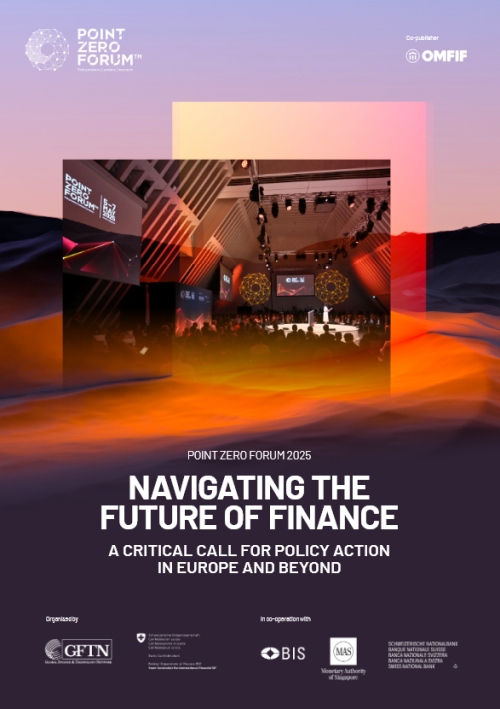
Image: Navigating the Future of Finance magazine (Point Zero Forum)
The 2025 Point Zero Forum (Jun 24-26) in Zurich drew 1,350 participants from 66 countries, including over 20% from public sector institutions. Across 121 sessions spanning 95 hours, 329 speakers explored the future of finance and technology. These numbers matter because the forum is where central banks, regulators, and institutions compare notes on what is implementable now, not just what's aspirational.
For Canadian fintechs, the conversations in Zurich are a warning and an opportunity. Europe is moving quickly to reset its financial infrastructure. Canada risks lagging unless it adapts. Read the post 2025 Point Zero Forum magazine, "A Critical Call for Policy Action in Europe and Beyond" (24 page PDF)
Offline payments and infrastructure security were considered a matter of national sovereignty, not just technology. Danmarks Nationalbank warned: “Without power, many offline payments methods aren’t viable,” linking payments directly to energy security.
The world’s largest stablecoin Tether confirmed it will leave Europe because of reserve and regulatory requirements. This shows that Europe is treating payments, AI, and data as part of its sovereignty strategy.
Canada has its own domestic payment systems operated by Payments Canada, but Canada still doesn't have live operating real-time retail payment rails. In cloud services, Canadian banks and fintechs are still dependent on American providers like AWS, Microsoft, and Google.
Central banks are now focused on tokenized settlement. The Swiss National Bank said: “Price stability is our main focus also in challenging times,” while the European Central Bank stressed that central bank money must remain “available and useful” in tokenized markets.
The Bank of England suggested that oversight of stablecoins may evolve as the “singleness of money” assumption is tested.
The Bank of Canada paused it's digital dollar research initiative. Europe and the U.K. are moving faster. Canadian fintechs should design tokenized solutions that can connect to global settlement networks, not just domestic payment systems.
The Basel framework assigns a 1,250% risk weight to exposures on public blockchains compared to standard weights for permissioned systems. That number explains why institutions are cautious about public chains even as liquidity scale requires them.
Solana’s Lily Liu argued that “the 5.5bn people on the internet” can only be reached through open infrastructure, while regulators noted that immutability makes reversals and sanctions enforcement difficult. The likely outcome is a dual architecture with permissioned networks for issuance and compliance, and public networks for liquidity and settlement.
Canadian institutions face the same Basel capital rules as peers in other markets. Without clear guidance on the use of public versus permissioned networks, Canadian fintechs may find it harder to connect to global liquidity pools.
68% of EU businesses say they struggle to understand their obligations under the EU AI Act, holding back investment. Global wealth manager, Julius Baer’s COO estimated that customer focused AI tools could generate revenue within 6 to 12 months.
At the forum, agentic AI systems were demoed handling insurance claims with observability features allowing human review. The key issue is still accountability with policymakers worrying about loss of control as AI systems become more autonomous.
Canada has not finalized its AI regulation but offers a voluntary AI code of conduct, giving fintechs some near term flexibility. But any deployment that scales internationally will need to comply with EU and U.S. standards. The strategic opportunity is to pilot auditable AI now while preparing for global regulatory alignment.
S&P projects global private equity will grow from $15 trillion in 2025 to $18 trillion by 2027. Citi and SIX Digital Exchange announced tokenized access to late-stage pre-IPO equities on SDX, launching in Q3 2025.
Tokenization will improve collateral usability and ownership visibility, but not resolve fundamental illiquidity or opaque valuations.
Canada has a growing private capital market but no regulated digital exchange on the scale of SIX. Canadian fintechs could position themselves as infrastructure providers for tokenized funds and secondary liquidity, complementing global platforms instead of competing directly.
At the forum, speakers pointed out that some carbon credits were issued for projects expected to reduce emissions over 30 years, even though the land rights lasted only 10 years. That kind of mismatch reduces trust in the market.
Bringing carbon credits into mainstream finance could help spread risk and attract more investment. But for the market to work, credits must be backed by strong certification, insurance to cover project failures, and common standards that everyone follows.
Canada has compliance carbon pricing systems, but its voluntary carbon credit market is smaller and less standardized compared to Europe and Asia. Canadian fintechs could carve out a leadership role by building platforms that prioritize data integrity and risk coverage.
Canada must decide whether to keep pace with progressing markets in Europe and Asia or risk being shut out of global settlement networks. If Europe can move from pilots to architecture, Canadian fintechs must not stand still.
 The National Crowdfunding & Fintech Association (NCFA Canada) is a financial innovation ecosystem that provides education, market intelligence, industry stewardship, networking and funding opportunities and services to thousands of community members and works closely with industry, government, partners and affiliates to create a vibrant and innovative fintech and funding industry in Canada. Decentralized and distributed, NCFA is engaged with global stakeholders and helps incubate projects and investment in fintech, alternative finance, crowdfunding, peer-to-peer finance, payments, digital assets and tokens, artificial intelligence, blockchain, cryptocurrency, regtech, and insurtech sectors. Join Canada's Fintech & Funding Community today FREE! Or become a contributing member and get perks. For more information, please visit: www.ncfacanada.org
 |  |  |
|---|---|---|
 |  |  |



August 26th, 2025

January 4th, 2024

June 1st, 2021

September 9th, 2020

July 9th, 2018

January 3rd, 2018

September 25th, 2017

June 20th, 2017

May 10th, 2017

December 14th, 2016

Leave a Reply